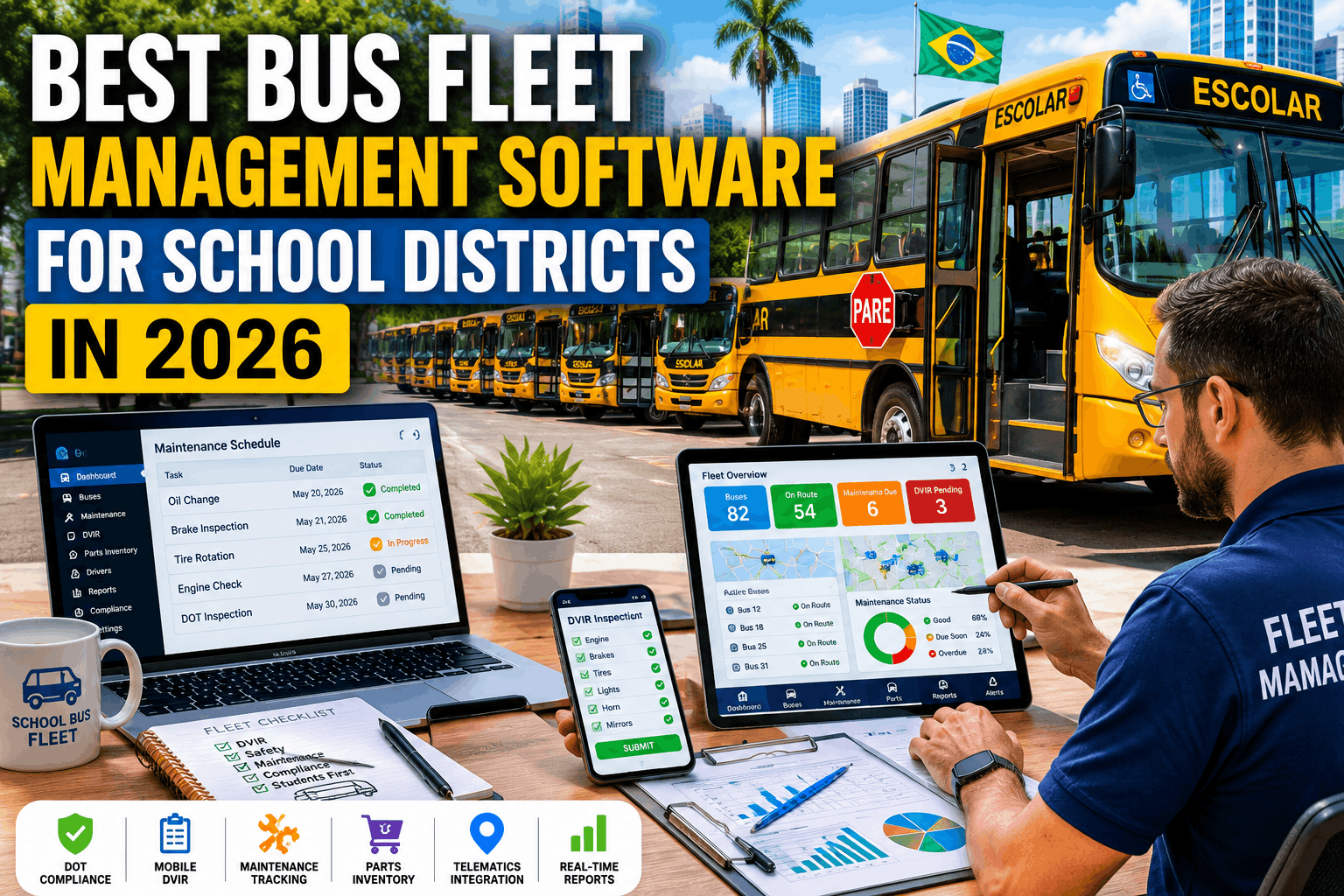
School districts face unique challenges in managing bus fleets — from student safety and route efficiency to DOT compliance and budget constraints. In 2026, the best fleet management software combines mobile DVIR, parts tracking, telematics integration, and compliance automation. This guide ranks the top solutions for K-12 transportation with pricing and feature comparisons.
School Fleet Software Guide 2026
Best Bus Fleet Management Software for School Districts in 2026
Best bus fleet management software for school districts in 2026 — ranked by DOT compliance, mobile DVIR, parts tracking, telematics integration, pricing.
School District Fleet Management Impact: The Cost of Inefficiency
School districts spend millions annually on bus maintenance, fuel, and operations. Without modern fleet management software, districts waste 15-25% of their maintenance budget through inefficient scheduling, duplicate repairs, and compliance gaps.
15-25%
Wasted maintenance budget
$500-$1,200
Savings per bus annually
60%
Reduction in paperwork
100%
DOT compliance target
Why School Districts Need Modern Fleet Management
Student Safety First
Every maintenance record is a safety record. Fleet software ensures no inspection is missed, no repair is delayed, and every safety issue is documented and resolved immediately.
Regulatory Compliance
DOT regulations for school buses are stringent. Modern software automates compliance tracking, generates required reports, and maintains audit-ready documentation automatically.
Budget Accountability
School districts operate on fixed budgets. Fleet software provides cost transparency, prevents duplicate repairs, and helps technicians make data-driven maintenance decisions.
Reduced Downtime
Preventive maintenance reduces emergency repairs. Better parts management and predictive maintenance keep buses running on schedule and protect daily student routes.
Technician Efficiency
Mobile DVIR and digital work orders eliminate paperwork, reduce clerical errors, and let technicians focus on actual maintenance rather than documentation.
Data-Driven Decisions
Real-time analytics reveal maintenance patterns, identify problematic vehicles, and support capital planning for bus replacement timing.
School Bus Fleet Management Software Comparison
1. BusCMMS
Best For: Comprehensive school district maintenance. Includes mobile DVIR, parts tracking, PM scheduling, and compliance reporting. Starting at $99/month.
2. Fleetio
Best For: General fleet management. Strong in fuel tracking and maintenance history. Starting at $45/month.
3. Samsara
Best For: Telematics integration. Excellent for GPS tracking and driver behavior. Custom pricing based on fleet size.
4. RTA Fleet Management
Best For: Large school districts. Comprehensive fleet management with school bus focus. Contact for pricing.
5. School Bus Fleet Manager
Best For: Small to medium school districts. Basic maintenance and routing features. Starting at $79/month.
6. Verizon Connect
Best For: GPS tracking and route optimization. Strong safety features. Custom pricing.
Detailed Pricing & Cost Analysis
Small Districts (25-50 buses)
Budget: $1,500-$2,500/month. BusCMMS or Fleetio recommended. ROI achieved in 18-24 months through maintenance cost reduction.
Medium Districts (51-150 buses)
Budget: $3,000-$7,500/month. BusCMMS, RTA, or Samsara recommended. ROI achieved in 12-18 months with multi-location support.
Large Districts (150+ buses)
Budget: $10,000-$25,000+/month. RTA, Samsara, or Verizon Connect recommended. Custom enterprise solutions with dedicated support.
Hidden Costs to Consider
Implementation fees (0-15%), training costs (typically $2,000-$5,000), data migration, and integration with existing systems.
Cost Savings Realized
Maintenance reduction: 15-25%. Fuel efficiency: 5-10%. Labor savings: 10-15%. Reduced downtime and emergency repairs: 30-40%.
Break-Even Analysis
Average payback period is 12-20 months. Larger districts and those with high maintenance costs achieve ROI faster.
School Fleet Software Feature Comparison
Different platforms excel in different areas. BusCMMS and Fleetio lead in maintenance management. Samsara and Verizon Connect excel in telematics. RTA provides comprehensive large-district solutions. School Bus Fleet Manager is best for smaller districts.
Implementation Timeline & Best Practices
Pre-Implementation (Week 1-2)
Assess current processes, define requirements, select software, plan data migration, identify key stakeholders, and schedule training.
Implementation (Week 3-6)
Configure system, migrate historical data, integrate with existing systems, conduct pilot testing with select technicians, and resolve issues.
Training Phase (Week 4-8)
Train technicians on mobile DVIR, conduct manager training on reporting, educate dispatchers on integration, and provide ongoing support.
Soft Launch (Week 7-10)
Deploy to select garages, monitor adoption, collect feedback, make refinements, and troubleshoot issues before full rollout.
Full Rollout (Week 11+)
Deploy district-wide, establish new processes, monitor KPIs, identify champions for peer support, and plan for ongoing optimization.
Success Factors
Executive sponsorship, clear communication, dedicated implementation team, adequate training, realistic timelines, and commitment to change management.
School District Requirements for Fleet Software
DOT Compliance
Must track inspections, maintenance, and driver qualifications. Automate compliance reporting and document management.
Mobile DVIR
Technicians need mobile access for inspections and repairs. Enable offline functionality for bus yard coverage.
Parts Inventory
Track parts usage and availability. Support multi-location inventory management for large districts.
Telematics Integration
Integrate with GPS tracking and engine diagnostic systems. Monitor vehicle health in real-time.
Reporting & Analytics
Generate compliance reports, maintenance history, and cost analysis. Support district-level and state reporting.
Student Safety Features
Track special equipment like wheelchair lifts and stop arms. Support student tracking integration.
Common Implementation Challenges & Solutions
Low User Adoption
Solution: Identify power users, provide peer training, celebrate early wins, make the system easy to use, and provide ongoing support.
Data Quality Issues
Solution: Perform data cleanup before migration, establish data entry standards, validate imported data, and conduct periodic audits.
Integration Problems
Solution: Plan integrations early, test thoroughly, use experienced integration partners, and have fallback procedures.
Resistance to Change
Solution: Communicate benefits clearly, involve staff in selection, address concerns early, provide excellent training, and celebrate successes.
Budget Constraints
Solution: Phase implementation by location, start with essential features, look for grant funding, prioritize high-impact areas, and measure ROI.
Ongoing Support Gaps
Solution: Establish internal support champions, ensure vendor provides adequate support, document processes, and plan for staff turnover.
School District Software Adoption Trends
School district software adoption has grown from 45% to 92% between 2019 and 2025. Digital transformation in K-12 transportation is accelerating as districts recognize the benefits of automation, compliance tracking, and cost savings. By 2026, nearly all districts will use some form of digital fleet management.
Integration & Technology Stack for Schools
Routing & GPS Integration
Connect with Samsara, Verizon Connect, or Geotab for real-time bus tracking, route optimization, and driver safety monitoring.
Accounting System Integration
Sync with school district accounting software to track maintenance costs, generate budget reports, and manage vendor invoices.
Student Information Systems
Integrate with SIS platforms to coordinate student pickup/dropoff tracking, special needs bus assignments, and emergency notifications.
Telematics & Diagnostics
Connect to engine diagnostics systems for predictive maintenance, fuel monitoring, and emissions compliance tracking.
Mobile Platforms
iOS and Android apps for drivers and technicians. Offline functionality essential for rural districts with limited connectivity.
Reporting Dashboards
Executive dashboards for superintendents, detailed reports for maintenance managers, and compliance reports for auditors.
Software Selection Checklist for School Districts
Budget & Pricing
Consider total cost including implementation, training, and support. Look for school district pricing options.
DOT & State Compliance
Ensure the software supports all required inspections, maintenance schedules, and reporting for school buses.
Integration Capabilities
Check compatibility with existing GPS, routing, and accounting systems. Open API is essential.
Mobile Access
Confirm mobile app availability for drivers and technicians. Offline functionality for rural districts.
Support & Training
Evaluate training resources and support availability. Look for dedicated school district support teams.
Scalability
Ensure the solution can grow with your district. Support multiple locations and fleet sizes.
School Fleet Management KPIs
Track these five metrics to measure your school fleet management program effectiveness:
Software Adoption Rate
Target: 100% of technicians and drivers using the platform. Track monthly. Low adoption reduces ROI.
PM Compliance
Target: 100% at every interval. Track by bus. School buses require strict maintenance scheduling.
DVIR Completion Rate
Target: 100% of pre and post-trip inspections completed. Track daily. Safety is paramount.
Cost Savings
Target: 15-25% reduction in maintenance costs. Track quarterly. Measure ROI of software implementation.
Student Safety Events
Target: Zero preventable incidents. Track monthly. Software helps identify and prevent issues.
Vendor Evaluation Scoring Matrix
Functionality (Weight: 30%)
Does the software have all required features? Mobile DVIR, PM scheduling, parts tracking, compliance reporting, and integration capabilities.
Ease of Use (Weight: 20%)
How user-friendly is the interface? Does it require minimal training? Is technical support readily available?
Cost (Weight: 20%)
What is the total cost of ownership? Implementation fees, training, support, and licensing. Calculate cost per bus monthly.
Reliability (Weight: 15%)
What is the vendor's track record? References from similar-sized districts, uptime guarantees, and support response times.
Scalability (Weight: 10%)
Can the system grow with your district? Support for multiple locations, staff expansion, and feature additions over time.
Support & Training (Weight: 5%)
What training and support is included? Dedicated support team, documentation, video tutorials, and ongoing updates.
Our school district of 200 buses implemented BusCMMS in 2024. In the first year, we achieved 98% PM compliance and reduced paperwork by 75%. Maintenance costs decreased by 18% through better scheduling and parts management. DOT compliance improved from 82% to 100%.
Digitize Your School District Fleet Management
BusCMMS helps school districts manage maintenance, compliance, parts, and safety in one platform. Mobile DVIR, automated PM scheduling, parts tracking, and compliance reporting designed specifically for K-12 transportation. Book a demo to see how we help school districts save time and money.
School District Fleet Management FAQs
What is the best bus fleet management software for school districts?
The best software depends on your district size and needs. BusCMMS is best for comprehensive maintenance management. Samsara excels in telematics. Fleetio offers general fleet management. Evaluate your district's specific requirements before choosing.
How much does school bus fleet software cost?
Pricing ranges from $45-$150 per vehicle per month depending on features. BusCMMS starts at $99/month. Fleetio starts at $45/month. Samsara and Verizon Connect require custom quotes. School districts often qualify for educational pricing discounts.
What features should school bus fleet software include?
Essential features include: mobile DVIR, PM scheduling, parts inventory, DOT compliance reporting, maintenance history, technician time tracking, and integration with GPS/telematics. Student safety features like wheelchair lift tracking are also important for school districts.
How does fleet software help with DOT compliance?
Fleet software automates inspection tracking, maintenance scheduling, and record keeping. It generates compliance reports, alerts technicians to overdue inspections, and maintains digital records of all maintenance activities. This reduces audit risk and improves safety.
Can school bus fleet software integrate with existing systems?
Most modern fleet software platforms offer API integration with routing software, accounting systems, and GPS tracking. Check with each vendor about specific integration capabilities. Open APIs are preferred for flexibility.
What is the ROI of school bus fleet management software?
School districts typically see ROI within 12-18 months through reduced maintenance costs, improved technician productivity, fewer breakdowns, and better parts inventory management. Most districts report 15-25% reduction in maintenance expenses.
The Bottom Line
Choosing the best bus fleet management software for school districts in 2026 depends on your district's specific needs, budget, and technical requirements. BusCMMS leads in comprehensive maintenance management with mobile DVIR, PM scheduling, parts tracking, and DOT compliance. Samsara and Verizon Connect excel in telematics integration. Fleetio provides solid general fleet management. School districts should prioritize DOT compliance, mobile accessibility, and student safety features when evaluating software. The right software can reduce maintenance costs by 15-25%, improve compliance, and protect student safety. When combined with proper implementation and training, fleet management software transforms school district transportation operations from reactive to proactive—catching issues before they affect student safety or cause costly breakdowns.