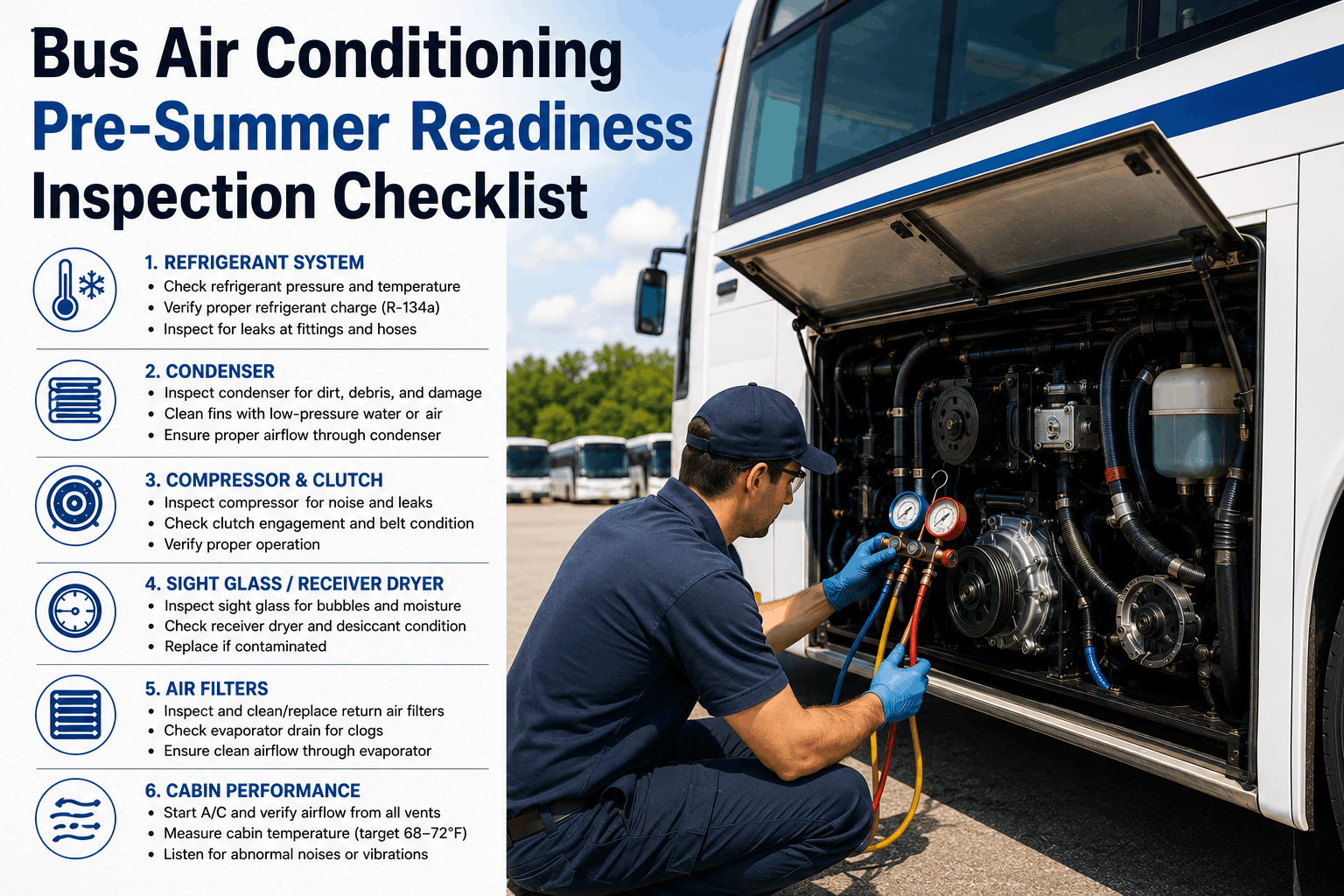
Bus air conditioning systems sit dormant through the winter months — compressor clutches corrode, refrigerant slowly migrates past aging seals, condenser fins accumulate road debris, and blower motors collect dust in housings that haven't turned since October. When summer heat arrives and drivers switch on the A/C for the first time, any one of these degradation points can trigger a mid-season failure that leaves students or passengers in a sweltering bus. For school buses and transit vehicles operating in warm-season climates, pre-summer A/C readiness inspection is not optional — it is a scheduled PM event that determines whether the fleet enters summer cooling season with confidence or with deferred problems that will fail at the worst possible time. This bus air conditioning pre-summer inspection checklist covers every component of the cooling system — refrigerant charge verification, condenser cleaning, compressor clutch inspection, sight glass evaluation, evaporator coil condition, return air filter service, and cabin temperature performance targets. Start your free trial to run this as a pre-loaded seasonal A/C PM checklist in BusCMMS — auto-scheduled by calendar trigger each spring before peak heat arrives.
Get Every Bus Ready for Summer Cooling Season — Before the Heat Hits
BusCMMS pre-loads complete pre-summer A/C PM checklists covering refrigerant charge, condenser condition, compressor clutch, evaporator coil, and cabin temperature verification. Auto-schedule by calendar trigger every spring. No more surprise A/C failures on the first hot day of the season.
Bus A/C System Overview & Pre-Summer Service Intervals
Modern school and transit bus air conditioning systems use engine-driven compressors, roof-mounted or front-wall condenser units, evaporator coils, and electronic expansion devices to deliver sustained cabin cooling under high heat loads. A fully loaded school bus in 95°F ambient heat generates significant internal heat from occupant body heat, solar gain through glass, and engine compartment heat transfer — the A/C system must overcome all of this to reach and hold cabin temperature targets. Pre-summer inspection should occur in April or early May — before ambient temperatures exceed 85°F and before summer routes begin — to allow time for refrigerant recharge, condenser cleaning, or compressor service without disrupting service schedules. Most OEM bus HVAC manufacturers specify annual A/C inspection at the start of each cooling season, with refrigerant system evacuation and full recharge every 3–5 years or when system pressure drops below specification.
Verify refrigerant charge via sight glass and manifold gauge, clean condenser coil, inspect compressor clutch engagement, check blower operation, and confirm cabin temperature reaches setpoint. A system that performs borderline in May will fail completely in July peak heat.
Verify cabin temperature reaches 72–75°F from 95°F ambient within 15 minutes. Check for refrigerant leaks, compressor noise, and blower function degradation. Any performance drop of more than 5°F from prior month indicates refrigerant loss or system problem.
Measure refrigerant pressures on high and low side, inspect compressor for oil seepage, re-clean condenser if bugs or road debris have reduced airflow since spring service. Replace return air filter if restriction is evident by reduced airflow.
Complete system evacuation per EPA Section 609 protocols, compressor oil analysis and replacement, desiccant cartridge replacement in receiver-dryer, full recharge with measured refrigerant. Oil balance is critical — excess or insufficient oil causes compressor failure.
Bus A/C Pre-Summer Readiness Inspection Checklist
Complete all sections before summer routes begin. Measure and record all pressure readings, temperature differentials, and sight glass observations — A/C performance is data-driven, not subjective. A system showing bubbles in the sight glass at idle or high-side pressure 30 psi above specification is degrading efficiency and nearing failure, even if cabin temperature is currently acceptable. Early detection during pre-season inspection prevents mid-summer breakdowns.
Bus A/C Refrigerant & Maintenance Material Specifications
| Component / Service | Specification | Capacity (Typical) | Service Interval |
|---|---|---|---|
| Refrigerant (Post-1994 Buses) | R-134a (EPA Section 609 certified) | 3–5 lbs per system | Recharge every 3–5 years or when pressure drops below spec |
| Compressor Oil | PAG 46 or PAG 100 per compressor OEM spec | 6–10 oz per compressor | Replace at full system evacuation and recharge |
| Receiver-Dryer / Desiccant | OEM desiccant cartridge (XH-7 or XH-9) | 1 per system | Replace every 3–5 years with full recharge |
| Return Air / Cabin Filter | OEM pleated media filter | 1–2 per bus (varies by layout) | Inspect pre-season; replace if visibly restricted or damaged |
| Compressor Drive Belt | OEM spec serpentine or V-belt | 1 per compressor | Inspect pre-season; replace if cracked, glazed, or missing ribs |
| High-Side Pressure Target | 200–220 psi at idle, 75–80°F ambient | — | Verify at every pre-season and monthly in-season check |
| Low-Side Pressure Target | 25–35 psi at idle, 75–80°F ambient | — | Verify at every pre-season and monthly in-season check |
| Supply Air Temperature Target | 40–50°F at duct outlet | — | Measure pre-season and monthly during cooling season |
How BusCMMS Automates Pre-Summer A/C PM Scheduling
Pre-summer A/C readiness inspection has a narrow scheduling window — it must happen after winter heating season ends but before summer heat peaks, typically April 1 through May 15 depending on region. Missing this window means either inspecting buses already in summer service (disrupting routes) or skipping inspection and hoping A/C systems hold through the season. BusCMMS schedules pre-summer A/C PM work orders by calendar trigger — automatically generating a pre-loaded A/C readiness checklist for each bus on April 1 (or your configured spring activation date). Technician sign-off, pressure readings, temperature test results, and component findings are captured digitally and retained. No more buses entering summer with unverified A/C systems. Book a demo to see the A/C seasonal scheduling workflow in a live fleet environment.
We had three buses lose A/C in the first week of June two years in a row. When I pulled the maintenance records, none of them had a documented pre-season A/C check — technicians were focused on spring brake and tire inspections and A/C fell off the list. Since moving to BusCMMS with automated April A/C PM scheduling, every bus gets a documented pre-season check including pressure readings and cabin temperature test before May 15. We haven't had a single in-season A/C failure since.
Frequently Asked Questions: Bus Air Conditioning Pre-Summer Inspection
When should pre-summer bus A/C inspection be completed?
Pre-summer A/C inspection should be completed between April 1 and May 15 for most US climates — after heating season ends and before ambient temperatures regularly exceed 85°F. Completing inspection in this window allows time for refrigerant recharge, condenser service, or compressor replacement without disrupting active summer routes.
What does a sight glass bubble indicate in a bus A/C system?
Bubbles or foam in the sight glass at idle with compressor engaged indicates the system is low on refrigerant — there is insufficient liquid refrigerant in the liquid line to produce a clear sight glass. A clear sight glass indicates proper charge. A completely clear sight glass that clears immediately at compressor engagement (no startup bubbles at all) may also indicate slight over-charge — verify with manifold gauge readings.
What is the correct cabin temperature target for a school bus A/C system in summer?
A properly functioning bus A/C system should cool the cabin from 90°F+ ambient to 75°F or below within 15 minutes with doors closed, blower on high, and maximum cooling selected. Supply air at duct outlets should measure 40–50°F. Cabin temperatures above 78°F after 15 minutes of maximum cooling operation indicate insufficient system capacity requiring diagnosis.
How often should bus A/C condenser coils be cleaned?
Condenser coils should be cleaned at pre-season inspection every spring and re-inspected at mid-season (July) for buses operating in high-debris environments (rural routes, areas with insects or heavy pollen). A condenser coil blocked by debris raises high-side pressure 20–40 psi above specification, reducing cooling capacity and shortening compressor life.
Can bus A/C refrigerant be topped up without full system evacuation?
Refrigerant can be added to a low system without full evacuation if: there is no evidence of moisture contamination (clear sight glass, no brown or acidic-smelling oil), the system has not been opened to atmosphere, and a leak has been located and repaired. If the system has been opened or shows contamination indicators, full evacuation, receiver-dryer replacement, and recharge is required. Partial top-up of a contaminated system accelerates compressor failure.
What causes a bus A/C compressor to fail mid-season?
The most common causes of mid-season compressor failure are: refrigerant leak that reduces system charge and allows compressor to operate with insufficient oil circulation; deferred pre-season inspection that missed early clutch bearing wear; condenser coil blockage causing sustained high-side over-pressure; and moisture contamination from a previously opened system that was not properly evacuated before recharge.
What refrigerant does a modern school bus A/C system use?
The vast majority of school and transit buses manufactured after 1994 use R-134a (HFC refrigerant). Charging or servicing requires EPA Section 609 certification. Never mix R-134a with R-12 or retrofit refrigerants without proper system flushing. Some newer buses may use R-1234yf — verify system label before connecting gauges or adding refrigerant.
How does BusCMMS schedule pre-summer A/C inspections across an entire fleet?
BusCMMS triggers pre-summer A/C PM work orders by calendar date (configurable spring activation date, typically April 1). Each work order is pre-loaded with the A/C readiness checklist, refrigerant pressure recording fields, and cabin temperature test documentation. Technician sign-off and measured values are retained digitally for fleet performance trending and audit purposes.
No More Summer A/C Surprises — Inspect Every Bus Before the Heat Arrives
BusCMMS auto-triggers pre-summer A/C PM work orders by spring calendar date. Capture refrigerant pressure readings, sight glass observations, and cabin temperature test results digitally. Keep your fleet cool all summer without manual scheduling overhead.