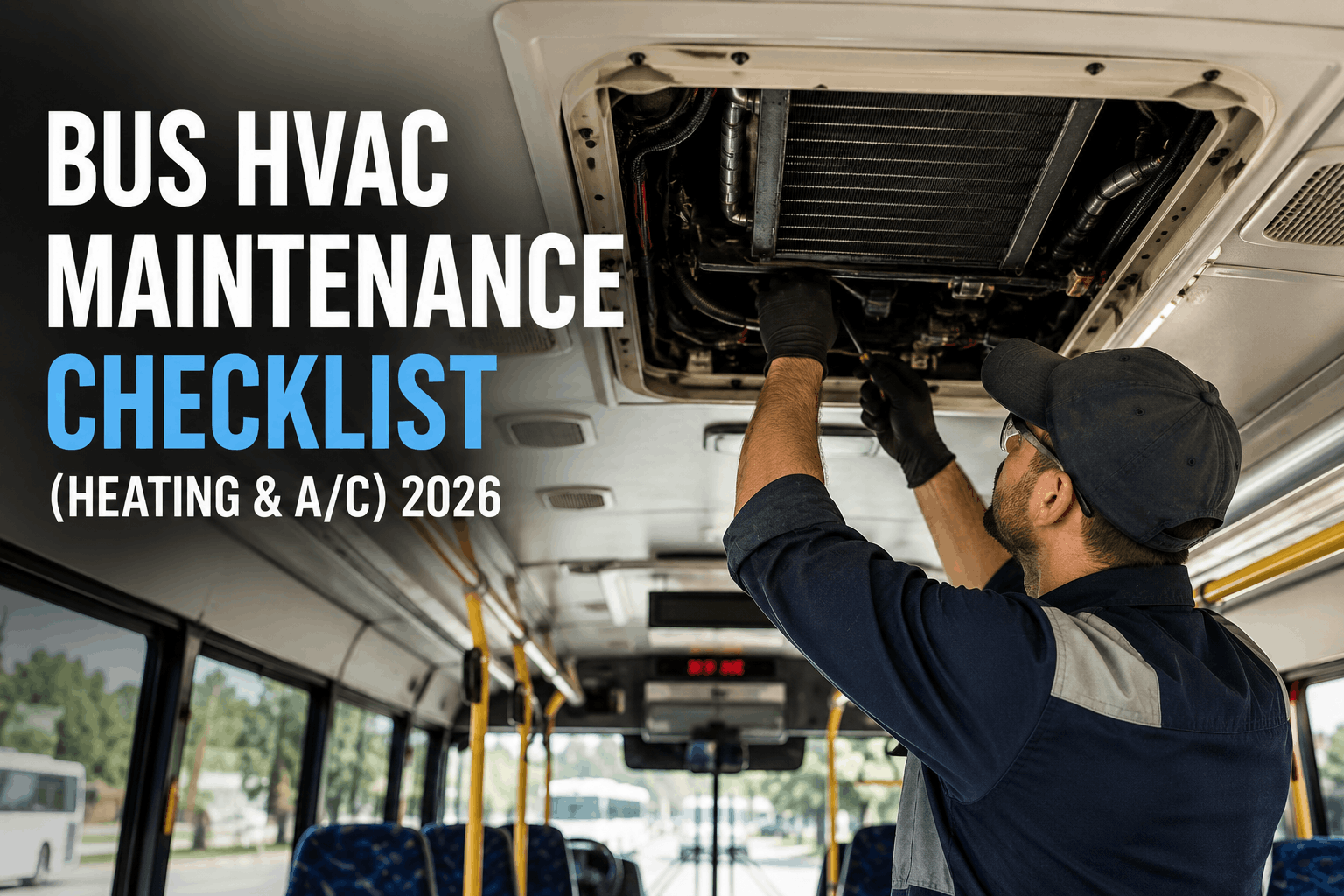
Bus heating, ventilation, and air conditioning (HVAC) systems operate under extreme cycling stress — heating from below-freezing ambient to cabin comfort in under 15 minutes during winter start-ups, then cooling from 95°F ambient to 72°F cabin in dense summer traffic. For school buses operating in 4-season climates, where routes begin before sunrise in January and continue into peak heat in September, HVAC system reliability is not optional — it is a student comfort and safety requirement that directly impacts ridership and driver performance. Yet HVAC maintenance is frequently deferred because compressor noise or weak cabin airflow develops gradually, falling below the threshold of visibility until a catastrophic failure occurs mid-season. This bus HVAC maintenance checklist covers every component of the heating and cooling system — seasonal pre-season checks, monthly operational verifications, refrigerant recharge intervals, and the less frequently performed but equally important compressor, evaporator, and blower motor inspections. Start your free trial to run this as a pre-loaded seasonal HVAC PM checklist in BusCMMS — with mileage-triggered scheduling and service interval automation.
Keep Every Bus Climate-Controlled Year-Round — On Schedule
BusCMMS pre-loads complete HVAC PM checklists for heating season, cooling season, and inter-season service. Auto-schedule by mileage or calendar trigger. No more failed compressors mid-route, no more student complaints about cabin temperature.
Bus HVAC System Overview & Service Intervals
Modern school and transit bus HVAC systems integrate engine-driven compressor clutches with electric blower motors, electronic control modules, and dual-zone or variable-capacity refrigerant loops. Understanding the full system architecture — from compressor displacement and clutch engagement to evaporator freeze protection and cabin air filtration — is essential for maintaining year-round climate control and preventing mid-season failures. Most OEM bus manufacturers specify HVAC service at 10,000-mile intervals or annually, whichever comes first, with refrigerant system evacuation and recharge required every 3–5 years or when system pressure drops below specification.
Verify heater core circulation, check blower motor function, test defrost system, inspect cabin air filter condition. A heater that doesn't warm cabin in 10 minutes or blower that runs at reduced speed in fall will fail completely by January.
Verify cabin temperature reaches setpoint within 15 minutes of activation. Check for refrigerant leaks, compressor noise, or blower function degradation. Any performance drop of more than 5°F from prior month indicates service required.
Measure refrigerant pressures on high and low side, inspect compressor for oil seepage, check electrical connectors for corrosion. Replace cabin air filter if restriction is evident by reduced airflow.
Complete system evacuation per EPA Section 609 protocols, oil analysis and replacement, desiccant cartridge replacement in receiver-dryer, full-system recharge with measured refrigerant. Oil balance is critical — excess or insufficient oil causes compressor failure.
Bus HVAC Maintenance & Inspection Checklist
Complete all applicable sections at the indicated service interval. Measure and record all pressure readings, temperature differentials, and electrical values — HVAC performance is data-driven, not subjective. A compressor running at 250 psi high-side pressure when specification calls for 200–220 psi is degrading efficiency and nearing failure, even if cabin temperature is adequate.
HVAC Refrigerant & Maintenance Material Specifications
| Component / Service | Specification | Capacity (Typical) | Service Interval |
|---|---|---|---|
| Refrigerant (Most School Buses) | R-134a (EPA approved) | 3–5 lbs | Recharge every 3–5 years or as needed |
| Compressor Oil | PAG or mineral-based per compressor type | 6–10 oz | Change at full system recharge |
| Receiver-Dryer Cartridge | OEM desiccant cartridge | 1 per receiver | Replace every 3–5 years with system recharge |
| Cabin Air Filter | OEM specification, pleated type | 1 per bus | Check monthly, replace if visibly restricted |
| Heater Hose (High-Temp) | Reinforced rubber, SAE J20R13 or R14 | Varies by application | Inspect annually, replace if cracked or pinched |
How BusCMMS Automates HVAC PM Scheduling
HVAC service intervals are seasonal — heating system checks in September, cooling system checks in April — and mileage-based simultaneously, which creates scheduling complexity when tracked manually. BusCMMS schedules HVAC PM work orders by calendar trigger (seasonal activation dates) and mileage threshold simultaneously. When a bus reaches its 10,000-mile interval OR the first day of September, whichever comes first, the system auto-generates a pre-loaded HVAC PM checklist work order for the shop. Technician sign-off and measured values (pressure readings, temperature differentials) are captured digitally and retained. No more buses failing mid-season because fall heating checks were forgotten. Book a demo to see the HVAC scheduling workflow in a live fleet environment.
We had a compressor fail on a bus in January with no warning. When I reviewed the maintenance records, the cooling system checks from the prior summer had been completed, but nobody had triggered the fall heating system pre-season check. Since moving to BusCMMS with automated seasonal HVAC scheduling, every bus gets heating verification before September 15 and cooling verification before May 1. No more surprise compressor failures mid-season.
Frequently Asked Questions: Bus HVAC Maintenance
How often should school bus HVAC systems be serviced?
Most OEM bus manufacturers specify HVAC service at 10,000-mile intervals or annually, whichever comes first. A complete refrigerant system evacuation, oil replacement, and desiccant cartridge replacement is required every 3–5 years depending on system usage and mileage. Monthly operational checks (pressure readings, temperature measurements) should be performed during the active heating or cooling season.
What refrigerant type does a modern school bus require?
The vast majority of school buses manufactured after 1994 use R-134a (HFC refrigerant). This is the EPA-approved replacement for R-12 (CFC) and is the legal standard in the United States. Charging or servicing an R-134a system requires EPA Section 609 certification. Never mix refrigerant types or attempt to retrofit an R-12 system with R-134a without proper system flushing and component replacement.
What does it mean if the A/C compressor cycles on and off every 10 seconds?
A compressor that cycles rapidly (every 10–30 seconds) indicates the system is over-pressurized — usually due to over-charge of refrigerant, a blocked orifice tube, or a failed receiver-dryer that is restricting expansion device flow. This is not normal operation. The system needs evacuation, desiccant replacement, and recharge to proper specification.
Why is the bus heater warming slowly when the engine is cold?
Slow heater warm-up in winter is most commonly caused by a heater control valve that is not opening fully or a circulation restriction in the heater core. A closed or partially open control valve prevents hot coolant from reaching the heater core. A pinched heater return hose or coolant leakage also restricts circulation. The heater should be providing warm air (75°F+) within 5–10 minutes of engine start in cold ambient.
Can a school bus HVAC system be serviced in the field or does it require a shop?
Minor HVAC service (cabin air filter replacement, compressor oil level check, hose inspection) can be performed in the field. Full system evacuation, recharge, and desiccant replacement require a recovery machine, vacuum pump, and certified EPA Section 609 technician working in a controlled shop environment. Do not attempt refrigerant service in the field — improper recovery or charging can damage the compressor and violates EPA regulations.
What is the normal high-side and low-side pressure for a bus A/C system?
For most school bus R-134a systems at idle with compressor engaged and ambient temperature 75–80°F: high-side (discharge) pressure should be 200–220 psi; low-side (suction) pressure should be 25–35 psi. Pressures vary significantly with ambient temperature and load. Pressures outside these ranges indicate leak, over-charge, under-charge, or compressor malfunction requiring service.
How does BusCMMS schedule HVAC maintenance across different seasons?
BusCMMS can trigger HVAC PM work orders by two simultaneous conditions: calendar-based (seasonal dates like September 1 for heating, May 1 for cooling) and mileage-based (every 10,000 miles). This ensures heating system checks happen before winter even if mileage hasn't been reached, and cooling checks happen before hot season. All measured values from technician inspections are retained digitally.
What is the most common cause of bus HVAC failure during the season?
The most common cause of mid-season HVAC failure is deferred seasonal pre-activation checks. A compressor that would have been identified as failing during a September heating check is not discovered until January when the bus enters full heating service. The second most common cause is refrigerant leak that goes undetected between annual services — small leaks result in gradual pressure drop and performance loss that is not caught without monthly pressure monitoring.
No More Mid-Season HVAC Surprises — Plan for Every Season
BusCMMS auto-triggers HVAC PM work orders by both seasonal date and mileage. Capture pressure readings and temperature measurements digitally. Keep your fleet comfortable year-round without manual scheduling overhead.