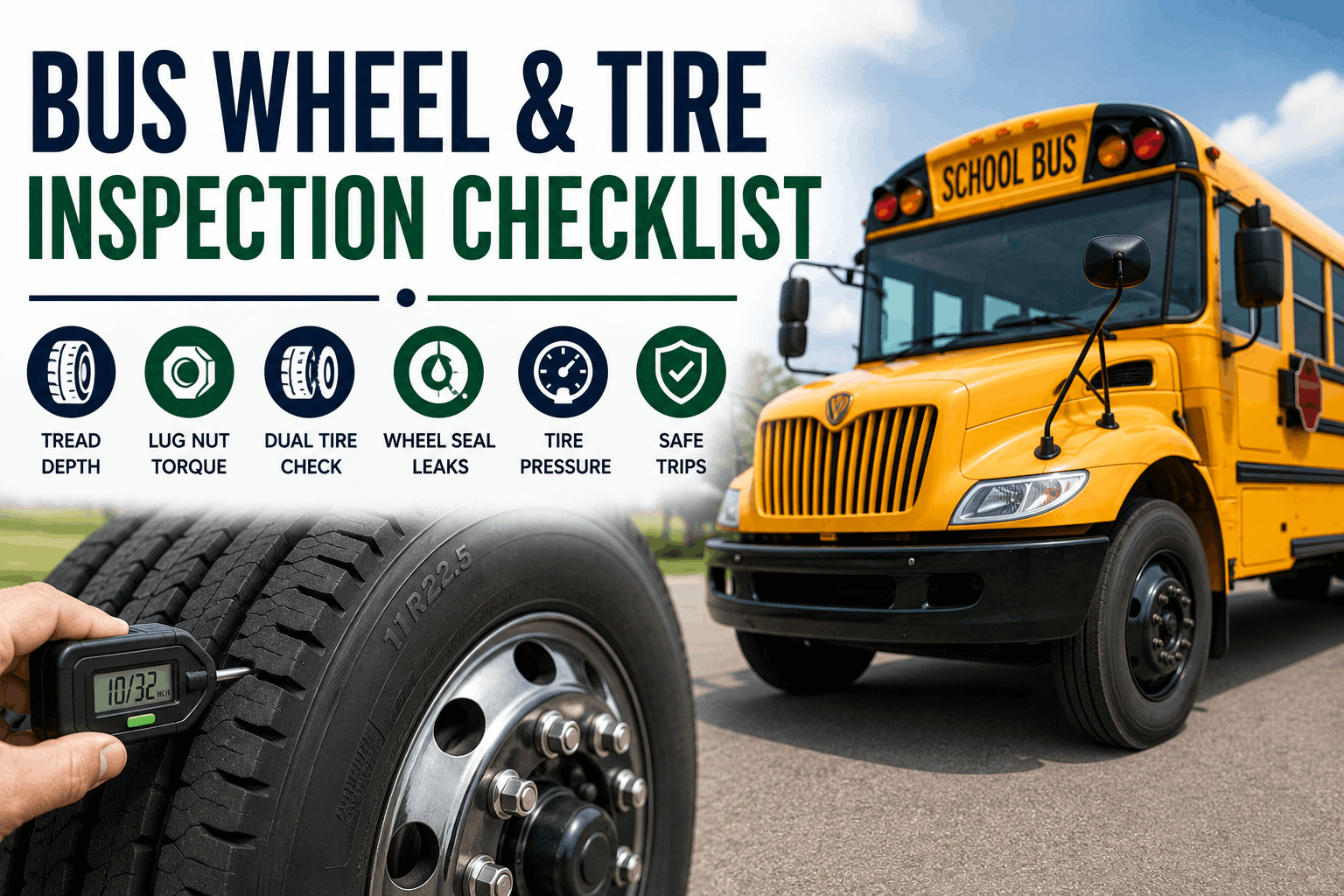
Tire and wheel failures are among the most preventable causes of commercial vehicle roadside incidents — and among the most frequently cited defects in FMCSA roadside inspections across U.S. school and transit bus fleets. A tire with tread below DOT minimums, a set of dual tires with more than a 1/4-inch diameter mismatch, or a wheel hub with under-torqued lug nuts does not produce a warning light before it produces a blowout, a wheel separation, or a roadside out-of-service order. For fleet operations running loaded school buses at GVWR daily, tire and wheel maintenance is not a once-a-year inspection — it is a rolling inspection program that begins with every pre-trip DVIR and extends through monthly pressure monitoring, seasonal rotation, and annual replacement planning. This bus tire inspection checklist covers every DOT-required test point — tread depth measurement, lug nut torque specifications, dual tire matching, wheel seal inspection, and retread compliance — structured for both daily driver DVIR use and periodic technician PM service. Start your free trial to run this checklist as a pre-loaded digital work order in BusCMMS with mileage-triggered scheduling and FMCSA-compliant recordkeeping.
Run Tire & Wheel Inspections as Digital Work Orders — Audit-Ready Every Time
BusCMMS pre-loads this complete tire and wheel inspection checklist for technician sign-off, schedules PM by mileage trigger, and retains every inspection record automatically per FMCSA 49 CFR 396 retention requirements.
DOT Tire & Wheel Compliance Standards for Bus Fleets
FMCSA 49 CFR Part 393 Subpart H establishes minimum tire and wheel standards for all commercial motor vehicles, including school and transit buses. These regulations define out-of-service conditions for tread depth, sidewall damage, load ratings, and wheel hardware. State school bus inspection programs in most jurisdictions are more stringent — some states mandate tire replacement at 4/32" tread depth rather than the federal 2/32" minimum for steering axles. Always verify your state's specific tire inspection requirements in addition to FMCSA minimums.
Tire standards — tread depth minimums, prohibited conditions (regrooved, sidewall damage, exposed cord), load rating requirements
Wheels and rims — prohibited cracks, elongated stud holes, missing or ineffective fasteners, rim matching requirements
Tires and wheels OOS criteria — 15 specific tire and wheel conditions resulting in immediate roadside out-of-service orders
Systematic inspection and maintenance — tire defects must be corrected before vehicle returns to service; all records retained 12 months
Bus Wheel & Tire Inspection Checklist
Complete all applicable sections at the indicated service interval. Record all measured values — tread depth, tire pressure, and lug torque readings must be documented with actual values for FMCSA compliance. A pass/fail checkmark without supporting measurements does not satisfy inspection documentation requirements.
DOT Tire Out-of-Service Thresholds: Quick Reference
| Tire / Wheel Condition | OOS Threshold | CFR / OOSC Reference | Measurement Method |
|---|---|---|---|
| Steering Axle Tread Depth | Less than 4/32" | 49 CFR 393.75(b) | Tread depth gauge at major groove |
| All Other Axle Tread Depth | Less than 2/32" | 49 CFR 393.75(c) | Tread depth gauge at major groove |
| Sidewall Damage / Exposed Cord | Any exposed cord or ply | CVSA OOSC Section 6.1 | Visual inspection full sidewall |
| Missing Lug Nut | Any missing fastener | 49 CFR 393.205 | Visual count at each wheel position |
| Dual Tire Contact | Any tire-to-tire contact | CVSA OOSC Section 6.4 | Visual — hand clearance check |
| Retread on Steering Axle | Any retread on front axle | 49 CFR 393.75(f) | Visual — DOT marking on tire |
| Tire Load Rating | Rating below GVWR load per position | 49 CFR 393.75(a) | Compare DOT load index to vehicle load |
How BusCMMS Manages Tire & Wheel PM Documentation
Tire and wheel maintenance documentation fails FMCSA review when torque values, tread depth measurements, and pressure readings are recorded as checkboxes rather than actual values — or when records cannot be retrieved for a specific bus during an audit. BusCMMS pre-loads this complete bus tire inspection checklist as a digital work order — with measurement entry fields for tread depth at every position, torque values at every wheel, and pressure readings per tire. Technician sign-off, timestamps, and measured data are retained automatically per FMCSA requirements. When a roadside inspector requests tire maintenance records, BusCMMS produces the complete history in minutes. Book a demo to see the tire PM workflow in a live fleet environment.
We had a tire-related OOS during a roadside inspection — a dual tire pair with a 3/8-inch diameter mismatch that nobody had caught because we were only recording pass/fail on the PM sheet, not actual measurements. After moving to BusCMMS with measurement-entry tire checklists, our technicians record actual tread depth and diameter at every position. We caught three mismatched dual assemblies in the first month and corrected them before inspection.
Frequently Asked Questions: Bus Tire & Wheel Inspection
What is the minimum tire tread depth for a school bus under DOT regulations?
Under FMCSA 49 CFR 393.75, the minimum tread depth for steering axle tires on buses is 4/32 inch measured in any major tread groove. For all other axle positions, the minimum is 2/32 inch. Many state school bus inspection programs are more stringent — requiring 4/32 on all axles. Always verify your state's specific requirement and use a calibrated tread depth gauge, not a visual estimate.
What is the correct lug nut torque for a school bus?
Lug nut torque varies by wheel type, stud size, and OEM specification. Typical ranges are 450–500 ft-lb for aluminum disc wheels on school buses, and 400–450 ft-lb for steel disc wheels. Always verify against the OEM specification plate on the vehicle. After any wheel removal, torque must be verified with a calibrated torque wrench — impact guns may not produce accurate final torque and must not be used as the sole tightening method.
Are retreaded tires allowed on school buses?
Retreaded tires are prohibited on the front (steering) axle of any bus designed to transport passengers under FMCSA 49 CFR 393.75(f). Retreads may be used on rear drive axles and tag axles provided they meet all applicable load and tread depth requirements. Some states impose additional retread restrictions for school buses — check your state's school bus tire regulations before mounting retreads on any axle position.
How much size difference is acceptable in a dual tire assembly?
FMCSA guidance and tire industry standards recommend that dual tire assemblies have matching overall diameters within 1/4 inch. A greater mismatch causes one tire to carry disproportionate load (the larger tire), while the other is dragged during rotation. Both tires wear prematurely and blowout risk increases significantly. Always measure actual outer diameter when replacing a single tire in a dual assembly.
How often should bus tire pressure be checked?
Tire pressure should be checked monthly at minimum, always measured cold (before operation or within 1 mile of departure). High-cycle school bus routes — typically 100+ stop-and-go cycles per day — cause tire temperatures to fluctuate significantly, making cold pressure the only reliable reference point. Pressure should also be checked any time a tire is visually inspected for damage and after any roadside tire event.
What causes cupping or scalloped tread wear on bus tires?
Cupping or scalloped wear — a wavy or pitted pattern across the tread surface — is caused by tire bounce from worn or failed shock absorbers, loose wheel bearings, or suspension components with excessive play. The tire bounces off the road surface at a regular frequency, wearing the tread in an uneven pattern. Installing new tires without correcting the underlying suspension issue results in rapid re-occurrence of the same wear pattern.
Is a single missing lug nut an FMCSA out-of-service condition?
Yes. Under FMCSA 49 CFR 393.205 and CVSA OOSC Section 6, a single missing, loose, or cracked lug nut on any wheel position is an immediate out-of-service condition. A roadside inspector discovering a missing lug nut will place the bus out of service on the spot. Missing lug nuts are most commonly found on wheels that have been recently serviced — re-torque checks at 50 miles post-service catch this before the bus enters service.
How does BusCMMS track tire life and replacement scheduling?
BusCMMS tracks tire tread depth readings at every PM service interval — when recorded digitally with the measurement-entry checklist, the system can trend tread depth against mileage to project remaining tire life and generate replacement alerts before tires reach OOS thresholds. This prevents reactive replacement (tires pulled at roadside inspection) and enables planned procurement and scheduled shop time for tire replacements.
Never Miss a Tire or Wheel Defect Before It Becomes a Roadside Event
BusCMMS auto-generates tire and wheel PM work orders at mileage triggers, pre-loads technician measurement checklists, and retains every tread depth, pressure, and torque value — giving your fleet DOT-compliant tire documentation without manual tracking.