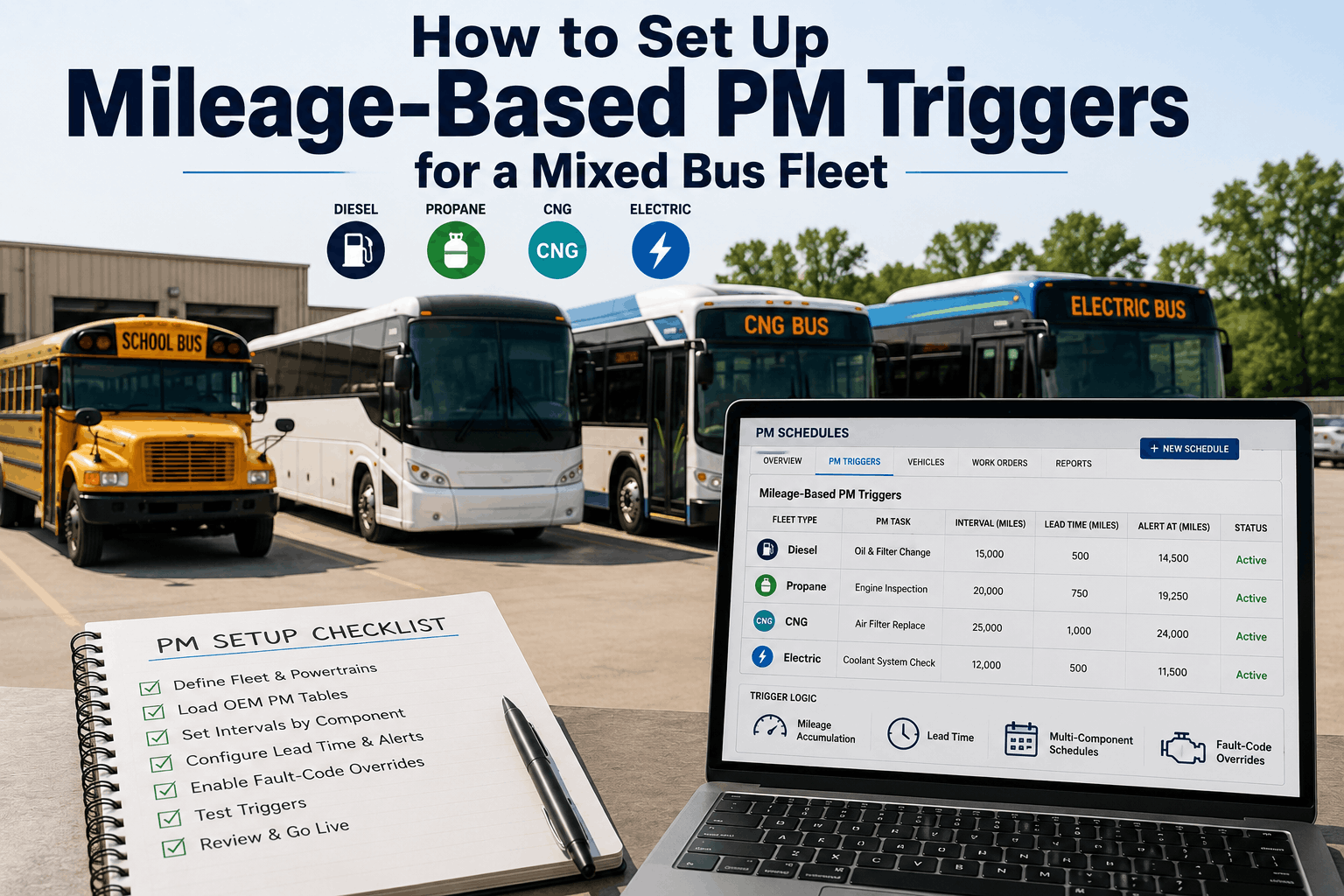
Setting up mileage-based preventive maintenance triggers across a mixed fleet of diesel, propane, CNG, and electric buses requires precise OEM interval mapping, lead time buffers, and fault-code overrides. This guide provides a step-by-step configuration framework so no bus runs past its PM due.
PM Trigger Setup Guide 2026
How to Set Up Mileage-Based PM Triggers for a Mixed Bus Fleet
Configure mileage-based PM triggers across diesel, propane, CNG and electric buses. OEM table, lead time, multi-component schedules, fault-code overrides.
The Cost of Missed PM Triggers in Mixed Fleets
Without mileage-based triggers, 35–45% of buses exceed their PM intervals, leading to component failures and emergency repairs. The average cost of a missed PM — including breakdown, tow, and overtime — ranges from $1,200 to $2,800 per incident.
35–45%
Buses overdue for PM without triggers
$1,200–$2,800
Cost per missed PM event
4–6 hrs
Average downtime per overdue failure
100%
Automation target with triggers
Why Mileage-Based Triggers Are Critical
Multi-Powertrain Complexity
Diesel, propane, CNG, and electric buses have distinct PM intervals. A unified trigger system accounts for each fuel type’s OEM recommendations.
Lead Time Buffering
Mileage-based triggers with configurable lead time ensure work orders are created 500–1,000 miles ahead, allowing parts ordering and scheduling.
Multi-Component Synchronization
Oil changes, filter swaps, and inspections can be grouped into single shop visits when triggers align across component schedules.
Fault-Code Overrides
Engine or battery fault codes can accelerate PM triggers. Smart overrides advance the next service when diagnostic thresholds are met.
Compliance Documentation
Automated triggers generate a digital trail for DOT and state audits, proving that every bus is serviced on time according to its duty cycle.
Budget Predictability
Accurate trigger forecasting allows districts to plan parts inventory and labor capacity across fuel types, reducing last-minute spending.
PM Trigger Configuration Progress
Diesel PM Interval Mapping
Map oil change, fuel filter, and chassis lube intervals per OEM specs. Most diesel buses trigger every 5,000–7,500 miles.
Propane & CNG Interval Mapping
Configure spark plug, coil, and fuel system checks at 7,500–10,000 miles. Include tank inspection triggers.
Electric Bus Interval Mapping
Set battery health, cooling system, and brake wear triggers at 10,000–15,000 miles. Motor inspections triggered by diagnostic codes.
Lead Time Buffer Configuration
Add 500–1,000 mile advance notice for each trigger. Adjust buffer per component criticality and parts lead time.
Multi-Component Schedule Sync
Group triggers that fall within 20% of each other’s interval to minimize shop visits while maintaining compliance.
Fault-Code Override Rules
Define which diagnostic trouble codes advance the next PM. Link engine, transmission, and battery fault thresholds.
Mixed Fleet Powertrain Distribution
A typical mixed fleet contains 45% diesel, 20% propane, 20% CNG, and growing electric segments. Each powertrain demands unique PM intervals and trigger logic for effective maintenance automation.
Common PM Trigger Configuration Mistakes
One-Size-Fits-All Intervals
Solution: Create separate PM templates for each fuel type. Load OEM interval tables into your CMMS and assign triggers per vehicle group.
No Lead Time Buffer
Solution: Configure advance notice windows of 500–1,000 miles. This allows parts ordering and prevents last-minute scheduling conflicts.
Ignoring Electric Bus Needs
Solution: Map battery state-of-health and cooling system triggers. Electric buses need distinct intervals for gearbox oil and brake wear.
Overlooking Fault-Code Integration
Solution: Enable fault-code overrides that pull forward PMs when critical engine or battery codes appear. Link telematics data to trigger logic.
Manual Trigger Adjustments
Solution: Use rule-based automation so triggers self-adjust after each completed PM. Eliminate manual date and mileage entry to avoid errors.
Missing Multi-Component Grouping
Solution: Set grouping rules that combine PMs within 20% of each other’s interval. This reduces shop visits without sacrificing compliance.
PM Trigger Configuration Checklist
OEM Interval Table Loaded
Upload manufacturer PM schedules for every powertrain in the fleet. Verify intervals for oil, filters, spark plugs, and high-voltage components.
Lead Time Buffer Set
Define advance notice windows per component type. Critical items get 1,000-mile buffers; standard items use 500-mile buffers.
Fault-Code Override Rules Active
Link diagnostic trouble codes to trigger escalation. Test that a MIL code advances the next PM by at least 50% of the remaining interval.
Multi-Component Grouping Configured
Set synchronization thresholds. Group PMs when their due mileages are within 1,000 miles of each other for the same vehicle.
Notification Workflow Tested
Verify that the CMMS sends alerts to the shop foreman, parts room, and fleet manager when triggers fire. Confirm mobile push delivery.
Reporting Dashboard Built
Create a PM compliance dashboard showing percentage of on-time PMs by fuel type, overdue mileage, and trigger accuracy.
PM Trigger Performance KPIs
PM Trigger Compliance Rate
Target: 95% of PMs completed within 500 miles of trigger. Track monthly per fuel type to identify configuration gaps.
Average Overdue Mileage
Target: Under 250 miles past due per bus. High values indicate lead time buffer or notification failure.
Lead Time Accuracy
Target: 90% of work orders created within the configured advance window. Measure deviation from planned trigger mileage.
Fault-Code Override Activation Rate
Target: 80% of critical fault codes successfully advance PMs. Monitor for missed overrides and adjust rule thresholds.
Multi-Component Sync Rate
Target: 70% of PM visits include at least two scheduled services. Higher sync reduces shop trips and fleet downtime.
PM Trigger Configuration Scoring Matrix
OEM Interval Mapping (Weight: 30%)
Are all fuel types covered with exact manufacturer intervals? Accuracy here directly impacts trigger reliability and compliance.
Lead Time Buffer (Weight: 20%)
Is the advance notice appropriate per component? Overly tight buffers cause last-minute scrambles; too wide reduces urgency.
Multi-Component Sync (Weight: 20%)
Does the system group compatible PMs? Effective grouping minimizes shop visits and technician idle time across fuel types.
Fault-Code Override Logic (Weight: 15%)
Are override rules tied to actionable codes? Proper integration prevents failures between scheduled intervals.
Fuel Type Variance Handling (Weight: 10%)
Does the trigger engine adjust for duty cycle differences among diesel, propane, CNG, and electric buses?
Notification & Workflow Rules (Weight: 5%)
Are alerts reaching the right people? Test mobile, email, and in-app notifications for all trigger events.
After implementing mileage-based PM triggers across our 200-bus mixed fleet, we reduced overdue PMs by 72% and saved $85,000 in emergency repairs annually. The multi-component sync alone cut shop visits by 30%.
Automate Your Mixed Fleet PM Triggers
BusCMMS configures mileage-based PM triggers with OEM interval mapping, lead time buffers, fault-code overrides, and multi-component grouping for diesel, propane, CNG, and electric buses. Book a demo to see how automation eliminates overdue PMs.
Mileage-Based PM Trigger FAQs
How do I set up PM triggers for a mixed diesel and electric fleet?
Create separate PM templates in your CMMS for each powertrain. Load OEM intervals for oil changes, battery checks, and motor inspections. Assign the correct template to each vehicle group so triggers fire based on actual mileage.
What lead time should I add to mileage-based triggers?
Add 500–1,000 miles of buffer depending on parts availability and shop capacity. Critical components like brakes or steering should have larger buffers to allow parts ordering without grounding the bus.
Can fault codes override the normal PM schedule?
Yes. Configure fault-code override rules that pull forward the next PM when specific engine, transmission, or battery diagnostic trouble codes appear. This addresses potential failures between scheduled intervals.
How do I synchronize multiple component PMs?
Use multi-component grouping rules. Define a mileage window (e.g., 1,000 miles) within which separate PMs are combined into one work order. This reduces the number of shop visits while maintaining compliance.
What is the best CMMS for mixed fleet PM triggers?
BusCMMS is purpose-built for mixed school bus fleets. It supports unlimited PM templates per fuel type, lead time buffers, fault-code overrides, and multi-component grouping. Integration with telematics enables real-time mileage sync.
How often should I review PM trigger configurations?
Review trigger configurations quarterly. Update intervals when OEM recommendations change, adjust buffers based on parts lead time, and refine fault-code rules as new diagnostic patterns emerge.
Precision Triggers Prevent Expensive Oversights
Mileage-based PM triggers are the backbone of a proactive mixed-fleet maintenance program. By mapping OEM intervals, buffering lead times, synchronizing multi-component services, and integrating fault-code overrides, districts eliminate overdue PMs and control costs across diesel, propane, CNG, and electric buses. The result is higher uptime, audit-ready documentation, and predictable budgeting. Pairing these rules with a fleet CMMS automates the entire workflow, turning trigger configuration into a one-time setup that protects every bus for its entire service life.