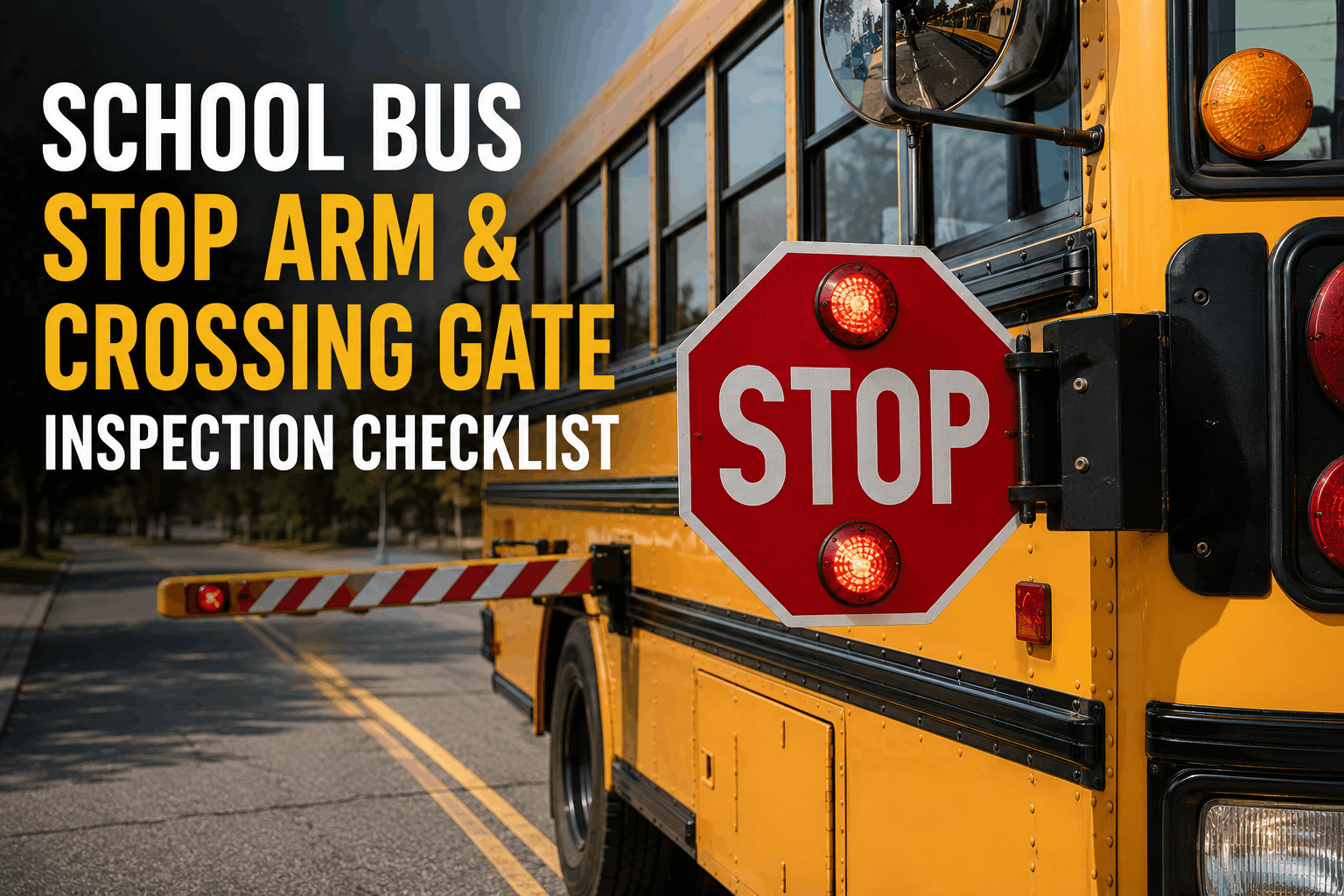
Stop arm and crossing gate systems are the most student-safety-critical components on a school bus — and among the most commonly documented defects in pre-trip DVIR records across U.S. school districts. A stop arm that fails to extend fully, a crossing gate that deploys sluggishly, or an 8-light flasher system with a burned bulb is not just a mechanical defect. It is a direct threat to the safety of children crossing in front of the bus, and a compliance exposure that puts the district, the driver, and the transportation director in the line of regulatory scrutiny. Every state with school bus inspection requirements mandates school bus stop arm inspection and crossing gate checklist verification as part of the daily DVIR process. NASDPTS (National Association of State Directors of Pupil Transportation Services) recommends daily functional testing of stop arms, crossing gates, and warning light systems as a minimum standard for student safety. This checklist covers every component of the stop arm and crossing gate safety system — daily pre-trip test points, weekly lubrication and hardware checks, and the less frequently performed but equally important structural and electrical inspections. Start your free trial to run this as a pre-loaded digital DVIR item in BusCMMS — with defect-to-work-order conversion in under two minutes.
Student Safety Starts with Every Pre-Trip — Make It Digital
BusCMMS pre-loads stop arm, crossing gate, and 8-light flasher inspection items in every driver DVIR. Defects convert to assigned shop work orders in one tap. No paper lag, no missed safety items, no compliance gaps.
Stop Arm & Crossing Gate System Overview
Modern school bus stop arm and crossing gate systems integrate pneumatic or electric actuation with the 8-light alternating flasher system and, on buses equipped with them, stop arm cameras for illegal passing documentation. Understanding the full system architecture is essential for thorough inspection — a crossing gate that deploys correctly but has a failed cable return spring will fail on the next cycle, not the current one.
Octagonal STOP sign with retro-reflective sheeting, pneumatic or electric actuator, pivot arm and mounting bracket. Typically mounted to driver's side body panel. Flashes in coordination with 8-light system.
Front-mounted student safety arm that extends from the front bumper area to prevent students from walking into the danger zone in front of the bus. Spring-loaded return, air or electric deployment.
Four amber lights activate 200 feet before the stop, transitioning to four red lights during loading/unloading. Both alternating pairs must flash in correct sequence — single-side or non-alternating failure is a violation.
Video recording system capturing illegal passing events. Requires lens cleaning, recording storage verification, and timestamp accuracy check. Many states have passed laws enabling citation issuance from stop arm camera footage.
Daily Pre-Trip Stop Arm & Crossing Gate Inspection Checklist
This section is designed for stop arm DVIR completion by the driver before every AM and PM run. All items must be checked with the bus stationary, engine running, and no students on board. Any failed item must be reported immediately — the bus must not enter student-loading service until the defect is corrected.
Weekly & Monthly Maintenance Inspection Points
| Component | Weekly Check | Monthly Check | Annual / As-Needed |
|---|---|---|---|
| Stop Arm Pivot Hardware | Visual — loose bolts | Torque pivot bolts to spec | Replace worn bushings |
| Stop Arm Actuator | Functional cycle test | Inspect air line / wiring | Actuator rebuild or replace |
| Crossing Gate Spring | Check return tension | Lubricate pivot point | Replace worn return spring |
| Crossing Gate Cable | Visual — fraying | Check cable tension | Replace at any sign of fraying |
| 8-Light Flasher Module | Functional test all 8 | Inspect wiring harness | Module replacement if erratic |
| Retro-Reflective Sheeting | Visual — condition | Clean and inspect edges | Replace if 50%+ reflectivity loss |
| Stop Arm Camera Storage | Indicator light check | Storage capacity review | Firmware update per vendor |
Student Mirror & Crossover Mirror Inspection
Student crossover mirror systems are required on all Type C and Type D school buses in the United States and must be adjusted to provide the driver with a view of the danger zone in front of the bus. NASDPTS and most state school bus inspection programs require school bus mirror inspection as a daily pre-trip item.
Verify driver can see the entire area in front of the bus from 0 to 200 feet forward while seated in the normal driving position. NASDPTS standard: driver must be able to see a 10-year-old child standing 12 feet in front of the bus bumper. Adjust mirror if visibility is compromised by vibration loosening the mounting bracket.
Verify flat driver-side mirror provides clear view from immediately adjacent to the front bumper to 200 feet rearward. Check bracket tightness — vibration from high-cycle stop-and-go routes loosens mirror mounts over a single week of operation. A mirror that vibrates in service provides no reliable safety field of view.
Verify passenger-side fender convex mirror provides a clear, undistorted view of the danger zone area on the passenger side of the bus from front bumper rearward. Cracks in the mirror lens distort the field of view and require replacement — a cracked mirror that appears functional in good light may create a blind zone in low-contrast conditions.
Verify interior mirror provides clear driver visibility of all student seating positions. Check mounting arm for looseness and adjust field of view before first run. A fogged, scratched, or improperly adjusted interior mirror reduces the driver's ability to monitor student behavior and identify medical emergencies during transit.
Our state inspection cited us for stop arm bulb defects two years in a row because drivers were noting them verbally but the paper DVIR forms were not reaching the shop until the next day. Since moving to BusCMMS mobile DVIRs, any stop arm or crossing gate defect creates a shop work order before the bus leaves the yard. We have had zero stop arm-related citations since deployment across 43 buses.
Frequently Asked Questions: Stop Arm & Crossing Gate Inspection
How often must school bus stop arms be inspected in the United States?
NASDPTS recommends and most state school bus inspection programs require daily functional testing of stop arm extension, retraction, and warning lights as part of the driver pre-trip DVIR. Monthly lubrication and torque checks of mechanical components are required, and full stop arm system inspection is required at each state annual inspection and at any PM-B or PM-C service interval.
What is the correct deployment angle for a school bus stop arm?
The stop arm must extend fully perpendicular to the bus body — 90 degrees from the bus side panel — when deployed. Any stop arm that fails to reach full perpendicular extension, droops below horizontal, or fails to latch in the retracted position is a defect requiring immediate shop attention before the bus enters student service.
What are the 8-light flasher requirements for school buses?
The 8-light alternating flasher system requires four amber warning lights to activate and alternate 200 feet before the stop, transitioning to four red lights when the door opens. All eight lights must operate — alternating in the correct pattern on both sides simultaneously. A non-alternating, single-side, or failed light is a state inspection violation in all states with school bus lighting requirements.
Can a school bus operate if the crossing gate is malfunctioning?
Whether a malfunctioning crossing gate is a mandatory out-of-service condition varies by state — most states require functional crossing gates on all buses so equipped and treat a failed gate as a condition requiring repair before student service. The federal standard is that the bus must be maintained in safe operating condition under 49 CFR 396.3. Transporting students on a bus with a known safety system failure creates significant liability exposure regardless of state-specific OOS criteria.
How does BusCMMS handle stop arm defects reported during DVIR?
In BusCMMS, when a driver flags a stop arm, crossing gate, or warning light defect during a mobile DVIR, the defect automatically creates an assigned work order in the shop — with the specific item, bus number, and driver report timestamp recorded. The bus is flagged as having an open safety defect until the work order is closed and the certifying technician signs off on the repair. The bus cannot be returned to student service status until the defect closure is documented.
What student mirror visibility standard is required for U.S. school buses?
NASDPTS recommends — and most state inspection standards require — that the driver be able to see a 10-year-old child standing at a specified distance in front of the bus bumper while seated in the normal operating position. Crossover and fender-mounted mirror systems must be adjusted to eliminate the danger zone blind spot directly in front of and adjacent to the front bumper — the area where student crossing fatalities most commonly occur.
How should stop arm camera footage storage be managed?
Stop arm camera storage management requirements vary by state and vendor contract — most programs require 7–30 days of footage retention with automated overwrite. Daily driver checks should confirm the power indicator is active and the lens is clean. Monthly reviews should verify storage capacity has not been exceeded, firmware is current, and footage timestamp accuracy is within the tolerance required for citation issuance in your state's enforcement program.
What lubrication does a crossing gate pivot point require?
Most crossing gate pivot assemblies require lithium-based grease or white lithium spray applied monthly to the pivot bushing and cable guide points. Avoid petroleum-based lubricants that attract road grit and accelerate bushing wear. The cable tension adjustment and return spring should also be inspected monthly — a crossing gate that deploys sluggishly in cold weather typically has a return spring that is losing pre-load and should be replaced before the following winter season.
Every Student Crossing Deserves a Fully Functional Safety System
BusCMMS pre-loads stop arm, crossing gate, mirror, and 8-light inspection items in every driver DVIR — with automatic work order creation for any defect. Keep your fleet citation-free and your students protected.