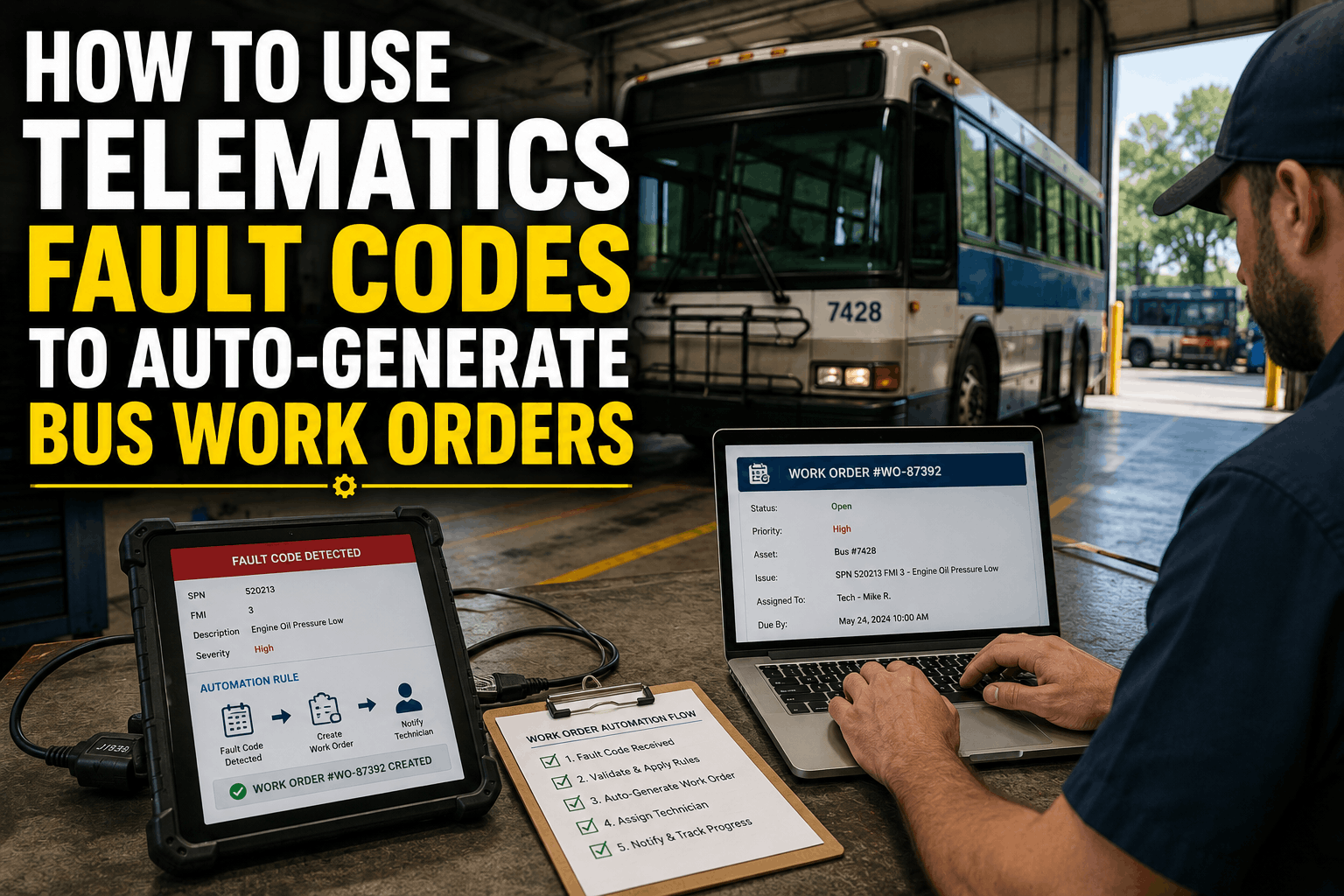
Telematics fault codes are flooding your fleet with data — but if they aren't automatically converted into work orders, critical engine and safety issues get missed. This guide shows how to map J1939 SPN/FMI codes from Samsara, Geotab, and Zonar into automated CMMS work orders with severity rules, dispatch holds, and escalation paths.
Telematics Work Order Guide 2026
How to Use Telematics Fault Codes to Auto-Generate Bus Work Orders
Convert J1939 fault codes from Samsara, Geotab, Zonar into automated CMMS work orders. SPN/FMI mapping, severity rules, dispatch holds, escalation paths.
Fault Codes Without Automation: The Missed Opportunity
Fleets miss 40–60% of fault codes that don't trigger a dashboard light. Unactioned codes lead to progressive damage, roadside breakdowns, and repair costs up to 3x higher. Automated work order generation closes this gap immediately.
40–60%
Unaddressed silent fault codes
3x
Repair cost multiplier if ignored
12–18 hrs
Avg. breakdown downtime
100%
Capture target with auto-WO
Why Automate Work Orders From Fault Codes
J1939 SPN/FMI Mapping
Every diagnostic trouble code is identified by Suspect Parameter Number and Failure Mode Identifier. Auto-mapping translates these into plain-language work order tasks instantly.
Severity-Based Routing
Critical codes like engine derate or brake system faults can immediately hold the bus at the yard. Non-critical codes generate planned PM work orders without disrupting routes.
Multi-Platform Integration
Samsara, Geotab, and Zonar each have unique APIs. A unified integration layer normalizes fault data into a single CMMS work order queue regardless of telematics provider.
Escalation Paths
If a work order isn't acknowledged within a set time, the system escalates to the shop foreman, then the fleet manager. No fault code falls through the cracks.
Dispatch Hold Automation
Red-tag faults automatically flag the bus as out-of-service in the dispatch system, preventing it from being assigned to a route until the work order is closed.
Predictive Trend Analysis
Aggregated fault code data reveals patterns across the fleet. Repeated SPNs on a particular engine family trigger proactive fleet-wide inspections.
Fault Code Automation Setup Progress
Telematics API Connection
Establish secure API connections to Samsara, Geotab, or Zonar. Verify real-time fault code streaming into the CMMS integration layer.
SPN/FMI Mapping Library
Load the complete J1939 SPN/FMI dictionary. Map each code to a specific work order template with required parts and labor estimates.
Severity Rules Configuration
Define three severity tiers: Red (immediate hold/urgent WO), Yellow (schedule within 48 hrs), Green (next PM). Assign codes to each tier.
Dispatch System Integration
Set up out-of-service flags that communicate with routing software. Test that red-tier codes block bus assignment until the work order is resolved.
Escalation Workflow Build
Create multi-level escalation chains: unacknowledged WO after 30 min → foreman; after 2 hrs → fleet manager; after 4 hrs → director.
Dashboard & Reporting
Build a live dashboard showing fault-to-work-order conversion rate, average response time, and top recurring SPNs across the fleet.
Fault Code Source Distribution
Engine and aftertreatment systems generate nearly half of all fault codes. Mapping these to automatic work orders prevents cascading failures and keeps emission systems compliant.
Common Auto-WO Configuration Mistakes
Ignoring Low-Severity Codes
Solution: Even green-tier codes should generate work orders attached to the next scheduled PM. This prevents a minor fault from persisting across service intervals.
Missing SPN/FMI Translations
Solution: Maintain a translation table that converts numeric SPN/FMI pairs into clear technician instructions. Update it when OEMs release new code definitions.
No Dispatch System Bridge
Solution: Integrate the CMMS with your routing platform so that buses with active red-tier work orders cannot be assigned until cleared by a supervisor.
Over-Alerting Technicians
Solution: Group related codes into a single work order when they originate from the same bus within a short time window. Avoid flooding the queue.
Lack of Escalation Rules
Solution: Build time-based escalation tiers. If a work order remains unacknowledged, escalate it. Track escalation metrics to refine response SLAs.
Static Severity Assignments
Solution: Allow dynamic severity changes based on frequency. A code that reappears three times in a week should escalate from yellow to red automatically.
Telematics Fault Code Integration Checklist
API Connection Validated
Confirm bidirectional data flow between telematics provider and CMMS. Test with a sample fault code to verify work order creation within 60 seconds.
SPN/FMI Library Complete
Ensure all OEM-specific codes for your fleet's engine families are mapped. Include both standard J1939 codes and manufacturer proprietary codes.
Severity Matrix Signed Off
Have your lead technician and fleet manager approve the Red/Yellow/Green severity assignments for the top 200 SPN codes in your fleet.
Dispatch Hold Tested
Run a live test with a red-tier code on a spare bus. Confirm the bus is blocked in the dispatch system and the work order is visible in the shop queue.
Escalation Paths Verified
Simulate an unacknowledged work order and confirm that notifications reach the foreman, then manager, within the configured time windows.
Dashboard Published
Share a real-time dashboard with the transportation team showing fault-to-WO metrics, open work orders by severity, and mean time to resolution.
Auto-WO Performance KPIs
Fault-to-WO Conversion Rate
Target: 100% of critical codes generate work orders within 2 minutes. Monitor for any dropped or delayed conversions.
Mean Time to Acknowledge
Target: Under 15 minutes for red-tier work orders. Measure from fault code timestamp to technician acknowledgment.
Escalation Trigger Rate
Target: Under 5% of work orders require escalation. High rates indicate alert fatigue or understaffing at the first response tier.
Dispatch Hold Accuracy
Target: Zero dispatch assignments against active red-tier holds. Audit monthly for violations.
Recurring Fault Reduction
Target: 25% reduction in repeat SPN codes within 90 days of automation. Track by code and bus.
Fault Code Automation Scoring Matrix
SPN/FMI Mapping Accuracy (Weight: 30%)
Are all fault codes correctly translated into work order language? Inaccurate mapping causes wrong repairs and wasted labor.
Severity Rule Precision (Weight: 25%)
Do severity tiers match actual repair urgency? Over-classifying drains resources; under-classifying risks safety and breakdowns.
Integration Reliability (Weight: 20%)
Is the telematics-to-CMMS connection stable? Any API downtime directly equals missed work orders and liability.
Escalation Effectiveness (Weight: 15%)
Do escalations reach the right person? Measure time from escalation trigger to supervisor intervention.
Dispatch Safety Lock (Weight: 5%)
Is the out-of-service flag enforced? Any bypass compromises student safety and must be eliminated.
User Adoption & Feedback (Weight: 5%)
Do technicians trust the auto-generated work orders? Regularly survey shop floor staff on code accuracy and workflow fit.
Integrating Samsara fault codes with our CMMS automated 300+ work orders per month that were previously missed. Our roadside breakdowns dropped by 40% in the first six months, and we eliminated the whiteboard entirely from the shop.
Turn Fault Codes Into Actionable Work Orders
BusCMMS integrates with Samsara, Geotab, Zonar, and other telematics platforms to auto-generate work orders from J1939 fault codes. Configure severity rules, dispatch holds, and escalation paths that protect your fleet. Book a demo today.
Telematics Fault Code Automation FAQs
What are J1939 SPN and FMI codes?
SPN (Suspect Parameter Number) identifies the component or system reporting an issue. FMI (Failure Mode Identifier) describes the type of failure. Together they form the standard diagnostic language for heavy-duty vehicles.
Can I use telematics fault codes from multiple providers?
Yes. A robust CMMS integration normalizes fault data from Samsara, Geotab, Zonar, and others into a single work order queue. Each provider's API is handled separately but the output is unified.
How quickly should a fault code generate a work order?
Critical codes should generate a work order within 60 seconds of arriving in the CMMS. Non-critical codes can be batched and processed every 5–10 minutes to manage system load.
What happens if a bus is already on route when a red fault appears?
Red-tier faults that affect safety (e.g., brake system, steering) should trigger an immediate recall procedure. The CMMS can send an alert to dispatch, and the bus returns to the yard at the next safe opportunity.
How do I handle duplicate fault codes from the same bus?
Configure the system to suppress duplicate work orders within a set time window (e.g., 4 hours). Instead, update the existing work order's occurrence count and timestamp.
Does fault code automation work with older buses?
Buses with J1939 or J1708 diagnostic ports can be integrated using aftermarket telematics devices. The fault code data is standardized, so even older engines benefit from automated work order generation.
Automated Fault-to-Work Order Is the New Standard
Telematics fault code automation transforms raw diagnostic data into a precise maintenance workflow. By mapping SPN/FMI codes, assigning severity rules, and integrating dispatch holds, school bus fleets stop ignoring silent failures and start preventing breakdowns. The result is higher uptime, controlled repair costs, and complete confidence that every fault is captured. Pairing telematics with a CMMS built for school buses makes this automation achievable within weeks, not months.