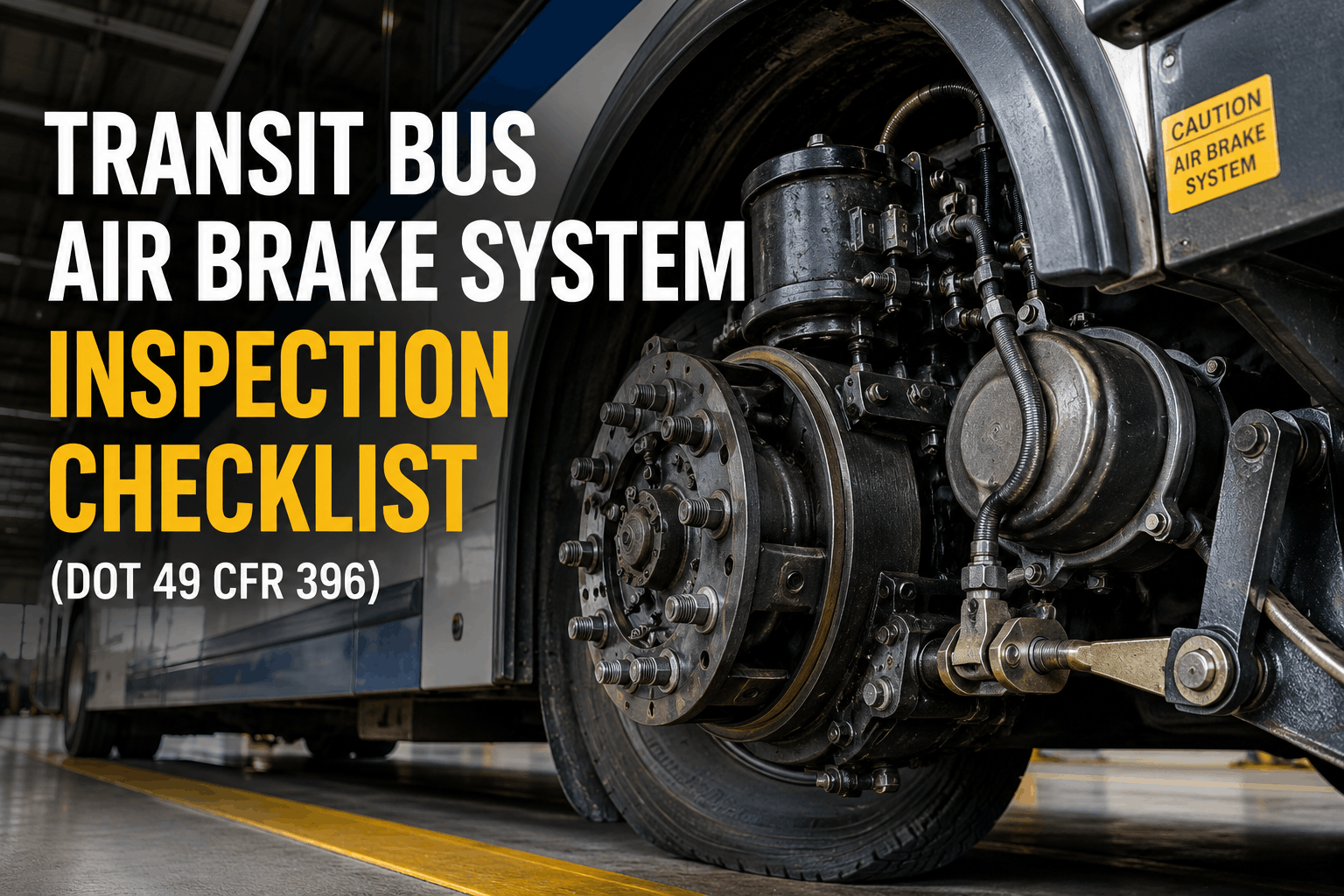
Air brake system failures are the number one mechanical cause of commercial vehicle roadside out-of-service violations in the United States — accounting for 43% of all vehicle OOS conditions in annual CVSA Roadcheck data. For transit and school bus operations, where passenger safety and regulatory scrutiny are both at their highest, a poorly documented or inconsistently performed transit bus air brake inspection is not just an operational risk — it is the most direct path to a Federal Motor Carrier Safety Administration compliance finding, a fleet out-of-service order, and civil liability exposure. FMCSA 49 CFR 396 mandates systematic inspection and maintenance programs for all commercial motor vehicles, including transit buses with a GVWR above 10,001 pounds. This air brake checklist covers every test point required by DOT standards — pressure build-up, leak rate, slack adjuster inspection, spring brake test, pushrod stroke, and hardware inspection — structured for bus technicians performing daily, annual, and PM interval service. Start your free trial to run this checklist as a pre-loaded digital work order in BusCMMS with auto-scheduling and FMCSA-compliant record retention.
Run DOT Air Brake Inspections as Digital Work Orders — Audit-Ready Every Time
BusCMMS pre-loads this complete air brake inspection checklist for technician sign-off, schedules brake PM by mileage trigger, and retains every inspection record automatically per FMCSA 49 CFR 396 retention requirements.
Regulatory Framework: 49 CFR 396 Air Brake Requirements for Transit Buses
FMCSA 49 CFR Part 393 Subpart C establishes the performance and equipment standards for air brake systems. Part 396 governs inspection, repair, and maintenance recordkeeping. Together, these regulations require transit agencies to: perform systematic bus brake PM at defined intervals, retain inspection records for 12 months (14 months for annual inspections), and ensure brake defects identified during DVIR are corrected before the vehicle re-enters service. State regulations for school buses in most jurisdictions are more stringent than FMCSA minimums — many states mandate brake inspections at intervals as short as 90 days for school buses, with documented test results required.
Brake system performance standards — required stopping distances, system integrity, brake balance requirements for all axles
Systematic inspection and maintenance — all brake defects must be repaired before vehicle returns to service; records retained 12 months
Annual vehicle inspection requirements — air brake system must pass all test points; inspector must hold valid FMCSA inspector qualifications
North American Standard Out-of-Service Criteria for brakes — 14 specific brake OOS conditions applied by roadside inspectors nationally
Transit Bus Air Brake Inspection Checklist
Perform all Phase 1 tests before vehicle movement. Phase 2 and Phase 3 inspections require the vehicle on a level surface with wheels chocked. All pressure readings must be recorded with actual values — not just pass/fail. FMCSA inspectors expect documented measurement values, not checkboxes.
Air Brake Out-of-Service Thresholds: Quick Reference
| Brake Component | OOS Condition | CFR / OOSC Reference | Measurement Required |
|---|---|---|---|
| Pushrod Stroke (Type 30) | Over 2.0 inches at 90 psi | 49 CFR 393.47(e) | Ruler measurement at 90 psi application |
| Pushrod Stroke (Type 24) | Over 1.75 inches at 90 psi | 49 CFR 393.47(e) | Ruler measurement at 90 psi application |
| Brake Lining (Non-steering) | Less than 1/4" at shoe center | CVSA OOSC Section 4.3 | Visual through inspection hole |
| Brake Lining (Steering) | Less than 3/16" at shoe center | CVSA OOSC Section 4.3 | Visual through inspection hole |
| Air Leak Rate (Brakes off) | Over 2 psi per minute | 49 CFR 393.47(b) | Gauge reading, engine off, 1 min |
| Spring Brake Auto-Apply | Fails to apply below 45 psi | 49 CFR 393.55 | Drain air test, vehicle stationary |
| Contaminated Brake Lining | Any oil, grease, or fluid contamination | 49 CFR 393.47(a) | Visual inspection with drum removed |
How BusCMMS Manages Air Brake Compliance Documentation
FMCSA 49 CFR 396 requires that brake inspection records include the date of inspection, the identity of the person performing the inspection, and documentation of defects found and corrected. Paper-based brake inspection documentation fails this requirement when forms are incomplete, unsigned, or not retained systematically. BusCMMS pre-loads this complete bus brake PM checklist as a digital work order — with technician sign-off, measurement entry fields for pushrod stroke and leak rate, and timestamp capture for every line item. Records are retained automatically per FMCSA requirements with no paper filing required. When a DOT inspector requests brake maintenance records for a specific bus, BusCMMS produces the complete documented inspection history in under five minutes. Book a demo to see the brake inspection workflow in a live transit fleet environment.
We had an unannounced FMCSA compliance review last spring. The inspector requested brake inspection records for 12 buses going back 14 months. I pulled everything from BusCMMS in about four minutes — printed pushrod stroke values, leak rate measurements, technician sign-offs, dates. The inspector said it was the most complete brake documentation he had seen from a transit agency our size. We passed with zero brake violations.
Frequently Asked Questions: Transit Bus Air Brake Inspection
What is the FMCSA-required air pressure build-up time for a transit bus?
Under 49 CFR 393.51, a transit bus air brake system must build pressure from 0 to governor cut-out within 3 minutes at governed engine speed. Best practice is 45 seconds from 85 to 100 psi — a build-up time significantly exceeding this indicates compressor wear, air dryer restriction, or a significant leak requiring investigation before the vehicle enters service.
What is the maximum allowable air leak rate for a transit bus?
For a single vehicle (bus without trailer) with brakes released, the maximum allowable leak rate is 2 psi per minute after the engine is turned off and the system is at full charge. With a full service brake application held, the maximum is 3 psi per minute. Exceeding either threshold is an FMCSA out-of-service condition under 49 CFR 393.47.
What is the OOS pushrod stroke limit for Type 30 air brake chambers?
The out-of-service limit for a Type 30 brake chamber is 2.0 inches of pushrod stroke measured at a 90 psi service application. Type 24 chambers have a limit of 1.75 inches. Any chamber at or exceeding these limits at a roadside inspection is an immediate out-of-service condition under 49 CFR 393.47(e) — record actual measured values on every inspection form, not just pass/fail.
How often should transit bus air brakes be inspected?
FMCSA requires a complete brake inspection as part of the annual vehicle inspection under 49 CFR 396.17. Most transit agencies also perform brake system checks at each PM-B (10,000-mile) service interval and during DVIR if any brake-related defect is noted. State school bus regulations in most jurisdictions require brake inspection at 90-day intervals for school buses regardless of mileage.
Can automatic slack adjusters be manually adjusted if stroke is out of specification?
Manually adjusting an automatic slack adjuster (ASA) to correct excessive stroke is a temporary measure that does not address the underlying cause. FMCSA guidance and industry practice is clear: if an ASA cannot maintain proper stroke after manual adjustment, the adjuster should be replaced, not repeatedly adjusted. A continuously out-of-adjustment ASA indicates internal wear or seized components.
What does it mean if a spring brake applies at 50 psi instead of the expected 20–45 psi range?
A spring brake that applies at 50 psi indicates the spring brake hold-off valve is malfunctioning — releasing spring pressure prematurely when supply pressure is still adequate for safe service braking. This condition requires hold-off valve inspection or replacement. The vehicle should not be returned to service until the spring brake application threshold is verified within specification.
How does BusCMMS help with air brake FMCSA compliance documentation?
BusCMMS pre-loads the complete air brake inspection checklist — including measurement fields for pushrod stroke, leak rate, and pressure readings — as a digital work order. Technician sign-off, date, and measured values are captured with timestamps and retained automatically per FMCSA 49 CFR 396.3 requirements. Complete brake inspection history for any bus is retrievable in under five minutes for audits or roadside inspection requests.
Is oil contamination on brake linings always an out-of-service condition?
Yes. Under 49 CFR 393.47(a) and CVSA OOSC Section 4.3, any brake lining contaminated with oil, grease, or brake fluid is an immediate out-of-service condition — regardless of remaining lining thickness. The source of contamination must be identified and corrected before new linings are installed. Returning a bus to service with contaminated linings is a serious regulatory and safety violation.
Keep Every Bus DOT-Compliant on Air Brakes — Automatically
BusCMMS pre-loads complete air brake inspection checklists with measurement fields, auto-schedules brake PM by mileage, and retains every inspection record audit-ready — so your fleet is always prepared for FMCSA review without manual filing.