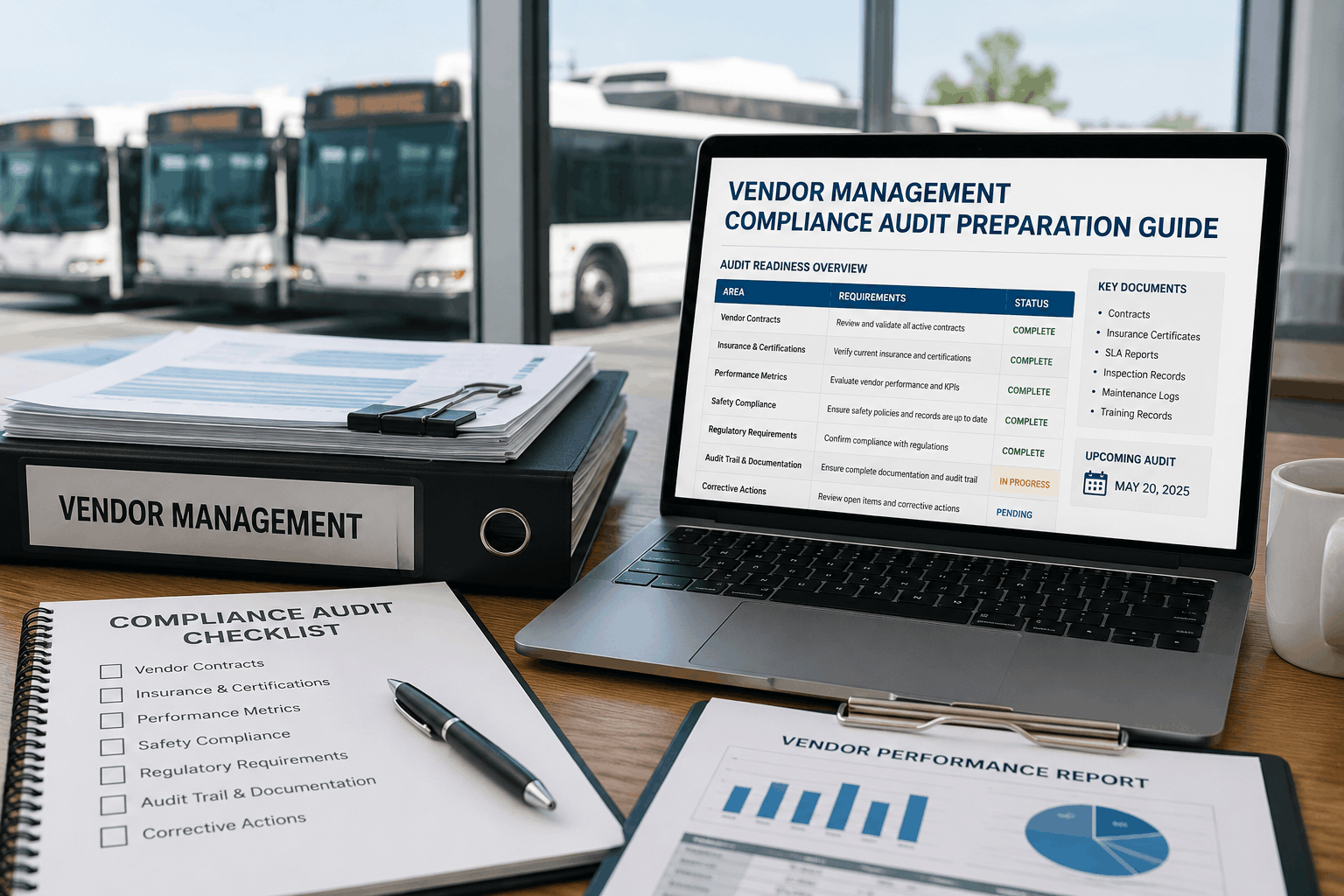
A transit agency with 160 buses and 45 active vendors received notice of an FTA triennial audit. The procurement manager had 10 days to produce documentation for every vendor relationship: contracts, insurance certificates, W-9 forms, purchase orders, receiving records, invoices, and warranty claims. The files were scattered across filing cabinets, email inboxes, and shared drives. Three vendors had expired insurance certificates. Four had missing W-9 forms. Two had contracts that expired six months ago. The agency spent 80 hours pulling documents together and still received audit findings for incomplete vendor files. Vendor management compliance is not an administrative afterthought — it's an audit requirement. This guide explains the technology, processes, and reporting metrics required for effective vendor management compliance across bus operations, and how to prepare for audits of your vendor relationships.
Vendor Compliance 2026
Vendor Management Compliance Audit Preparation Guide
Understand the technology, processes, and reporting metrics required for effective vendor management compliance across bus operations.
Vendor Compliance Impact — 160-Bus Fleet
Vendors with expired insurance (Before)3-5 per audit
Missing W-9 forms (Before)4-8 per audit
Expired contracts (Before)2-3 per audit
Audit preparation time (Before)80+ hours
Optimized compliance rate98%+ vendor files complete
Optimized audit prep timeUnder 4 hours
Vendor management compliance is the structured process of maintaining accurate, complete, and audit-ready documentation for every external supplier that supports your maintenance operation. It covers parts vendors, tire dealers, body shops, towing services, dealerships, warranty administrators, and specialty repair shops. A compliant vendor file includes: W-9 form, insurance certificates (general liability, auto, workers' comp), signed contract or purchase agreement, approved vendor application, pricing agreement, and contact information. Non-compliant vendor files create audit findings, payment delays, and legal risk. The most common vendor compliance failures are expired insurance certificates, missing W-9 forms, contracts that have lapsed, and no documented vendor approval process.
Required Vendor File Contents
W-9 formRequired for payment processing and 1099 reporting
Insurance certificatesGeneral liability, auto, workers' comp with expiration dates
Signed contractPricing, terms, service levels, termination clauses
Approved vendor applicationOnboarding documentation, references, capabilities
Common Compliance Gaps
Expired insurance35% of vendors have expired certificates
Missing W-925% of vendor files missing W-9 forms
Expired contracts15% of vendor contracts expired
No approval documentation20% of vendors lack approval records
Automate vendor file management — book a demo
To stay audit-ready, track these vendor compliance metrics monthly. The dashboard should show percentage of vendors with current insurance certificates (target 100%), percentage with W-9 on file (target 100%), percentage with active contracts (target 100%), number of vendors with expiring insurance in next 30/60/90 days, number of vendors with contracts expiring in next 30/60/90 days, and vendor compliance score (average across all categories). Review these metrics at monthly procurement meetings. Flag any vendor below 100% compliance for immediate action.
Vendor Compliance Target Benchmarks
Insurance certificates current
Vendor approval documentation
Overall vendor compliance score
Track vendor compliance metrics — sign up free
A CMMS with vendor management features transforms compliance from manual to automated. The system stores all vendor documents in one searchable location. It tracks insurance certificate expiration dates and sends alerts 30, 60, and 90 days before expiration. It tracks contract expiration dates and notifies procurement before renewal deadlines. It logs every purchase order, receiving record, and invoice for audit trails. It provides vendor performance scorecards. It generates audit-ready vendor files on demand. Fleets using CMMS for vendor management reduce audit preparation time by 80-90%, eliminate expired insurance findings, and maintain 98%+ vendor compliance rates.
Manual Vendor Management
Documents in filing cabinets, email, shared drives
Expiration dates tracked manually, often missed
No audit trail for vendor transactions
Audit preparation: 2-4 weeks of searching
Compliance rate: 70-85% typical
Result: Audit findings, payment delays, compliance risk.
CMMS-Enabled Vendor Management
All documents stored centrally, searchable
Automated expiration alerts at 30/60/90 days
Complete audit trail for all vendor transactions
Audit preparation: 30 minutes to 4 hours
Compliance rate: 95-100% achievable
Result: Audit-ready, lower risk, faster payments.
See automated vendor compliance in action — book a demo
When an audit notice arrives, you need to produce vendor documentation quickly. Use this checklist to prepare in advance so you're never scrambling.
Vendor Audit Preparation Checklist
Vendor master list
Complete list of all active vendors with contact information and service categories
Insurance certificates
Current certificates for all vendors, expiration dates tracked
W-9 forms
Signed W-9 on file for every vendor receiving payments
Contracts and agreements
Signed contracts, pricing agreements, terms and conditions
Purchase orders
All POs with approvals, dates, quantities, pricing
Receiving records
Proof of delivery, quantities received, condition
Invoice matching
Three-way match (PO, receiving, invoice) documentation
Warranty claims
Claim submissions, approvals, payments, denials
Vendor performance reviews
Quarterly reviews, fill rates, on-time delivery, quality scores
Store all vendor documents in one place — sign up free
Vendor management compliance is essential for audit readiness. Every vendor file must contain current insurance certificates, W-9 forms, signed contracts, and approval documentation. Monthly compliance reviews should track insurance expiration, contract expiration, and document completeness. A CMMS automates vendor management: central document storage, expiration alerts, audit trails, and audit-ready file generation. Fleets using CMMS for vendor management reduce audit preparation time by 80-90%, eliminate expired insurance findings, and maintain 98%+ compliance rates. The investment in vendor management technology typically pays for itself in the first audit cycle through avoided findings and reduced preparation time. BusCMMS provides the tools needed to centralize vendor files, track expirations, log purchase orders, and generate audit reports — all in one platform.
Build your vendor compliance framework — book a demo
Stay Vendor-Compliant and Audit-Ready
Centralized vendor files, expiration alerts, purchase order tracking, audit trails — all in one CMMS platform. Free 14-day trial.
What is vendor management compliance?
Vendor management compliance is the process of maintaining complete, accurate documentation for every external supplier — W-9 forms, insurance certificates, contracts, purchase orders, and audit trails.
What documents should every vendor file contain?
W-9 form, current insurance certificates (general liability, auto, workers' comp), signed contract or purchase agreement, approved vendor application, and pricing agreement.
How often should vendor files be reviewed?
Review insurance certificates and contracts monthly for upcoming expirations. Review complete vendor files quarterly. Update immediately when documents expire.
What are the most common vendor compliance audit findings?
Expired insurance certificates (35% of vendors), missing W-9 forms (25%), expired contracts (15%), and no documented vendor approval process (20%).
How does a CMMS improve vendor compliance?
A CMMS centralizes vendor documents, tracks expiration dates, sends automated alerts, logs purchase orders and receiving, and generates audit-ready vendor files on demand.
Does BusCMMS include vendor management features?
Yes. BusCMMS tracks vendor files, insurance expirations, contract expirations, purchase orders, receiving records, invoice matching, warranty claims, and vendor performance.
Vendor Management Compliance — Complete Guide
Centralized vendor files, expiration alerts, purchase order tracking, audit trails. Everything fleets need for vendor compliance and audit preparation.