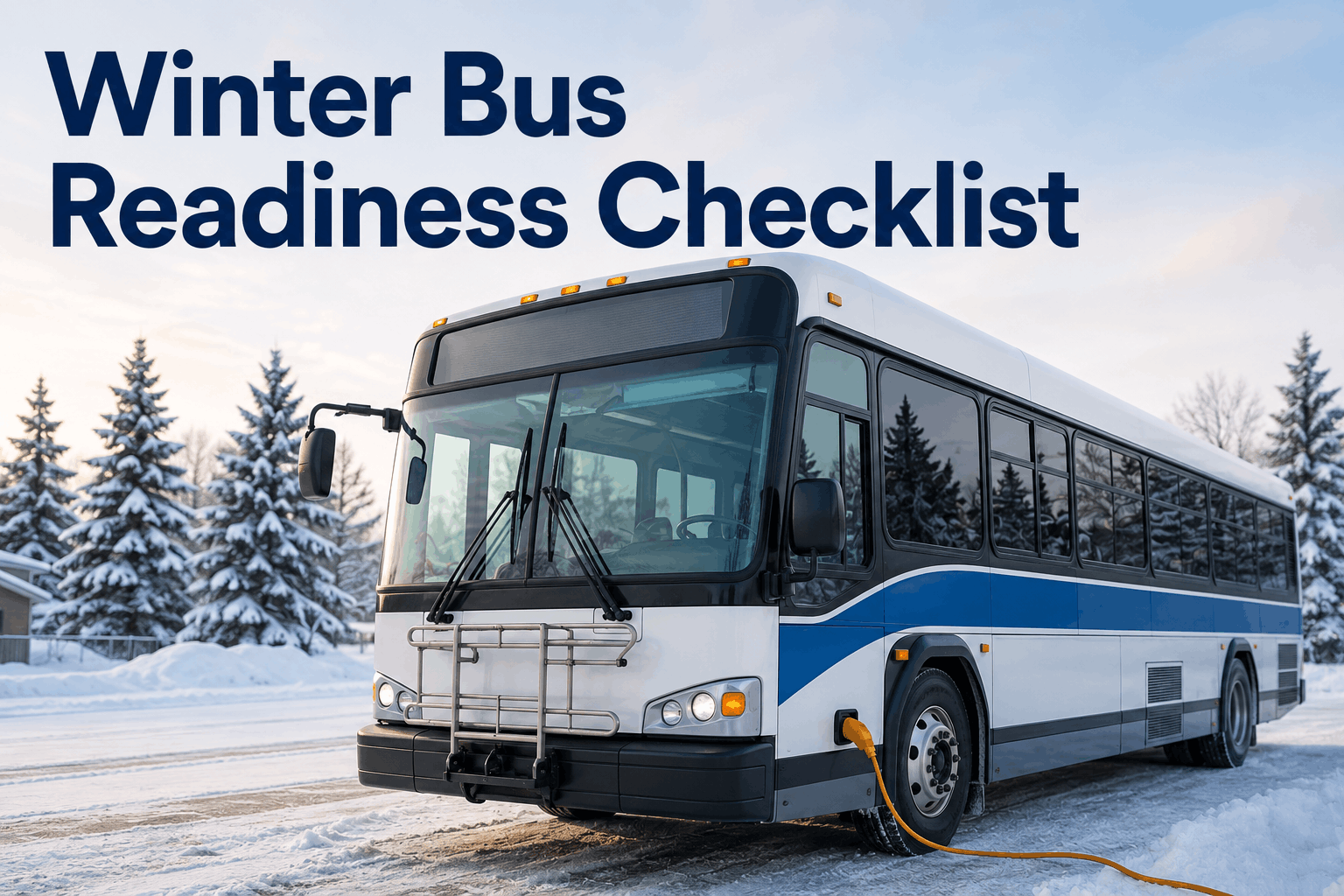
Cold weather is the most operationally disruptive condition a school or transit bus fleet faces — not because of road conditions alone, but because of the compounding mechanical failures that low temperatures trigger across multiple systems simultaneously. A battery that tested at 75% capacity in October will not start a diesel engine at 5°F. A heater core with a hairline leak that was manageable in September becomes a fogged windshield at 20°F. A washer fluid reservoir filled with summer formula becomes a frozen block the first morning temperatures drop below freezing. For fleet operations that cannot delay routes regardless of temperature, winter readiness is not a reactive process — it is a scheduled pre-season preparation program completed before the first forecast of below-freezing temperatures. This winter bus readiness checklist covers every cold-weather system on the bus — block heater inspection, battery load testing, antifreeze verification, defrost system testing, tire pressure cold-weather adjustment, and snow chain preparation — structured as a one-time pre-season shop event that prevents cold-start failures, visibility failures, and traction failures throughout the winter operating cycle. Start your free trial to schedule this checklist as a calendar-triggered PM work order in BusCMMS — auto-generated every September for every bus in your fleet.
Winterize Every Bus Before the First Freeze — Automatically
BusCMMS auto-generates winter readiness PM work orders by calendar trigger every September. Pre-loads this complete checklist for every bus. No manual scheduling, no buses missed, no cold-start surprises in January.
Winter Readiness Service Intervals & Timing
Winter bus preparation should be completed as a single scheduled shop event per bus, ideally in September or early October — before the first forecasted freeze in your operating region. Splitting winter prep across multiple service visits increases the risk of missing items and delays corrective action on defects found during checks. The following interval grid shows what must be completed pre-season versus what requires ongoing monthly monitoring through the winter operating cycle.
Block heater test, battery load test, antifreeze concentration check, coolant flush if needed, defrost verification, washer fluid change to winter formula, tire pressure adjustment, chain inventory and fit check.
Verify block heater operation before overnight cold snaps, check tire cold pressure (drops approximately 1 psi per 10°F temperature drop), inspect wiper blades for ice damage, confirm washer fluid level and freeze rating.
Inspect undercarriage for road salt accumulation on brake lines and fuel lines. Verify chain condition after use. Check that air system purged properly after extended cold-weather operation. Inspect rubber seals on doors for ice damage.
Remove and inspect chains for wear, wash and store. Inspect undercarriage for salt-related corrosion. Change washer fluid back to summer formula. Document battery condition after winter load and flag any units approaching replacement threshold.
Winter Bus Readiness Inspection Checklist
Complete all sections below as a single pre-season shop event. Record all measured values — antifreeze freeze point, battery load test result, and tire pressure readings must be documented with actual values for fleet maintenance records. A bus that fails any item in this checklist must have the defect corrected before the first below-freezing operating day.
Winter Readiness Component Quick Reference
| Component | Winter Specification / Action | Failure Mode if Skipped | Check Timing |
|---|---|---|---|
| Block Heater | Verify amp draw; 1.0–1.5A per 750W element | Hard or no-start below 15°F | Pre-season & monthly |
| Battery Pack | Load test at 50% CCA; min 9.6V hold | No-start after cold overnight | Pre-season; replace if >4 years |
| Antifreeze Concentration | Protect to -34°F minimum in northern climates | Coolant freeze, cracked block/heater core | Pre-season; recheck mid-winter |
| Washer Fluid | Winter formula rated -25°F or lower | Frozen reservoir/lines; zero visibility | Pre-season; check monthly |
| Wiper Blades | Replace with winter-rated blades | Streak/skip in snow; unsafe visibility | Pre-season |
| Tire Pressure | Adjust for cold ambient (add 1 psi/10°F drop) | Under-inflation, poor traction, blowout risk | Monthly through winter |
| Air Dryer Desiccant | Replace if saturated; verify purge cycle | Frozen air lines; brake system failure | Pre-season |
How BusCMMS Automates Winter Fleet Preparation
Winter readiness failures happen most often not because fleets don't know what to check — they happen because the pre-season preparation event never gets scheduled, or gets partially completed and not tracked to closure. BusCMMS schedules winter readiness PM work orders by calendar trigger, automatically generating a pre-loaded checklist work order for every bus in the fleet on a configurable date in September. Technician sign-off, measured values (antifreeze freeze point, battery CCA, block heater amp draw), and defects found are all retained digitally. Any bus with an open winter readiness defect is flagged in the fleet status dashboard until the repair is closed. Book a demo to see winter scheduling in a live fleet environment.
Last winter we had three no-start events in the first two weeks of January — all traced to block heater elements that had failed over the summer and were never caught because we had no formal pre-season check process. After implementing BusCMMS with a calendar-triggered October winterization work order for all 71 buses, we caught four failed block heaters in pre-season checks, replaced them before the first freeze, and had zero cold-start failures all winter.
Frequently Asked Questions: Winter Bus Readiness
When should winter bus preparation be completed?
Winter bus preparation should be completed as a scheduled shop event in September or early October — before the first forecasted freeze in your operating region. Completing winterization after temperatures have already dropped means some buses may have already experienced cold-related degradation (battery discharge, antifreeze dilution from condensation) that makes the checks less reliable. Pre-season preparation in early fall gives the most accurate baseline.
How do you test a bus block heater without special equipment?
The simplest field test is to plug in the block heater, wait 30 minutes, then feel the coolant hose immediately adjacent to the heater inlet — it should be noticeably warm (100°F+). A more reliable method is using a clamp-on ammeter around the heater cord while plugged in — a functioning 750W element draws approximately 1.0–1.5 amps on a 120V circuit. Zero amp draw confirms a failed element even if the cord and plug appear undamaged.
What antifreeze freeze point is adequate for a school bus in cold climates?
For northern U.S. climates where overnight temperatures regularly fall below 0°F, coolant should provide freeze protection to at least -34°F — which corresponds to approximately a 50/50 mix of ethylene glycol concentrate and water. Using a refractometer is the most accurate method of measuring freeze point. Avoid exceeding 70% glycol concentration — beyond this ratio, freeze protection actually decreases and heat transfer efficiency drops significantly.
At what age should bus batteries be proactively replaced before winter?
Bus batteries over 4 years old should be load-tested in September — any battery failing the load test (voltage drops below 9.6V at 50% CCA) must be replaced before winter. Batteries between 3–4 years old that pass load test should be flagged for monitoring through the winter, as performance can degrade rapidly below 20°F. A proactive replacement program for all batteries over 4 years eliminates the vast majority of cold-start no-start events.
How much does tire pressure drop in cold weather?
Tire pressure drops approximately 1 psi for every 10°F decrease in ambient temperature. A school bus tire inflated to 100 psi at 80°F in August will measure approximately 93–95 psi at 20°F in January — already below the minimum recommended inflation pressure for most bus tires. Pre-season pressure adjustment and monthly cold-weather pressure checks throughout winter are essential to maintaining safe inflation levels.
Can summer diesel fuel be used in below-freezing temperatures?
Standard summer-blend diesel (No. 2) begins to gel at approximately 15°F, forming wax crystals that clog fuel filters and restrict fuel flow to injectors. In very cold conditions this causes engine starvation and no-start events. Winter-blend diesel (typically a blend of No. 2 and No. 1 diesel) has a lower cloud point. Most fuel suppliers automatically transition to winter blend in October — confirm with your supplier and use anti-gel fuel additive for extreme cold events below -10°F.
What snow chain size does a school bus require?
Snow chain size is determined by the exact tire size on the drive axle of your bus. Chains are sized by tire width and aspect ratio — an incorrect chain that is too small will not fit, and one that is too large will contact wheel well metal or brake components during operation, causing damage. Always verify chain fit by physically installing on the bus during your pre-season check, not just by checking the catalog size against the tire sidewall marking.
How does BusCMMS help prevent winter fleet failures?
BusCMMS automatically generates winter readiness work orders for every bus in the fleet on a configurable September calendar trigger — no manual scheduling required. The pre-loaded checklist captures measured values (antifreeze freeze point, battery CCA, block heater amp draw) digitally, so fleet managers have documented evidence of pre-season preparation for every bus. Any open defects are flagged in the fleet dashboard until resolved, preventing buses with unresolved cold-weather issues from entering winter service.
Stop Cold-Weather Failures Before They Happen — Every Year
BusCMMS auto-generates winter readiness work orders for every bus in September, pre-loads this complete checklist, and flags any bus with open cold-weather defects until repaired. No more January no-starts, no more frozen washer lines, no more missed block heater failures.