It's 6:15 AM, 12°F outside, and Bus #29 won't start. Slow crank, dim lights, nothing. The battery tested "weak" at last year's PM — but nobody replaced it because it still started. Now you need a tow, a substitute bus, and 38 students are late. The battery cost $150. The no-start cost $800. This happens 6–8 times every winter across the average 50-bus fleet. Every single one was preventable.
2026 Battery Guide
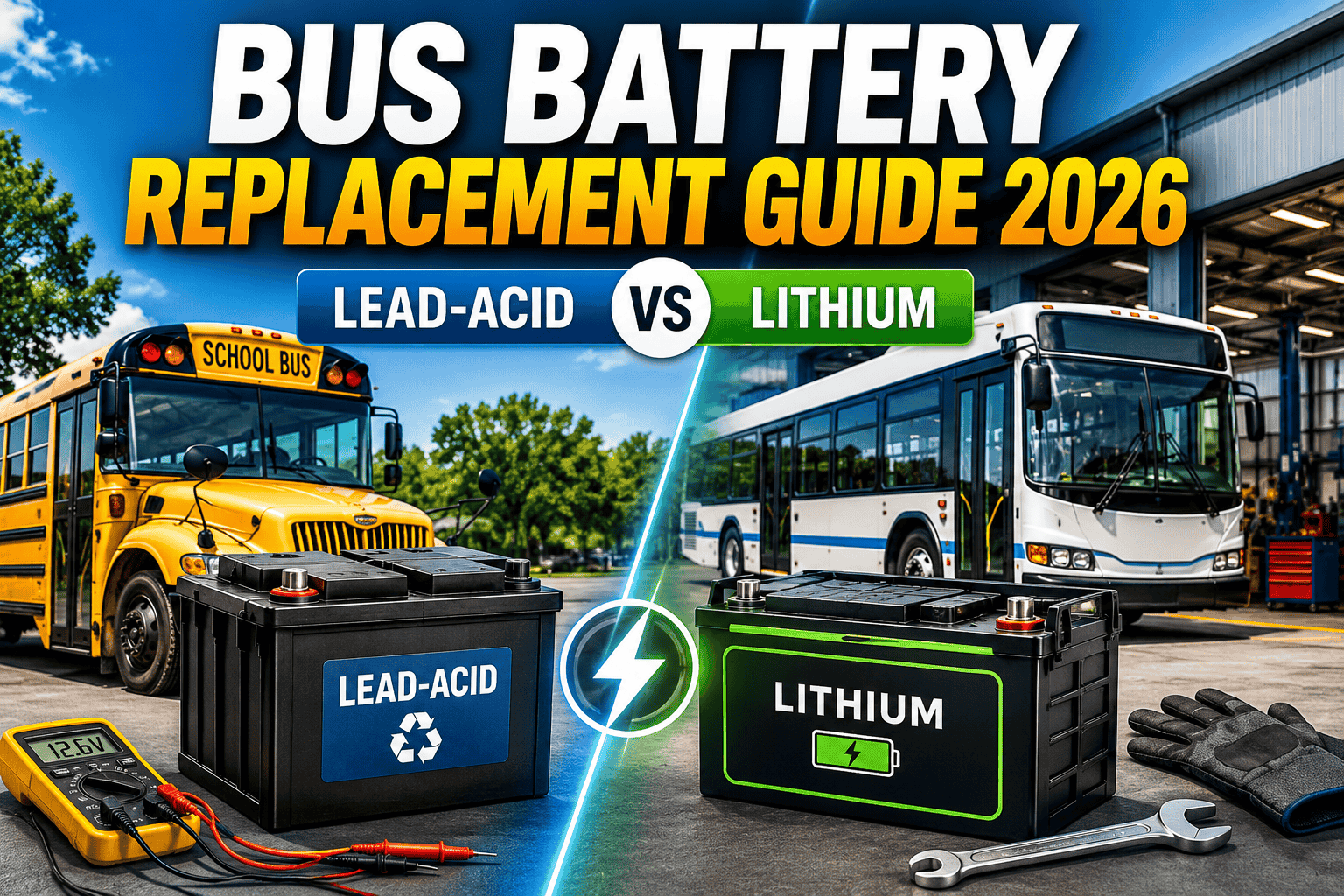
Bus Battery Replacement Guide 2026: Lead-Acid vs Lithium for Bus Fleets
Which battery. When to replace. How to never get surprised by a dead bus on a cold Monday morning again.
01
Three Battery Technologies: Visual Comparison
Flooded Lead-Acid
Budget Pick
$120–$300
Cheapest upfront. Shortest life. Most maintenance. Fine for mild-climate budget fleets.
AGM (Sealed)
Best Value
$200–$500
Best cost-per-year. Zero maintenance. Handles bus vibration. Recommended for most fleets.
Lithium LiFePO4
Premium Pick
$400–$1,500
Longest life. Lightest weight. Highest upfront cost. Best for EV auxiliary and high-cycle fleets.
02
Group 31 vs 8D: Which Configuration for Your Bus
2x Group 31
1,500–2,100 combined CCA · ~130 lbs total
Type C school buses, shuttles, most districts
Always replace both at the same time
1–2x 8D
1,100–1,600 CCA each · 130–160 lbs each
Type D transit, coach, heavy AC loads
Load test annually, replace at 4 years max
Track battery type, group size, and age per bus — book a demo
03
6 Warning Signs Before a Battery Dies
Batteries don't die suddenly — they give warnings for weeks. Catch these early = $150 replacement on your schedule. Miss them = $800 tow at 6 AM:
Early Warning
Slow cranking on cold mornings
Voltage drops below 9.6V during crank. Starts today — won't start on the coldest day.
Early Warning
Dim headlights at idle
Lights brighten with RPM = battery can't hold charge. Alternator is compensating.
Getting Serious
Load test below 80%
Tests "weak" or "marginal." It works today because it's warm. It won't work in December.
Getting Serious
Heavy terminal corrosion
White/green crust = electrolyte leaking through failing seal. Clean, test, likely replace.
Critical
Swollen or bloated case
Overcharging or internal short. Replace immediately — acid leak or rupture risk.
Critical
Age over 4 years (any condition)
Heat and vibration degrade plates invisibly. Replace regardless of test results.
BusCMMS tracks battery install date and every load test result per bus. Age-based alerts fire at your threshold — typically 3 years for flooded, 4 for AGM. When a mechanic logs "weak" at the spring PM, the system flags it for replacement before winter.
Track every battery from install to replacement — sign up free
04
Cold Weather: Why Buses Die in Winter
The Double Hit: Less Power + More Demand
80°F
Starts easily
32°F
Tight margin
0°F
No-start zone
-20°F
Dead bus
At 0°F, the lines cross — battery output drops below engine demand. A battery that tested "good" at 80°F has zero margin at 0°F. The fix: test in October, replace below 80%, schedule fleet-wide with BusCMMS. One PM trigger. Every bus. Every October. Automatically.
A $150 Battery Prevents an $800 Morning. Track Every One.
Battery install date. Load test history. Age-based replacement alerts. Pre-winter PM triggers. Per-bus tracking. No more Monday morning surprises. Free 14-day trial.
AGM for most fleets. Flooded for budget. Lithium for EV auxiliary and high-cycle. Group 31 pairs for school buses. 8D for transit and coach. Test in October. Replace at 4 years or 80% — whichever first. BusCMMS tracks it all per bus, automatically. Zero no-starts all winter.
Zero No-Starts. Zero Tows. Zero Late Routes.
Battery age tracking. Load test logging. Replacement alerts. Pre-winter PM triggers. Per-bus history. One dashboard. Every bus protected. Free 14-day trial.
How often should bus batteries be replaced?
Flooded lead-acid: 3–4 years. AGM: 4–5 years. Replace regardless of test results at those ages. Load test at seasonal PMs — replace immediately below 80% capacity. BusCMMS tracks battery age and generates alerts.
Should I use Group 31 or 8D batteries?
Most Type C school buses: 2x Group 31 in parallel (1,500–2,100 combined CCA). Type D transit/coach: 1–2x 8D (1,100–1,600 CCA each). Always replace paired batteries simultaneously — mismatched batteries kill the new one.
Is AGM worth the extra cost?
Yes for most fleets. Costs 40–100% more upfront but lasts 1–2 years longer, zero maintenance, handles vibration better, 10–15% better cold performance. Over 5 years, AGM costs less per year than flooded when you factor replacement frequency and labor.
Why do bus batteries fail in winter?
Double hit: battery delivers 40–60% CCA at 0°F while the diesel engine needs 2x cranking power. A "good" battery at 80°F fails at 0°F because the margin disappears. Fix: pre-winter testing in October, replace below 80%.
Can BusCMMS track battery replacement schedules?
Yes. Battery install date, type, group size, brand, and every load test result — per bus. Age-based alerts at your threshold. Pre-winter PM triggers for fleet-wide testing. Complete battery history searchable in 30 seconds.