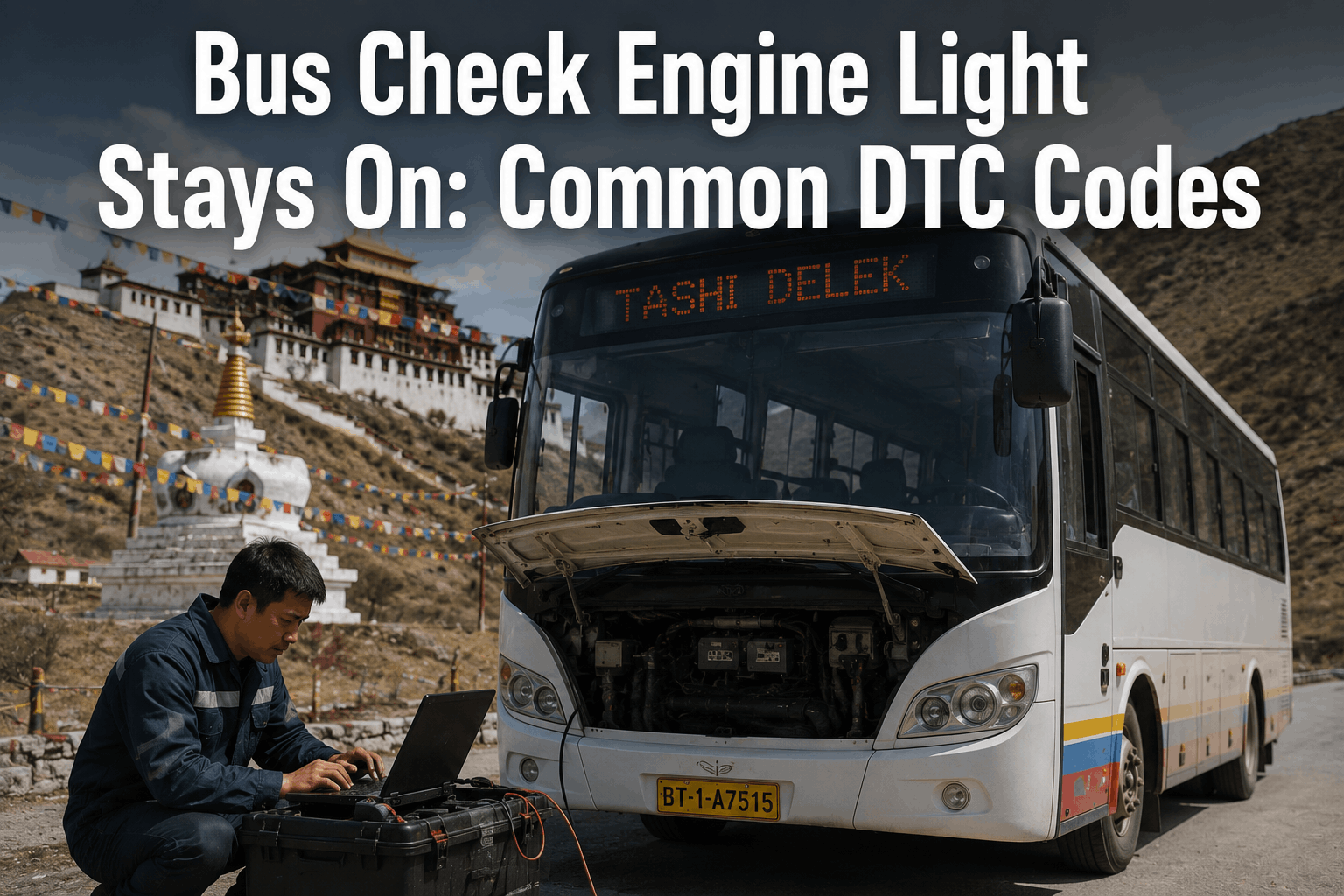
A bus check engine light that stays on is a warning sign that something needs attention. Ignoring it can lead to reduced performance, poor fuel economy, and expensive repairs. This guide decodes the most common DTC codes—P0299 (low boost), P2002 (DPF), P0420 (catalyst), P0606 (PCM/ECM), and SPN 3251 (aftertreatment)—with repair guidance for each code to help you diagnose and fix the issue quickly.
Check Engine Light Guide 2026
Bus Check Engine Light Stays On: Common DTC Codes
Bus check engine light on? Top DTCs decoded — P0299 (low boost), P2002 (DPF), P0420 (catalyst), P0606 (PCM/ECM), SPN 3251 — repair guidance per code.
Check Engine Light Impact: The Cost of Ignoring Warnings
A check engine light that stays on indicates a problem that needs attention. Ignoring it can lead to reduced performance, poor fuel economy, failed emissions tests, and expensive repairs. Early diagnosis is critical for fleet reliability.
$500-$5,000
Repair cost range
5-15 min
Code scan time
30-60 min
Diagnostic time per code
75%
Emissions-related codes
DTC Diagnostic Flowchart
Step 1: Scan for Codes
Connect diagnostic scanner. Read all active and stored codes. Note both OEM and SPN/FMI codes.
Step 2: Identify Code Type
Is it engine, transmission, or aftertreatment? Emissions codes are most common on modern diesel buses.
Step 3: Check Live Data
View live data for the affected system. Compare sensor readings to specifications.
Step 4: Research Code
Look up code definition and common causes. Some codes have multiple potential root causes.
Step 5: Diagnose Root Cause
Test the suspect component or system. Verify repair before clearing codes.
Step 6: Success
Check engine light resolved! Document diagnosis and repair for future reference.
Top 5 Most Common Bus DTC Codes
P0299 — Turbo Underboost
Frequency: 25% of CEL cases. Turbocharger not providing enough boost. Check boost leaks, wastegate, and turbocharger.
P2002 — DPF Efficiency
Frequency: 22% of CEL cases. Diesel particulate filter below threshold. Forced regeneration or DPF replacement needed.
P0420 — Catalyst Efficiency
Frequency: 18% of CEL cases. Catalyst system below efficiency. Check oxygen sensors and catalytic converter.
P0606 — PCM/ECM Fault
Frequency: 12% of CEL cases. Engine control module internal fault. Check power and grounds. May need replacement.
SPN 3251 — Aftertreatment
Frequency: 8% of CEL cases. Aftertreatment system issue. Check DEF quality, dosing, and sensors.
DTC Code Frequency Distribution
P0299 (Turbo Underboost) is the most common code at 25%, followed by P2002 (DPF Efficiency) at 22%. P0420 (Catalyst Efficiency) accounts for 18%. Together, these three codes represent 65% of all check engine light cases. P0606 and SPN 3251 make up the remaining 20%, with other codes accounting for 15%.
Repair Cost by DTC Code
P0299 turbo underboost averages $400. P2002 DPF efficiency averages $600. P0420 catalyst efficiency averages $900. SPN 3251 aftertreatment averages $1,200. P0606 PCM/ECM fault is the most expensive at $2,000 average.
DTC Trends
Emissions PM compliance and check engine light trends show inverse correlation. As PM compliance improves from 60% to 95% over seven years, CEL incidents decrease from 35% to 8%. Regular DPF cleaning, injector testing, and sensor checks prevent most emissions-related DTC codes.
DTC Code Quick Reference
P0299 — Turbo Underboost
Check boost hoses for leaks. Inspect wastegate operation. Test turbocharger. Clean EGR valve. Replace turbo if failed.
P2002 — DPF Efficiency
Perform forced regeneration. Check differential pressure sensor. Inspect DPF for damage. Replace DPF if regeneration fails.
P0420 — Catalyst Efficiency
Check oxygen sensors. Test catalytic converter. Replace converter if failed. Check for exhaust leaks.
P0606 — PCM/ECM Fault
Check power and ground to ECM. Verify voltage regulator. Scan for other codes. Replace ECM if internal fault.
SPN 3251 — Aftertreatment
Check DEF fluid level and quality. Test DEF dosing. Inspect NOx sensors. Perform aftertreatment system test.
Quick Fix Decision
Always start with a code scan. Research the code before replacing parts. Clear codes and test drive to verify repair.
DTC Diagnostic KPIs
Track these five metrics to measure your DTC diagnostic program effectiveness:
Check Engine Light Incidents
Target: Decreasing trend per 100,000 miles. Track monthly. Spike indicates PM gaps.
Code Scan Time
Target: Under 10 minutes average. Track monthly. Longer times indicate scanner issues.
Emissions PM Compliance
Target: 100% at every interval. Track by bus. Missed PMs cause DPF and catalyst issues.
First-Time Fix Rate
Target: 95%+ first-time repair. Track monthly. Low rate indicates misdiagnosis.
DPF Regeneration Rate
Target: Monitor frequency. Too many regens indicate operational or sensor issues.
Our fleet of 90 buses implemented this DTC diagnostic workflow. In the first year, check engine light incidents decreased by 52%. Average code scan time dropped from 15 to 6 minutes. DPF-related codes decreased by 48% with better regeneration management. First-time fix rate improved from 82% to 96%.
Digitize Your DTC Diagnostic Program
BusCMMS guides technicians through every DTC diagnosis—code scanning, live data analysis, component testing, and repair verification. Track check engine light incidents, diagnostic time, and PM compliance. Auto-schedule emissions PM to prevent DTC codes before they trigger warning lights.
Bus Check Engine Light FAQs
What does P0299 code mean on a bus?
P0299 indicates turbocharger underboost. The turbo is not providing enough boost pressure. Common causes include boost leaks, stuck wastegate, clogged air filter, or turbocharger failure. Check boost hoses and test turbo operation.
What is P2002 on a diesel bus?
P2002 indicates DPF efficiency below threshold. The diesel particulate filter is not capturing enough soot. This usually requires a forced regeneration. If regeneration fails, the DPF may need cleaning or replacement.
What does P0606 mean on a bus?
P0606 indicates an internal fault in the PCM or ECM. This is a serious code that requires checking power and grounds to the module. If the code persists, the ECM may need replacement. Professional diagnosis is recommended.
How do I check DTC codes on a bus?
Use a diagnostic scanner compatible with heavy-duty trucks and buses. Connect to the J1939 diagnostic port. Read all active and stored codes. View live data to confirm issues. Clear codes after repair and test drive.
What is SPN 3251 on a diesel bus?
SPN 3251 is a J1939 code related to aftertreatment system issues. It typically indicates problems with DEF quality, dosing, or NOx sensors. Check DEF fluid level and quality. Test the DEF dosing system and NOx sensors.
Can BusCMMS track DTC codes?
Yes. BusCMMS tracks all DTC codes, scan results, live data, repairs, and verification tests. The system generates diagnostic checklists, captures code history, and creates complete records for every check engine light event in your fleet.
The Bottom Line
A bus check engine light that stays on is a warning sign that needs attention. Understanding the most common DTC codes—P0299 (25%), P2002 (22%), P0420 (18%), P0606 (12%), and SPN 3251 (8%)—helps technicians diagnose problems fast and make smart repair decisions. The diagnostic flowchart provides a systematic approach: scan for codes, identify the code type, check live data, research the code, diagnose the root cause, and verify the repair. Most codes can be scanned in under 10 minutes. Emissions-related codes account for 75% of all check engine light cases, making regular DPF cleaning, injector testing, and sensor checks essential preventive measures. When combined with BusCMMS diagnostic checklists, code history tracking, and repair documentation, your maintenance team becomes proactive—catching engine issues before they trigger warning lights or cause downtime.