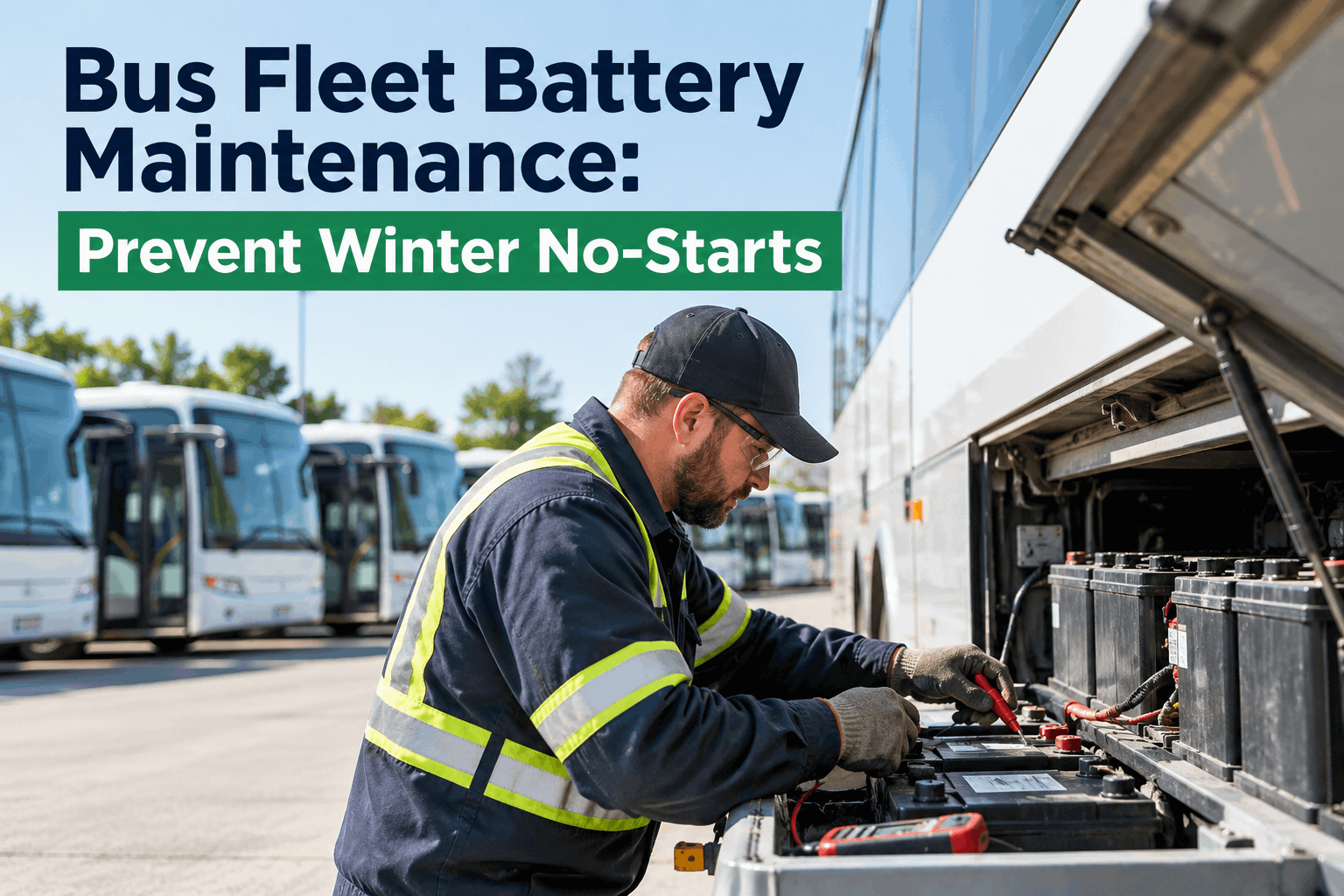
It's 6 a.m., 4 degrees out, and the first three buses just click when the drivers turn the key — batteries that all passed a glance in October. That's bus fleet battery maintenance in a nutshell: a battery that cranks fine in fall gives up at the first hard freeze, when cold robs its power just as the engine needs more. You can see how BusCMMS schedules battery testing before the cold in a demo.
Bus Fleet Battery Maintenance: Prevent Winter No-Starts
A no-start isn't bad luck — it's physics. As the temperature drops, the power a battery can deliver falls while the power the engine needs to crank rises. Where those two lines cross is a bus that won't start. Here's that crossover, and why fall testing is the fix.
Illustrative. A battery can lose a big share of its cranking power near 0F while the engine needs much more to turn over cold oil. A weak battery that's fine in fall lands in the no-start zone the first freezing morning.
Why Batteries Pass in Fall and Fail in Winter
The frustrating part of a no-start is that the battery seemed fine a month ago. It was — at 55 degrees. Cold changes the math in three ways at once, which is why a battery that's merely weak sails through autumn and then quits the first hard freeze.
Cold saps the battery
Low temperatures thicken the electrolyte and raise internal resistance, so a battery can deliver only a fraction of its rated cranking power near zero. The reserve that covered a tired cell in fall is simply gone.
Cold oil fights the starter
Engine oil thickens as it gets colder, so the starter has to work harder to turn the engine over. Demand goes up at the exact moment supply goes down — the worst possible timing.
Age shows up under load
An older battery holds a surface charge that reads fine on a voltmeter but collapses under a real crank. Only a load test in the cold reveals it — and by then it may be a no-start.
A voltmeter reading of 12.6 volts means almost nothing about whether a bus will crank at 4 degrees. The only honest test is a load test — and the time to run it is fall, not the first freezing morning.
The Battery Health Checks That Actually Predict a No-Start
You don't need a lab — you need the right five checks run consistently per bus, and the judgment to read them together. Here's what to measure, what it tells you, and the action each result calls for.
Swipe sideways to see all columns
The load test is the one that matters most — voltage can lie, but a battery either holds under load or it doesn't. Run these in the fall window and the weak units declare themselves while you still have time to swap them on your schedule. You can sign up free and log every battery test per bus today.
Reading the Load Test: Keep, Watch, or Replace
A load test gives you cranking capacity as a share of the battery's rating. That one number, read against three zones, tells you exactly what to do with each battery before the cold arrives.
Illustrative. A battery testing at 62% cranks fine today but sits in the danger band — it's the unit that no-starts on the first freeze. Caught in fall, it's a planned swap, not a crisis.
The amber band is where no-starts hide: those batteries work in mild weather, so nobody replaces them — then the cold finds them. Flagging the amber units in fall is the entire difference between a planned swap and a stranded route. You can sign up free and start flagging those amber batteries now.
Your Pre-Winter Battery Readiness Checklist
Run every bus against this list before the first freeze. Each "no" is a bus that could be clicking in the cold on a December morning — and each is a cheap fall task next to a stranded route.
- Every battery is load-tested before winterA real cranking test, not a voltmeter glance, is scheduled per bus in the fall window — so weak units surface early.
- Battery age and install date are trackedYou know each battery's age per bus, so units near end of life get replaced proactively instead of failing in service.
- Terminals are cleaned and connections checkedCorrosion and loose cables that choke cranking current are caught and fixed before they cause a cold-morning failure.
- A failed test becomes a replacement work orderA battery below threshold opens a tracked job automatically, so the swap is scheduled, not left as a note that gets lost.
- Replacement batteries are stocked ahead of the coldThe right batteries are on the shelf before winter, so a failed test doesn't mean waiting on a shipment in a cold snap.
- You can see which buses are at riskA dashboard shows battery test status and age across the fleet, so you know you're winter-ready before the first freeze.
Six checks, one dashboard. If most are "no," the cold-morning scramble isn't bad luck — it's testing that never happened before the freeze, and that's a scheduling fix. You can see fall battery scheduling run in a demo.
How BusCMMS Keeps Your Fleet Starting All Winter
Preventing no-starts is a testing-and-tracking problem: get the load tests done before the cold, know every battery's age, and act on the weak ones. That's exactly what a bus-built CMMS turns from a clipboard chore into a routine.
Fall testing scheduled per bus
Battery load testing is triggered ahead of winter on each unit's PM schedule, so the whole fleet gets checked in the fall window instead of after the first failure.
Battery age and history tracked
Install dates and test results live with each bus, so lifecycle and risk are visible — and end-of-life batteries get replaced on plan, not in a panic.
Failed tests become work orders
A battery below threshold opens a replacement job on a tech's list, with the part checked against stock, so the swap happens before the cold tests it.
BusCMMS reports its fleets holding 95%-plus availability — including through the coldest mornings, by catching weak batteries in the fall. You can bring your fleet's winter prep to a demo and see the plan.
From the Shop Floor
Key Takeaways on Bus Fleet Battery Maintenance
Winter no-starts aren't random — they're weak batteries meeting cold physics on a predictable schedule. Four things to carry into fall.
Cold is the trigger, not the cause
Power drops as demand rises. A weak battery was always going to fail.
Load-test, don't voltmeter
Voltage can read fine on a battery that won't crank cold. Test under load.
Watch the amber band
Batteries in the 50-75% zone are the ones that no-start first. Swap them.
Do it in fall, on your schedule
Test, track age, stock parts before the freeze — not during it.
Treat bus fleet battery maintenance as a fall deadline, not a winter emergency. Load-test every battery, track its age per bus, flag the amber units, and keep replacements on the shelf — and the cold mornings that used to mean a row of clicking buses become just another day the fleet rolls out on time. The freeze is coming on schedule; your no-starts don't have to.