An auditor points at one driver's name and asks for the file. You have a few minutes to produce a complete CDL driver qualification file — and if one document is missing or expired, that is a finding. Getting the driver qualification file right is quiet work until the day it is not. You can book a demo to see how driver credentials and records stay audit-ready alongside the rest of your fleet compliance.
BUS FLEET COMPLIANCE · DRIVER QUALIFICATION FILE
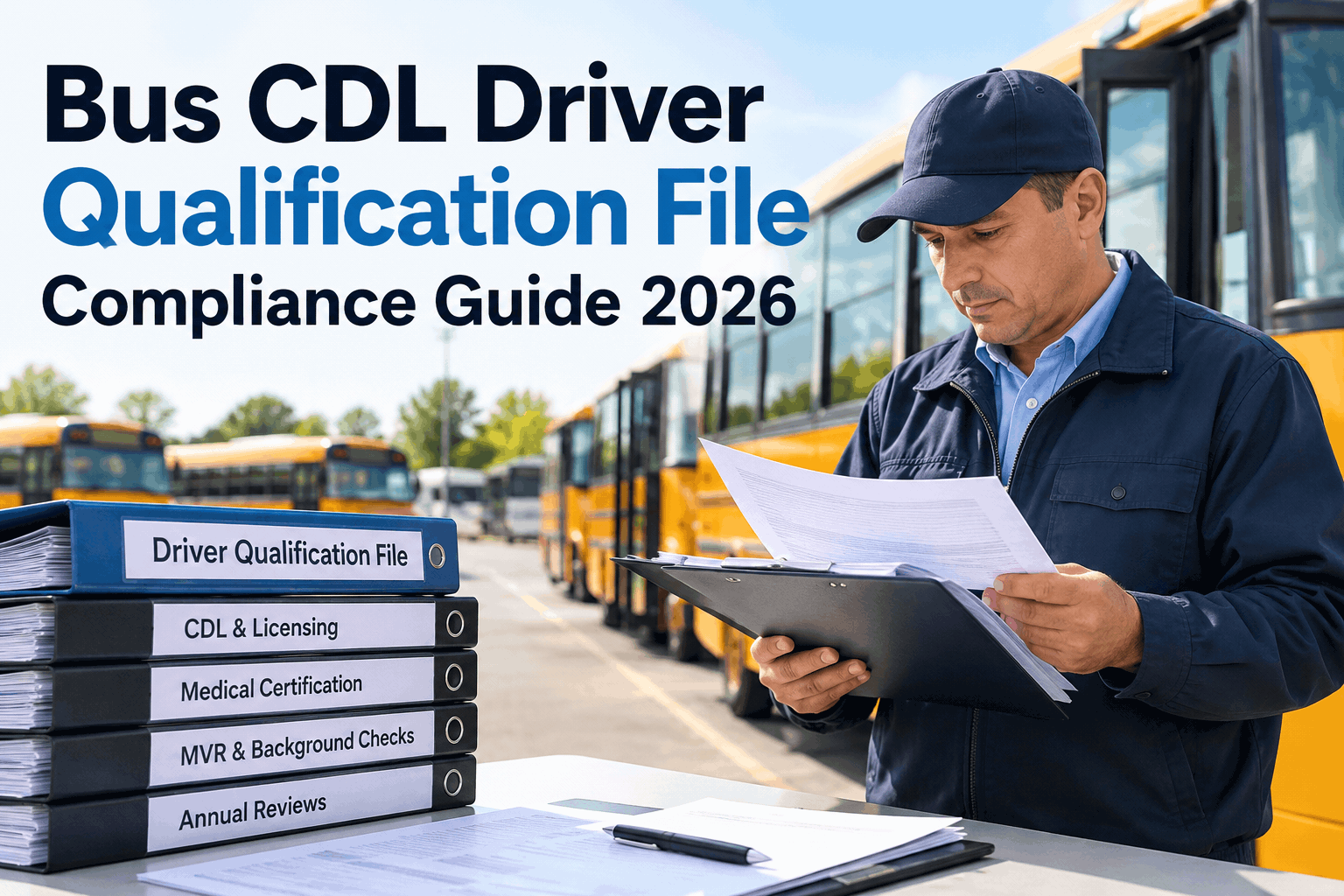
Bus CDL Driver Qualification File Compliance Guide 2026
Every CDL bus driver needs a complete driver qualification file under FMCSA Part 391. Here is exactly what belongs in it, how long you keep each piece, and how to keep the expiring items from becoming an audit finding.
391.51The FMCSA rule that defines what a qualification file must contain
+3 yrsKeep the file for 3 years after the driver leaves the fleet
12 moThe MVR and review are refreshed every year, like clockwork
Why the CDL Driver Qualification File Is the First Thing an Auditor Opens
In an FMCSA audit, driver files are low-hanging fruit. The documents are either there and current or they are not, and a reviewer can check that in minutes, which is why they tend to get looked at first. For a bus fleet carrying passengers, an incomplete qualification file is not a paperwork quibble — it is a direct safety-and-compliance finding, and the agency weighs driver qualification heavily when there are people on board. The hard part is not understanding the rule; it is staying complete across every driver, every month, without anything slipping. Three things make these files quietly dangerous.
Missing a single document is a finding
The file is pass or fail by document. One absent MVR, a missing road-test certificate, or no National Registry note counts against you the same as if nothing were there.
Parts of it expire on their own
The medical card and the annual MVR and review have dates. A file that was perfect last year fails the day a medical certificate lapses and no one caught it.
You keep it long after they leave
The file does not close when a driver quits. You hold it for three years after they leave, so a file you forget about is still a file you can be audited on.
The whole game is complete and current, for every driver, all the time — which is impossible to do from memory and easy to do when the expiring pieces are tracked.
How Long You Keep a Driver Qualification File
Retention trips up as many fleets as the contents do. The file lives through the driver's whole employment and does not close when they leave — it has a three-year tail afterward, and individual dated documents inside it roll off on their own schedule. Treating a resignation as the moment to shred the file is one of the most common and avoidable mistakes in driver-file compliance. You can book a demo to see how records stay organized through that whole lifecycle. Here is the lifecycle, start to finish.
The practical read: open the file right, add the annual MVR and review every twelve months, and do not purge the file early when someone resigns. You can create a free account to keep the expiry and review dates visible so none of the recurring items slip.
The Driver Qualification File Items That Actually Expire
Most of a qualification file is set-once paperwork — the application, the road test, the hiring MVR — filed once and never touched again. The findings almost always come from the three items with a clock on them, because those are the ones that can quietly go stale while the rest of the file looks perfect. A driver who was fully qualified in January can be out of compliance in July without a single document being lost, simply because a renewal date passed. These are what a tracking system earns its keep on. You can start a free account and put the expiry dates somewhere they cannot be forgotten.
Where BusCMMS Fits Your CDL Driver File Compliance
BusCMMS is a bus maintenance system, so it does not replace a full document-management binder for every DQF page, and it is worth being clear about that. What it owns is the part that actually fails audits — the expiring credentials and the maintenance records an FMCSA review examines in the same visit. Think of it as covering the moving parts of compliance while your recordkeeping holds the static documents. Four things it does well.
CDL and medical expiry tracking
Each driver's CDL, endorsements, and medical certificate dates tracked with alerts before they lapse — the items that fail audits.
Annual review reminders
The 12-month MVR inquiry and review surfaced on schedule, so the recurring items are done on time, not rediscovered during an audit.
Maintenance records beside it
The DVIR, PM, and repair history an audit checks in the same visit, kept audit-ready so the whole compliance picture is one place.
Pull it fast when asked
When a reviewer names a driver or a bus, the credential status and maintenance record come up in moments, not a filing-cabinet dig.
95%+Fleet availability BusCMMS reports for fleets on scheduled PM
25-35%Maintenance cost reduction BusCMMS reports within 12 months
2-4 wksTypical BusCMMS rollout, not months of setup
Figures above are reported by BusCMMS from its own customer data, not independent third-party research. BusCMMS tracks credential expiry and maintenance records; it is not a substitute for complete DQF recordkeeping.
A Safety Manager's Take
Key Takeaways on CDL Driver Qualification File Compliance
The driver qualification file comes down to knowing what goes in it, keeping the dated items current, and holding it as long as the rule says.
01
Know the required contents
Application, MVRs, road test, annual review, medical certificate, and registry note.
02
Watch the dated items
The medical card and annual MVR and review are what actually fail audits.
03
Keep it three years after
The file does not close when a driver leaves — retain it for three years.
04
Track, do not remember
Alerts on expiry dates turn an audit scramble into a routine status check.
Keep every file complete and the expiring pieces current, and a driver-file audit becomes a non-event. For how the maintenance side of compliance works beside it, our complete guide to what a bus CMMS does walks through the whole system.
FAQ
CDL Driver Qualification File: Common Questions
What documents are required in a CDL driver qualification file?+
Under 49 CFR 391.51, a driver qualification file must contain the driver's employment application; the motor vehicle record obtained from each licensing state at the time of hire; documentation of the road test (the road test certificate, a copy of the license accepted in place of a road test, or the written statement for exempt drivers); the annual motor vehicle record inquiry; the annual review note on the driving record; the medical examiner's certificate or a legible copy, along with the medical certification status from the CDLIS record for CDL holders; a Skill Performance Evaluation certificate or federal medical exemption document where one applies; and the note verifying the medical examiner is listed on the National Registry. In short: application, MVRs, road test, annual MVR and review, medical certificate, registry verification, and any SPE or exemption. Always confirm the current requirements for your operation with your compliance advisor.
How long must a bus fleet keep a driver qualification file?+
The file is kept for the entire time the driver is employed by the carrier and for three years after the driver leaves. That three-year tail is where fleets slip, because it is easy to assume a file can be discarded when someone resigns. Within the file, certain recurring items can be removed three years after their own execution date — the annual MVRs, the annual review notes, the medical examiner's certificates and any CDLIS record obtained for medical status, medical variances, the SPE certificate or exemption letter, and the National Registry verification note. So the file as a whole has a three-years-after-departure retention, while individual dated documents inside it roll off three years after they were created. The safe practice is to retain the full file through employment plus three years and not purge it early.
How often does the annual MVR and driving record review happen?+
At least once every 12 months. Under Part 391, the carrier must obtain a motor vehicle record for each driver from the licensing authority and review that driving record at least annually to determine whether the driver still meets the qualification standards. A dated note of that review goes in the qualification file. The common failure is simple drift: a review done in, say, March one year quietly slips to April or May the next, and now there is a gap longer than twelve months that an auditor can flag. Because it is a recurring, date-driven task across every driver, it is exactly the kind of thing that benefits from a reminder system rather than a calendar note someone has to remember to check. Confirm the specific review requirements for your operation with your compliance advisor.
What happens if a driver qualification file is incomplete during an audit?+
An incomplete or out-of-date qualification file is a violation, and because driver files are quick for an auditor to check, they are a common source of findings in an FMCSA review. A missing required document — no hiring MVR, no road test certificate, no National Registry verification — counts against the carrier, as does an expired medical certificate or an annual review that has drifted past twelve months. Depending on the scope and pattern of the problems, findings can affect a carrier's safety rating and lead to corrective action. For a passenger carrier the stakes are higher because the agency weighs driver qualification heavily when people are on board. The practical defense is to keep every file complete and the dated items current all the time, rather than trying to fix gaps in the window before a review. This is general guidance, not legal advice; confirm specifics with your compliance advisor.
Does BusCMMS manage driver qualification files?+
BusCMMS is a bus maintenance management system, so it is not a full document-management product for storing and versioning every page of a DQF. What it does own is the part of driver compliance that actually fails audits: the expiring credentials. It tracks each driver's CDL, endorsements, and medical examiner's certificate with alerts before they lapse, and it surfaces the annual MVR and review on schedule so the recurring items are not forgotten. Alongside that, it keeps the maintenance, DVIR, and PM-compliance records that an FMCSA review examines in the same visit, so the driver-credential side and the vehicle side of your compliance are visible in one place and quick to pull. The honest framing: use proper DQF recordkeeping for the complete file, and use BusCMMS to make sure the dated credentials never lapse and the maintenance records are always audit-ready. To see it mapped to your fleet, book a demo.