Bus Driver Hours of Service Rules 2026 | BusCMMS Guide
Here is the mistake that gets bus operators in trouble: assuming the driving limits are the same as a truck's. They are not. Bus driver hours of service rules run on their own numbers — 10 hours driving, a 15-hour window, 8 hours off — and getting them wrong is how a driver gets pulled or a carrier fails an audit. You can book a demo to see how the maintenance side of compliance is tracked alongside the hours your drivers run.
BUS FLEET COMPLIANCE · HOURS OF SERVICE
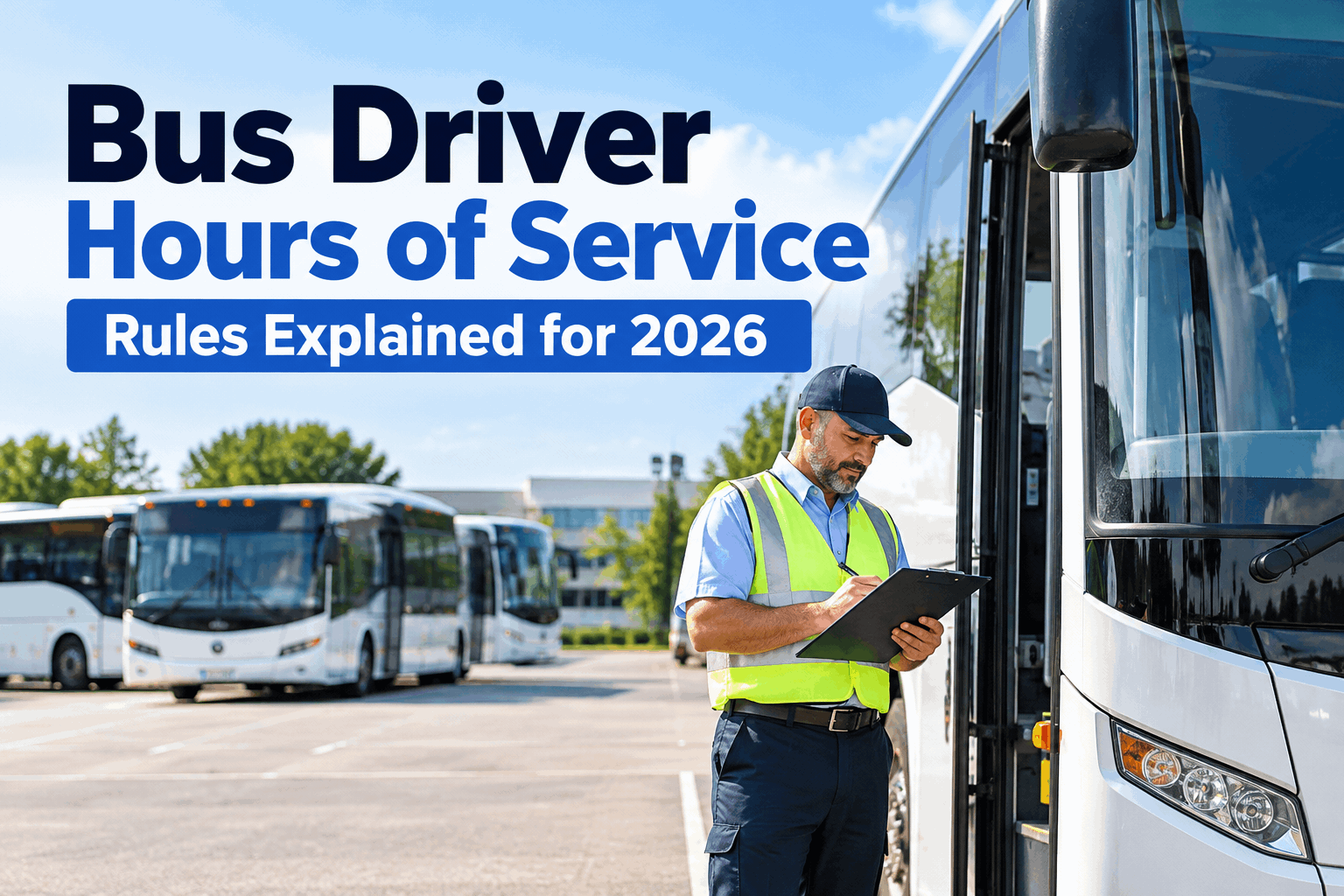
Bus Driver Hours of Service Rules Explained for 2026
Passenger-carrying drivers follow their own hours-of-service rules under 49 CFR 395.5 — different limits than trucks, with their own exemptions. Here is the duty day laid out plainly, how it differs from property carriers, and where the records that back it up fit your fleet.
10 / 15 / 8Driving hours / on-duty window / off-duty reset, for bus drivers
60 / 70Weekly on-duty limit over 7 or 8 consecutive days
395.5The FMCSA rule that sets passenger-carrier hours of service
The Four Core Bus Driver Hours of Service Limits
Under 49 CFR 395.5, a passenger-carrying driver works inside four limits. Three govern the daily shift and one governs the week. Learn these four and you understand the backbone of bus driver hours of service. The point of the rules is fatigue: a tired driver with a full bus is the risk the limits are built to prevent, which is why the hours are enforced strictly and why an inspector can place a driver out of service on the spot for a violation.
10
Hour driving limit
A driver may drive a maximum of 10 hours after 8 consecutive hours off duty. The 11th hour is off limits until the clock resets.
15
Hour on-duty window
A driver cannot drive after being on duty 15 hours following 8 off. Unlike a truck's window, off-duty breaks do not pause this clock.
8
Hour off-duty reset
Eight consecutive hours off duty resets both the 10-hour and 15-hour limits. A meal stop only counts if the driver is fully relieved of the vehicle.
60/70
Hour weekly limit
No driving after 60 on-duty hours in 7 days (carriers not running daily) or 70 in 8 days (carriers running every day).
The limits can be extended by up to 2 hours in adverse driving conditions, but the four numbers above are the ones every bus dispatcher and driver should know cold.
Bus Driver HOS Rules Are Not Truck Rules
This is where operators who came from trucking get caught. Passenger-carrying and property-carrying drivers follow different hours-of-service limits, and the differences are not small. A dispatcher who schedules a coach driver on an eleven-hour driving plan, or who assumes a break pauses the clock the way it can for a truck, has just built a violation into the day without meaning to. Here they are side by side so the gaps are clear.
The weekly 60/70-hour limit is the same for both, but the daily rules differ at every line — and the one that trips people most is that a bus driver's 15-hour window keeps running even during breaks, so a long layover between runs still eats into the day. A driver who takes a four-hour break mid-shift does not get those four hours back; the window closes 15 hours after it opened, period. You can create a free account to keep your maintenance and inspection records audit-ready next to it.
Hours of Service Exemptions Every Bus Operator Should Know
The limits are not the whole story. Two provisions change how the hours work in practice — the short-haul exception that frees many local operations from full logging, and the sleeper-berth split for drivers on long runs. Neither one lets a driver work longer than the underlying limits; they change the paperwork and the flexibility, not the fatigue math. You can book a demo to see how your inspection records stay organized whichever way your drivers log.
Most charter and motorcoach runs still log with an ELD, while many fixed-route transit and local school operations fall under the short-haul exception and keep simple time records instead. The short-haul call hinges on the details — the air-mile radius measured from the reporting location, and the return inside 14 hours — so a route that usually qualifies can lose the exception on a day it runs long or far. Either way, confirm which applies to your operation with your compliance advisor; this is general guidance, not legal advice. You can book a demo to see how the records side fits your fleet.
Where Hours of Service Meets Your Maintenance Records
An FMCSA compliance review looks at more than driver logs. It looks at whether your buses were inspected and maintained, and whether you can prove it. BusCMMS does not track driver hours — that is what an ELD is for — but it owns the maintenance half of the same audit, and the two sit naturally together. You can start a free account and have the inspection and PM records ready before a review is ever scheduled.
Driver DVIRs, logged
Pre- and post-trip inspection reports time-stamped against the bus and the driver — the record that pairs with the hours they drove.
CDL and certification tracking
Each driver's CDL and endorsement expiry tracked, so a license lapse never puts an unqualified driver behind the wheel.
PM on schedule, proven
Preventive maintenance scheduled and recorded, so the inspection and service history is complete when a review asks for it.
Audit-ready in minutes
Pull the full maintenance, DVIR, and PM-compliance record for any bus on demand, instead of digging through a filing cabinet.
95%+Fleet availability BusCMMS reports for fleets on scheduled PM
25-35%Maintenance cost reduction BusCMMS reports within 12 months
2-4 wksTypical BusCMMS rollout, not months of setup
Figures above are reported by BusCMMS from its own customer data, not independent third-party research. BusCMMS is a maintenance system and does not record driver hours of service.
A Fleet Compliance Manager's Take
Key Takeaways on Bus Driver Hours of Service
Bus driver hours of service comes down to four numbers and one honest reminder that the records around them matter just as much.
Different numbers at every line, and no required 30-minute break.
03
The window never pauses
Off-duty breaks do not stop the 15-hour on-duty clock from running.
04
Records are the other half
An audit checks maintenance and inspection records alongside the hours.
Get the hours right with your ELD and keep the maintenance side audit-ready, and an FMCSA review stops being a fire drill. For how the maintenance half works, our complete guide to what a bus CMMS does walks through the whole system.
FAQ
Bus Driver Hours of Service: Common Questions
What are the hours of service rules for bus drivers?+
Passenger-carrying commercial drivers follow the hours-of-service rules in 49 CFR 395.5. The core limits are: a driver may drive a maximum of 10 hours after 8 consecutive hours off duty; a driver may not drive after being on duty 15 hours following those 8 hours off; and 8 consecutive hours off duty resets both the 10-hour and 15-hour limits. On the weekly side, a driver may not drive after 60 on-duty hours in 7 consecutive days if the carrier does not operate every day, or 70 hours in 8 consecutive days if it does. The 10-hour and 15-hour limits can be extended by up to 2 hours in adverse driving conditions. These apply to charter, motorcoach, and other for-hire passenger operations; always confirm how they apply to your specific operation with a compliance advisor.
How do bus HOS rules differ from truck driver rules?+
The numbers are different at nearly every line. Passenger-carrying (bus) drivers get a 10-hour driving limit, a 15-hour on-duty window, and reset on 8 consecutive hours off duty, with no federally required 30-minute driving break. Property-carrying (truck) drivers get an 11-hour driving limit, a 14-hour window, reset on 10 consecutive hours off, and a required 30-minute break after 8 cumulative hours of driving. One subtle but important difference: a truck's 14-hour window is a straight clock from coming on duty, and a bus's 15-hour window is counted from on-duty time in a way that off-duty breaks do not pause either one. The weekly 60/70-hour limit is the same for both. Operators who move drivers over from trucking have to retrain these differences, because assuming the truck numbers apply to a bus is a common and costly mistake.
Is there a short-haul exemption for bus drivers?+
Yes. The short-haul exception applies to passenger carriers as well as property carriers. A driver who operates within a 150 air-mile radius of the normal work reporting location and returns to that location within 14 consecutive hours can be exempt from the electronic logging device and record-of-duty-status requirements, keeping simpler time records instead. This is why many fixed-route transit operations and local school bus routes do not run full ELD logs, while charter and motorcoach operations that travel farther typically do. The driver still has to stay within the underlying driving and on-duty limits; the exception changes the paperwork, not the hours themselves. Confirm whether your operation qualifies with your compliance advisor, because the details of the reporting location and the 14-hour return matter.
Do school bus and transit drivers follow the same HOS rules?+
The federal passenger-carrying hours-of-service rules in 49 CFR 395.5 apply to commercial passenger operations, but how they land depends on the operation. Many school bus and fixed-route transit drivers operate locally and qualify for the short-haul exception, so they stay within the driving and duty limits but keep time records rather than full ELD logs. Some school transportation also operates under state rules or specific exemptions layered on top of the federal framework. Charter, motorcoach, and longer-distance passenger operations are more likely to run full logs. Because the picture varies by operation type, distance, and state, the safe approach is to treat the 395.5 limits as the baseline and confirm the exact logging and exemption rules for your fleet with a compliance advisor rather than assuming one answer fits every bus.
Does BusCMMS track driver hours of service?+
No. Driver hours of service are tracked with an electronic logging device, which is a separate category of product. BusCMMS is a maintenance management system, so it owns the other half of an FMCSA compliance picture: the maintenance and inspection records. It keeps driver pre- and post-trip DVIRs time-stamped against each bus, tracks CDL and endorsement expiry so an unqualified driver is not assigned, schedules and records preventive maintenance so the service history is complete, and lets you pull the full maintenance and inspection record for any bus in minutes when a review asks for it. The honest way to think about it: your ELD proves the hours were legal, and BusCMMS proves the buses were inspected and maintained. A compliance review wants both, and BusCMMS is built for the maintenance side. To see it mapped to your fleet, book a demo.