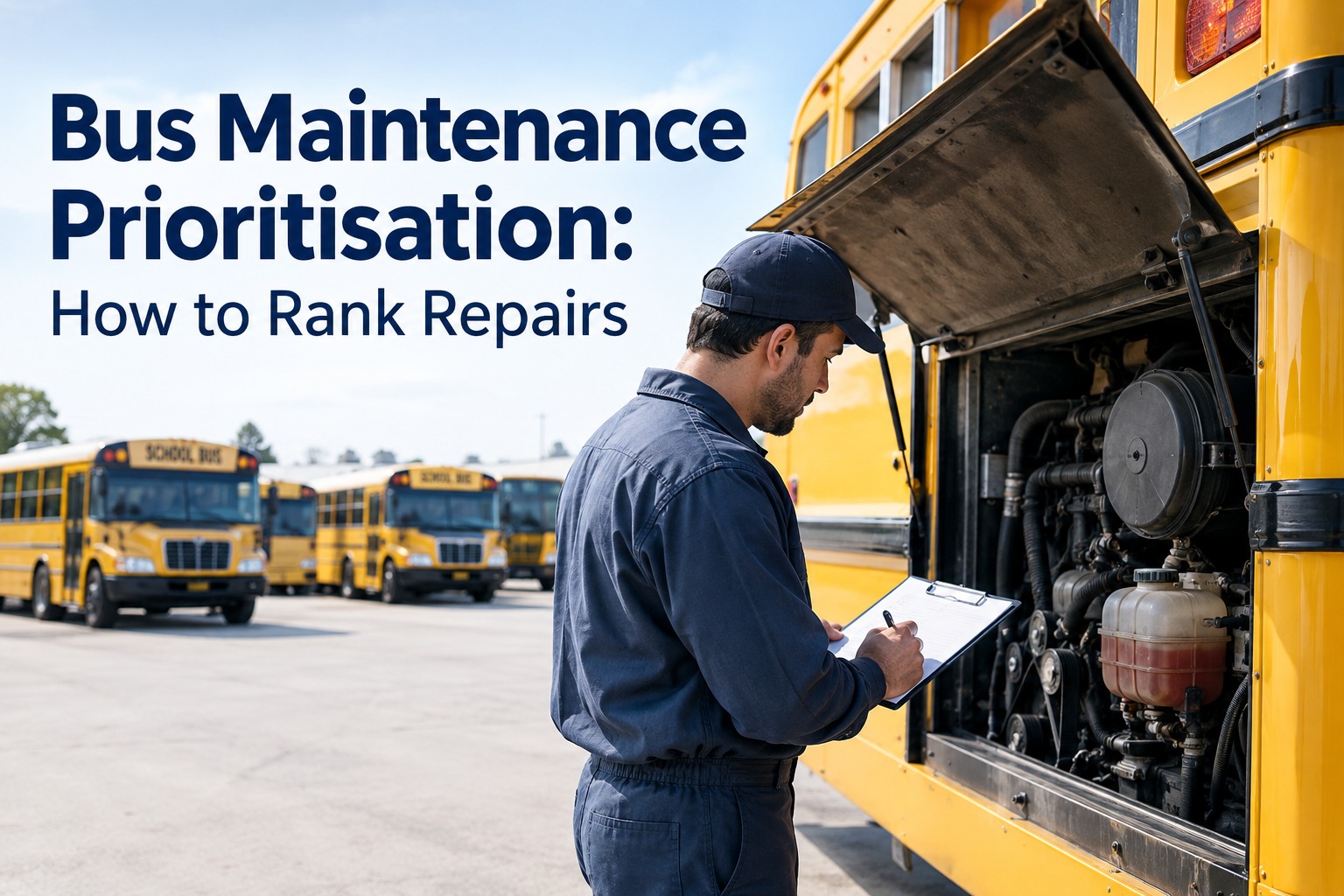
Your shop manager takes three calls in one hour: a soft brake pedal, a bus dispatch needs back for the afternoon, and a PM three weeks overdue. Each sounds urgent, and without a system the one who calls last usually wins. Bus maintenance prioritisation replaces that scramble with a scoring model, so the same defect gets the same rank no matter which technician is on shift or how loudly the request comes in.
Bus Maintenance Prioritisation: How to Rank Repairs by Real Risk
A repeatable scoring model so your team knows what must be fixed now, what can wait, and why -- with the decision on the record.
- P1Safety — fix now, out of service
- P2Compliance / imminent failure
- P3Scheduled PM — on interval
- P4Minor / defer with a record
Same defect, same rank — every shift
Why the Loudest Problem Gets Fixed First
With no formal way to rank work, the queue fills in the order requests arrive -- shaped by who follows up hardest. A driver who calls twice jumps ahead of a defect that is quietly more dangerous. Urgency and importance are not the same thing, and without a system they get confused.
The cost of that confusion is predictable. PM work gets pushed because nothing is on fire yet, then comes back as a road call that costs more and grounds the bus longer. Meanwhile 20% of buses typically generate 80% of unplanned downtime -- and without prioritisation, the shop never gets ahead of those units.
A scoring model fixes this by removing the guesswork. When safety, compliance, and downtime are scored the same way every time, the queue holds its shape across shifts instead of changing with whoever is managing it that day. That consistency is the whole point of bus maintenance prioritisation -- and you can see how BusCMMS builds it into the work-order queue in a demo.
The Four Things That Set a Repair's Priority
Every repair gets ranked on the same four questions. Score them consistently and the priority almost sets itself -- the judgment moves out of the moment and into the model.
Safety Risk
Could this defect endanger passengers or the driver? This factor always wins -- it can pull any repair straight to the top.
Compliance Exposure
Does leaving it unfixed create a DVIR gap or DOT violation? Regulatory risk pushes a repair up fast.
Downtime Impact
Does the bus have a route today, and is a spare available? A unit on a primary route outranks one with slack.
Failure Probability
How likely and how soon will it fail? A worsening trend or overdue PM raises the odds -- and the priority.
The order matters. Safety and compliance are non-negotiable gates -- they can force a repair to the top on their own. Downtime and failure probability are the tie-breakers that rank everything left over. Get this hierarchy wrong and you optimise for the wrong thing -- fixing what is convenient instead of what is critical. Our preventive maintenance program guide covers how failure-history data feeds that fourth factor.
The P1-P4 Priority Tiers, Defined
Four factors collapse into four tiers. Every work order lands in exactly one, and each tier carries its own response time and rule. This is the backbone of the whole system -- simple enough that any technician can apply it the same way.
- P1Critical — Fix Now
Safety-critical defects: brakes, steering, a school bus stop arm or lift. Bus is out of service until repaired and certified. No deferral, ever.
- P2Urgent — This Cycle
Compliance exposure or a defect trending toward failure. Not out-of-service yet, but repaired within the current maintenance cycle before it escalates.
- P3Scheduled — On Interval
Routine PM within its window. Stays P3 until its threshold passes -- then it escalates to P2 as failure probability climbs, not before.
- P4Minor — May Defer
Cosmetic or non-safety items within spec. Deferrable with a documented reason, approver, and repair-by date -- never open-ended.
The escalation rule on P3 is what most fleets miss. Once a PM is past its threshold by a set amount, it climbs to P2 because the failure risk has genuinely risen -- a PM 500 miles overdue on a primary route is a different animal than one 50 miles over. That is what keeps scheduled work from rotting at the bottom. You can sign up free and set your own escalation thresholds in minutes.
When Two Repairs Are Both P1
Tiers get you most of the way. But some mornings you have two P1s and one open bay -- a safety defect on one bus and a route-critical failure on another. The rule that resolves it is simple and worth writing into your policy: safety exposure outranks downtime cost, every time.
Both are urgent. Only one can hurt someone. When you cannot address both at once, the safety repair goes first and -- this part matters -- you document the triage decision. That record protects the operation if the second repair escalates while it waits. It is worth seeing how BusCMMS records the triage trail in a demo.
Prioritisation Only Works If It Runs at Intake
A scoring model in a binder does nothing. The reason prioritisation fails in most shops is that the ranking happens in someone's head after the request lands, instead of being applied automatically the moment it is created. Build the tiers and escalation rules into intake and the queue reflects risk without anyone re-sorting it.
The payoff is real and fast. One transit operation reported 38% fewer breakdowns and 24% lower repair costs after moving to digital work-order routing that pushed urgent repairs to the front (customer-reported). The queue stopped being a to-do list and became a risk-ranked plan. You can sign up free and build your prioritised queue this week.
How BusCMMS Runs Your Priority Queue
Prioritisation lives or dies on where the ranking happens. BusCMMS is built for buses from day one and scores every work order at intake, so the queue is risk-ordered without anyone re-sorting it. These are the capabilities that make it run on its own.
Auto-Generated Work Orders
Failed DVIR items and PM triggers convert straight into work orders, carrying photos and history into the queue.
Priority Tagging
Every order tagged P1–P4 on safety, compliance, downtime, and failure risk -- the queue sorts itself.
PM Escalation
Overdue PMs climb from P3 to P2 automatically once past a set threshold, so scheduled work never rots at the bottom.
Safety-Critical Flags
Bus-specific safety defects auto-flag as P1 and out-of-service, so they can never slip down the queue.
Problem-Bus Insight
Surfaces the 20% of buses driving most of your downtime, so priority attention goes where it actually pays.
Parts Pre-Reserve
Reserves parts when a priority order is created, so a stockout doesn't turn a 2-hour fix into a 3-day grounding.
The result is a shop that spends its hours on what matters most instead of what shouted loudest. Fleets moving to prioritised digital routing consistently see measurable breakdown reduction within the first couple of months, based on customer-reported outcomes. See it on your own queue -- book a demo and watch your work orders auto-rank.
Prioritisation Turns a To-Do List Into a Risk Plan
A maintenance queue without a scoring model is just a list of complaints in call order. With one, it becomes a ranked plan where the most dangerous, most costly, and most overdue work rises on its own. The judgment stops depending on who is on shift.
- Rank on safety, compliance, downtime, failure risk
- Sort into P1–P4 tiers with clear response rules
- Safety outranks downtime -- and document the triage call
- Apply it at intake, not after the request lands
Do that and your team stops reacting to whoever shouts loudest and starts working the risk in order -- fewer breakdowns, cleaner audits, and a queue that anyone on any shift can trust to be right.
Frequently Asked Questions
What is bus maintenance prioritisation?
Bus maintenance prioritisation is the practice of ranking repairs by real risk rather than by the order requests arrive. Each work order is scored on four factors -- safety risk, compliance exposure, downtime impact, and failure probability -- then sorted into priority tiers (P1 to P4) with defined response rules. The goal is a queue that holds its shape across shifts, so the same defect gets the same rank no matter who is managing the shop. It replaces "fix the loudest problem first" with a consistent, defensible system that puts the most critical work at the top.
How do you decide which bus repair to do first?
Score each repair on four factors and let the hierarchy decide. Safety risk comes first -- any defect that could endanger passengers or the driver goes to the top and, if safety-critical, the bus is out of service. Compliance exposure (a DVIR gap or DOT violation) is the next gate. Downtime impact and failure probability then act as tie-breakers, ranking everything left over -- a bus on a primary route with no spare outranks one with slack, and a worsening trend outranks a stable one. When two repairs are both critical, safety exposure outranks downtime cost every time.
What are the P1 to P4 maintenance priority tiers?
P1 (Critical) is safety-critical work -- brakes, steering, a stop arm or lift -- where the bus is out of service until repaired and certified; no deferral. P2 (Urgent) is compliance exposure or a defect trending toward failure, repaired within the current maintenance cycle. P3 (Scheduled) is routine PM within its interval. P4 (Minor) is cosmetic or non-safety work that can be deferred with a documented reason, approver, and repair-by date. The key rule is escalation: a P3 PM climbs to P2 once it passes its threshold by a set amount, because failure probability has genuinely risen.
Why does maintenance prioritisation fail in most fleets?
Because the ranking happens in someone's head after the request lands, rather than being applied automatically at intake. Without a formal system, the queue fills in the order requests arrive, shaped by who follows up hardest -- so urgency gets confused with importance, and PM work gets pushed until it returns as a costlier failure. Prioritisation only holds when tiers and escalation rules are built into the intake workflow, so the queue reflects risk consistently across every shift instead of changing with whoever is managing it that day.
How does BusCMMS help prioritise bus repairs?
BusCMMS scores every work order at intake on safety, compliance, downtime, and failure risk, so the queue ranks itself without manual re-sorting. Failed DVIR items and PM triggers auto-convert into work orders; safety-critical bus defects flag as P1 and out-of-service so they cannot slip down the list; and overdue PMs escalate from P3 to P2 automatically once past a set threshold. It also surfaces the roughly 20% of buses driving most of your downtime and pre-reserves parts when a priority order is created, so a stockout doesn't turn a short repair into a multi-day grounding.