Your driver reports "the bus feels loose in the steering wheel" during the morning route. You send it back out for the afternoon run because there is no spare and 47 kids need to get home. Two months later a state DOT inspector puts a wear gauge on the kingpins and finds 0.014 inches of play. The spec is 0.010 inches. That bus gets an out-of-service sticker on the spot, your fleet goes into intervention status, and you spend the next three weeks pulling paperwork trying to prove your PM history. This checklist is what would have caught it three months earlier -- during a 20-minute scheduled inspection.
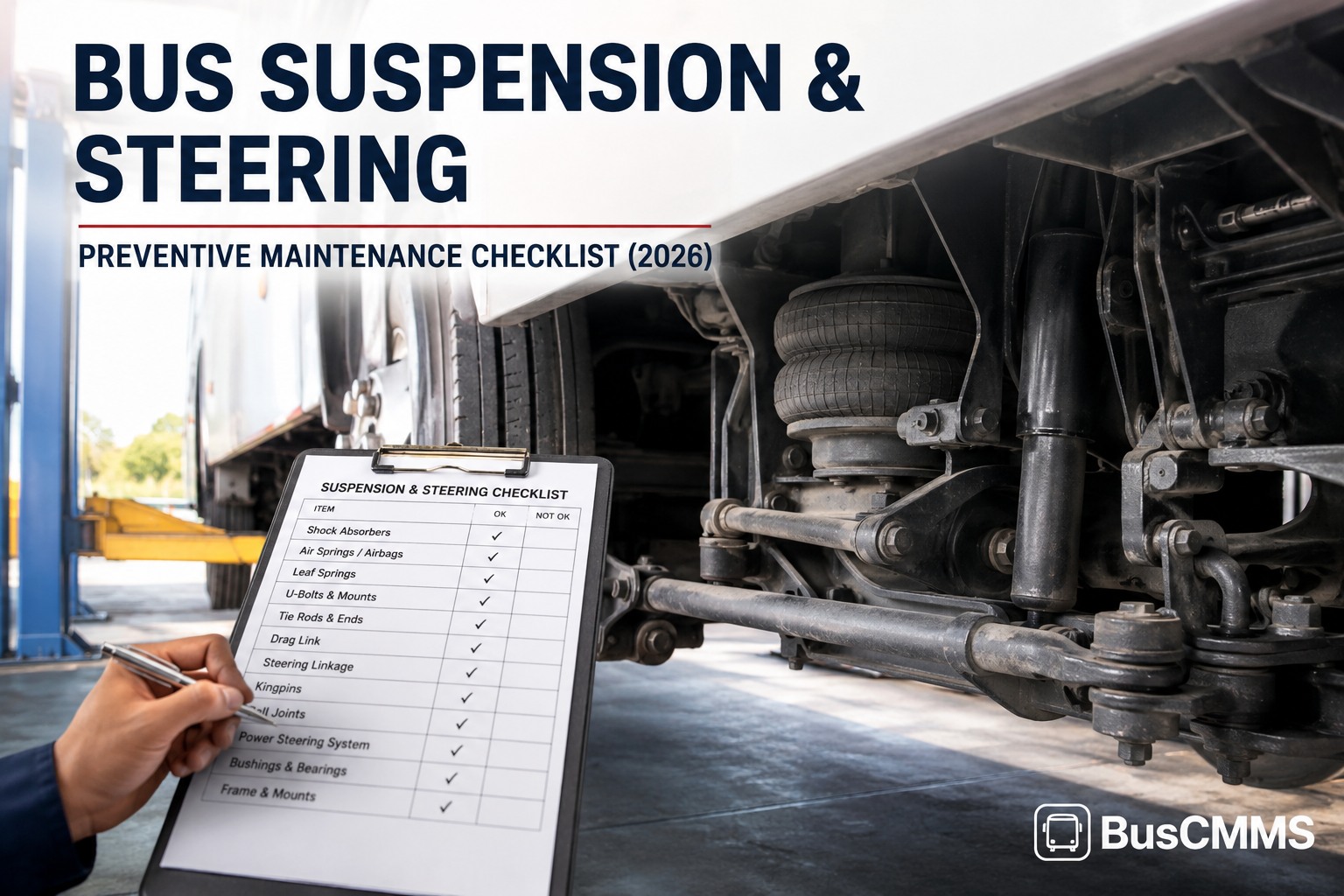
Bus Suspension & Steering Preventive Maintenance Checklist (2026)
Complete inspection framework for the components that keep the bus tracking straight -- air bags, shocks, tie rods, drag link, pitman arm, kingpins, steering knuckles, and power steering. Wear limits, inspection methods, and pass/fail thresholds.
Suspension + Steering Failure Is a Fatal-Class Safety Issue
These are the components that keep the bus in its lane, respond to driver inputs and absorb road impacts before they reach passengers. Failure is not a "come back to it" item.
Kingpin wear OOS limit
Federal out-of-service threshold. Any measurable kingpin play beyond this gets an immediate DOT out-of-service sticker at inspection.
Acceptable tie rod play
Tie rod ends should have zero measurable play at any point in their service life. Any detectable movement = immediate replacement, no exceptions.
Per-repair cost avoided
Kingpin service caught at PM: $1,500. Kingpin failure with knuckle damage: $5,000-$8,000. Steering linkage catastrophic failure: potentially unlimited liability.
Roadside inspection category
Suspension + steering are Category 8 violations in the CVSA out-of-service criteria -- the same category as brake defects. Fleet inspection scores hit hard.
Book a demo to see how BusCMMS tracks suspension + steering PM per bus with wear-limit alerts.
Break the Inspection Into 5 Zones for Consistent Coverage
A 22-point suspension + steering inspection is easy to rush through when it lives on one long checklist. Split by zone so nothing gets skipped when the shop gets busy.
Air Suspension System
Air bags, ride height, leveling valves, air lines, auxiliary tank pressure.
Shock Absorbers
Leak inspection, bounce test, mount condition, bushing wear.
Steering Linkage
Tie rod ends, drag link, pitman arm, steering shaft U-joints, grease points.
Kingpins + Steering Knuckles
Vertical + horizontal play measurement, grease service, wear limits.
Power Steering System
Fluid level + condition, pump operation, pressure test, hose inspection.
Book a demo to see zone-by-zone PM checklist tracking per bus in BusCMMS.
22-Point Suspension + Steering Inspection Checklist
Every item includes the inspection method, the wear limit or spec, and the required action when out of spec. Use this at every scheduled PM.
Air Suspension System
-
A1
Air Bag Visual Inspection
Method: Visual inspection with light. Check air bag body for cracks, cuts, chafing, or age hardening. Inspect crimp bands for corrosion.
Wear Limit:No cracks, cuts, or bulges. Any surface damage = replace. -
A2
Ride Height Measurement
Method: Measure from ground to reference point per OEM spec at all four corners. Bus should be level with air system pressurized and at operating temperature.
Wear Limit:Within ±0.5 inch of OEM spec. Adjust leveling valves if out of spec. -
A3
Air Leak Test
Method: Charge air system to full pressure, shut off engine, apply soap solution to fittings and air bag seams. Observe for bubbles indicating leaks.
Wear Limit:No visible bubbles. System pressure drop max 2 psi/minute. -
A4
Leveling Valve Function
Method: With engine off and pressure charged, add weight to bus. Verify valve opens to raise chassis. Remove weight. Verify valve closes and system holds.
Wear Limit:Valve responds within 5 seconds. No sticking or delayed response. -
A5
Air Lines + Auxiliary Tank
Method: Inspect all air lines for chafing, kinks, or heat damage. Drain moisture from auxiliary tank. Check tank pressure per OEM.
Wear Limit:No visible damage. Auxiliary tank holds spec pressure.
Shock Absorbers
-
B1
Shock Leak Inspection
Method: Visual inspection of shock body for oil weep, wet residue, or spray pattern. Wipe clean and re-inspect after test drive if uncertain.
Wear Limit:Bone dry. Any wet weep = replace. Light film from road oil = OK. -
B2
Bounce Test
Method: Push down on bumper corner and release. Chassis should return to rest position within 1-2 oscillations. More than 2 bounces indicates worn shocks.
Wear Limit:1-2 oscillations max. Continued bouncing = replace both shocks (per axle). -
B3
Mount + Bushing Inspection
Method: Inspect upper and lower shock mounts for cracks, wear, or missing hardware. Check bushings for compression or splitting.
Wear Limit:No cracks or missing hardware. Bushings intact, no visible splits. -
B4
Attaching Hardware Torque
Method: Verify all shock attaching bolts to OEM torque spec using calibrated torque wrench. Common issue: bolts loosen over time from vibration.
Wear Limit:Torque to OEM spec (typically 60-100 ft-lbs). Retorque if loose.
Steering Linkage
-
C1
Tie Rod End Play Test
Method: With front wheels off ground, grip tie rod ends and attempt to move by hand. Have assistant rock steering wheel while observing tie rod movement.
Wear Limit:ZERO play. Any detectable movement in tie rod end = immediate replacement. -
C2
Drag Link Inspection
Method: Inspect drag link for straightness. Check both ends for socket play. Verify jam nuts tight and cotter pins present.
Wear Limit:Straight, no bends. Socket play zero. Jam nuts torqued, cotter pins installed. -
C3
Pitman Arm Condition
Method: Visual inspection for cracks. Check attaching nut torque to OEM spec. Verify no play between pitman arm and steering gear box output shaft.
Wear Limit:No cracks. Nut torqued to OEM (typically 300+ ft-lbs). No shaft play. -
C4
Steering Shaft U-Joints
Method: With engine off, rotate steering wheel back and forth in small movements. Feel for looseness or clicking in the steering column joints.
Wear Limit:Smooth motion, no clicks or free play. Any looseness = replace U-joint. -
C5
Grease Fitting Service
Method: Service all grease fittings on tie rod ends, drag link ends, and kingpins with OEM-spec grease. Verify grease pushes out old contamination.
Wear Limit:All fittings take grease. Clean grease visible at each seal.
Kingpins + Steering Knuckles
-
D1
Kingpin Vertical Play
Method: Raise front wheels off ground. Grip wheel at 12 and 6 positions and rock in and out. Measure movement with dial indicator on knuckle.
Wear Limit:Less than 0.010 inch. Any reading at or above 0.010" = federal OOS. -
D2
Kingpin Horizontal Play
Method: With wheels raised, grip wheel at 3 and 9 positions. Rock side to side while assistant observes kingpin bushing area for movement.
Wear Limit:No visible movement at kingpin. Any observable play = replace bushings. -
D3
Kingpin Grease Service
Method: Locate upper and lower kingpin grease fittings. Apply OEM-spec grease until fresh grease appears at bushing seals.
Wear Limit:Both fittings take grease. Neglected grease = accelerated wear. -
D4
Steering Knuckle Inspection
Method: Visual inspection of knuckle body for cracks, especially near mounting surfaces and tie rod arm attachment points.
Wear Limit:No cracks visible. Any crack = out of service until replaced.
Power Steering System
-
E1
Fluid Level + Condition
Method: Check power steering reservoir with engine off. Fluid should be at spec level, clean and clear amber. Dark or burnt smell = needs service.
Wear Limit:At full mark. Clean amber color. No burnt smell. -
E2
Pump Operation
Method: With engine running at idle, turn steering wheel lock to lock. Listen for pump whine, groan, or excessive noise. Check for smooth response.
Wear Limit:Smooth response. No whine or groan. No steering wheel jerk. -
E3
Pressure Test
Method: Install pressure gauge in high-pressure line. Turn steering wheel to full lock and hold briefly. Read maximum system pressure.
Wear Limit:Within OEM spec (typically 1,200-1,500 psi). Low reading = pump wear. -
E4
Hose + Cooler Inspection
Method: Inspect all power steering hoses for weeping, bulges, chafing, or heat damage. Check cooler for airflow blockage or leak.
Wear Limit:No weeping, bulges, or chafing. Cooler clean and clear.
When to Run Each Zone of the Inspection
Not every item needs monthly checking. Sequence the 22 inspection points across three intervals so shop time is spent efficiently and nothing gets missed.
Visual + Fluid Level
- Air bag visual (A1)
- Ride height check (A2)
- Shock leak inspection (B1)
- Power steering fluid (E1)
- General walk-around
Play Test + Grease Service
- Air leak test (A3)
- Bounce test (B2)
- Tie rod end play (C1)
- Grease service (C5, D3)
- U-joint check (C4)
Full Wear Measurement
- Kingpin play measurement (D1, D2)
- Power steering pressure (E3)
- All torque verification (B4)
- Complete linkage inspection
- Full 22-point checklist
Book a demo to see how BusCMMS auto-schedules A/B/C-check inspections per bus.
How BusCMMS Automates Suspension + Steering PM
Paper PM sheets get lost. Wear measurements documented on shop clipboards do not become history. Digital PM tracking is what turns 22 inspection points into a defensible fleet record.
Zone-based digital checklist
All 22 items organized into 5 zones on the technician's tablet. Skip nothing, log wear measurements per inspection, attach photos of concerns for review.
Wear-limit alerting
Enter a kingpin play measurement approaching 0.010 inch and the system flags it before it hits federal OOS. Predictive scheduling catches wear trends across intervals.
Auto A/B/C-check scheduling
Monthly, quarterly, and annual inspections auto-scheduled per bus based on mileage or calendar. No spreadsheet tracking, no missed intervals.
Failed-item work order
Any inspection item failed generates a work order automatically. Failed tie rod end = repair scheduled + parts flagged for order + technician assigned.
Historical wear trending
Kingpin wear at each PM logged over the life of the bus. See the wear curve, project replacement timing, catch accelerating wear before failure.
Compliance audit trail
Every inspection date-stamped, technician-signed, and preserved for DOT audit. When the inspector asks "prove you did this," the answer is a PDF export.
Book a demo to see the suspension + steering PM workflow live in BusCMMS.
How often should bus suspension and steering PM be done?
Suspension + steering PM should follow a three-tier interval schedule: monthly A-check for visual inspection and fluid levels (approximately 15 minutes), quarterly B-check adding play tests and grease service (approximately 30 minutes), and annual C-check with full wear measurements including kingpin play, pressure testing, and torque verification (approximately 90 minutes). School buses and transit buses running high daily mileage may need shorter intervals -- 5,000 to 10,000 mile A-checks are common.
What is the federal out-of-service limit for bus kingpin wear?
The federal DOT out-of-service threshold for kingpin play is 0.010 inch when measured vertically at the wheel. Any bus with kingpin play meeting or exceeding 0.010 inch will be placed out of service at roadside inspection under CVSA (Commercial Vehicle Safety Alliance) criteria. Measurement is done with the wheel raised, gripping at 12 and 6 o'clock positions, and reading movement with a dial indicator on the steering knuckle. Kingpin wear is progressive -- catch it in the 0.006-0.008 inch range at PM and schedule the repair before it becomes an OOS event.
How do you inspect a tie rod end for wear?
With the front wheels off the ground, grip each tie rod end firmly and attempt to move it by hand while an assistant rocks the steering wheel back and forth. Any detectable movement or clicking in the tie rod end indicates wear and requires immediate replacement -- there is no acceptable wear range for tie rod ends. Also visually inspect for grease boot damage, missing cotter pins, and jam nuts that have loosened. Tie rod failure at highway speed is catastrophic; this is a zero-tolerance wear item.
What are the most common bus suspension and steering failures?
The most frequent failures on bus suspension + steering systems are: kingpin wear (from missed grease intervals), air bag failure from age and heat exposure (200,000-300,000 mile typical life), shock absorber leaks (aging), tie rod end wear (missed grease service), power steering leaks (hose failure or pump wear), and leveling valve sticking (contamination). Every one of these is preventable with the 22-point PM checklist run at the recommended intervals. Missed grease service is the single largest driver of premature suspension + steering component failure across bus fleets.
How does BusCMMS help manage suspension and steering PM?
BusCMMS runs the 22-item suspension + steering inspection as a zone-based digital checklist on the technician's tablet. Wear measurements are logged per PM cycle, alerts fire when values approach OOS limits (kingpin play trending toward 0.010 inch), A/B/C-check intervals auto-schedule per bus by mileage or calendar, failed items generate work orders automatically, and every inspection date-stamps into a DOT audit trail. Historical wear trending across the life of each bus surfaces components approaching replacement before roadside failure. Book a 20-minute demo to see the workflow live, or start a 30-day free trial.