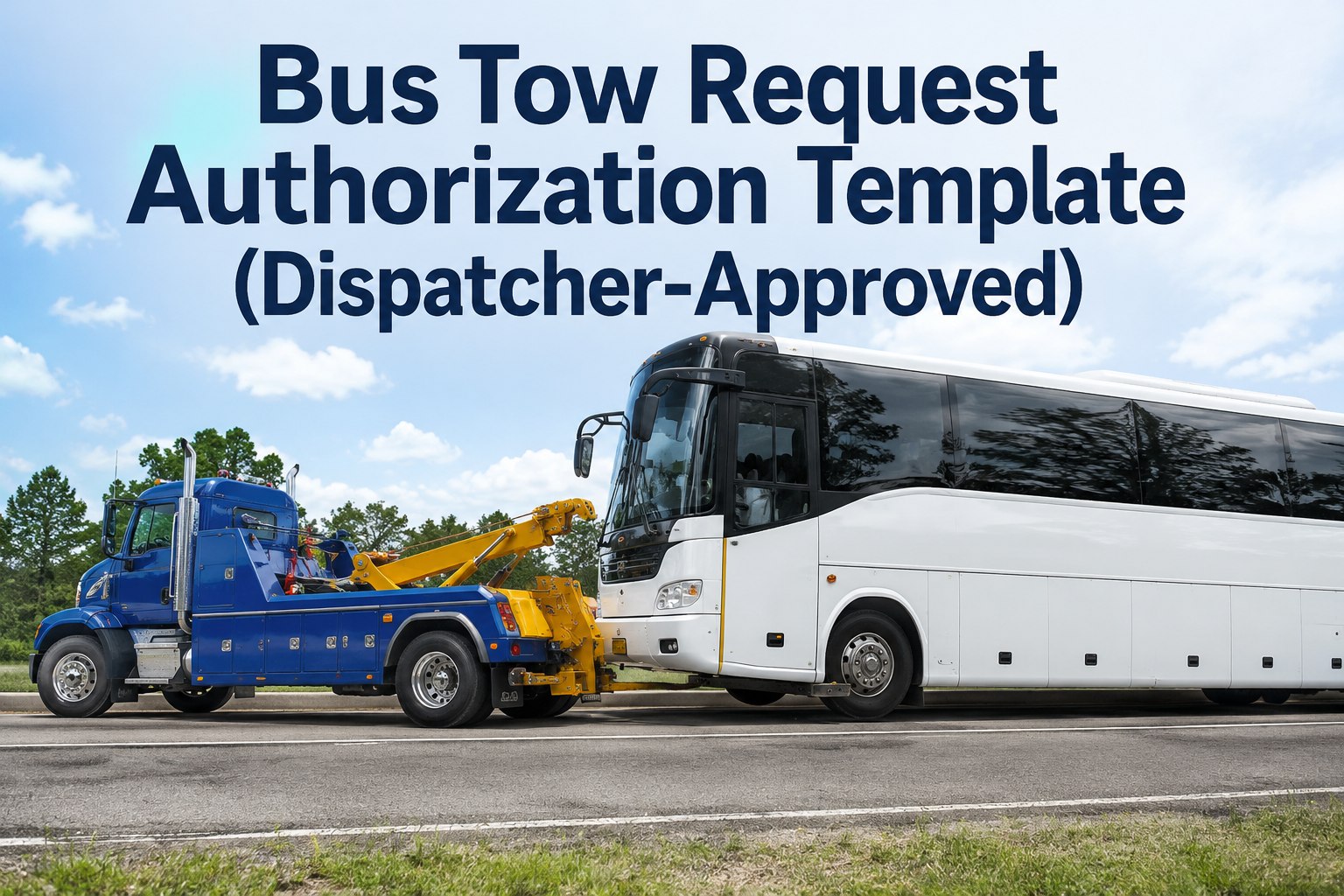
It is 2:47 p.m. on a Tuesday. Bus #47 on Route 12 is at mile marker 214 on the interstate with 22 students on board and coolant pooling under the front axle. The engine temperature gauge has crossed the red zone. The driver radios dispatch. Dispatch has thirty seconds to make three decisions: get the students off the bus safely, find a tow that can move a fifteen-ton diesel bus, and authorize a repair that will show up as a $2,500 to $5,000 line item on next month’s budget. If your fleet has a proper bus tow request authorization template locked into its dispatch workflow, this is a fifteen-minute procedure. If it does not, this is where fleets end up paying $4,800 for what should have been a $1,600 tow, arguing with a vendor six weeks later about whether the frame damage was pre-existing and answering awkward questions from a district auditor who wants to know why there is no PO number attached to a $3,200 expense.
Bus Tow Request Authorization Template: The 5-Stage Dispatcher Framework
A complete tow request authorization framework covering incident capture, dispatch approval, vendor assignment, tow execution, and handoff — so every tow gets a PO number, every vendor gets locked-in terms, and every dollar gets accounted for.
- 22 fieldsacross 5 stages
- $2.5K–$5K+typical bus tow cost
- <5 mindispatch to vendor
- 3 signaturescloses the record
Dispatch workflows, tow authorization, and vendor management on one platform
The 5 Breakdown Scenarios That Trigger a Bus Tow Authorization
Every fleet dispatcher runs into these five scenarios eventually. Recognizing them fast is what separates a fifteen-minute recovery from a two-hour scramble.
-
Mechanical Failure
Engine, transmission, or drivetrain issues that make the bus undriveable. Most common cause of authorized tows.
-
Overheating / Fluid Loss
Coolant, oil, or hydraulic fluid loss on route. Continuing risks catastrophic engine damage — tow required immediately.
-
Accident / Collision
Any collision requiring investigation, insurance documentation, or safety inspection before the bus returns to service.
-
Tire Failure
Blowout or catastrophic tire damage where roadside change is not feasible — commonly outside driver capability on a 15-ton bus.
-
Electrical / Battery
Total electrical failure on diesel buses or main battery pack fault on EVs. Neither can be jump-started roadside safely.
Different scenarios trigger different vendor types and cost bands. A tire failure typically resolves faster and cheaper than a full mechanical tow, while an accident tow often carries insurance documentation requirements that other tows do not. The template below captures all of them under one workflow. Book a demo to see BusCMMS handle live tow authorization workflows.
The Complete 5-Stage Bus Tow Request Authorization Template
The full field-by-field template your dispatch team can adopt as-is. Every stage represents a moment in the tow lifecycle, and every field has a defined format so nothing gets skipped in the rush.
-
01
The Incident
Capture what happened, where, and who is on board — the first ninety seconds of the call.
- Bus # + Driver · ID + CDL number
- Date & Time · auto-timestamped
- Location · GPS, mile marker, route
- Reason for Tow · free-text description
- Passenger Status · on board, evacuated, transferred
-
02
Dispatch Authorization
The formal approval that unlocks the PO and locks in the vendor relationship.
- Dispatcher Name & ID · who owns the request
- Authorization Time · HH:MM AM/PM
- PO / Auth Number · the invoice anchor
- Priority Level · Emergency / Urgent / Standard
-
03
Vendor Assignment
Locking in the tow company, operator, equipment type, and arrival window before the truck rolls.
- Tow Company · name + contact number
- Operator & Truck ID · driver + unit assigned
- Tow Type · flatbed, wheel-lift, hook-lift
- ETA & Actual Arrival · both timestamps captured
-
04
Tow Execution
The actual haul — origin, destination, condition, and locked-in cost estimate before wheels turn.
- Destination Facility · shop name + address
- Miles Towed · from breakdown to shop
- Pre-Tow Condition · damage notes + photos
- Estimated Cost · hookup + per-mile + surcharge
-
05
Handoff & Sign-Off
Closing the loop — arrival, condition check, actual cost, and the three signatures that make it audit-ready.
- Arrival Time · at destination facility
- Receiving Mechanic · name + contact
- Post-Tow Condition · new damage check
- Actual Cost · final invoice total
- 3 Signatures · dispatch, tow driver, receiving
Twenty-two fields, five stages, one workflow. The dispatch team fills it live during the tow event. The finance team pulls the record when the invoice arrives. The auditor pulls it when a claim lands. All three see the same complete document. Book a demo to see this exact template pre-loaded in the BusCMMS dispatch workflow.
What a Heavy-Duty Bus Tow Actually Costs in 2026
Heavy-duty tow pricing is not the passenger-car math most people carry in their heads. A bus is not towed for $150. The 2026 numbers below reflect what U.S. tow vendors actually charge for a fifteen-ton bus recovery, based on national rate surveys.
Fee just to bring the wrecker to your bus and connect. Heavy-duty rate is 3–5x the passenger-car rate.
Once hooked up. A 30-mile tow to the shop adds $150–$300 on top of the base fee alone.
Night, weekend, or holiday calls. Applied to base + mileage. Locking in your primary vendor at pre-negotiated rates avoids the worst of this.
If the bus is off the roadway, in mud, or requires rotator equipment. One-hour minimum in almost every market.
Real-world 2026 range for a bus tow event. Complex recoveries with rotator equipment can exceed $7,500. Every one of these dollars needs a PO number attached before finance closes the month.
The savings from a locked-down tow authorization process are not hypothetical. Fleets with pre-negotiated vendor contracts and enforced PO workflows typically pay 20-30% less per tow event than fleets calling whatever vendor answers first at 2 a.m. Multiply that across a large fleet with even a few tow incidents per year and the difference lands in the tens of thousands. Book a demo to see how BusCMMS locks in vendor terms and enforces PO capture.
How BusCMMS Turns Tow Requests Into Audit-Ready Records
A paper tow slip ends up in a folder. A digital tow authorization becomes structured data your dispatch team, finance team, and auditor can all reference from the same record. Book a demo to see how BusCMMS converts every tow event into an audit-ready record.
Pre-Loaded Template
22-field tow authorization workflow ready on day one — no configuration required.
Auto PO Generation
Every tow authorization triggers a unique PO number · no manual numbering, no duplicates.
Vendor Database
Pre-negotiated tow vendors with contact info, rates, and coverage areas · dispatch picks in one click.
Photo Attachments
Pre-tow and post-tow photos attach to the record · damage disputes settle in minutes.
Cost Reconciliation
Estimate vs actual cost tracked per tow · invoice mismatches surface immediately for finance.
Three-Party Sign-Off
Dispatch, tow driver, and receiving shop all sign digitally · record cannot close until all three complete.
BusCMMS reports that fleets on its platform process tow requests in an average of under five minutes from breakdown call to vendor dispatch, with 100% of records fully documented at closeout — BusCMMS’s own reported figures from bus-fleet customers in production. Book a demo to see the tow authorization workflow on live fleet data.
What is a bus tow request authorization template and why does my fleet need one?
A bus tow request authorization template is a structured form your dispatch team fills out any time a bus needs to be towed — capturing incident details, dispatch approval, vendor assignment, tow execution, and handoff. It exists because heavy-duty bus tows in 2026 run $2,500 to $5,000 or more per event, and every one of those dollars needs a PO number, a documented vendor, and a signature trail. Without a template, fleets end up with disputed invoices, missing paperwork during audits, and inflated costs from vendors who know there is no rate lock in place.
Who is responsible for approving a bus tow request?
Authorization typically flows through the dispatcher on shift, with escalation to a fleet supervisor or transportation director for tows above a set dollar threshold (often $1,500 to $2,500). The template captures who approved the request, at what time, and under which priority level (Emergency, Urgent, Standard). For school districts, the transportation director usually signs off on any tow event during the closeout stage. For transit agencies, the operations manager typically owns final approval.
How much does a heavy-duty bus tow typically cost in 2026?
2026 U.S. heavy-duty bus tow costs typically run $2,500 to $5,000 per event, with complex recoveries exceeding $7,500. The pricing breaks down into a base hookup fee ($150 to $550), a per-mile rate ($5 to $10 per mile), and add-ons for after-hours service (+20 to 50%) or winching and recovery ($150 to $300 per hour with one-hour minimums). Fleets with pre-negotiated vendor contracts typically pay 20-30% less per event than fleets calling ad-hoc.
What are the most common mistakes fleets make with tow authorization?
Four mistakes dominate: no PO number attached to the tow event (which finance rejects at invoice reconciliation), no pre-tow condition photos (which makes damage disputes impossible to resolve), no post-tow sign-off from the receiving shop (which leaves the record open indefinitely), and missing timestamps on dispatch and vendor arrival (which makes ETA disputes and after-hours surcharge disputes unwinnable). All four are solved by a structured template with enforced completion.
Can we go fully digital with tow authorization, or does paper still have a place?
Fully digital is now the norm for fleets serious about cost control and audit readiness. Digital tow authorization gives you auto-generated PO numbers, cryptographic timestamps that vendors cannot dispute, photo attachments for damage documentation, and searchable retrieval when finance or insurance asks for a specific record months later. Paper still shows up in some smaller operations, but paper logs are the source of most tow-related invoice disputes and audit findings.