Your Bus 17 rolls into the shop with a failed alternator at 47,000 miles. Your tech installs a $650 replacement, closes the work order, and moves on. Two months later you find out the original alternator was still under warranty for another 90 days -- that $650 was covered, minus a $50 deductible. You just left $600 on the table. Multiply that pattern across an entire fleet: engines with unused powertrain coverage, HVAC systems past claim windows, tire casings that could have been retreaded for free. Industry data suggests 15-20% of eligible warranty claims never get filed because nobody knew the coverage was active. On a 40-bus fleet, that is $200,000-$500,000 in unclaimed warranty per year.
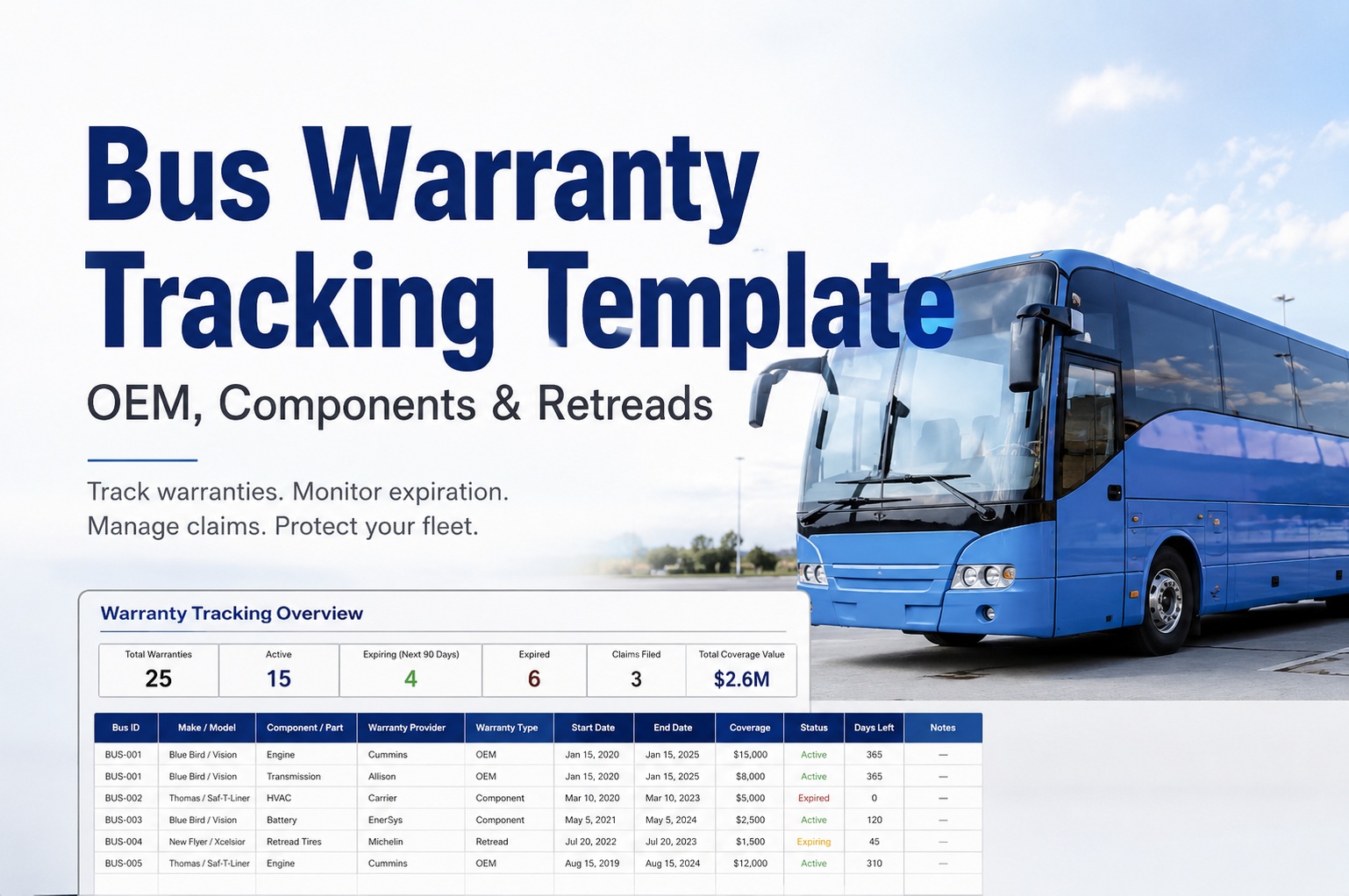
Bus Warranty Tracking Template (OEM, Components & Retreads)
The complete warranty tracking template for bus fleets -- OEM chassis, powertrain, HVAC, batteries, wheelchair lifts, tire retreads and everything else covered. Plus the PM documentation trail that keeps claims from getting denied.
- EngineCummins B6.7 Active · 18 mo $8K-$15K
- TransmissionAllison Active · 12 mo $3K-$8K
- HVACThermo King Expiring · 2 mo $2K-$5K
- BatteriesOE spec Active · 8 mo $500-$1.5K
- AlternatorReman Expired Missed
- Tire RetreadsCasing tracked Active · 6 mo $200-$500
Money Left on the Table When Warranty Tracking Fails
Fleets that do not systematically track warranty coverage per bus per component pay for repairs that should be covered. The dollar impact is not marginal.
Eligible claims never filed
Industry estimate. Fleets pay for repairs on parts still under warranty because tracking is fragmented across paper, spreadsheets, and mechanic memory.
Annual missed recovery per bus
Averaged across a fleet with mixed vehicle ages. Newer buses miss more (more active coverage), older buses miss less (less active coverage) -- but both miss.
Claims denied for PM gaps
Most warranty denials trace to missing preventive maintenance documentation. "Prove you did the required service" is question #1 from every warranty adjuster.
Warranty types per bus
OEM chassis, engine, transmission, component-level (HVAC, alternator, injectors), tire casings, and extended warranties. Each has its own clock and terms.
Book a demo to see how BusCMMS surfaces every active warranty per bus with expiration alerts.
Bus Warranty Tracking Template: Complete Field Structure
Every field the template needs to capture. Organized into four blocks. Missing any field creates a blind spot that costs warranty recovery.
Asset Identification
- Bus number -- internal fleet ID
- VIN -- required for OEM warranty verification
- Make + Model + Year -- chassis manufacturer
- Engine + Trans serials -- separate warranty registration
- In-service date -- warranty clock start point
- Purchase odometer -- for mileage-based warranties
Warranty Details
- Warranty type -- OEM / component / extended / reman
- Component covered -- specific system or part
- Provider -- OEM, manufacturer, or third party
- Effective + Expiration dates -- time boundaries
- Mileage limit -- if mileage-based
- Deductible -- often $0-$500 per claim
- Transferable? -- matters for resale value
Claim History
- Claim date -- when filed
- Component + Issue -- what failed and why
- Status -- pending / approved / denied / paid
- Amount claimed -- initial submission
- Amount received -- final recovery
- Turnaround days -- filed to paid
- Denial reason -- if applicable, for pattern review
Supporting Documentation
- PM history -- proof that required service was done
- DVIR references -- pre-failure inspection records
- Photos -- component condition + failure evidence
- Diagnostic codes -- ECU fault codes at failure
- Fluid analysis -- lab results if requested
- Original invoice -- purchase + install receipts
5 Warranty Categories Every Fleet Must Track
Each category has its own timeline, terms, and claim process. Treat them as one lump and you will miss claims in every category.
OEM Chassis + Bumper-to-Bumper
Full-vehicle coverage from the chassis manufacturer. Typically 1-3 years / 100K-150K miles. Covers most systems but usually excludes wear items.
Powertrain (Engine + Transmission + Axle)
Longer-term coverage on major drivetrain components. Cummins, Detroit Diesel, Allison, and Meritor offer 3-5 year / 200K-500K mile powertrain warranties. Highest per-claim recovery value.
Component-Specific (HVAC, Lifts, Electronics)
Third-party manufacturer warranties on individual systems. Thermo King HVAC, Braun wheelchair lifts, Bendix brakes, aftermarket electronics. Terms vary from 1-3 years. Requires tracking each provider separately.
EV Battery + Motor (Electric Buses)
Long-term coverage unique to electric buses. Battery pack warranties typically run 8-12 years / 500K miles. Electric motor 5-10 years. Charging infrastructure 2-5 years. Massive per-claim value (battery replacement can exceed $150K).
Tires + Retread Casings
New tires carry 5-7 year mileage warranties from major manufacturers. Retreads carry 1-3 year mileage warranties per retread. Casing tracking is where most fleets lose money -- casings become eligible for another retread only if properly documented through their life.
Reman Parts + Aftermarket
Every reman part installed on the bus comes with its own warranty clock (typically 12-24 months). Aftermarket parts vary. Each install starts a new tracking obligation. This is where the "$650 alternator" gets missed most often.
Why PM Documentation Is the Difference Between Approved and Denied
Warranty adjusters do not deny claims to be difficult. They deny claims that cannot prove the PM was done. Here is what every claim needs.
- PM records showing OEM-spec intervals hit
Oil changes, filter replacements, coolant service on time, per OEM.
- Fluid analysis results if required
Some warranties require documented lab analysis at specific intervals.
- DVIR history without unresolved items
Driver-reported issues in prior 30-90 days must show as addressed.
- Diagnostic codes at failure
ECU fault codes captured at the time of failure, not reconstructed later.
- Photos of failed component
Visual evidence of the failure mode. Some providers require pre-teardown photos.
- Serial numbers for identification
Engine, transmission, and component serials for provider verification.
Tire Retread Tracking: The Warranty Nobody Tracks Well
Retread tracking is unique. Same casing gets retreaded 2-4 times, each retread has its own warranty, and the casing itself has eligibility rules. Poor tracking here quietly costs thousands per year.
Casing serial assigned
Every new tire casing gets a unique serial. This is the entity being tracked through 5-7 years of service life across multiple retreads.
New tire warranty (5-7 yr)
Manufacturer warranty on the new tire. Mileage-based, prorated. Requires proof of proper installation and pressure maintenance.
First retread (1-3 yr)
Casing sent for first retread cycle. New warranty starts on the retread. Casing eligibility depends on inspection at return.
Second + third retreads
Casing can typically be retreaded 2-4 times if maintained properly. Each retread has separate warranty terms. Casing rejected if damaged.
Casing retirement
Casing reaches end of service life or fails inspection. Track disposal, replacement cost, and lifetime cost-per-mile for that casing.
Fleets that track casings individually save $500-$1,500 per bus per year on tire recovery. Fleets that only track by wheel position lose casings that were still eligible. Book a demo to see per-casing tracking + warranty history in BusCMMS.
How BusCMMS Automates Warranty Tracking
The reason most fleets miss warranty recovery is not lack of intent -- it is fragmentation. Warranties live in filing cabinets, PM records live on paper, and nobody has time to cross-reference before ordering a replacement.
Warranty registry per bus
Every warranty on every bus tracked with type, provider, effective + expiration dates, mileage limits, and deductible. Fleet-wide dashboard shows active coverage at a glance.
Expiration alerts
Warranty expiring in 30/60/90 days? Alerts fire before the coverage window closes. Prompts the shop to file eligible claims before the deadline.
PM history auto-linked
When a work order gets created, the CMMS auto-links the PM history that warranty adjusters will ask for. No scrambling through binders when the claim gets submitted.
Warranty check before parts order
When a technician creates a work order for repair, the system flags any active warranty on the failed component -- so warranty gets checked before parts get ordered.
Claim tracking workflow
Every claim tracked from filing to payment: submission date, provider, amount claimed, amount received, denial reasons. Turnaround time reports surface providers that pay slowly.
Per-casing tire tracking
Individual tire casings tracked through their full life -- new tire, retread cycles, warranty status per retread, disposal. Casing-level cost-per-mile reporting.
Book a demo to see the warranty tracking + claim workflow live on your fleet size.
Annual Warranty Recovery by Fleet Size
Real dollar impact of systematic warranty tracking. Based on typical 15-20% capture improvement across mixed-age bus fleets.
How many different warranties are typically active on a single bus?
A newer diesel bus typically has 3-5 layers of active warranty coverage: OEM chassis (1-3 years), powertrain from engine + transmission manufacturers (3-5 years, longer mileage), component-specific from HVAC / lifts / electronics vendors (1-3 years), tire casings (5-7 years new + 1-3 years per retread), and any recently-installed reman parts (12-24 months). Electric buses add battery + motor coverage (8-12 years). Each has different terms and its own claim clock.
Why do warranty claims get denied and how do I prevent it?
The top denial reasons are missed PM intervals, wrong fluid used (non-OEM viscosity or spec), aftermarket modifications, late claim filing (past 30-90 day windows), and missing serial verification. Prevention comes from documented PM discipline (proving service was done on OEM intervals), keeping OEM-spec fluids and parts, filing claims within the required window, and maintaining serial records for major components. A CMMS that auto-links PM history to warranty claims eliminates most denial risk.
How much warranty recovery does the average fleet actually miss per year?
Industry estimates suggest 15-20% of eligible warranty claims never get filed on fleets without systematic tracking. For a mixed-age 40-bus fleet, that typically translates to $200,000-$500,000 annually. Newer buses in the fleet contribute more (more active coverage windows), older buses contribute less. The recovery is not fabricated -- it is money spent on repairs that should have been billed to the warranty provider instead.
How does retread casing tracking actually work?
Each tire casing has a unique serial that stays with the casing through its full life. New tire warranty covers the initial tread life (5-7 years). When the tread wears out, the casing goes to a retreader for a new tread application, which starts its own 1-3 year warranty. A quality casing can typically go through 2-4 retread cycles before being retired. Fleets that track only by wheel position (not by casing serial) lose casings that were still eligible for another retread. Per-casing tracking recovers $500-$1,500 per bus per year on average.
How does BusCMMS help maximize warranty recovery?
BusCMMS tracks every warranty per bus (OEM, powertrain, component, EV, tire retreads, and reman parts) with type, provider, dates, mileage limits, and deductibles. Alerts fire on warranties expiring in 30/60/90 days. When a technician creates a work order for repair, the system flags any active warranty on the failed component -- so warranty gets checked before parts get ordered. PM history auto-links to claim filings, satisfying the #1 warranty adjuster question. Per-casing tire tracking manages retread cycles through the full casing life. Book a 20-minute demo to see the workflow live, or start a 30-day free trial.