A rider in a wheelchair is waiting at the stop, the lift grinds, stalls, and will not deploy, and the driver has to pull away and leave them there. That is the moment ADA compliance stops being paperwork and becomes a person left behind. Bus wheelchair lift maintenance keeps that from happening, and the records that prove you kept the lift in service keep you compliant. See how lift inspections and logs work in a demo.
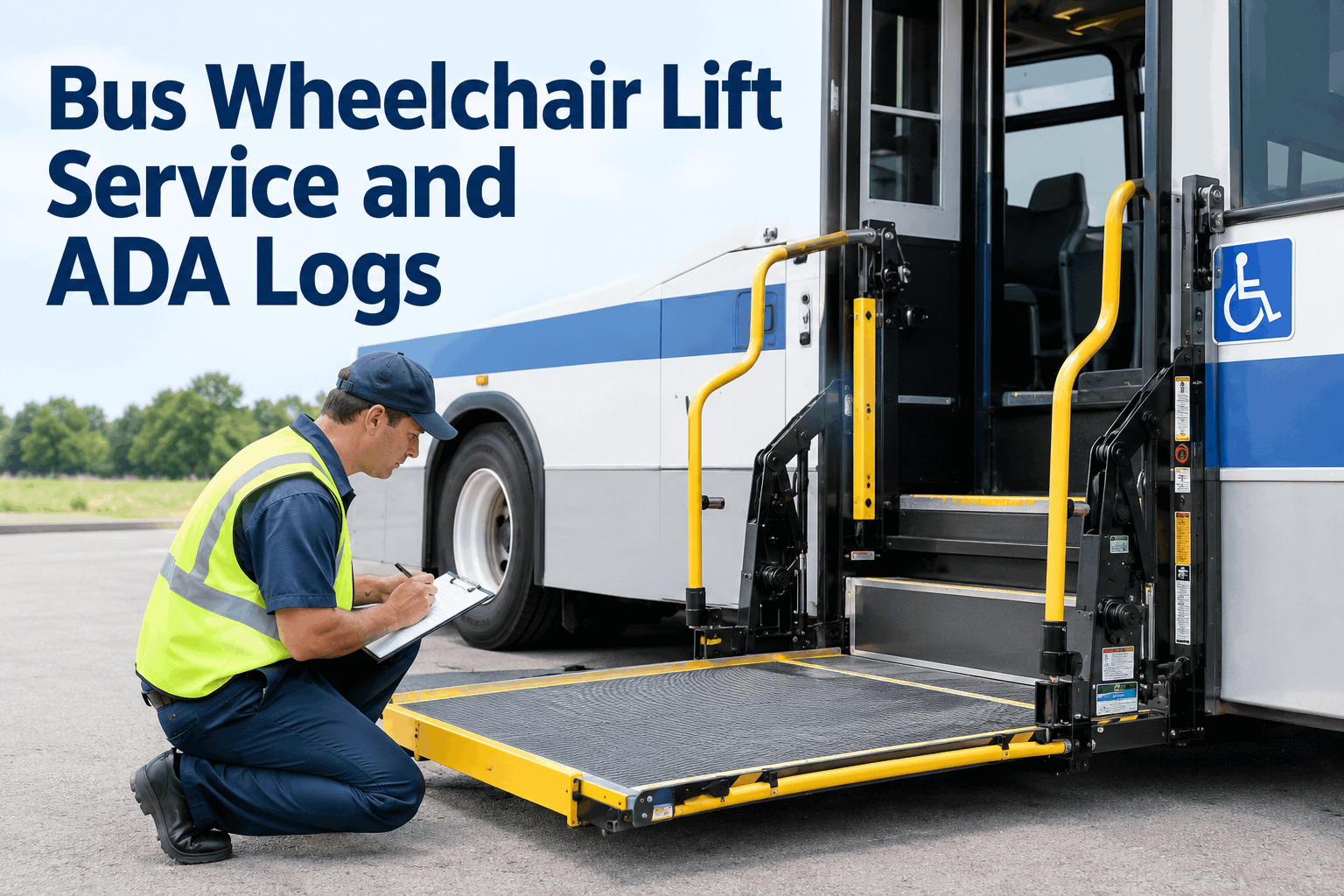
Bus Wheelchair Lift Service and ADA Logs
The ADA requires accessible features to be kept in working order, and a broken lift runs on a short clock. Tracking lift inspections, service, and faults in one place keeps the lift reliable and the records ready.
Why a Wheelchair Lift Is Not Just Another Component
A failed tail light is a defect. A failed wheelchair lift is a rider who cannot board, and a compliance problem with a deadline attached. That is why ADA lift maintenance sits in a category of its own, with rules and stakes a normal repair does not carry.
The clock is real
Under the ADA, a bus with an inoperable lift is generally limited to three days of use before it must come off the road. A fault is not something you get to sit on.
It has to be cycled daily
Operators are expected to cycle the lift as part of the pre-trip inspection, so a problem is caught in the yard, not when a rider is waiting at the curb.
The records get reviewed
An FTA triennial review looks at how you maintain accessible features. Scattered paper logs make that stressful; a clean, exportable record makes it routine.
A missed defect is a complaint
A rider left behind can file an ADA complaint, and those are taken seriously. Reliable lifts and solid records are the best protection against that outcome.
None of this requires a specialist team, it requires the inspections, service, and faults to live in one place that tracks the deadlines for you. Fleets that run lift maintenance this way stop getting caught by the clock, and you can sign up free and set up your lift schedules to see how it fits.
Where Your ADA Logs Actually Come From
The ADA record you hand a reviewer is not a separate document you fill out at year-end. It is the byproduct of three routines you already run, captured as you go. Wheelchair lift inspection logs build themselves when the parts feed one place, which is the part that is easiest to grasp by watching the log assemble in a demo.
When the daily check, the PM, and the repairs all land in one system, the ADA log is already written by the time a reviewer asks for it. No year-end scramble.
What to Track for a Wheelchair Lift
Wheelchair lift preventive maintenance comes down to a focused list. Keep these current per lift and you cover the reliability, the safety, and the ADA record at the same time.
Swipe sideways to see all columns.
Follow your lift manufacturer's service intervals and your agency's ADA procedures for the specifics. With these tracked per lift, you can see a lift's full history in one place during a demo rather than piecing it together from separate logs.
Your Wheelchair Lift Readiness Checklist
Run this against your accessible fleet. Tick every box and a lift fault is caught early, fixed inside the window, and logged, so a rider is never left behind and a reviewer is never a problem.
-
The lift is cycled on every pre-tripA daily cycle check is built into the driver's pre-trip, so a fault shows up in the yard, not at the curb.CRITICAL
-
A lift fault starts the 3-day clockThe moment a fault is logged, the repair deadline is tracked, so the bus never quietly overstays the limit.CRITICAL
-
Lift PM is on a schedule, not a hunchHydraulics, cables, interlocks, and safety stops are serviced on an interval so they do not fail under a rider.CRITICAL
-
A failed check becomes a work orderWhen the cycle check fails, it opens a tracked repair rather than a note someone has to carry to the shop.PLAN
-
Every check and repair is logged by dateThe record builds itself as the work happens, so the ADA log is never something you reconstruct later.PLAN
-
You can export the record for a reviewA complete lift history pulls cleanly for an FTA triennial review, so compliance is something you show, not sweat.PLAN
Six boxes, and the first three are where a stranded rider or a blown deadline gets prevented. You can sign up free and set up a lift schedule for each bus this week.
How BusCMMS Handles Lift Service and ADA Logs
Tracking a lift's daily check, its PM, and its faults against a compliance clock is exactly what a maintenance system is built to do. BusCMMS keeps all three on each bus and turns them into the record automatically.
Lift cycle check on the pre-trip
The daily lift cycle is part of the bus-specific pre-trip inspection, and a failed check opens a work order on its own, so a fault never rides out of the yard.
Faults tracked against the deadline
A logged lift fault starts a tracked clock, so you always know which buses are on the window and which need to come off the road.
ADA logs that export clean
Every check, service, and repair lands on the record, so the accessibility history for a triennial review is a few clicks, not a week of digging.
It is the same digital inspection and work-order flow that runs the rest of your fleet, with the lift's ADA deadlines built into it rather than tracked on the side.
A Maintenance Director's Take
Our triennial review used to mean a week of pulling lift records out of three different places and hoping they matched. Now the daily cycle check, the PM, and every repair are all on the bus, so the accessibility log is just there. The real win is smaller, though: we have not left a rider at a stop since the cycle check went digital.
Key Takeaways on Bus Wheelchair Lift Maintenance
A wheelchair lift is where safety, service, and compliance meet, and all three come from the same tracking. Four things to carry away.
A broken lift is on a clock
The ADA generally limits a bus with an inoperable lift to three days, so a fault needs tracking, not a shrug.
Cycle it daily
The pre-trip cycle check catches a fault in the yard and logs the check in the same step.
The log builds itself
Daily checks, PM, and repairs in one place add up to the ADA record without extra paperwork.
Reliability is the real goal
The records matter, but a lift that works every time is what keeps the promise to the rider.
Run bus wheelchair lift maintenance as one tracked routine, with the daily check, the PM, and the fault clock in a single place, and both the compliance record and the rider's experience take care of themselves, which is the whole point of the lift being there.