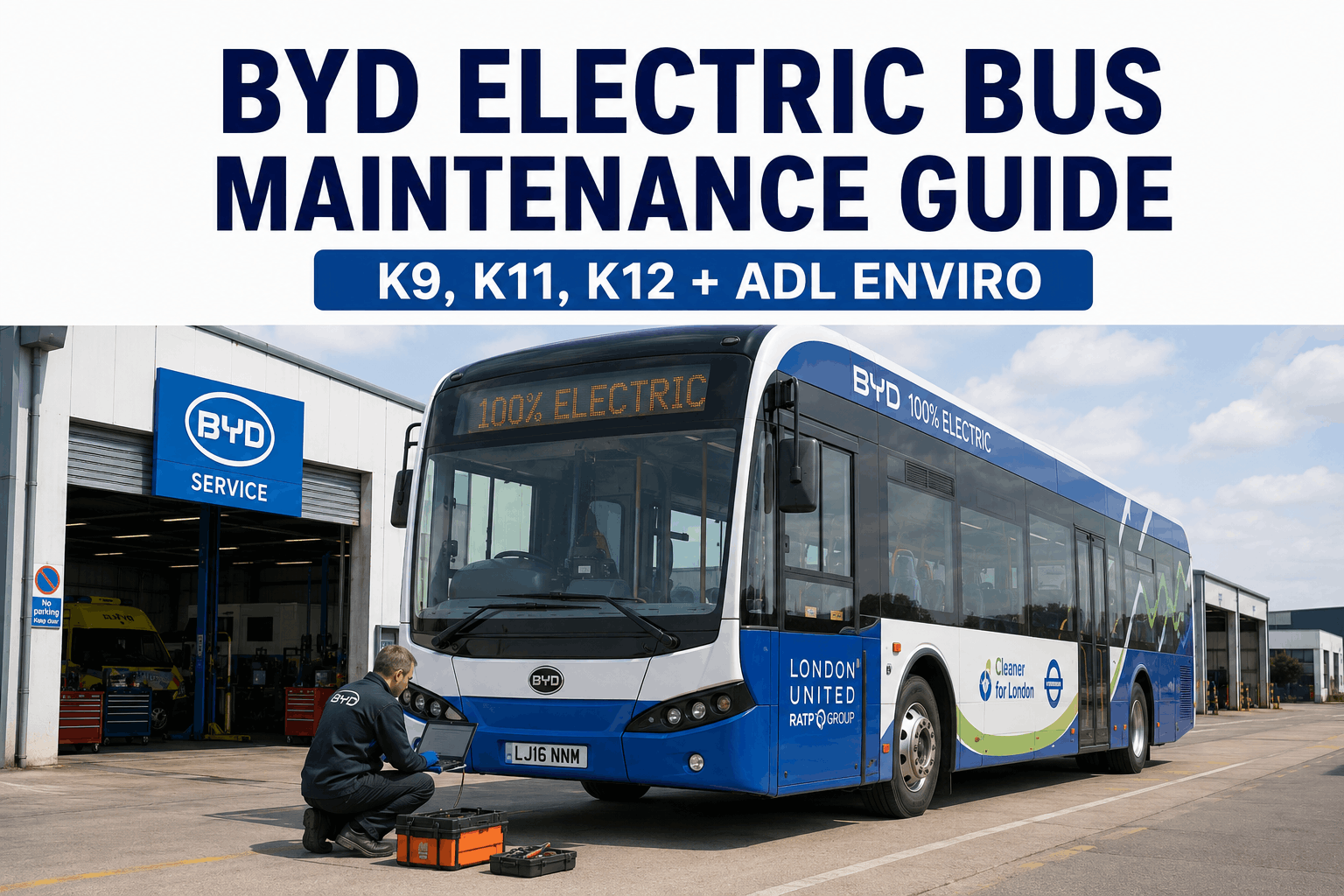
BYD electric buses are the global leaders in zero-emission public transport. Proper maintenance is essential to maximize battery life, ensure HV safety, and optimize performance of K9, K11, K12, and ADL Enviro200EV/400EV models. This guide covers HV safety, BMS management, battery cooling, regenerative brakes, and predictive maintenance for your electric fleet.
BYD Electric Bus Maintenance Guide 2026
BYD Electric Bus Maintenance Guide
BYD electric bus maintenance guide. K9, K11, K12 and ADL Enviro200EV/400EV. HV safety, BMS, battery cooling, regen brakes and predictive maintenance.
BYD Electric Bus Maintenance Impact: The Cost of Battery Health
BYD electric buses represent significant investment in zero-emission technology. A new K9 electric bus costs $450,000 or more. Battery replacement costs $100,000-$150,000. Proper maintenance extends battery life and maximizes range.
$450,000+
New K9 electric bus cost
$100,000+
Battery replacement cost
500,000 km
Battery warranty coverage
40%
Lower lifecycle cost vs diesel
BYD Electric Bus PM Progress
1
Daily Walkaround
Pre-trip inspection. Check HV system status, battery SOC, tire pressure, and brakes.
2
HV Safety Inspection
Inspect HV cables, connectors, and insulation. Check for damage or wear. Verify safety interlocks.
3
Battery Management System
Check BMS diagnostics. Monitor cell voltage balance. Verify thermal management operation.
4
Battery Cooling Service
Clean cooling system. Check coolant levels. Verify fans and pumps operate correctly.
5
Regenerative Brake Test
Test regen braking function. Verify energy recovery. Check brake pad wear.
6
Predictive Maintenance
Analyze telematics data. Identify potential issues. Schedule preventive repairs.
7
Major Service (100,000 km)
Complete system inspection. HV system check. Battery capacity test. Component replacement.
8
Battery Health Assessment
Full battery capacity test. Cell balancing check. Lifecycle analysis. Warranty documentation.
BYD Models & Maintenance Comparison
K9, K11, and K12 models have high maintenance requirements due to advanced battery systems. ADL Enviro200EV/400EV models require very high maintenance with specialized components and dual-manufacturer complexity.
BYD Electric Bus Failure Distribution by System
BYD electric bus failure distribution shows battery issues most frequently at 35%, followed by thermal management problems at 23%. Electrical failures account for 22%, and brake system issues represent 20%. Regular PM and predictive maintenance reduce these failures by up to 50%.
BYD Electric Bus Service Pass/Fail Thresholds
HV Safety
Pass: All HV cables intact. Insulation resistance >500kΩ. Safety interlocks functional.
Fail: Damaged HV cables. Low insulation resistance. Faulty interlocks.
Battery Management
Pass: Cell voltage balance within 50mV. SOC accuracy ±2%. No fault codes.
Fail: Cell imbalance >100mV. SOC drift >5%. Fault codes present.
Battery Cooling
Pass: Coolant level proper. Temp differential <5°C. Fans and pumps operational.
Fail: Low coolant. Temp differential >10°C. Cooling system malfunction.
Regenerative Braking
Pass: Regen power >50kW. Brake pads above minimum. Smooth deceleration.
Fail: Regen power <30kW. Worn pads. Inconsistent deceleration.
Battery Capacity
Pass: Capacity >80% of rated. Cycle count within warranty. Performance stable.
Fail: Capacity <80% of rated. Warranty threshold reached. Performance degradation.
Replacement Trigger
Replace battery when capacity drops below 80%. Replace HV cables if damaged. Replace regen brake components when worn. Document all service actions for warranty.
BYD Electric Bus Maintenance KPIs
Track these five metrics to measure your BYD electric bus maintenance program effectiveness:
HV System Safety
Target: 100% inspection compliance. Track by bus. HV safety is critical for technician protection.
Battery Health Score
Target: 90%+ average. Track monthly. Monitor capacity and cell balance trends.
Thermal Management
Target: Temp differential <5°C. Track monthly. Poor thermal management reduces battery life.
Regen Brake Performance
Target: >50kW regen power. Track monthly. Low regen indicates brake or system issues.
Predictive Maintenance Accuracy
Target: 90%+ prediction accuracy. Track monthly. Accurate predictions reduce unplanned downtime.
BYD Electric Bus Battery Health Trends
Battery capacity trends show gradual decline from 98% to 85% over seven years with proper thermal management. Regular battery health assessments identify degradation patterns early. Proactive maintenance extends battery life and protects warranty coverage.
BYD Electric Bus HV Safety Components
HV Battery Pack
Inspect monthly for damage, swelling, or leaks. Check voltage balance across cells. Monitor temperature differentials.
HV Cables & Connectors
Inspect quarterly for wear, corrosion, or damage. Check insulation resistance. Verify connector seating and locking.
Safety Interlocks
Test monthly for proper function. Verify HV disable circuits. Check service disconnect operation.
BMS System
Monitor continuously. Check cell balancing. Verify SOC accuracy. Review fault logs weekly.
Thermal Management
Check cooling system monthly. Clean cooling fans. Verify pump operation. Monitor coolant levels.
Charging System
Inspect charging ports monthly. Test charging efficiency. Verify communication protocols. Monitor charging cycles.
Our fleet includes 45 K9 buses, 20 K11 articulated units, and 15 ADL Enviro200EV models across 3 countries. After implementing this electric bus maintenance program, we achieved 98% HV safety compliance and extended battery life by 15%. Predictive maintenance identified 32 potential failures before they occurred. Battery health monitoring reduced warranty claims by 40%.
Digitize Your BYD Electric Bus Maintenance Program
BusCMMS guides technicians through every electric bus service—HV safety inspection, BMS diagnostics, battery cooling service, regenerative brake testing, and predictive maintenance analysis. Auto-schedule PM intervals based on mileage and calendar. Complete audit trail for every electric bus in your fleet. Track battery health, HV safety compliance, and warranty documentation.
BYD Electric Bus Maintenance FAQs
What is the recommended PM schedule for BYD electric buses?
BYD recommends daily walkaround inspections, monthly HV safety checks, quarterly BMS diagnostics, and annual battery health assessments. Major service at 100,000 km. Always follow manufacturer-specific maintenance intervals for your model.
What HV safety procedures are required for BYD electric buses?
HV safety requires certified technician training, proper personal protective equipment (PPE), HV disconnect procedures, insulation resistance testing, and lockout/tagout protocols. Always follow manufacturer safety guidelines.
How do you maintain BYD electric bus batteries?
Maintain batteries through proper thermal management, regular BMS diagnostics, cell balancing, avoiding deep discharges, and controlling charging rates. Battery health assessments should be performed annually.
What is regenerative braking maintenance?
Regenerative brake maintenance includes testing regen power output, inspecting brake pads for wear, checking friction brake operation, and verifying energy recovery efficiency. Regular testing ensures optimal performance.
How does predictive maintenance work for electric buses?
Predictive maintenance uses telematics data, BMS diagnostics, and trend analysis to identify potential failures before they occur. It monitors battery health, thermal performance, and component wear patterns to schedule maintenance proactively.
Can BusCMMS track BYD electric bus maintenance history?
Yes. BusCMMS tracks all electric bus maintenance, HV safety inspections, BMS diagnostics, battery health assessments, and warranty documentation. The system generates PM schedules, sends due-date alerts, and creates complete maintenance records for every electric bus in your fleet.
The Bottom Line
Maintaining BYD electric buses properly is essential for maximizing battery life, ensuring HV safety, and optimizing zero-emission operations. The 8-step PM workflow—daily walkaround, HV safety inspection, BMS diagnostics, battery cooling service, regen brake testing, predictive maintenance, major service, and battery health assessment—identifies issues before they cause failures. Battery, thermal, and electrical issues account for 65% of BYD electric bus failures. Regular PM reduces these failures by up to 50% and extends battery life significantly. This guide provides the step-by-step procedures your technicians need to maintain every electric bus in your fleet. When combined with BusCMMS digital inspection forms, complete maintenance history tracking, HV safety documentation, battery health monitoring, and predictive maintenance analytics, your BYD electric program becomes proactive—catching issues before they cause downtime, range reduction, or expensive battery replacement.