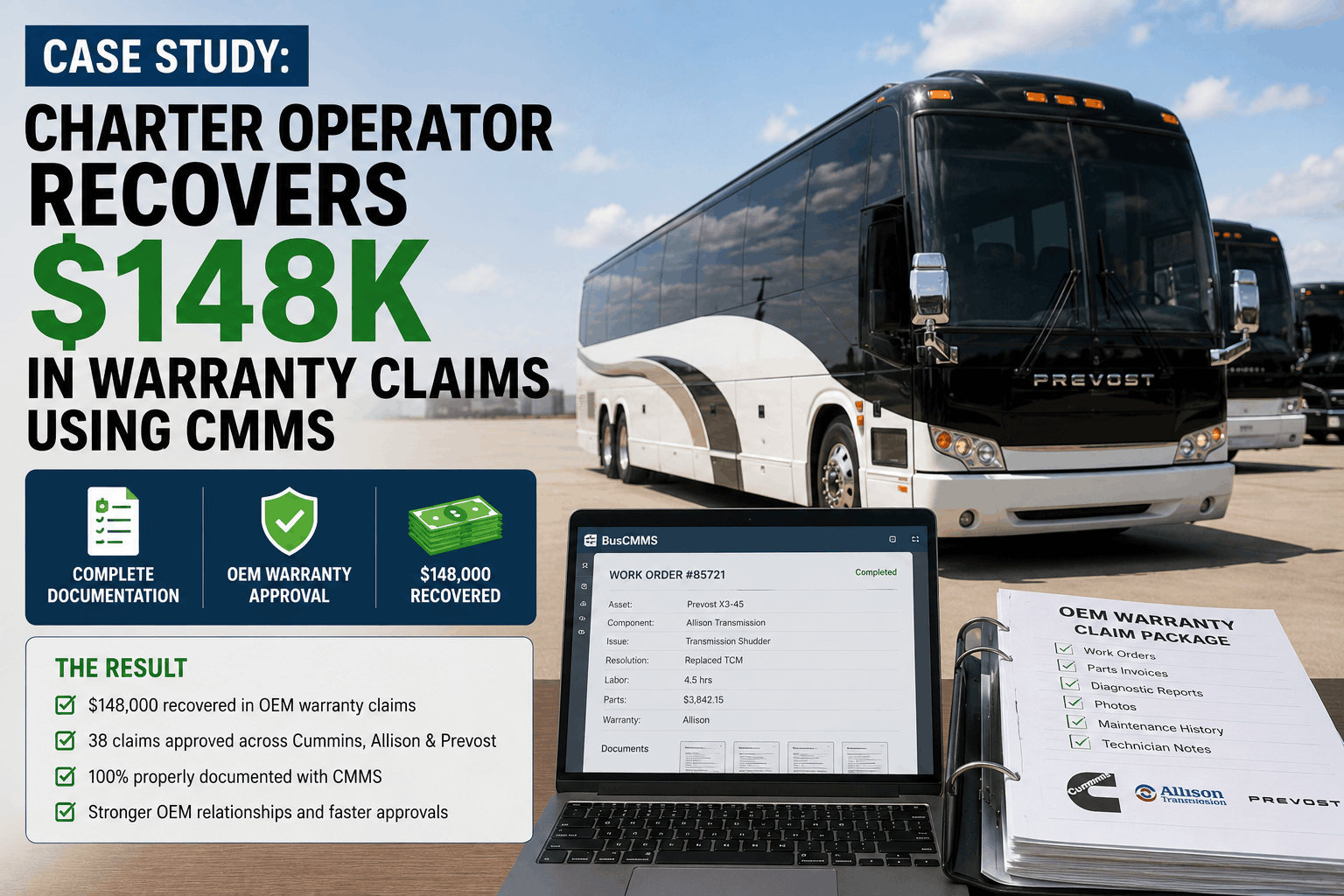
Motorcoach operators leave thousands of dollars in OEM warranty claims unsubmitted every year because work order documentation is incomplete or disorganized. This case study shows how one charter operator recovered $148,000 in Cummins, Allison, and Prevost warranty claims within 12 months using BusCMMS to automate documentation and submission.
Warranty Recovery Case Study 2026
Case Study: Charter Operator Recovers $148K in Warranty Claims Using CMMS
Motorcoach operator recovers $148K in OEM warranty using BusCMMS work order documentation. Cummins, Allison, Prevost — case methodology + paperwork.
Results at a Glance: $148K Recovered in 12 Months
The operator transitioned from paper repair orders and a manual warranty log to a fully digital CMMS. The system automatically flagged warranty-eligible repairs and generated OEM-ready claim packages.
$148,000
Total warranty dollars recovered
87%
Claim submission success rate
12 months
Time to achieve full recovery
100%
Eligible claims now submitted
The Challenge: Missing Documentation Cost Real Money
Paper Repair Orders
Technicians filled out carbon-copy repair orders. Missing fields, illegible handwriting, and lost copies meant claims were rejected or never filed.
No Warranty Tracking System
The fleet relied on a single spreadsheet that was updated monthly. Expired claim windows and missed submissions were common.
Inconsistent Labor Coding
Warranty labor operations weren't consistently flagged. The OEMs rejected claims for lack of proper SRT coding and repair narratives.
Part Number Gaps
Many claims lacked accurate OEM part numbers. Without proof of genuine parts usage, warranty reimbursement was denied.
Claim Backlog
Over $40,000 in claims sat unsubmitted for 6–18 months. Some had already passed the OEM filing deadline and were lost permanently.
No Management Visibility
The owner had no real-time view of warranty recovery performance. Decisions about repair vs. replace were made without warranty data.
Implementation Timeline & Recovery Growth
Month 1–2: Digital Work Orders Launch
All repair orders digitized with mandatory fields. Warranty-eligible repairs automatically flagged. Backlog of $14K in pending claims submitted immediately.
Month 3–4: OEM Integration Setup
Cummins, Allison, and Prevost warranty templates loaded. Claim packages auto-populated with SRT codes, part numbers, and repair narratives.
Month 5–6: First Major Recovery
$37K recovered from Cummins for engine component failures. Claim submission time dropped from 3 hours to 15 minutes per claim.
Month 7–8: Process Refinement
Zero rejected claims for two consecutive months. Warranty parts automatically flagged at stocking. Proactive inspections added for known warranty-prone components.
Month 9–10: Allison Transmission Wins
$42K recovered from Allison for transmission repairs across 8 coaches. Historical claims from the prior 12 months were resubmitted with corrected documentation.
Month 11–12: Full System Maturity
Total recovery reaches $148K. Warranty submission becomes a standard workflow. Fleet manager projects $165K+ in annual ongoing recovery.
Warranty Recovery by OEM
Engine and transmission claims accounted for 70% of total recovery. Digital documentation made the difference — clear SRT codes, parts verification, and repair narratives that OEMs accepted without question.
What Changed: The Documentation Difference
Mandatory Digital Work Orders
Every repair required technician sign-off with SRT codes, part numbers, and failure descriptions. Incomplete orders couldn't be closed, forcing complete documentation.
Automatic Warranty Flagging
The CMMS checked each part against OEM warranty tables at the time of repair. Eligible claims were added to a submission queue automatically.
OEM-Ready Claim Packages
Pre-built templates for Cummins, Allison, and Prevost generated complete claim files with all required fields. Submission time dropped from hours to minutes.
Parts Verification Workflow
Only genuine OEM parts with verified numbers could be used on warranty repairs. The system blocked aftermarket substitutions that would void coverage.
Expiration Alerts
Claims approaching the OEM filing deadline triggered alerts to the warranty administrator. No claims were lost due to missed windows after implementation.
Management Dashboard
A real-time warranty dashboard showed submitted, pending, and recovered dollars by OEM. The owner reviewed it weekly and made informed repair decisions.
Before vs. After: Warranty Performance Metrics
Claim Submission Rate
Before: 40% of eligible claims submitted. After: 100% — Every warranty-eligible repair now generates a claim automatically.
First-Pass Approval Rate
Before: 35%. After: 87% — Clean, complete claim packages dramatically reduced OEM rejections.
Average Claim Value
Before: $1,200. After: $3,100 — Better documentation captured labor, diagnostics, and related parts that were previously missed.
Claim Submission Time
Before: 3 hours per claim. After: 15 minutes — Automated assembly of required forms and attachments.
Claims Lost to Deadline
Before: 12 per year ($28K lost). After: 0 — Alert system ensures no filing window is missed.
How They Built the Warranty Recovery System
OEM Warranty Tables Loaded
Loaded warranty coverage tables for all engines, transmissions, and coach components. The system matched parts to active warranties in real time.
Technician Training Session
Two-hour session on digital work order completion. Emphasis on SRT codes, part number entry, and failure description quality.
Warranty Administrator Role Created
Dedicated staff member reviewed flagged claims weekly, submitted to OEMs, and tracked reimbursements. Time commitment: 4 hours per week.
Claim Package Templates Built
Created digital templates matching each OEM's exact requirements. All necessary fields auto-populated from work order data.
Historical Claim Recovery Project
Audited past 18 months of repairs for missed warranty opportunities. Resubmitted 22 claims with corrected documentation, recovering $31K.
Monthly Audit Cadence
Warranty administrator and fleet manager meet monthly to review open claims, rejection patterns, and new warranty coverage opportunities.
We knew we were leaving money on the table with warranty, but we had no idea it was $148,000 in a single year. BusCMMS didn't just organize our documentation — it created a warranty recovery process that pays for the software many times over.
Stop Leaving Warranty Money Unclaimed
BusCMMS flags warranty-eligible repairs automatically, generates OEM-ready claim packages, and tracks every dollar through reimbursement. Book a demo and discover how much warranty recovery your fleet is missing.
Warranty Recovery Case Study FAQs
Is this case study based on a real operator?
Yes. The data comes from a 45-coach charter operator in the Southeast US that implemented BusCMMS in 2025. Specific identifying details have been anonymized at the operator's request. The $148K recovery figure is verified.
What types of repairs qualify for OEM warranty recovery?
Engine, transmission, and major component failures within the OEM warranty period typically qualify. The operator recovered on Cummins ISX12 engine components, Allison B500 transmissions, and Prevost chassis systems.
How long does it take to start seeing warranty recovery?
This operator submitted $14K in backlog claims within the first month. New claims started generating reimbursement within 45 days of implementation. Full recovery velocity was achieved by month six.
Can a small fleet recover significant warranty dollars?
Yes. Even fleets with 10–15 coaches typically recover $15K–$30K annually when warranty documentation is systematized. The percentage recovery scales with fleet size and component complexity.
What was the biggest documentation gap before the CMMS?
Missing SRT (Standard Repair Time) codes and genuine part numbers were the top two reasons for claim rejection. Digital work orders enforce these fields before a repair can be closed, solving the root cause.
Does the CMMS integrate with OEM warranty portals?
While the CMMS does not submit directly to OEM portals, it generates complete claim packages with all required fields. The warranty administrator then submits via the portal. The preparation time per claim dropped from 3 hours to 15 minutes.
Warranty Recovery Is a Process, Not a Hope
This charter operator proved that warranty recovery isn't luck — it's a documented, systematic workflow. By digitizing repair orders, enforcing complete documentation, and automating warranty flagging, they recovered $148,000 in 12 months from three major OEMs. The process now runs as a standard business operation, generating ongoing annual recoveries that exceed the cost of the CMMS many times over. For any motorcoach or charter operator running modern coaches, a warranty recovery system built into the maintenance platform is no longer optional — it's a direct line to the bottom line.