The CNG leak check on bus 7 got done Tuesday — your tech is sure of it. But when the inspector asks for the record, it is a smudged clipboard line, and the one before it is missing. The inspection happened; the proof did not. You can see how a tracked CNG leak-check log makes every inspection audit-ready.
CNG Bus Fuel System Leak Inspection: Checks, Logs, and Audit-Ready Records
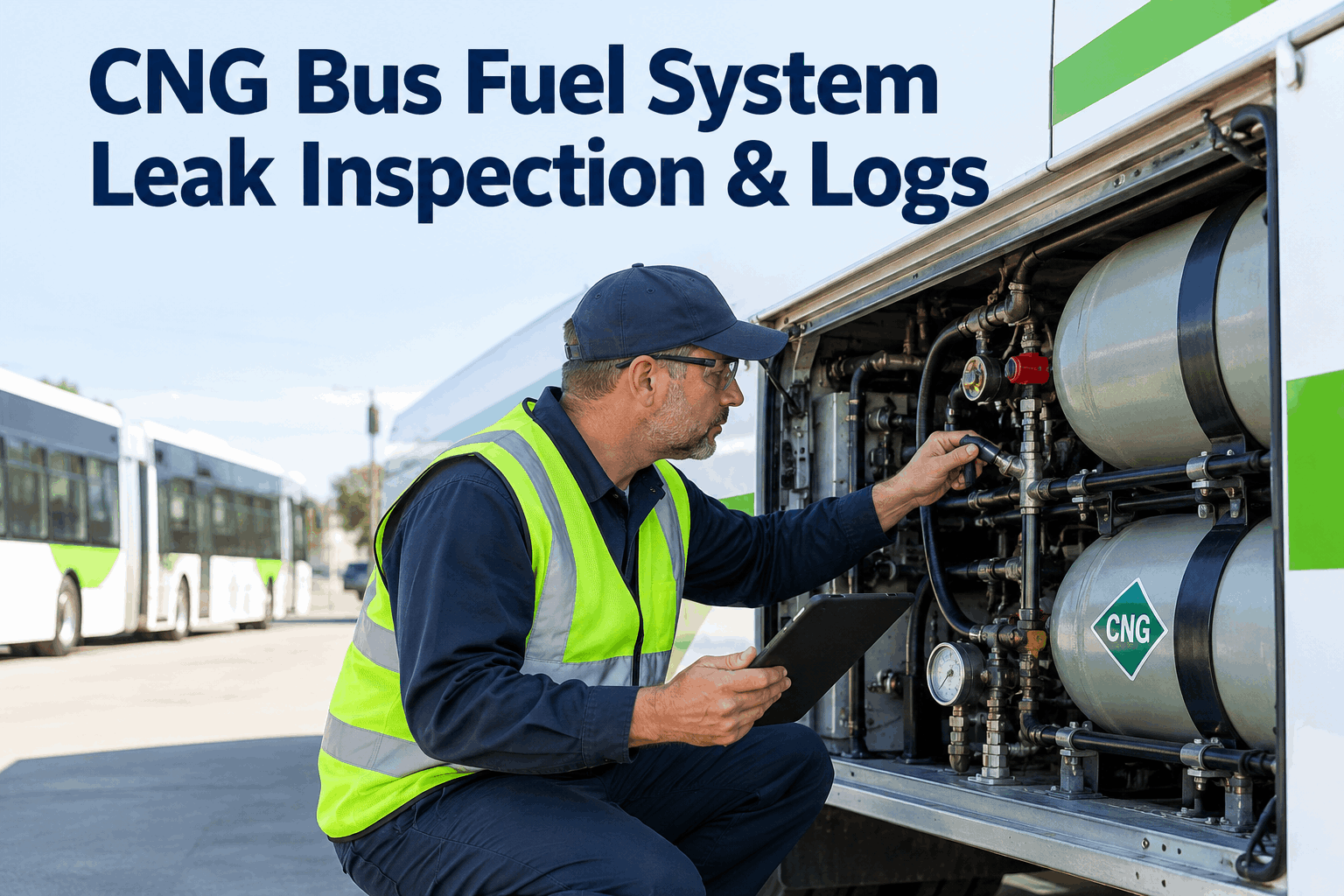
A CNG leak inspection is only as good as the record it leaves behind. Every high-pressure component from the fill receptacle to the regulator has to be checked — and every check has to be logged, so a methane leak is caught early and a compliance audit is a non-event. Here is the system you are inspecting, and where the leaks hide.
What a Methane Reading Actually Means
A CNG leak check is not just a visual once-over. Techs confirm suspect joints with a methane detector that reads in percent of the lower explosive limit, or %LEL — the share of the concentration needed for an explosive mixture. The number the detector shows is the difference between "log it and move on" and "clear the shop now," so every tech needs to read it the same way.
Zone thresholds shown are a common fleet convention — many detectors alarm around 10% LEL and treat 25% as an evacuate point. Set yours to your site's safety plan and your detector manufacturer's guidance, then make the same numbers mean the same action for every tech. A reading only protects you if it is recorded and acted on the same way every time — written on a clipboard, that number is gone by next week. You can start free and capture every reading against the bus and the joint.
Where Paper Leak-Check Logs Fail You
Heavy-duty CNG buses need a documented fuel-system inspection at least once a year, with cursory checks at every pre-trip and a detailed check after any accident or thermal event. That is a lot of records — and on paper, the one the auditor wants is always the one that went missing.
The CNG Fuel System Leak Inspection Checklist
A detailed CNG leak inspection walks the whole high-pressure system. Run this on every CNG bus, record the result at each point, and the log builds itself as you go.
- Fill receptacle, cap, and check valveThe fueling point sees the most connect-and-disconnect wear — check for leaks and damage first.CRITICAL
- Storage cylinders, container valves, and PRDsInspect cylinders and pressure-relief devices for damage, corrosion, and leaks per the OEM and CGA guidance.CRITICAL
- Fuel lines, hoses, and fittingsMethane-test every joint; lines and fittings are the most common slow-leak point.CRITICAL
- Shut-off valves and pressure regulatorConfirm the manual shut-off seals and the regulator holds pressure without seeping.KEY
- Mounting brackets, labels, and defueling valveVerify everything is secure and labeled — loose mounts and missing labels are common audit findings.KEY
- Record every reading, date, and inspectorThe log is the proof — capture the %LEL result, the point, the date, and who signed off.LOG
On paper this is six places to check and six chances to lose the record. In BusCMMS it is a pre-loaded CNG inspection form where each point is logged, a failed check opens a work order, and the whole history is one click from an audit. You can book a demo and see the CNG leak-check form built in.
How BusCMMS Logs CNG Leak Inspections
The difference between a clipboard and a compliance record is whether the inspection is tied to the bus, the date, and the result in a system you can search. Here is what that looks like for a CNG fleet.
Pre-loaded CNG inspection forms
The fuel-system leak-check form is built in — cylinders, valves, lines, regulator — so techs follow the same walk-around every time instead of a form someone drew up once.
Every reading logged to the bus
Each %LEL reading is captured against the specific bus and joint, with the date and the inspector — a record that holds up in an audit, not a line that fades on a clipboard.
Failed checks become work orders
A leak above threshold opens a work order automatically, tagged to the component — so the repair is tracked to completion, not left on a sticky note until it is forgotten.
The whole history, one click away
When an inspector asks for a bus's leak-check history, you pull the full record in seconds instead of digging through a binder — the audit becomes a formality.
Interval guidance per the NGV System Inspection Guide and FMVSS 304 (effective March 2022), which sets at least annual fuel-system inspection for heavy-duty natural-gas vehicles. Buses fall in the heavy-duty class, so the annual-minimum detailed inspection applies — on top of pre-trip and post-event checks.
That is how a CNG fleet stops treating leak checks as a paperwork chore and starts treating them as the safety and compliance backbone they are — worth seeing on your own fleet in a short walkthrough of CNG leak-check logging.
Our CNG leak checks were always getting done — proving it was the problem. The inspector did not care that we were careful; he cared whether the record existed. We had one gap from a tech who left, and it cost us. Now every methane reading is logged to the bus the second it is taken, and the last audit took twenty minutes. The inspection was never the hard part. The paper trail was.
CNG Leak Inspection and Logs: The Short Version
Check the whole high-pressure system
From fill receptacle to regulator, every cylinder, valve, line, and fitting is a leak-check point.
Read the methane detector the same way
A %LEL reading drives action — log it, tag it, or evacuate — so every tech must interpret it consistently.
The record is the compliance
A detailed inspection is required at least yearly for heavy-duty CNG buses — and the proof is the log, not the memory.
Tracked beats paper every audit
One missing clipboard line is a finding; a searchable log makes the whole history one click away.
CNG leak inspection is where safety and compliance meet — a missed leak is a hazard, and a missed record is a violation. Do the walk-around, read the detector the same way every time, and log every point so the proof is always there. That is how a CNG fleet turns a required inspection into a defensible record instead of a recurring audit scramble. You can start free and make every leak check audit-ready.
CNG Leak Inspection: Common Questions
What does a CNG bus fuel system leak inspection cover?
A detailed CNG leak inspection covers the entire high-pressure system: the fill receptacle and cap, check valves, storage cylinders and their container valves, pressure-relief devices, manual shut-off valves, the pressure regulator, filtration, fuel lines and hoses, mounting brackets, system labels, and the defueling valve. Each connection is checked visually for damage and tested for leaks with a methane detector. Every point should be recorded so the inspection produces a complete, defensible log.
How often must CNG buses have a fuel system inspection?
Under FMVSS 304 guidance effective March 2022, heavy-duty natural-gas vehicles — which includes buses — need a documented fuel-system inspection at least every 12 months. On top of that annual detailed inspection, best practice is a cursory leak-and-damage check at every pre-trip and post-trip, and a full re-inspection after any accident or thermal event. Cylinders also carry their own periodic inspection requirements per the manufacturer and CGA guidance.
How do you detect a CNG leak on a bus?
Three ways, used together. A rotten-egg smell or a hissing sound is the first warning. A methane detector gives a measurable reading in percent of the lower explosive limit, or %LEL, which tells you how serious the leak is. And a visual inspection catches damage, corrosion, or loose fittings before they become leaks. Suspect joints are confirmed with the detector, and the reading determines whether you log it, tag and repair it, or evacuate the area.
Why do CNG leak-check records matter for compliance?
Because in an audit, the inspection you cannot prove did not happen. Regulators and safety auditors want to see a documented history of fuel-system inspections, the results, and the corrective action taken on any defect. A missing record — even for a check that was genuinely performed — is a finding. Keeping every leak check logged to the bus, with the reading, date, and inspector, turns compliance from a scramble through binders into a record you can produce on demand.
How does BusCMMS help with CNG leak inspection records?
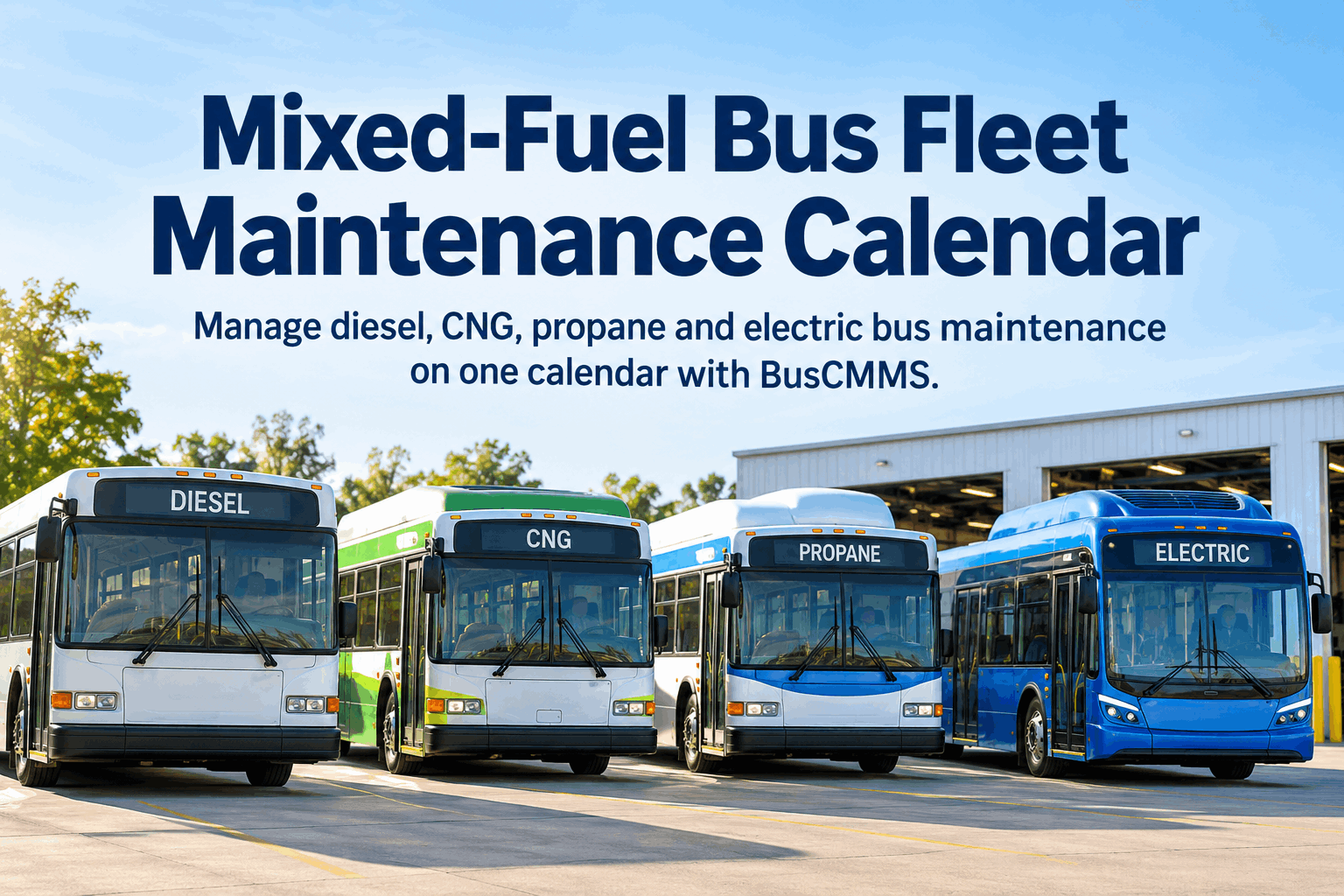
BusCMMS provides CNG-specific inspection forms covering the full high-pressure system, logs every methane reading against the specific bus and joint with the date and inspector, and automatically opens a work order when a check fails so the repair is tracked to completion. The complete leak-check and repair history for any bus is then one click away for an audit. It keeps CNG inspection logic alongside your diesel, propane, and electric buses on one dashboard, so every fuel type gets the right checks on schedule.