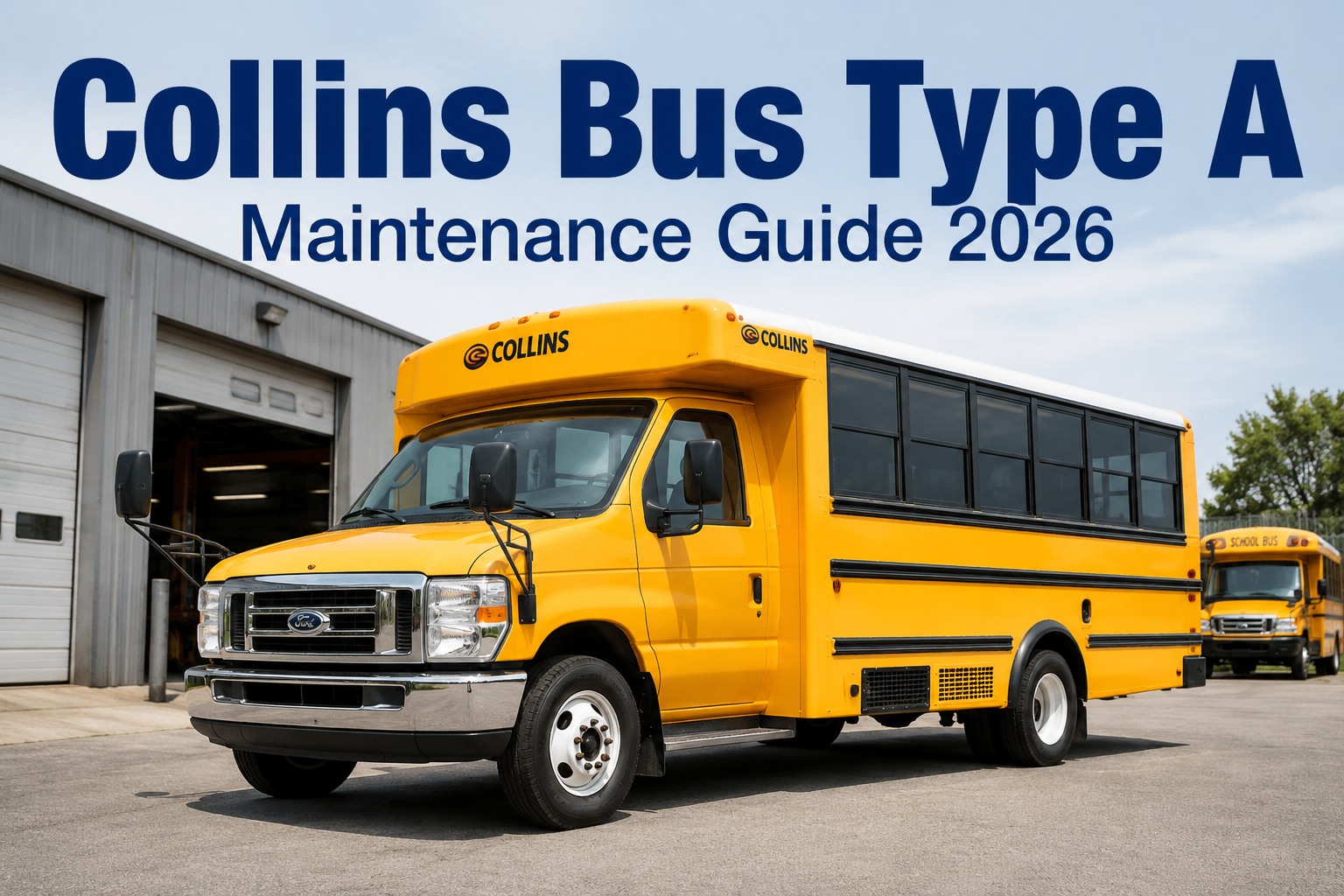
Collins Bus has been building Type A school buses out of South Hutchinson, Kansas for over 55 years, and that longevity is why the average Collins-heavy district today has NexBus, Grand Bantam, and Bantam variants spanning 15-20 model years side by side on the shop floor. A 2009 Grand Bantam on a pre-DPF chassis. A 2016 NexBus with DEF and SCR. A 2024 E-Transit electric. Each is a completely different maintenance program, and treating them all as "Collins Type A" is why so many districts under-maintain them. This guide organizes maintenance the way a Collins-heavy fleet actually operates: identify your model year era first, then dial in the chassis, the powertrain, the ADA lift, and the age-band playbook that keeps each generation on the road. See BusCMMS run age-band PM templates on your Collins fleet → book a 20-min demo.
The Collins Bus Timeline Fingerprint
Every Collins on your roster falls into one of four eras. The era determines the entire PM program, the aftertreatment discipline, the parts sourcing risk, and the tooling required. Point at each unit on your roster and mark the era.
ERA APre-2007 Pre-DPF Simplicity Era
Aftertreatment:None (pre-emissions rules)Complexity:Lowest engine complexityParts sourcing:HIGH RISK · discontinued OEM partsERA B2007-2010 Early DPF (No SCR) Era
Aftertreatment:DPF only, no DEF systemComplexity:Regen management requiredParts sourcing:MEDIUM RISK · some OEM discontinuedERA C2011-2020 DPF + SCR + DEF Era
Aftertreatment:DPF + SCR with DEF fluidComplexity:Full modern emissions disciplineParts sourcing:LOW RISK · OEM parts currentERA D2020-2026 Current Fleet Era
Aftertreatment:Latest DEF-Master + E-TransitComplexity:Emissions + BEV pathwaysParts sourcing:LOW RISK · full OEM support
Walk your yard right now and count how many buses fall in each era. If your Era A + Era B count is above 25% of your Collins fleet, you have a parts-sourcing problem coming that most fleet software cannot solve. Section 5 addresses this specifically.
The Collins Model Family Tree
NexBus, Grand Bantam, Bantam, Super Bantam — and the Ford E-Transit electric. Six model lines share a body language but not a maintenance program.
Collins Bus produces the widest Type A model lineup in the industry. NexBus is the flagship school bus line. Grand Bantam is the dual-rear-wheel large-capacity variant. Bantam and Bantam 422 are single-rear-wheel light configurations. Super Bantam is the mid-size dual-rear-wheel option. Sister brands Mid Bus and Corbeil use the same underlying construction with minor styling differences. And since 2023, the Ford E-Transit electric variant is the first Type A school bus on a full-line-automaker electric powertrain. If your fleet has more than one model line, you have more than one PM program.
NexBus
Main Type A school bus line. Available on Chevrolet, GMC, or Ford chassis with gas, diesel, CNG, propane, or hybrid engines. Altoona-tested 7 years / 200,000 miles.
Grand Bantam
Dual rear wheel, up to 35 passengers. The workhorse Collins for larger route counts. Built on Ford E-450 or Chevy 6500 chassis.
Bantam / Bantam 422
Single rear wheel, up to 20 passengers. Best for special-needs routes and small rural runs. Ford E-350 or Chevy 4500 chassis.
Super Bantam
Dual rear wheel, up to 30 passengers. Middle-ground capacity between Bantam and Grand Bantam. Same chassis options.
E-Transit Type A
Ford E-Transit electric chassis, 68 kWh battery, 8-year/100K-mile warranty. Available for orders May 2023. First Type A electric from a full-line automaker.
Mid Bus & Corbeil
Collins Industries sister brands. Same tubular roof bow, same G90 galvanized steel frame, minor exterior styling differences.
Each model line accepts different chassis + engine combinations. Section 3 addresses the chassis split. See BusCMMS enforce model-specific PM per Collins line → book a demo.
The Aftertreatment Age Question (This Is the Central Discipline)
Different Collins model years = fundamentally different emissions systems. Same PM template on all of them is why regen faults, DEF crystallization, and SCR failures happen.
Micro Bird fleets bleed money on Ford-vs-GM chassis confusion. Collins fleets bleed money on aftertreatment-era confusion. A pre-2007 Grand Bantam has a simple diesel and no emissions system to service. A 2008 Collins has a DPF that needs regen management but no DEF. A 2015 NexBus has both DPF and SCR with DEF quality tracking. A 2024 unit has the latest DEF-Master calibration. A single-template PM program on this mixed fleet is a broken program. The three lanes need to be run separately.
Pre-DPF (Pre-2007)
Simplest engine, hardest partsEarly DPF (2007-2010)
DPF regen only, no SCRDPF + SCR + DEF (2011-2026)
Full modern emissions disciplineThe three lanes need three separate PM templates and three separate diagnostic disciplines. This is the single biggest maintenance discipline gap on multi-generation Collins fleets. See BusCMMS load emissions-era-specific PM per bus automatically → book a demo.
Chassis Split: Ford E-Series, Chevy/GMC, Ford Transit, E-Transit Electric
Every Collins is one of four chassis families. Each has its own fluids, diagnostics, and torque numbers.
Below the Collins body, every bus is one of four chassis platforms. Collins uses the Ford E-Series (E-350, E-450) with the current 7.3L V8 "Godzilla" gasoline engine (350 hp / 468 lb-ft) or older 6.8L V10 configurations. Collins uses the Chevy/GMC 4500/6500 with the 6.6L V8 L8T gasoline engine (350 hp / 400 lb-ft). Collins uses the Ford Transit for smaller-capacity variants, and since 2023 the Ford E-Transit with a 68 kWh battery and an 8-year/100K-mile warranty. Each family has its own fluids, its own diagnostic tool, its own transmission service program. Cross-contamination between them is the top warranty rejection reason.
Motorcraft Gold and Dex-Cool are chemically incompatible. Cross-contamination between Ford and Chevy Collins chassis destroys water pumps within weeks. This alone is worth per-chassis fluid enforcement. Sign up free and log per-bus chassis + fluid spec →
The 90-Day ADA Lift Discipline (Mini-Section)
Wheelchair-accessible Collins buses carry the district's ADA-critical routes. The 90-day certification clock is not negotiable.
A significant portion of any Collins fleet carries wheelchair lifts — the model lineup was designed with special-needs configurations as a core use case. Each wheelchair-accessible Collins carries its own 90-day ADA lift certification clock. Miss it and the bus cannot legally carry the student until re-certified. The full lift discipline is straightforward and needs its own countdown per bus — not a shared PM date on a spreadsheet.
Last certifiedDAY 60
Schedule alertDAY 90
Expires
Every wheelchair-accessible Collins needs its own 90-day countdown, its own alert, its own escalation. See BusCMMS run per-bus 90-day ADA countdowns → book a demo.
The Age-Band Quarterly Playbook (The Centerpiece)
If your Collins is in Era A, do this in Q1, Q2, Q3, Q4. Same for Era B and Era C. A tactical planning grid every fleet supervisor should print and post.
This is the section that separates disciplined multi-generation Collins fleets from struggling ones. The three aftertreatment eras identified in Section 2 map to three different quarterly PM focuses. Era A (pre-DPF) needs proactive parts sourcing every quarter. Era B (early DPF) needs regen management attention. Era C (DPF+SCR+DEF) needs full modern discipline. Overlaying quarterly PM focuses on top of era gives the shop foreman a printable tactical planning grid: this quarter, on Era A buses, focus here.
Pre-2007Winter chassis & cooling auditParts sourcing pre-order for annual PMSuspension & brake full teardownEnd-of-life vs rebuild decision
2007-2010DPF regen health scanDPF ash cleaning if due (100K-150K)Route review: short-trip regen riskInjector spray pattern check
2011-2020DEF quality lab testSCR NOx sensor scanDPF regen health scanDEF tank cleanout for winter storage
2020-2026Full modern PM per OEM intervalWarranty claim window reviewSoftware / calibration updatesBEV thermal system audit (E-Transit)
Print this. Post it above the shop supervisor's desk. Every Monday morning, look at what quarter it is and what era each Collins on the shop floor falls in. That is disciplined multi-generation fleet maintenance. See BusCMMS auto-load era-specific quarterly PM items per Collins → book a demo.
We run 18 Collins Type A buses across model years 2008 through 2024. Six are Grand Bantams from 2008 to 2012 — pre-DPF and early-DPF era. Eight are NexBus from 2015 to 2020 with DPF and SCR. Four are new Grand Bantams from 2022 to 2024. For years we ran one PM template on all of them. Two problems became obvious once we mapped them to the era grid. Our 2009 units were coming due for DPF ash cleaning that the shop had never done because we never tracked that interval. And our 2015-2020 NexBus fleet had four DEF quality faults in one quarter because we were topping off DEF from a bulk drum that had been open 18 months past its shelf life. Moved to era-specific PM templates in BusCMMS and inside 90 days the DEF fault count went to zero and we had a parts pre-order plan for the pre-DPF buses. Not one more emergency road call from an emissions fault this year.
What a Multi-Generation Collins Fleet Gets in BusCMMS
Six capabilities purpose-built for the Type A fleet supervisor running four aftertreatment eras and four chassis families at the same time.
Era-specific PM templates
Pre-DPF, early DPF, DPF+SCR+DEF, and current fleet templates load automatically per model year on the bus record. No manual sorting.
Ford / Chevy / Transit / BEV lane separation
Fluid spec locked per chassis. Cross-contamination alerts fire before wrong fluid gets logged. BEV thermal-system PM loads on E-Transit only.
ADA lift 90-day countdown per bus
Every wheelchair-accessible Collins has its own clock. 30-day scheduling alert. 15-day escalation. 7-day route-manager notification.
Parts sourcing risk flags
Era A units get parts pre-order alerts each quarter. Discontinued OEM parts flagged. Aftermarket cross-references logged per bus.
DEF quality & shelf-life tracking
DEF bulk drum open-date logged. 18-month shelf-life alert fires before quality faults occur. DEF cross-contamination prevention.
Age-band quarterly matrix loaded
The 4x4 era-by-quarter matrix from Section 5 lives in the shop dashboard. Automatic per-bus items every quarter.
Four DEF quality faults in one quarter to zero in 90 days — on the same 18-Collins fleet, same DEF fluid supplier, different tracking discipline. That is the era-PM ROI. See how →
Frequently Asked Questions
What Collins Bus Type A models are currently in production?
Collins Bus produces the widest Type A model lineup in the industry from South Hutchinson, Kansas as a subsidiary of REV Group. The NexBus is the flagship Type A school bus line, available on Chevrolet, GMC, or Ford chassis with gasoline, diesel, CNG, propane, or hybrid engines and Altoona-tested for 7 years / 200,000 miles. Grand Bantam is the dual-rear-wheel large-capacity variant seating up to 35 passengers on a Ford E-450 or Chevy 6500 chassis. Bantam and Bantam 422 are single-rear-wheel light configurations seating up to 20 passengers on a Ford E-350 or Chevy 4500 chassis. Super Bantam is the mid-size dual-rear-wheel option seating up to 30 passengers. Since May 2023, Collins offers a Ford E-Transit electric Type A with a 68 kWh high-voltage battery and an 8-year/100,000-mile warranty -- the first Type A school bus on an electric powertrain from a full-line automaker. Sister brands Mid Bus and Corbeil share the same underlying construction with minor styling differences. Every Collins uses a one-piece tubular roof bow (66% stronger than traditional steel), a G90 galvanized steel frame, HSLA (high-strength, low-alloy) steel construction, and SafeGuard XChange Seating.
Why does model year matter so much for Collins Bus maintenance?
Because Collins has been building Type A buses continuously for over 55 years, the average Collins-heavy district today has units spanning three or four fundamentally different aftertreatment eras on the shop floor at the same time. Pre-2007 (Era A) buses have simple diesels with no DPF, no SCR, no DEF -- but parts sourcing gets increasingly hard as OEM components are discontinued. 2007-2010 (Era B) buses introduced DPF (diesel particulate filter) technology requiring regen management but no DEF fluid. 2011-2020 (Era C) buses added SCR (selective catalytic reduction) with DEF (diesel exhaust fluid) tracking -- ISO 22241 32.5% urea with a 2-year shelf life and a DEF cross-contamination risk that costs $2,500-$5,000 in SCR damage. 2020-2026 (Era D) buses run the current DEF-Master emissions calibration plus the newer BEV E-Transit pathway. Running a single PM template across all four eras is why fleets get regen faults on pre-2010 buses, DEF quality failures on 2015-2020 buses, and BEV thermal alerts on 2024 units -- all preventable with era-specific PM discipline.
What is the difference between Ford and Chevy chassis on a Collins Bus?
Collins buses ride on four chassis families and each has its own fluids, diagnostics, and torque numbers. Ford E-Series (E-350 or E-450) uses the current 7.3L V8 "Godzilla" gas engine producing 350 hp / 468 lb-ft with Motorcraft SAE 5W-30 or 10W-30 oil, Motorcraft Gold VC-13 HOAT coolant, and Ford IDS/FDRS diagnostics -- GVWR 10,050-14,500 lb. Chevy/GMC 4500 or 6500 uses the 6.6L V8 L8T gas engine producing 350 hp / 400 lb-ft with Dexos1 Gen 3 5W-30 oil, Dex-Cool OAT orange coolant, and GM MDI/GDS2 diagnostics -- GVWR 9,900-14,200 lb. Ford Transit uses a 3.5L V6 (or diesel option) with a 10-speed automatic, Motorcraft 5W-30 oil, Motorcraft Gold coolant, and Ford IDS diagnostics -- GVWR 9,000-10,360 lb. Ford E-Transit BEV has a 68 kWh high-voltage battery, an 8-year/100,000-mile warranty, no oil changes, no spark plugs, no DPF, no DEF -- but adds thermal system PM, high-voltage cable inspection, and coolant loop service. Motorcraft Gold and Dex-Cool are chemically incompatible; cross-contamination destroys water pumps within weeks and is the top warranty rejection reason on mixed Ford/GM Collins fleets.
How often does a Collins Bus wheelchair lift need certification?
Every 90 days. The ADA-mandated 90-day wheelchair lift certification is not a suggestion -- it is the operational contract with students whose routes depend on that bus. Collins buses often carry a single special-needs student on a single route where no spare wheelchair-accessible bus exists, meaning an expired certification means the bus cannot legally carry the student until re-certified. Each 90-day certification covers hydraulic reservoir fluid level and condition, cylinder seal integrity, platform load test, all interlocks (door, ignition, kneel), wheelchair tie-down anchor pull test, occupant restraint condition and function, emergency backup pump operation, and the visible certification sticker. Every wheelchair-accessible Collins needs its own 90-day countdown clock -- not a shared PM date on a spreadsheet. Best practice is a 30-day scheduling alert, a 15-day escalation to the shop supervisor, and a 7-day route-manager notification if the appointment has not been booked.
How does BusCMMS help a multi-generation Collins Bus fleet?
BusCMMS runs era-specific PM templates that load automatically per model year on the bus record. Pre-2007 Era A units get parts-sourcing risk flags and quarterly pre-order alerts because OEM components are increasingly discontinued. 2007-2010 Era B units get DPF regen health scans and route-review prompts for short-trip risk. 2011-2020 Era C units get DEF quality lab tests, SCR NOx sensor scans, DPF ash cleaning at 100K-150K miles, and DEF bulk-drum shelf-life tracking (18-month alert before quality faults occur). 2020-2026 Era D units run current OEM PM intervals plus BEV thermal system audits on E-Transit buses. Chassis lane separation locks fluid spec per Ford E-Series, Chevy/GMC, Ford Transit, or E-Transit BEV -- attempting to log Motorcraft Gold on a Chevy or Dex-Cool on a Ford fires a cross-contamination alert to the shop supervisor before the entry saves. Every wheelchair-accessible Collins carries its own 90-day ADA lift countdown with 30/15/7-day escalation. One 18-Collins Southeast school district maintenance supervisor running units from 2008 through 2024 reported cutting DEF quality faults from four in one quarter to zero in 90 days after moving to era-specific PM templates -- and eliminating emergency road calls from emissions faults entirely for the year.