A large transit agency managing 450 buses struggled with compliance visibility. Federal DOT audits were unpredictable. Some buses had complete maintenance records. Others had scattered documentation across multiple systems. When an audit arrived, the agency spent three weeks scrambling to pull records, cross-reference data, and prove compliance. The audit found violations — not because maintenance was poor, but because the compliance story wasn't organized. After implementing a compliance analytics framework that unified records, created real-time audit trails, and automated compliance reporting, the same agency passed the next audit in four days with zero violations. Compliance analytics isn't about doing more maintenance. It's about proving you're doing it right. Here's how transit agencies build compliance analytics systems that answer auditors' questions before they're asked.
Compliance Analytics Framework for Transit Agencies
Auditors want proof. Build systems that organize maintenance data, create audit trails, and automate compliance reporting.
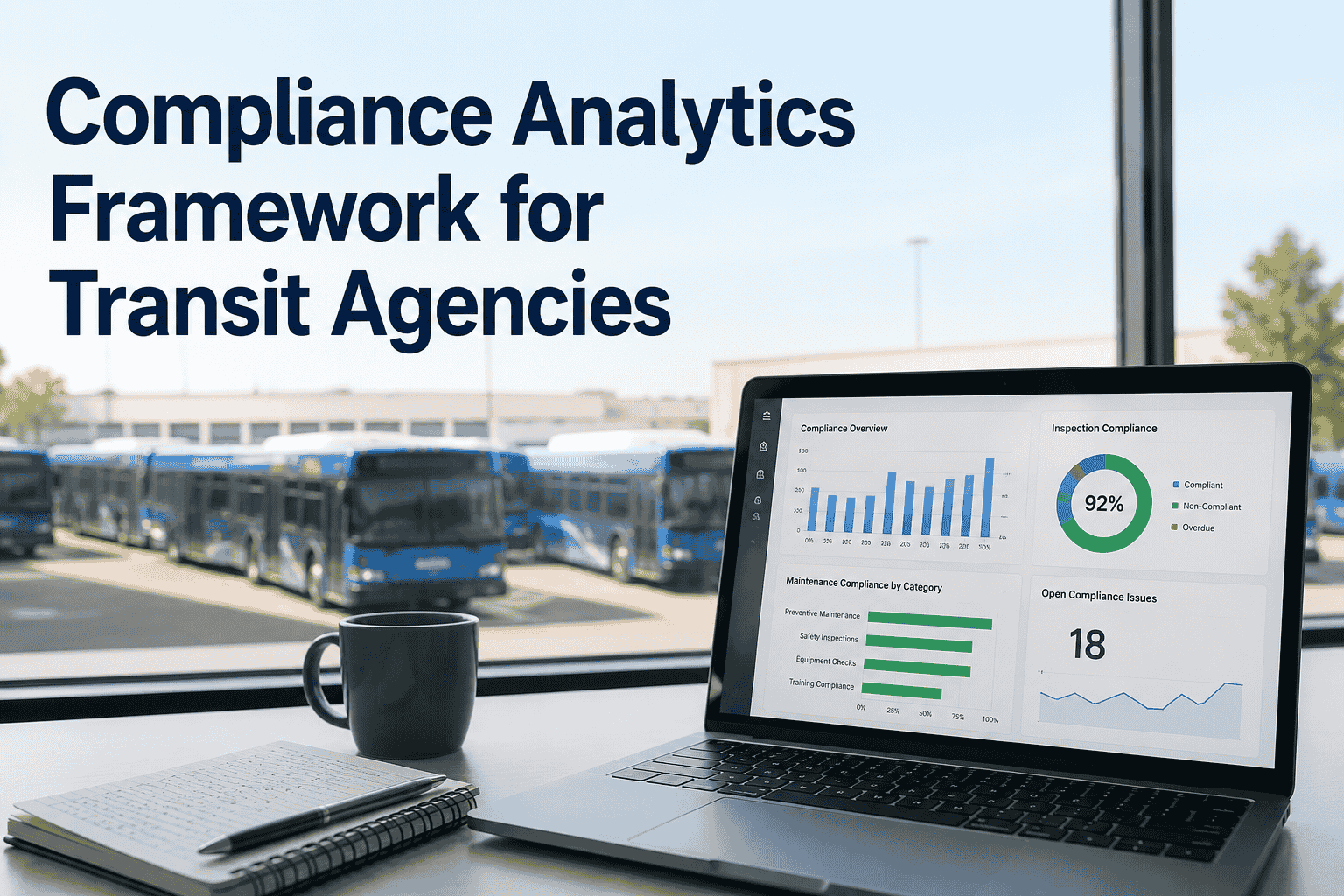
Compliance analytics is the systematic collection, organization, and analysis of maintenance and operational data to prove regulatory compliance. For transit agencies, this means: automated tracking of preventive maintenance schedules, digital documentation of all maintenance work, real-time compliance status dashboards, and automated audit-ready reports. Without it, compliance is reactive: auditors ask questions, you scramble to find answers. With it, compliance is proactive: you know your compliance status at all times and can generate audit reports on demand. The difference is not in the level of maintenance performed. It's in the visibility and organization of the data that proves maintenance was done. Compliance analytics frameworks typically include: unified data collection (all vehicles, all work, one system), automated audit trails (timestamp, who, what, when), real-time compliance dashboards (showing compliance status by vehicle and regulation), and one-click audit reporting (pull any audit report in minutes).
A complete compliance analytics framework includes four core components. First: unified data collection. All maintenance work (preventive, corrective, emergency) is logged in one system with mandatory fields (vehicle ID, work date, work type, technician, parts used, completion date). Second: automated audit trails. Every work order, inspection, and decision is timestamped and attributed to a specific user, creating an immutable record. Third: real-time compliance dashboards. Compliance status by vehicle, by regulation type, and by time period is visible to management at all times. Fourth: automated reporting. Pull compliance reports by regulation (FTA, DOT, FMCSA, local), by vehicle, by time period, or by maintenance type with one click. These four components work together: data collection feeds the audit trail, audit trails power the dashboards, and dashboards enable automated reports.
Transit agencies face compliance checks from multiple regulators: FTA (Federal Transit Administration), DOT (Department of Transportation), FMCSA (Federal Motor Carrier Safety Administration), and local authorities. Each has slightly different requirements, but common metrics appear everywhere. First: preventive maintenance compliance (PM schedule adherence). Have scheduled maintenance items been completed on time? Second: safety inspection compliance (annual, triennial inspections). All required safety inspections completed and documented? Third: driver qualification compliance (licensing, medical certification, training records). Do all drivers meet legal requirements? Fourth: vehicle inspection compliance (pre-trip DVIRs, defect documentation). Are drivers performing and reporting inspections? Fifth: parts and fluid tracking (replacement records, disposal documentation). Are parts tracked and legally disposed? Sixth: maintenance worker qualifications (certifications, training records). Do mechanics meet required standards? A compliance analytics system tracks all six categories automatically and flags non-compliance before auditors discover it.
Implementation doesn't require a massive overhaul. Start with data unification: move all maintenance records into one CMMS. Set up mandatory fields so every work order captures compliance-critical information. Enable audit trails so every action is timestamped and attributed. Then build dashboards: real-time compliance status by vehicle and regulation. Finally, automate reporting: templates for the audits you face regularly. The timeline is typically 90 days from start to full compliance analytics capability. Month one focuses on data migration and system setup. Month two focuses on dashboard development and staff training. Month three focuses on automation and fine-tuning. By month four, compliance analytics is operational and audit-ready.
Compliance analytics transforms auditing from a scramble into a routine. Instead of desperately gathering records when auditors arrive, you have organized data, documented proof, and automated reports ready at all times. A compliance analytics framework includes unified data collection, automated audit trails, real-time dashboards, and automated reporting. Implementation takes 90 days and pays back immediately: audit preparation drops from weeks to days, violations drop from 8–15 to 0–2, and pass rates improve to 92–98%. Transit agencies that invest in compliance analytics stop viewing audits as stressful and start viewing them as opportunities to demonstrate operational excellence. BusCMMS provides the compliance analytics infrastructure: unified maintenance tracking, real-time audit trails, compliance dashboards, and one-click audit reporting.