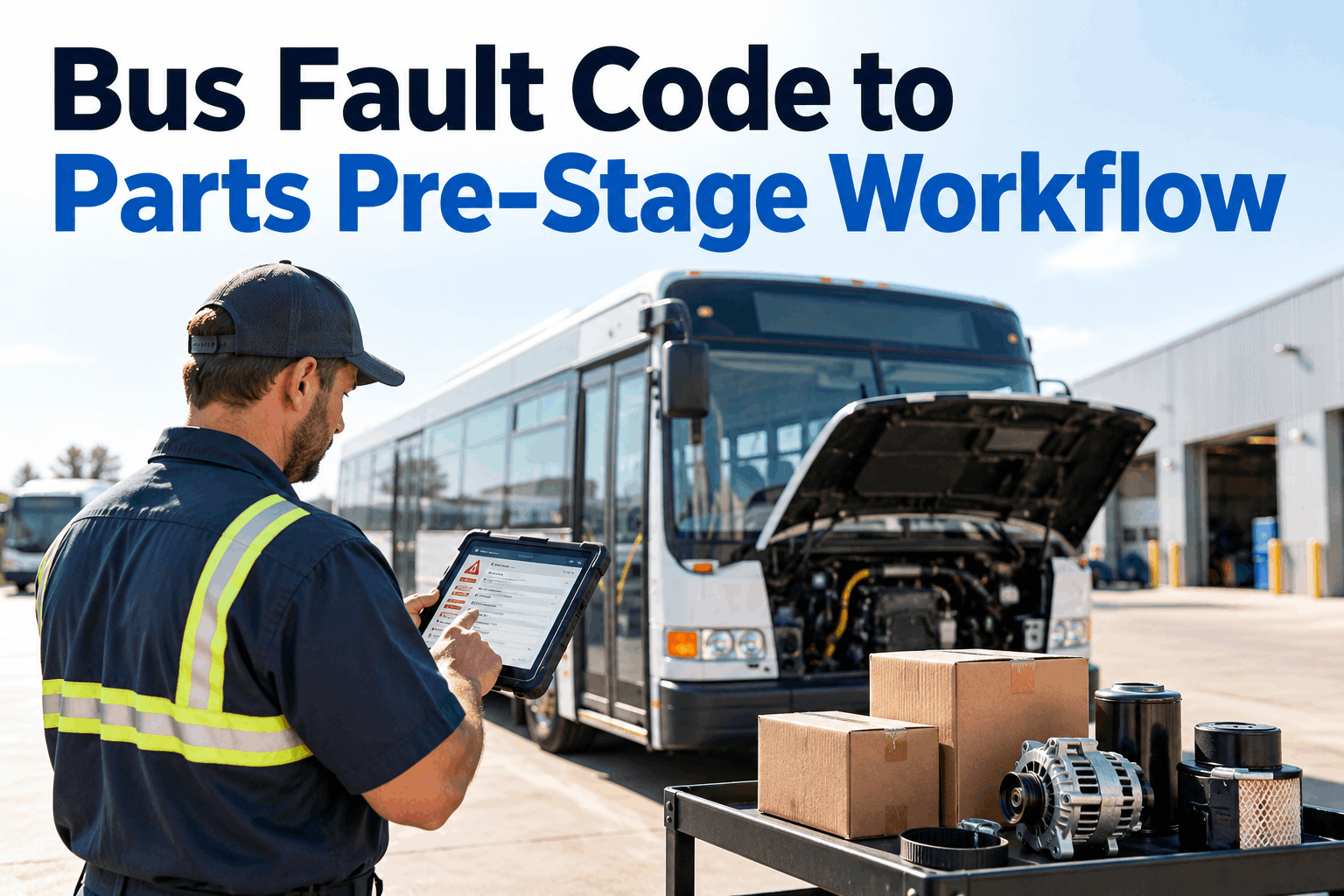
A fault code lands at 2 p.m.: SPN 157, FMI 18, from the engine. The bus finishes its route, rolls in — and the clock starts. Diagnose, find the part, discover it is not on the shelf, order it, wait a day while the bus sits dead on a lift. You can see how pre-staging parts from a fault code closes that gap.
Bus Fault Code to Parts Pre-Stage: Repairs Ready Before the Bus Is
A J1939 fault code already tells you what failed and how, the moment it happens. Read it right and the parts can be waiting at the bay before the bus even gets there. Here is the code, decoded.
Where the Downtime Actually Goes
The repair itself is rarely the problem. Most of a bus's time on the lift is spent waiting — waiting to be diagnosed, waiting on a part that was not on the shelf. Pre-staging attacks the wait, not the wrench time.
Catch the fault code while the bus is still finishing its route and the part can be pulled, reserved or ordered before it ever reaches the bay. You can book a demo and see the wait collapse on your own fault codes.
From Code to the Right Part on the Shelf
A fault code is only useful if it points to action. The same SPN and FMI that name the failure also point at the parts a tech will most likely need — which is exactly what you want staged before the work order is even opened.
Swipe the table sideways on a phone to see all three columns.
Illustrative J1939 examples — actual parts depend on your engine, model year, and OEM. The point is the code narrows the list before the bus arrives.
The Pre-Stage Workflow, Step by Step
Pre-staging is not guesswork — it is a fixed chain that runs the moment a fault code arrives, while the bus is still on the road. Five steps, each automatic once it is set up.
Fault code arrives
The telematics connector pulls the J1939 code the instant the engine controller logs it — mid-route, not at end of shift.
Code becomes a work order
The code auto-creates a work order on the right bus, pre-filled with the SPN/FMI and the system it came from — no manual entry.
Likely parts flagged
The system maps the code to the parts a tech will probably need and checks them against current inventory.
Parts pulled or ordered
In stock? Reserved and set aside. Not in stock? An order fires now — while the bus is still earning its route, not after it is parked.
Bus arrives to a ready bay
The work order is open, the part is on the bench, the tech starts turning wrenches on arrival instead of starting a parts hunt.
The whole chain runs before the bus is even in the yard. You can sign up free and wire your fault codes into this flow.
Is Your Fleet Ready to Pre-Stage? A Quick Check
Pre-staging only works if a few pieces are in place. Run this against your shop — every gap is a place a bus still sits waiting on a part.
- 1Fault codes flow in automatically from telematicsCodes arrive in real time mid-route, not read off a scanner at end of day.CONNECT
- 2A code opens a work order on its ownNo one re-keys the SPN/FMI or forgets to log it — the WO is already there.AUTOMATE
- 3Parts are linked to common fault codesThe system knows which parts a given code usually needs, so it can flag them.MAP
- 4Inventory is live, so you know what is on the shelfReal counts, not a guess — the difference between reserving a part and ordering one.STOCK
- 5Out-of-stock parts trigger an auto-orderThe order fires at code time, not after the tech discovers the bin is empty.REORDER
Most fleets have the telematics feed and stall on the rest. Closing those gaps is exactly what a walkthrough of the fault-to-parts flow is built to show.
Fault Codes That Build the Repair for You
Telematics, work orders, and parts inventory working as one chain — what a bus-specific CMMS does with a fault code that a standalone scanner never will.
Fault codes auto-create work orders
Pre-built Samsara and Geotab connectors turn a J1939 code into a work order on the right bus the moment it logs — no manual entry, no lost codes.
Parts flagged against live inventory
The likely parts are checked against real stock counts, so you know instantly whether to reserve one or order one.
Auto-reorder before the shelf is empty
Usage tracking and reorder alerts keep the common fault-code parts in stock, so pre-staging is not blocked by an empty bin.
My techs used to lose half a day to the parts counter. A code would come in, they would diagnose, walk to the cage, find the part gone, then wait on an order with the bus already down. Now the fault code flags the part before the bus is back — nine times out of ten it is sitting on the bench when the driver hands over the keys. We got buses back on routes a full day faster.
Key Takeaways on Fault-to-Parts Pre-Staging
The code already names the part
A J1939 SPN and FMI tell you what failed and how — enough to know the likely parts before anyone opens the hood.
The wait is the downtime
Most of a bus's time on the lift is waiting to be diagnosed and waiting on a part — not the repair itself.
Pre-stage while it is still rolling
Act on the code mid-route and the part is reserved or ordered before the bus is ever parked.
It takes one connected chain
Telematics, work orders, and live inventory in one system turn a code into a ready repair automatically.
A fault code is a head start, not just an alert. Use it to build the work order and stage the parts, and the bus spends its downtime being repaired instead of waiting to be — you can sign up free and put your fault codes to work.
Fault Code to Parts Pre-Stage FAQs
What is a fault code to parts pre-stage workflow?
It is a workflow that uses a vehicle's diagnostic fault code to prepare the repair before the bus reaches the shop. When a telematics system reports a J1939 fault code, the workflow turns it into a work order, identifies the parts the repair will likely need, checks them against inventory, and reserves or orders them. The result is that the part is staged and the work order is open by the time the bus arrives, instead of the shop starting a diagnosis and parts hunt from scratch.
How does a J1939 fault code tell you which part to stage?
A J1939 fault code has four parts: the source address (which controller reported it), the SPN or Suspect Parameter Number (what failed, such as fuel rail pressure), the FMI or Failure Mode Identifier (how it failed, such as below normal or data erratic), and the occurrence count (how many times since the code was cleared). Together the SPN and FMI narrow the failure to a specific component and failure mode, which maps to a short list of likely parts. Actual parts still depend on the engine, model year, and OEM, but the code gets you to the right shelf before diagnosis.
How much downtime does parts pre-staging actually save?
It depends on the fault, but the biggest savings come from eliminating the wait, not speeding up the wrench work. In a reactive repair, a bus can sit on the lift for a day or more waiting on a part that was not in stock. When the part is reserved or ordered the moment the fault code arrives — while the bus is still finishing its route — that waiting window largely disappears, and the repair starts on arrival. Fleets that pre-stage commonly report buses returning to service a full day sooner on parts-dependent repairs.
Do I need special hardware to read bus fault codes?
Usually not beyond the telematics device most fleets already run. Modern telematics units (such as Samsara and Geotab) read J1939 data off the vehicle's existing network and report fault codes in real time, which a CMMS can ingest through a pre-built connector. You do not need a technician plugging in a handheld scanner at end of shift — that is exactly the delay pre-staging removes, because the code arrives mid-route instead.
How does BusCMMS handle fault code to parts pre-staging?
BusCMMS uses pre-built telematics connectors to ingest J1939 fault codes in real time, auto-creates a work order on the correct bus with the code details filled in, and flags the likely parts against live inventory — reserving what is in stock and triggering a reorder for what is not. Because the work-order, parts, and inventory modules are one system, the repair is staged before the bus arrives. It is purpose-built for bus fleets and typically live in two to four weeks. You can start free or book a demo to see the flow run on real fault codes.