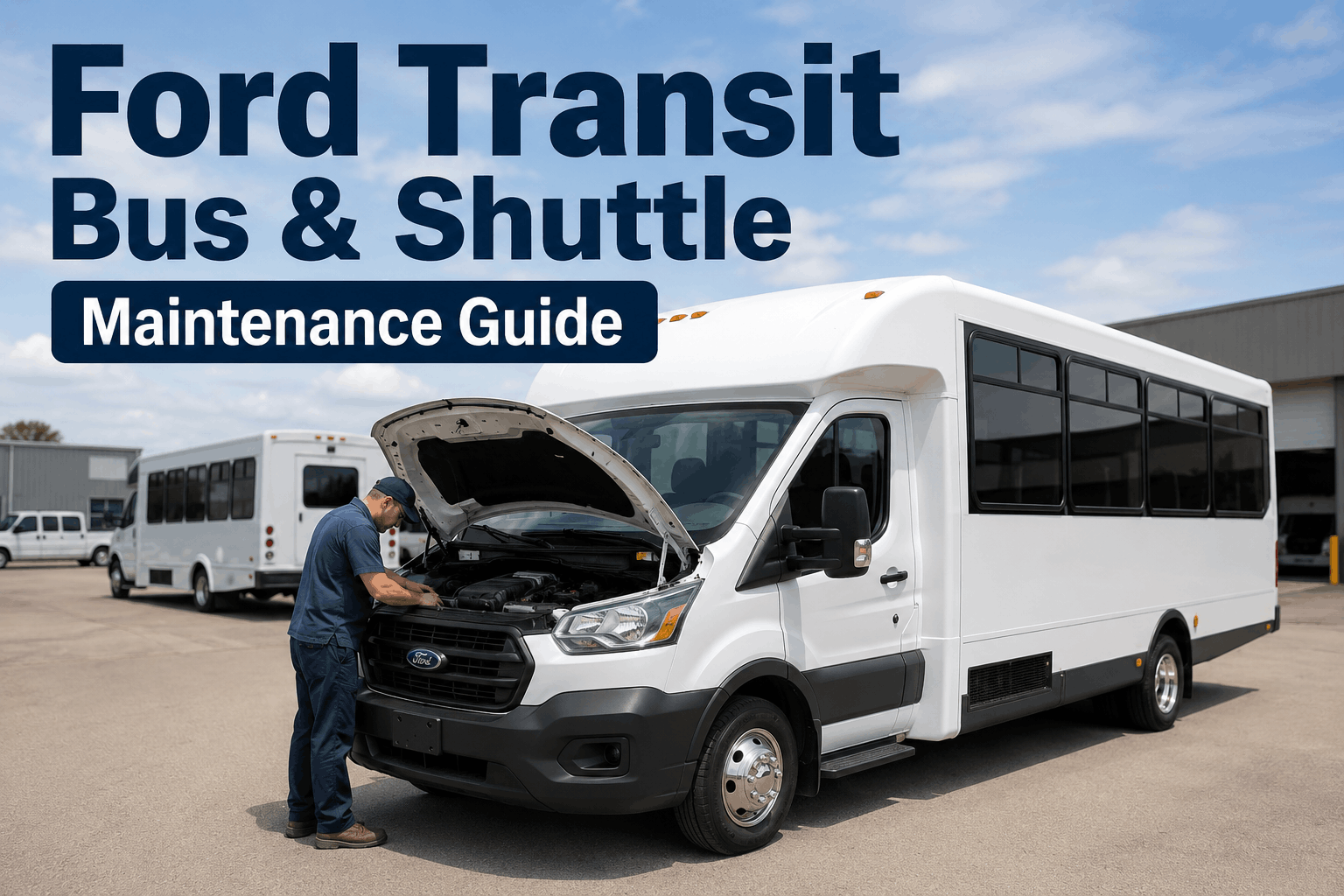
Ford Transit buses and shuttles are America's most versatile passenger vans for airport, hotel, and university shuttle operations. Proper maintenance is essential to maximize the life of EcoBoost gas and PowerStroke diesel options. This guide covers PM schedules, common issues, conversion notes, and parts availability for your Transit fleet.
Ford Transit Bus/Shuttle Guide 2026
Ford Transit Bus & Shuttle Maintenance Guide
Ford Transit bus and shuttle maintenance guide. EcoBoost gas and PowerStroke diesel options, common issues, conversion notes, PM schedules and parts.
Ford Transit Shuttle Maintenance Impact: The Cost of Versatility
Ford Transit buses are America's most popular passenger shuttles. A new Transit bus conversion costs $60,000-$90,000. Downtime costs operators $400-$1,200 per day in lost revenue.
$60,000+
Transit conversion cost
$400-$1,200
Daily downtime cost
350,000 km
Average Transit life
30%
Lower lifecycle cost with PM
Ford Transit PM Progress
1
Daily Walkaround
Pre-trip inspection. Check fluids, lights, tires, brakes, and safety systems.
2
Service A (10,000 km)
Oil and filter change. Brake inspection. Tire pressure check. Fluid top-up.
3
Service B (20,000 km)
Complete inspection. All fluid checks. Filter replacement. Belt and hose inspection.
4
Service C (40,000 km)
Engine inspection. Cooling system service. Transmission fluid check. Brake system inspection.
5
Service D (60,000 km)
Transmission service. Differential service. Suspension inspection. Electrical system check.
6
Service E (80,000 km)
Major service. All fluids replaced. All filters replaced. Full system inspection.
7
Major Overhaul (200,000 km)
Timing belt/chain service. Transmission rebuild. Complete chassis inspection.
8
Life Extension (300,000 km)
Major component replacement. Life extension inspection. Complete vehicle restoration.
Ford Transit Gas vs Diesel Comparison
EcoBoost gas engines have moderate maintenance requirements with lower annual costs averaging $1,200. PowerStroke diesel engines require high maintenance with average annual costs of $2,500 due to DEF systems, fuel filters, and specialized service.
Ford Transit Gas vs Diesel Failure Distribution
Gas Engine Failures
Diesel Engine Failures
Gas engine failures are primarily ignition-related (40%) and fuel system issues (30%). Diesel engine failures are dominated by turbo/EGR issues (35%) and fuel/DEF system problems (35%). Understanding these differences helps target maintenance efforts effectively.
Ford Transit Service Pass/Fail Thresholds
Engine Oil
Pass: Oil at proper level. Clean color. Changed at recommended interval.
Fail: Low oil level. Dark or contaminated oil. Overdue for change.
Transmission
Pass: Fluid at proper level. No leaks. Smooth shifting operation.
Fail: Low fluid level. Transmission leaks. Harsh shifting or hesitation.
DEF System (Diesel)
Pass: DEF level adequate. No crystallization. System functioning properly.
Fail: Low DEF level. Crystallization present. NOx sensor issues.
Ignition System (Gas)
Pass: Spark plugs at spec. Coils functional. Smooth idle and acceleration.
Fail: Misfire codes. Worn plugs. Failed coils.
Brake System
Pass: Brake pads above minimum. No leaks. Proper operation.
Fail: Worn pads below minimum. Brake fluid contamination. Air in system.
Replacement Trigger
Replace timing chain at 200,000 km. Replace transmission fluid every 60,000 km. Replace DEF injector if crystallized. Replace spark plugs every 100,000 km (gas). Document all service actions.
Ford Transit Maintenance KPIs
Track these five metrics to measure your Ford Transit maintenance program effectiveness:
PM Compliance
Target: 100% at every interval. Track by bus. Missed PMs increase failure risk significantly.
Gas vs Diesel Cost Ratio
Target: Track gas vs diesel maintenance costs. Diesel typically 2x gas maintenance costs.
Conversion Inspection Rate
Target: 100% compliance with conversion safety inspections. Track by bus.
Parts Availability Rate
Target: 95%+ in-stock. Track monthly. Ford parts network provides good coverage.
Repair Cost per Mile
Target: Decreasing or stable trend. Track monthly. Spike indicates component issues.
Ford Transit PM Trends
PM compliance and cost efficiency trends show consistent improvement from 65% to 95% over seven years. Cost efficiency improves as preventive maintenance reduces emergency repairs and extends component life.
Transit Bus Conversion Maintenance
Seating System
Inspect seat belts daily. Check seat anchors monthly. Verify passenger restraint systems quarterly.
Entry & Exit
Check entry step condition. Verify non-slip surfaces intact. Inspect grab handles and handrails.
HVAC System
Check rear HVAC monthly. Clean filters quarterly. Verify temperature control for passenger comfort.
Lighting & Signage
Test all interior and exterior lights. Verify signage visibility. Check emergency lighting monthly.
Accessibility Features
Test wheelchair lift if equipped. Verify securement track condition. Ensure all accessibility features functional.
Safety Systems
Test backup alarm. Check camera systems. Verify emergency exits function properly.
Our university shuttle fleet includes 30 EcoBoost gas Transits and 15 PowerStroke diesel Transits. After implementing this maintenance program, we achieved 98% PM compliance and reduced unplanned downtime by 55%. Gas vs diesel cost optimization saved $18,000 annually. Conversion-related repairs decreased by 42%.
Digitize Your Ford Transit Maintenance Program
BusCMMS guides technicians through every Transit service—daily walkaround, A through E services, major overhauls, and conversion inspections. Auto-schedule PM intervals based on mileage and calendar. Complete audit trail for every Transit shuttle in your fleet. Track gas vs diesel performance and conversion compliance.
Ford Transit Bus/Shuttle Maintenance FAQs
What is the recommended PM schedule for Ford Transit shuttles?
Ford recommends Service A at 10,000 km, Service B at 20,000 km, Service C at 40,000 km, Service D at 60,000 km, and Service E at 80,000 km. Major overhaul at 200,000 km. Follow your specific model's maintenance manual.
What are common issues with EcoBoost and PowerStroke engines?
EcoBoost common issues: ignition coil failures, carbon buildup on valves, turbo wastegate issues. PowerStroke common issues: DEF system crystallization, EGR valve sticking, turbocharger failures. Regular PM catches these issues early.
How much does Ford Transit bus maintenance cost?
Annual maintenance costs range from $1,500 to $4,000 per Transit depending on engine type and mileage. Gas models average $1,200-$2,000. Diesel models average $2,500-$4,000. Major overhauls cost $5,000 to $12,000.
What is the average lifespan of a Ford Transit shuttle?
Ford Transit shuttles typically last 300,000 to 350,000 km with proper maintenance. EcoBoost gas engines often achieve 300,000 km. PowerStroke diesel engines can exceed 350,000 km with proper maintenance.
What is special about Ford Transit bus conversion maintenance?
Transit bus conversions require additional maintenance for seating systems, passenger amenities, accessibility features, and safety equipment. Regular conversion inspections are essential for passenger safety and compliance.
Can BusCMMS track Ford Transit maintenance history?
Yes. BusCMMS tracks all Transit maintenance, repairs, parts replacements, and conversion inspections. The system generates PM schedules, sends due-date alerts, and creates complete maintenance records for every Transit shuttle in your fleet.
The Bottom Line
Maintaining Ford Transit shuttle buses properly is essential for maximizing airport, hotel, and university transport operations uptime while minimizing lifecycle costs. The 8-step PM workflow—daily walkaround, A through E services, major overhaul, and life extension—identifies issues before they cause failures. EcoBoost gas and PowerStroke diesel engines each require specialized maintenance approaches. Regular PM reduces failures by up to 40% and extends bus life beyond 350,000 km. Conversion inspections ensure passenger safety and compliance. This guide provides the step-by-step procedures your technicians need to maintain every Transit shuttle in your fleet. When combined with BusCMMS digital inspection forms, complete maintenance history tracking, gas vs diesel performance monitoring, conversion inspection management, and lifecycle cost analysis, your Transit program becomes proactive—catching issues before they cause downtime, service disruption, or expensive component failures.