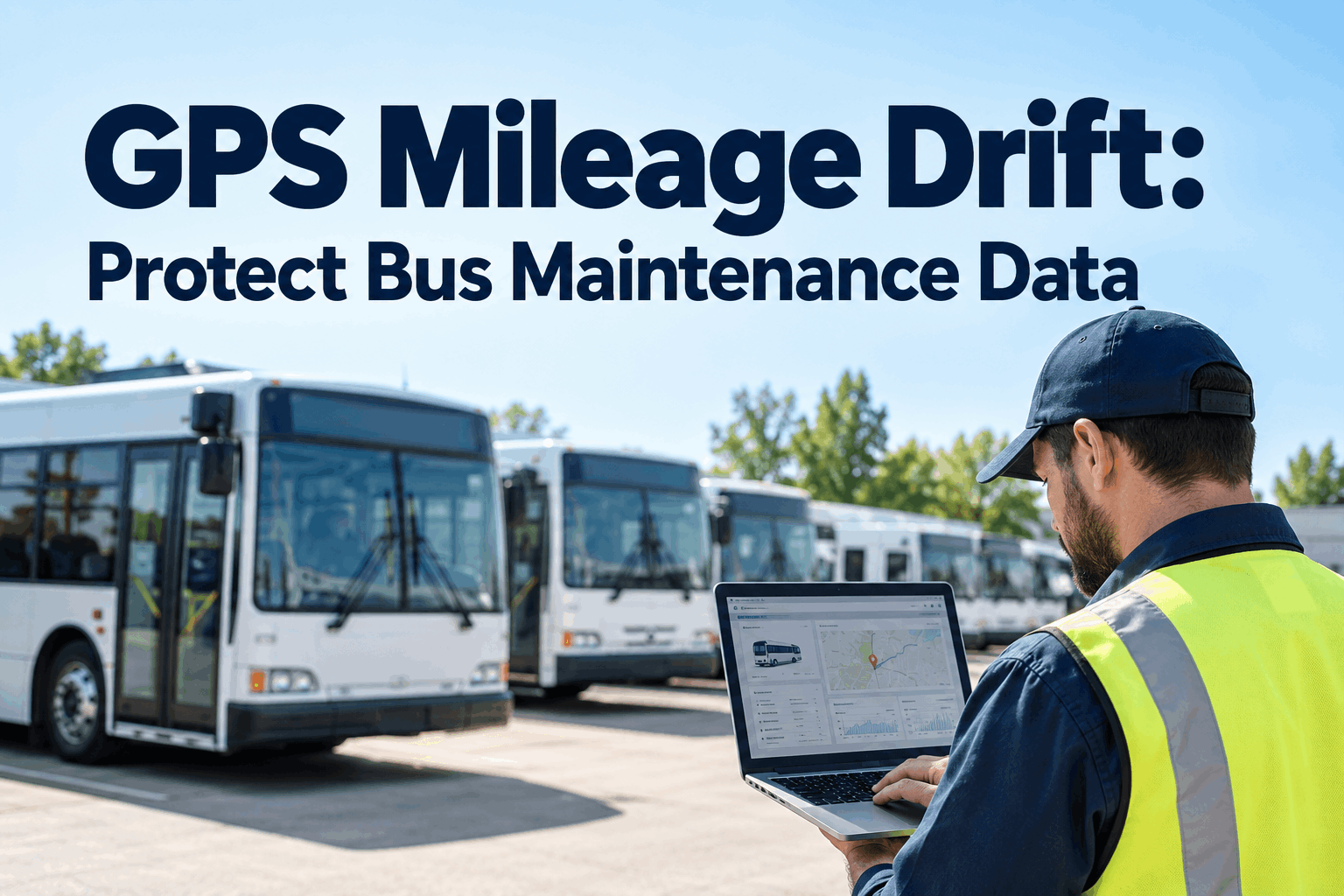
Your dashboard says bus 14 ran 62,400 miles this year. The dash odometer reads 61,050. That 1,350-mile gap is GPS mileage drift, and it quietly decides when your next PM fires and whether your cost-per-mile numbers are real. You can see how validated mileage keeps PM on the true number in a demo.
GPS Mileage Drift: Keeping Your Bus Maintenance Data Honest
The gap between GPS-reported miles and the real odometer does not stay small — it compounds all year, until it is big enough to move a PM date. Here is that drift, drawn.
Where Drift Enters Your Maintenance Data
Mileage does not stay in your telematics app. It flows into the two systems you make decisions with — and a drifted number corrupts both on the way, because nothing downstream alarms on a figure that is only a little off.
Put one validation gate between capture and the systems that use the number, and drift never reaches your schedule or your budget. You can book a demo and watch a drifted reading get stopped at the gate.
Why the Two Numbers Disagree
Understanding odometer accuracy means accepting that GPS and the odometer measure distance in completely different ways, so a gap is normal. Drawn to the same scale, here is how far each one can bend.
Typical industry ranges, not a single standard. Per trip the error is tiny; across a year it compounds into the gap above.
What That Growing Gap Actually Breaks
The drift in the chart is not a reporting curiosity. Three concrete things downstream inherit the error the moment the gap gets wide enough.
PM fires on the wrong mile
Over-report and the 60K service fires early on a bus that is not due. Under-report and the bus sails past its real interval — oil, brakes, or filters overdue on an active route.
Cost per mile goes wrong
Cost per mile is dollars over miles. Drift the denominator and every figure you take to the board — per bus, per route, per mile — is built on a number you cannot defend.
Records stop matching reality
When history shows miles that never matched the odometer, warranty claims, resale records, and audit trails inherit the error — and you explain the mismatch.
Is Your Fleet Already Drifting? 5 Signs to Check
You rarely see drift directly — you see its symptoms. Open each sign and check it against your own shop. The more that sound familiar, the more your mileage is already steering decisions it should not.
A bus hit its mileage PM but the dash odometer disagreed
Your cost-per-mile numbers move for no clear reason
Two systems show two different mileages for the same bus
A reading once dropped, stalled, or jumped thousands overnight
Nobody checks GPS miles against the odometer, ever
Recognize two or more? Drift is already in your data. You can book a demo and have us check your own feed for these signs.
The Fix, and the BusCMMS Feature Behind It
Each sign above has a specific fix — and a specific BusCMMS capability that does it for you, instead of adding another manual check to your week.
- 1Pull mileage from one sourcePre-built Samsara and Geotab connectors ingest odometer readings automatically — one feed per bus, no hand-keying.CONNECTORS
- 2Catch the impossible readingsReadings that drop, spike, or stall are flagged for drift before anything downstream trusts them.VALIDATION
- 3Reconcile to the dash odometerThe running number is trued to the real odometer on a set cadence — ideally captured at PM time in the work order.RECONCILE
- 4Fire PM on the validated mileMileage-based PM triggers run off the trusted reading, so no fuel-type's service is skipped or wasted.AUTO PM
- 5Report on the same clean numberThe cost-per-mile dashboard draws from the validated figure, so maintenance and budget never disagree.DASHBOARD
That is five manual checks turned into one automated loop. You can sign up free and connect a telematics feed to see it run on your buses.
Telematics That Feeds Clean Data, Not Drift
Pre-built connectors, validated mileage, and automatic PM from the trusted number — what a bus-specific CMMS does with a telematics feed that a raw integration never will.
Pre-built telematics connectors
Odometer and fault data flow in automatically from Samsara, Geotab, and more — no hand-keying, one consistent source per bus.
Mileage validated on the way in
Readings are checked for drift and impossible jumps before they are trusted, so a bad data point never silently moves a PM date.
PM and reports on one clean number
The validated reading drives mileage-based PM and feeds cost-per-mile dashboards — maintenance and budget finally agree.
I used to think our GPS miles were gospel. Then a bus that read 58,000 on the dash was showing 60,500 in the system, and it had already pulled its 60K PM two weeks early. Multiply that across 40 buses and you are either doing services nobody needs or missing ones you do. Now the system reconciles to the odometer at PM time — I stopped guessing which number was real.
Key Takeaways on GPS Mileage Drift
Drift is normal, not a fault
GPS and the odometer measure distance differently, so a gap always exists — and it grows across a year of hard miles.
The danger is silent
Drifted miles push PM triggers early or late and skew every cost-per-mile figure you take to the board.
The fix is a validation gate
Not picking a side — one source, flag the impossible, reconcile to the odometer, then drive PM from the trusted number.
Let the CMMS hold the line
A bus-specific CMMS that validates mileage on the way in keeps maintenance and reporting on the same clean figure.
GPS mileage drift will not announce itself — it just quietly moves a service date and skews a report. Validate the number before it drives a decision, and your telematics finally works for your maintenance data instead of against it — you can sign up free and put your fleet on validated mileage.
GPS Mileage Drift FAQs
What is GPS mileage drift?
GPS mileage drift is the growing gap between the distance a GPS or telematics system calculates and the actual mileage on a vehicle's odometer. GPS estimates distance from location samples and can lose accuracy with infrequent sampling or dropped signal, while the odometer counts wheel rotations and is affected by tire wear and calibration. Both measure the same trip differently, so a small per-trip difference is normal — it compounds into a meaningful gap over a year of heavy use.
How accurate is GPS mileage compared to the odometer?
Industry references put GPS distance error at roughly 1 to 2 percent, while mechanical odometer error can run up to about 5 percent and increases as tires wear (a change of about 5 mm in wheel radius shifts the reading around 2 percent). Neither is perfectly accurate. For bus maintenance, what matters is not which is more accurate in the abstract but which reading has been validated and reconciled before it triggers a service or calculates cost per mile.
Why does GPS mileage drift matter for bus maintenance?
Because mileage-based preventive maintenance and cost reporting both run on the mileage number. If GPS over-reports, PM triggers fire early and you waste shop time; if it under-reports, a bus can blow past its real service interval with overdue oil, brakes, or filters on an active route. Cost per mile is dollars divided by miles, so a drifted denominator skews every figure you take to the board. Clean, validated mileage keeps both maintenance and budget decisions honest.
How do you correct or validate mileage data?
Validation is a loop: pull mileage from one consistent source (your telematics feed) rather than mixing hand-entries and GPS pulls; automatically flag implausible readings such as a value lower than the last, an overnight jump of thousands of miles, or a bus reporting zero for days; reconcile the running number against a read of the dash odometer on a set cadence, ideally at PM time; and drive PM triggers and cost reports off that validated figure. Automating the loop keeps it running without manual effort.
How does BusCMMS handle mileage data integrity?
BusCMMS uses pre-built telematics connectors (such as Samsara and Geotab) to ingest odometer readings automatically, validates those readings for drift and impossible jumps before they are trusted, and uses the reconciled number to auto-trigger mileage-based preventive maintenance. The same validated figure feeds the cost-per-mile dashboard, so maintenance and reporting agree. It is purpose-built for bus fleets and typically live in two to four weeks. You can start free or book a demo to see the validation run on a live feed.