IC Bus CE Series Maintenance Tips & Fleet Guide 2026
A yellow IC CE Series does not roll on a bad stop arm or a dead warning lamp — those are the items that turn a pre-trip into a no-go. IC Bus CE Series maintenance is school bus work, which means the student-safety equipment matters as much as the engine. You can book a demo to see school-bus inspections tracked on one dashboard and keep a defect from becoming a bus that cannot run its route.
SCHOOL BUS MAINTENANCE · IC BUS CE SERIES
IC Bus CE Series Maintenance Tips & Fleet Guide 2026
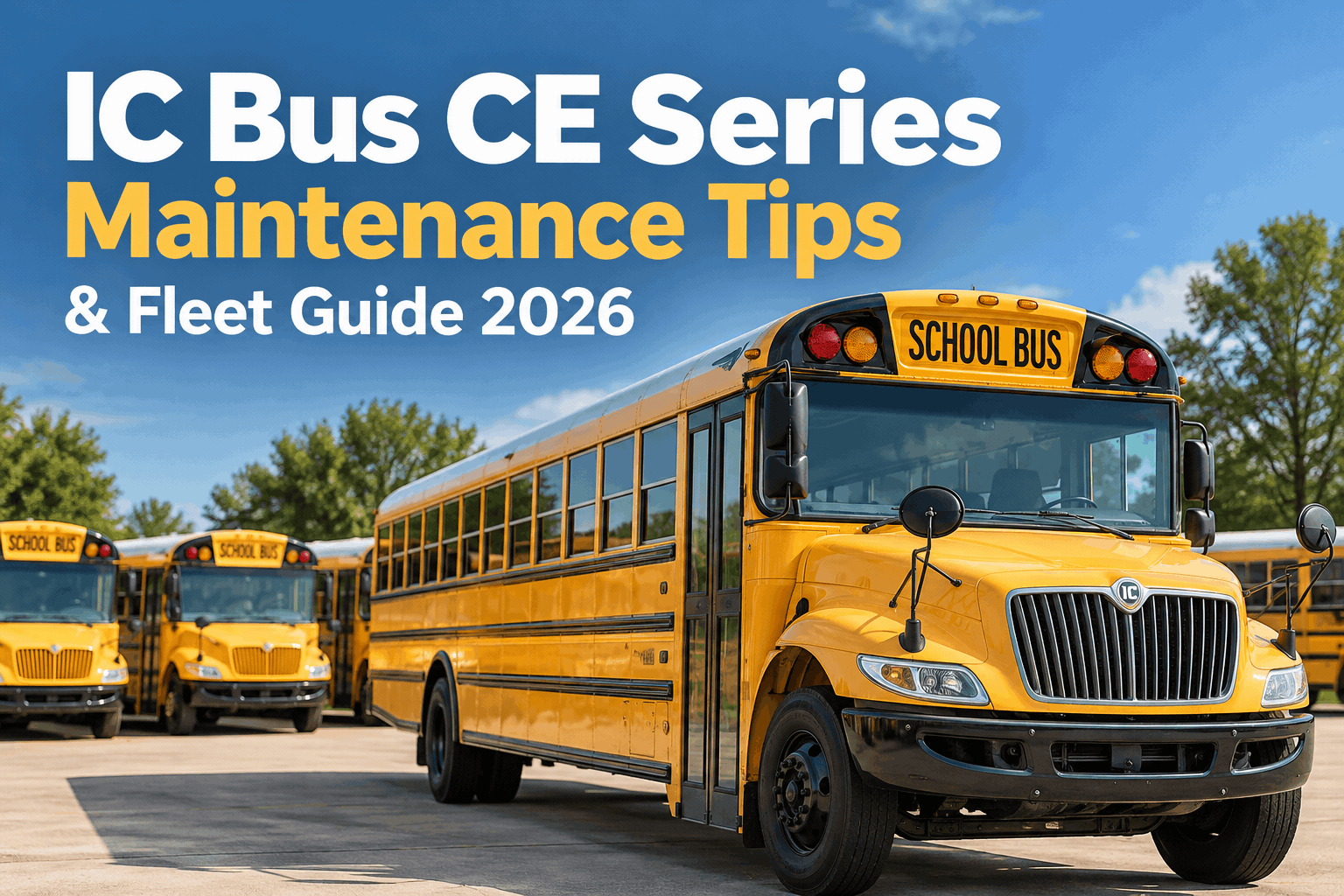
The CE Series is IC Bus's flagship Type C yellow bus and one of the most common school buses on the road. These are the tips that keep it safe and on route — the student-safety systems, the Cummins B6.7 and electric powertrains, and how to track a whole district fleet without paper.
Type CConventional yellow bus — the most common school bus on the road
B6.7 & EVCummins B6.7 diesel or the CE Series Electric, on one fleet
2-4 wksTypical BusCMMS rollout — the whole district fleet on one dashboard
Why IC Bus CE Series Maintenance Is Not Like Any Other Bus
A CE Series has everything a regular bus has — engine, brakes, HVAC, electrical — plus a whole layer of student-safety equipment that carries children and that a state inspector checks hard. That extra layer is what makes school bus maintenance its own job.
Safety equipment is non-negotiable
The stop arm, crossing gate, 8-light warning system, and crossover mirrors protect kids at every stop. A failure on any one is a no-go defect, not a minor fix — the bus does not run.
The inspector is coming
School buses face regular state DOT inspections and federal DVIR rules. A missed pre-trip item or a gap in the records is how a district fails an inspection and pulls buses off routes.
The route will not wait
A down CE Series means a cold morning with no bus for a route of kids. There is rarely a spare sitting ready, so preventive maintenance has to catch problems before the 6am pre-trip does.
A CE Series inspection is safety equipment plus the standard bus — the student-protection systems are checked every trip, and the records are what an inspector asks to see.
What a CE Series Adds Over a Standard Bus Inspection
The clearest way to think about CE Series maintenance is to separate the student-safety systems unique to a yellow school bus from the standard systems every bus shares. Both get checked; the safety side is what makes it a school bus.
A generic fleet tool has no idea what a stop arm or an 8-light system is, so those items get added as custom fields and quietly forgotten. A bus-built system ships with the school-bus DVIR ready — you can create a free account and load the CE Series inspection in minutes.
The CE Series Defects That Keep a Bus in the Yard
Not every defect is equal. On a school bus, some failures are no-go — the bus does not carry kids until it is fixed — while others get logged and scheduled. Knowing which is which, and routing each the right way, is the heart of a school-bus pre-trip.
8-light
Test the full amber-then-red warning sequence every day; a single dead lamp is a no-go, because it is what stops traffic for crossing kids.
Stop arm
Cycle the stop arm and check it extends, lights, and retracts cleanly — it and the crossing gate are the most-watched safety items on the bus.
Brakes
Check the brake system daily; on a bus full of kids, brakes and steering are safety-critical and get the same no-go treatment as the stop arm.
Engine
On the Cummins B6.7, service by hours as well as miles and let regens finish — short in-town routes idle hard and rarely clear the DPF.
Electric
On a CE Series Electric, add high-voltage and charging checks and schedule by charge cycles — the safety equipment stays exactly the same.
Build these into the driver's digital DVIR so the safety-critical items cannot be skipped, and route anything that fails straight into a work order. Three are every-trip no-go checks; two are logged by interval.
Stop arm, crossing gate, 8-lightCycle the stop arm, test the crossing gate, and run the full amber-to-red warning sequence. Any failure is a no-go.
NO-GO
Brakes, steering, and tiresCheck the brake system, steering, and tire condition. On a bus of students these are safety-critical and get the no-go treatment.
NO-GO
Mirrors, exits, lights, and doorsCrossover and student mirrors set, emergency exits and buzzers work, all lights function, and the entrance door cycles clean.
NO-GO
Powertrain PM by typeCummins B6.7 oil, fuel, and DPF service by miles and hours, or electric high-voltage and charging checks by charge cycles.
BY INTERVAL
HVAC, records, and fault codesService HVAC on schedule and log every inspection and fault code against the bus — that record is what a DOT review asks for.
RECORD
A digital DVIR means a driver cannot quietly pass a dead warning lamp to get the bus out on time, and every check is time-stamped against that bus — start a free account and set up the CE Series pre-trip today.
What School Bus Fleet Maintenance Software Should Do for a CE Series Fleet
A generic fleet tool treats a school bus like a delivery van and leaves the safety and compliance work to you. A bus-built CMMS ships knowing what a CE Series fleet needs — you can book a demo to see it run on your own district fleet. Four capabilities matter most.
School-bus DVIRs built in
Stop arm, crossing gate, 8-light, mirrors, and emergency exits pre-loaded as required items — no building safety forms from scratch.
Failed checks to work orders
A no-go defect auto-opens a work order and flags the bus, so a bad stop arm cannot slip back onto a route by mistake.
PM for diesel and electric
Cummins B6.7 intervals and CE Series Electric high-voltage service on one dashboard, each triggered by miles, hours, or charge cycles.
Audit-ready inspection records
Every DVIR, repair, and PM time-stamped and exportable for state DOT inspections and FMCSA reviews, not reconstructed after the fact.
95%+Fleet availability BusCMMS reports for fleets on scheduled PM
25-35%Maintenance cost reduction BusCMMS reports within 12 months
2-4 wksTypical BusCMMS rollout, not months of setup
Figures above are reported by BusCMMS from its own customer data, not independent third-party research.
A Transportation Director's Take
Key Takeaways on IC Bus CE Series Maintenance
Keep a CE Series fleet safe and on route and it comes down to four habits, all of which get easier when every bus and every check is tracked.
01
Safety equipment is the job
Stop arm, crossing gate, 8-light, and mirrors are no-go items checked every trip.
02
Records pass the inspection
Time-stamped DVIRs and PM history are what state DOT and FMCSA reviews ask for.
03
Diesel or electric, one dashboard
B6.7 intervals and CE Series Electric service tracked side by side.
04
Catch it before the pre-trip
Preventive maintenance keeps a defect from becoming a no-go on a cold morning.
Run every CE Series on scheduled PM and keep the safety systems in the daily check, and a defect never becomes a route of kids without a bus. For how it all fits together, our complete guide to what a bus CMMS does walks through the whole system.
FAQ
IC Bus CE Series Maintenance: Common Questions
What makes IC Bus CE Series maintenance different from other buses?+
The CE Series is a Type C conventional yellow school bus, so on top of the normal bus systems — engine, brakes, HVAC, electrical — it carries a full layer of student-safety equipment: the stop arm, the crossing gate, the eight-light amber-to-red warning system, crossover and student mirrors, emergency exits, and warning and strobe lights. Those systems protect children at every stop, so a failure on one is a no-go defect that keeps the bus in the yard rather than a minor fix. School buses also face regular state DOT inspections and federal DVIR rules, so the inspection records matter as much as the repairs. Good CE Series maintenance means treating the safety equipment as a daily must-check, keeping clean time-stamped records, and running the Cummins B6.7 or electric powertrain on its own schedule underneath all of that.
What engine does the IC CE Series use and how is it serviced?+
The current diesel CE Series uses the Cummins B6.7, rated around 220 to 300 horsepower, paired with an Allison automatic transmission. It is serviced like any B6.7: oil and filter, fuel filters, DPF cleaning, and the DEF system, each on its own interval. The key point for a school bus is that the manufacturer's mileage intervals are maximums for ideal duty, and school routes are severe service — short in-town legs, lots of stops, and heavy idle that rarely gets the exhaust hot enough to finish a regeneration. So most districts service by engine hours and calendar as well as miles, triggering on whichever comes first. The CE Series is also offered as the CE Series Electric, which has no engine maintenance at all but instead needs high-voltage, battery, and charging service, often scheduled partly by charge cycles. Always confirm intervals against the Cummins and IC Bus manuals for your specific bus.
What are the most important CE Series safety items to check daily?+
The student-safety systems come first because they are no-go items. Every trip, test the stop arm (it extends, lights, and retracts), the crossing gate, and the full eight-light warning sequence from amber to red — these are what stop traffic and protect kids crossing in front of the bus. Check brakes, steering, and tires, which are safety-critical on any bus carrying students. Confirm the crossover and student mirrors are set so the driver can see the danger zones, that emergency exits and their buzzers work, and that all exterior and interior lights and the entrance door function. A failure on any of these should keep the bus parked until it is repaired. Building this list into a digital pre-trip, with a failed item automatically opening a work order, is how districts make sure a safety defect never slips through on a busy morning.
How is maintaining a CE Series Electric different from the diesel?+
The entire student-safety side is identical — stop arm, crossing gate, eight-light system, mirrors, and emergency exits all get the same daily no-go checks whether the bus is diesel or electric. What changes is the powertrain. The diesel runs Cummins B6.7 engine maintenance: oil, fuel filters, DPF, and DEF. The CE Series Electric has no engine PM; instead it needs high-voltage system checks, battery and thermal-management service, and charging-equipment inspection, and it is often scheduled partly by charge cycles rather than just miles. The high-voltage work also carries its own safety procedures and qualified-technician requirements. Because of that, you cannot run the diesel and electric sides of the fleet off one identical schedule, which is why assigning each bus its own PM profile — while keeping the safety checks the same across all of them — is the practical approach.
How does BusCMMS help manage an IC Bus CE Series fleet?+
BusCMMS is purpose-built for bus fleets, so the school-bus work ships ready instead of needing weeks of setup. It provides pre-loaded school-bus DVIRs covering the stop arm, crossing gate, eight-light system, mirrors, and emergency exits; it auto-opens a work order and flags the bus when a no-go item fails, so a safety defect cannot be assigned to a route by mistake; it schedules preventive maintenance for both Cummins B6.7 diesels and CE Series Electric buses on one dashboard, triggered by miles, hours, or charge cycles; and it keeps every DVIR, repair, and PM time-stamped and exportable for state DOT inspections and FMCSA reviews. Parts like filters, DEF, and common CE Series components are tracked with auto-reorder so they are on the shelf when a bus is due. Most districts are live in two to four weeks. To see it mapped to your own fleet, book a demo and bring your bus list.