Deferring a repair is not the mistake. Deferring it without a record is. When an attorney subpoenas your maintenance files after a crash, or an auditor pulls a DVIR with a noted defect, the question is never just "did you fix it?" -- it is "who decided to wait, why, and where is that in writing?" Maintenance deferral documentation is the paper trail that turns a defensible operational decision into exactly that, instead of a liability waiting to surface.
Maintenance Deferral Documentation: Turn Deferred Work Into Defensible Records
What to capture, which defects you can never defer, and how to build an audit-proof deferral trail your safety and legal teams can stand behind.
- Defectwhat was found, where
- Reasonwhy it was safe to wait
- Approverwho authorized it
- Timelinerepair-by date
- Closurecertified when done
Miss one field and the record stops protecting you
The Deferral Isn't the Liability -- The Missing Record Is
Every fleet defers work. Parts are on backorder, a bus is needed for a route, a non-critical item can safely wait for the next PM. That is normal operations, not negligence. The liability appears only when the decision to wait leaves no trace -- because then there is nothing to prove the decision was reasonable.
Attorneys and auditors read gaps as guilt. When a DVIR notes a defect and the file shows no repair, no rationale, and no approver, the violation clock is treated as running from the day it was reported -- often months earlier. That single gap is where a routine review becomes a citation.
Same underlying decision. One is a liability exhibit; the other is proof of a functioning safety program. The difference is entirely in the documentation. If you want to see how a deferral record gets built and closed inside one system, you can book a demo of the BusCMMS compliance workflow.
The Six Fields Every Deferral Record Needs
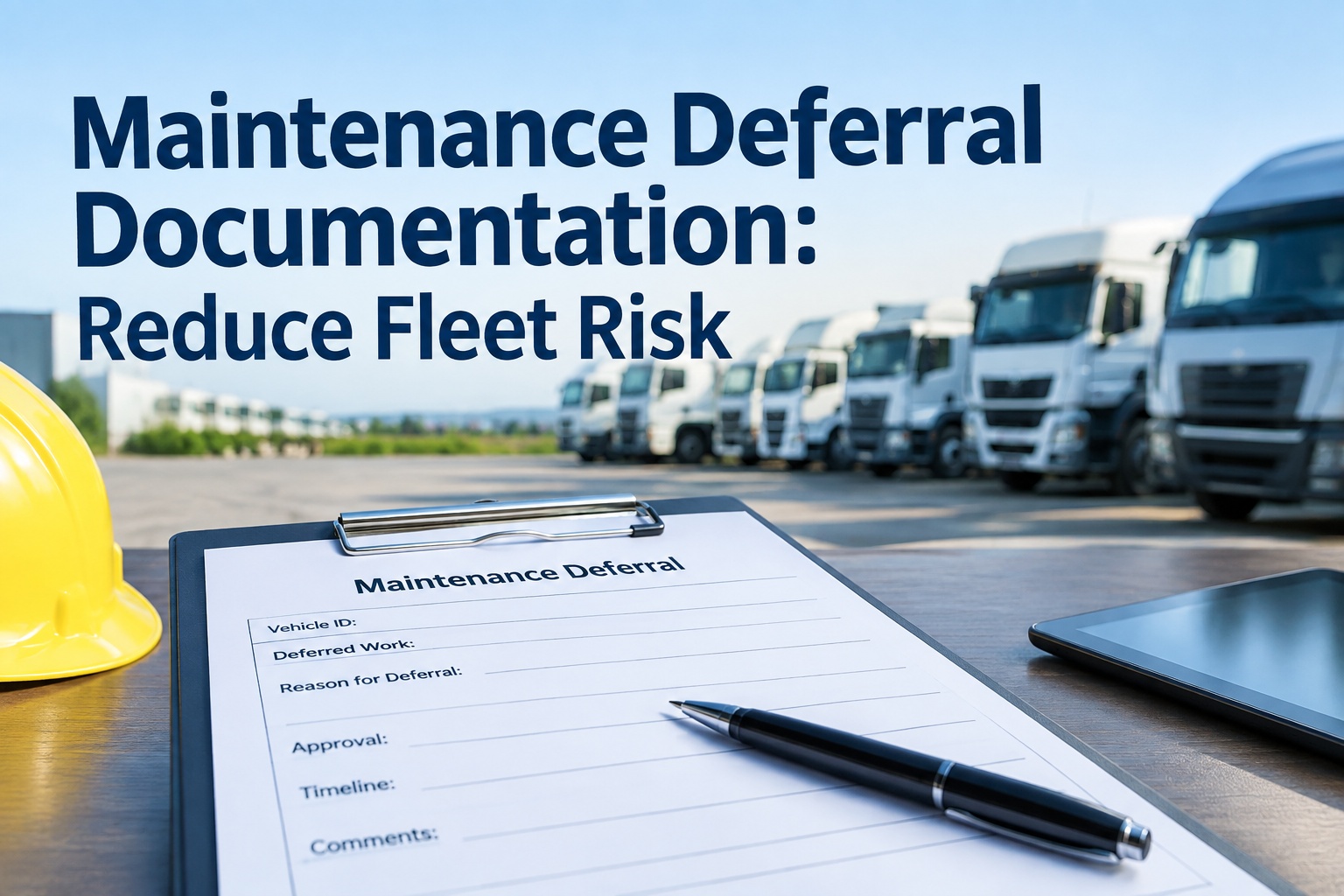
A defensible deferral record is not a sticky note on a work order. It is a structured entry that answers every question an auditor or attorney will ask before they ask it. Miss any one of these six fields and the record stops protecting you.
- 1
The Defect
Exactly what was found and where -- tied to the originating DVIR or inspection, not a vague "brake issue."
- 2
The Deferral Reason
Why it was safe to wait -- within manufacturer spec, part on order, condition monitored. The safety justification.
- 3
The Approver
Who authorized the deferral, by name and role. A technician note is not an approval for a risk decision.
- 4
The Repair-By Date
A firm deadline, not "later." An open-ended deferral is indistinguishable from an ignored defect.
- 5
Interim Controls
Any monitoring or limits placed on the bus while deferred -- shows active management, not passive neglect.
- 6
The Closure
Repair certified in writing when complete, linking back to the original defect. The chain has to close.
Notice that these six fields together tell a complete story: a defect was found, judged, authorized, bounded by a deadline, managed in the meantime, and resolved. That is the narrative that holds up. For the daily inspection side that feeds these records, our digital bus inspection guide covers how defects get captured in the first place.
What You Can Never Defer -- No Matter the Paperwork
Documentation makes a lawful deferral defensible. It does not make an unlawful one acceptable. Some defects are safety-critical: the moment they cross the threshold, the bus is out of service, and no approval or deadline changes that. A record that "documents" running an unsafe bus does not protect you -- it convicts you.
- Brakes below safe limit
- Any steering-system defect
- Suspension, frame, or coupling failure
- Tires below tread / with visible damage
- Required lighting inoperative
- Emergency exits, stop arm, or lift on a school bus
- Cosmetic body or trim damage
- Minor fluid top-offs within spec
- Cabin comfort items (non-safety)
- Wear items still within manufacturer tolerance
- Non-critical interior fixtures
- Scheduled items pending a bundled PM
The economic rule reinforces the safety rule. Deferral is only cost-positive while the item is within spec; the moment a worn part starts damaging what it touches, every extra day adds cost on top of risk. When your safety team can see condition data on every unit, that line is easy to hold -- worth seeing how BusCMMS flags safety-critical defects in a demo.
The Approval Chain That Makes a Deferral Stick
A defensible deferral is not one person's judgment call scribbled on a work order. It is a short chain of accountability, and every link needs a name attached. Here is the workflow that turns a deferral from a personal decision into a documented, authorized one.
The critical link is step three. Safety-critical defects -- brakes, steering, suspension, lighting -- should require a named supervisor to clear the operational risk, not just a technician's note. A repair note confirms the work; a sign-off confirms the risk decision. You can sign up free and set up your own approval workflow in an afternoon.
Why Documentation Standards Just Got Stricter
If the bar for maintenance records feels higher in 2026, it is. Federal recordkeeping expectations expanded, and the fleets exposed are the ones whose deferral decisions live in someone's memory or a scattered folder instead of a linked digital trail.
- eDVIR
Electronic DVIR Rule
FMCSA's 2026 rule (49 CFR 396.11/396.13) formally authorized electronic DVIRs, pushing fleets toward digital defect-to-repair trails.
- CHAIN
The Certification Chain
Auditors trace defect to repair certification. A break anywhere -- including an untracked deferral -- is a federal violation.
- DATA
Structured-Data Records
2026 guidance expects per-vehicle history in structured formats -- manual spreadsheets no longer satisfy the standard.
- SUB
Subpoena Exposure
After any incident, maintenance and deferral records become discoverable evidence -- read line by line for what was known and when.
The thread through all four is the same: the record has to be complete, linked, and produced on demand. Paper-based fleets fail here because the deferral note lives in a different folder than the DVIR and the repair. When all four sit on one record, the audit trail assembles itself -- book a demo to see that trail generated automatically.
How BusCMMS Builds an Audit-Proof Deferral Trail
The reason deferrals slip through is fragmentation -- the defect, the decision, and the repair live in three different places. BusCMMS is built for buses from day one and keeps them on one linked record, so the deferral trail is complete by design. These are the capabilities that make it work.
Closed-Loop DVIR
Failed inspection items auto-convert to work orders, carrying photos, notes, and vehicle history -- no re-entry, no lost slips.
Approval Sign-Off
Deferrals require a named approver with reason and repair-by date -- the manager sign-off that safety-critical work demands.
Deadline Alerts
Every open deferral is tracked and flagged before its repair-by date passes, so nothing quietly ages out.
Safety-Critical Flags
Bus-specific defects -- brakes, steering, lifts, stop arms -- flag as non-deferrable so they never get waved through.
Full Audit Trail
Every defect, deferral, approver, and certification retained with timestamps -- FMCSA-ready and produced in minutes, not hours.
Recurring-Defect Reports
Patterns by unit surface the buses that keep generating the same defect -- the ones a safety manager needs to watch.
One Texas district reported 100% inspection compliance for 24 straight months and zero violations at its last audit after moving to digital DVIR and compliance tracking (customer-reported). That is what a complete deferral trail buys you: not just a cleaner audit, but a safety program you can defend. See it on your fleet -- book a demo and walk through a live deferral record.
Maintenance Deferral Documentation Is Cheap Insurance
Deferring safely is part of running a fleet. Deferring silently is what ends careers and empties budgets after a crash. The record costs almost nothing to create and everything to be missing -- it is the cheapest insurance a safety manager can buy.
- Capture all six fields -- defect, reason, approver, deadline, controls, closure
- Never defer safety-critical defects -- documentation won't save an unsafe bus
- Require a named approver on every deferral
- Keep defect, deferral, and repair on one linked record
Do that and a deferral stops being a hidden liability and becomes what it should be: documented proof that your fleet weighs safety, decides responsibly, and follows through -- every time, on the record.
Frequently Asked Questions
What is maintenance deferral documentation?
Maintenance deferral documentation is the written record created whenever a fleet decides to delay a repair rather than perform it immediately. A defensible record captures six things: the specific defect and where it was found, the reason the deferral was safe, the named person who approved it, a firm repair-by date, any interim controls placed on the vehicle, and the certified closure once the repair is done. Its purpose is to prove that a decision to wait was reasonable, authorized, and followed through -- turning what could look like neglect into documented evidence of a functioning safety program.
Why is documenting deferred maintenance so important for liability?
Because after an incident, maintenance records become discoverable evidence, and auditors and attorneys read documentation gaps as negligence. A repair order showing work was recommended but never authorized -- with no deferral rationale and no approver -- reads as a defect the company chose to ignore to save money. When a DVIR notes a defect and the file shows no repair and no deferral record, the violation is often treated as running from the day the defect was first reported. Complete documentation is what separates a defensible operational decision from evidence of systemic neglect.
Which defects can never be deferred?
Safety-critical defects that affect the vehicle's ability to operate safely can never be deferred, no matter how well documented. These include brakes below safe limits, any steering-system defect, suspension, frame, or coupling failures, tires below tread or with visible damage, and inoperative required lighting. On a school bus, emergency exits, the stop arm, and the wheelchair lift are equally non-negotiable. Once these cross the out-of-service threshold, the vehicle must be repaired and certified before dispatch -- documentation of running an unsafe bus does not protect a fleet, it establishes liability.
Who should approve a maintenance deferral?
A named supervisor or manager -- not just the technician who found the defect. A technician's repair note confirms the work; a manager sign-off confirms the operational risk decision, which is a different judgment. For safety-critical categories like brakes, steering, and suspension, a second review by a named authority is what a strong safety program looks like on paper. The approver's name, role, the reason for deferral, and the repair-by date should all live on the record, so accountability for the decision is never ambiguous if it is later questioned.
How does BusCMMS help document deferred maintenance?
BusCMMS keeps the defect, deferral decision, approval, and repair on one linked record, so the audit trail is complete by design rather than assembled from scattered folders. Failed inspection items auto-convert to work orders with photos and history; deferrals require a named approver with a reason and repair-by date; open deferrals are tracked and flagged before the deadline passes; and safety-critical bus defects flag as non-deferrable so they cannot be waved through. Every defect, approval, and certification is retained with timestamps, producible for an FMCSA audit in minutes instead of hours.