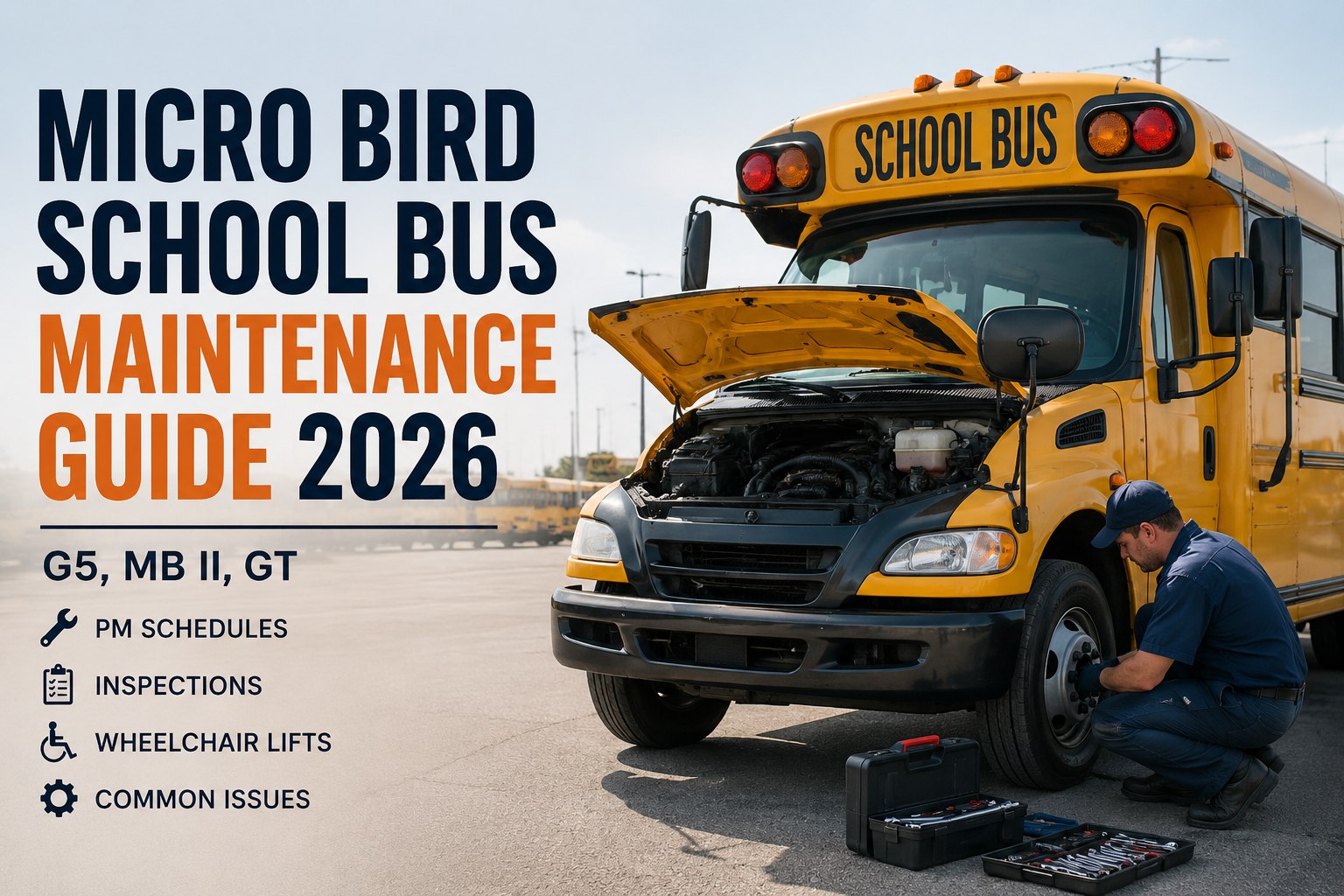
Micro Bird by Girardin is a Blue Bird / Girardin Minibus joint venture formed in October 2009 that consolidated all Blue Bird Type A school bus production at the Drummondville, Quebec facility. Three model lines currently roll off that line: the dual-rear-wheel G5 (up to 36 passengers, 2005-present), the single-rear-wheel MB-II (up to 20 passengers, 1991-present), and the newer T-Series on Ford Transit chassis (2014-present). All three are built on Ford E-350/E-450 or Chevy/GMC 4500/6500 cutaway light-truck chassis with a Ford 7.3L V8 gas, GM 6.6L V8 gas, ROUSH propane, or battery-electric powertrain. This is the 2026 maintenance guide -- chassis + engine matrix, PM schedule ladder, fluid specifications, the 2022 NHTSA recall context, and the 10 fault areas Micro Bird shops see most. See BusCMMS run per-chassis PM schedules on your Micro Bird fleet → book a 20-min demo.
Micro Bird by Girardin Maintenance Guide
3-model lineup, chassis + engine matrix, 5-tier PM schedule, fluid specifications, 2022 recall context, and the 10 fault areas Micro Bird shops see most.
Dual Rear Wheel
Single Rear Wheel
Ford Transit Platform
The Chassis + Engine Combinations Matrix
Every Micro Bird = Ford or GM chassis + gas / propane / electric powertrain. Tooling and PM differ per combo.
Every Micro Bird ends up as one of six chassis-engine combinations on the shop floor -- and each combo has its own oil interval, its own diagnostic tool, its own transmission fluid spec, and its own service literature. Fleets running both Ford and GM chassis alongside each other often make the mistake of PM-scheduling all buses on a single interval, missing the smaller intervals demanded by severe duty or propane-specific service.
The Ford 7.3L "Godzilla" and GM 6.6L L8T deliver identical 350 hp -- but different torque curves, different plug schedules, different diagnostic tools. Same PM interval across all combos misses this. See BusCMMS enforce chassis-specific PM per bus → book a demo.
The 5-Tier PM Schedule
Type A cutaway chassis means Ford/GM light-truck PM intervals with Micro Bird body-specific additions layered on top.
A Micro Bird PM schedule looks different from a full-size school bus schedule. The underlying chassis is a Ford or GM light-truck platform, so oil intervals are 7,500-10,000 miles instead of 25,000-45,000 miles. But the school bus body brings additional PM items no truck shop tracks -- wheelchair lifts, 8-light warning systems, stop arms, emergency exits, and student mirror inspection. The 5-tier ladder below layers both together.
Daily Pre-Trip DVIR
DAILY · DRIVERCHASSIS
- Fluids visual (oil, coolant, power steering)
- Tires, air pressure
- Lights, mirrors, wipers, horn
- Brakes function test
BODY / SCHOOL BUS
- 8-light warning system
- Stop arm extension + retraction
- Emergency exits + door alarms
- Wheelchair lift function (if equipped)
Monthly / 5,000 Mile
5,000 MI · TECHCHASSIS
- Battery load test
- Belt condition + tension
- Undercarriage inspection
- Ford/GM diagnostic scan
BODY / SCHOOL BUS
- Aluminum panel + seam check
- Wheelchair lift hydraulic top-off
- Interior floor + step condition
- Seat belt anchor inspection
7,500-10,000 Mi Oil Change
7.5K-10K MI · SHOPENGINE
- Engine oil + filter (spec per chassis)
- Air filter inspection / replace
- Tire rotation
- Fluid top-offs
BODY / SCHOOL BUS
- Wheelchair lift full function test
- Emergency door alarm + interlock
- Belt condition + fastener check
30,000 Mile Major Service
30,000 MI · SHOPCHASSIS + DRIVETRAIN
- Fuel filter (esp. propane: primary + secondary)
- Transmission fluid check
- Brake pad + rotor measurement
- Coolant sample
- Chassis grease per lube chart
BODY / SCHOOL BUS
- ADA wheelchair lift 90-day certification
- Emergency exit alarm calibration
- Body corrosion inspection (aluminum/steel joints)
100,000 Mile Overhaul Checkpoint
100,000 MI · SHOPENGINE + DRIVETRAIN
- Spark plugs replace (100K standard)
- Coolant flush + refill (Motorcraft Gold / Dex-Cool)
- Trans fluid + filter (Allison / Ford 6R140)
- Diff fluid change (rear axle)
BODY / SCHOOL BUS
- Full lift teardown + reseal
- Body panel inspection + touch-up
- Belt system full recertification
Every tier layers chassis PM (light-truck side) with body PM (school-bus side). Miss either and the compliance gap opens somewhere. See BusCMMS run both chassis and body PM sub-schedules per Micro Bird → book a demo.
Fluid Specifications by Chassis
Ford vs GM cross-contamination is the classic Micro Bird shop mistake. Every fluid tracked by chassis, not by fleet.
Ford Motorcraft Gold coolant is not GM Dex-Cool. Ford 5W-30 with Motorcraft spec is not GM Dexos1 Gen 3. The propane fuel system needs its own PM adder ROUSH-specific service literature. Every Micro Bird shop tech should have the 6-fluid chart below on the wall behind the parts counter -- broken out by chassis, not by fleet.
Motorcraft Gold and Dex-Cool are incompatible. Mixing them in the wrong chassis destroys cooling system components in weeks. This is the top Micro Bird warranty rejection reason. Sign up free and log per-bus chassis + fluid spec →
The 2022 Recall + Top 10 Fault Areas
One documented NHTSA recall, plus the 9 fault patterns Micro Bird shops see repeatedly.
Micro Bird by Girardin has one documented federal safety recall of note -- NHTSA Campaign 22V-540 in September 2022 covering 127 units of 2021-2022 G5, MB-II, and T-Series buses with insufficiently attached interior window-panel sections that could fail under FMVSS 221 School Bus Body Joint Strength. If your fleet has any 2021-2022 Micro Bird buses on the roster, verify recall completion status. Beyond the recall, the fault patterns below are what shops running Micro Bird fleets see most.
2021-2022 G5 / MB-II / T-Series Window Panel Recall
- 01
Body-to-Chassis Joint Fatigue
STRUCTURALAluminum body panels on steel chassis. Contact points corrode over time. Inspect mounting brackets at every 30K-mile major service.
- 02
Ford 7.3L Spark Plug Wear
POWERTRAIN"Godzilla" V8 100K plug interval is standard, but propane variants foul plugs faster. Watch for irregular idle, misfire codes. Change per fuel type.
- 03
Wheelchair Lift Hydraulic Leaks
ADA COMPLIANCESlow lift, pressure loss, cylinder seal leaks. Micro Bird's exclusive dual-door lift adds seal count. Monthly top-off + annual full inspection.
- 04
Aluminum Body Corrosion
CLIMATE-DRIVENAluminum-to-steel contact points corrode from road salt in northern climates. Undercarriage rinse + protective spray annually prevents cascade.
- 05
Rear Leaf Spring Fatigue
HIGH-MILEAGECutaway chassis rear leaf packs wear from full-passenger loading. Symptom: sagging rear, uneven ride. Inspect at 60K, replace at 100K-150K.
- 06
8-Light System Flasher Failures
SCHOOL BUS-SPECIFICAmber + red flasher module aging. Random light failure or intermittent function. Daily DVIR catches it -- monthly bench test prevents route disruption.
- 07
ROUSH Propane Regulator Issues
PROPANE-SPECIFICLPG regulator on ROUSH Gen5 system requires periodic inspection. Symptom: hard start, hesitation, power loss. Follow ROUSH service schedule.
- 08
Chevy 6.6L L8T Lifter Issues
POWERTRAINWell-documented across L8T platform. Watch for ticking, misfire codes, sudden power loss. GM TSB documented -- warranty claim path exists.
- 09
Coolant Cross-Contamination
WARRANTY-CRITICALMotorcraft Gold in GM chassis or Dex-Cool in Ford = incompatible chemistry, gasket damage in weeks. Top warranty rejection cause on Micro Bird fleets.
- 10
AC Compressor Belt Loading
PROPANE MODELSHigher AC compressor loading on propane variants. Belt tension + tensioner condition matter more than on gas. Check monthly, replace at 60K.
Faults 2, 3, and 6 all surface during a properly run monthly 5,000-mile service. Faults 1, 5, and 8 need the 30K major service to catch. Skipping intervals means catching all 10 as road calls. See BusCMMS flag Micro Bird fault patterns from PM templates → book a demo.
Where BusCMMS Fits Your Micro Bird Fleet
Six ways the Type A cutaway platform gets the same maintenance discipline as the Type C big buses -- instead of being the fleet's forgotten stepchild.
Per-Chassis PM Schedules
Ford E-350/E-450, Chevy 4500/6500, Ford Transit each run their own OEM PM interval. No manual tracking of which bus is on which chassis.
Body + Chassis PM Sub-Templates
Each PM tier has a chassis section (Ford/GM light-truck items) and a body section (school bus items). Neither gets skipped.
ADA Wheelchair Lift Certification
90-day ADA lift certification tracked per bus with alerts before expiration. Never fail a passenger transport audit again.
Recall Tracking Per Bus
NHTSA campaign 22V-540 and any future recall status logged per VIN. Compliance completion date documented.
Propane vs Gas Service Differentiation
ROUSH Gen5 propane items load automatically on propane-equipped buses. No mixing of gas and propane service schedules.
Cross-Chassis Fluid Spec Enforcement
Motorcraft Gold flags on Ford chassis. Dex-Cool flags on GM chassis. Cross-contamination alert if wrong spec logged.
We run 22 Micro Birds -- 14 G5 dual rear wheel on Ford E-450 and 8 MB-II single rear wheel on Chevy 4500. Before BusCMMS the Type A fleet was the stepchild -- shop treated all 22 the same because "they're all just cutaways". Which meant we were running Motorcraft Gold coolant on 8 GM chassis and losing water pumps at 45K when we should have gotten 100K. Two water pump replacements at $1,400 each before we caught it. In BusCMMS the coolant spec is locked per chassis type on the bus record. Attempting to log the wrong coolant fires an alert to the shop supervisor. Same discipline for oil spec, trans fluid, spark plug interval. We now hit the manufacturer intervals per chassis instead of the average of both. Simple change, but it's already saved 3 water pumps and one 6.6L L8T lifter cascade we caught early because the 5K PM template flagged the tick pattern.
3 water pumps and one L8T lifter cascade caught by coolant spec + chassis-specific PM enforcement. That is the Type A CMMS ROI. See how →
Frequently Asked Questions
What models does Micro Bird by Girardin currently produce?
Micro Bird by Girardin is the 2009 joint venture between Blue Bird and Girardin Minibus that consolidated all Type A school bus production at Girardin facilities in Drummondville, Quebec, Canada. Three current model lines are produced. The G5 is the dual-rear-wheel platform introduced in 2005, seating up to 36 passengers across up to 6 rows on either a Ford E-450 chassis or a Chevy/GMC 6500 chassis with gasoline, propane, or battery-electric (G5E) powertrain. The MB-II is the single-rear-wheel platform introduced in 1991, seating up to 20 passengers across 5 rows of 34-inch seats on either a Ford E-350 chassis or a Chevy/GMC 4500 chassis with gasoline or propane powertrain. The T-Series is the newest platform introduced in 2014, built on the Ford Transit chassis and available in either single or dual rear wheel configuration with reduced weight and improved maneuverability, gasoline powertrain. All three model lines meet FMVSS school bus safety standards, feature heavy-gauge galvanized steel side-impact barriers, monobloc galvanized steel roof arches for rollover protection, aluminum body panels for corrosion resistance, and available 3-point lap-shoulder seat belts and wheelchair-accessible configurations.
What is the recommended PM schedule for a Micro Bird?
Micro Bird PM schedules layer light-truck chassis intervals (Ford or GM) with school bus body PM items unique to Type A cutaway platforms. Tier 1 is the daily driver DVIR: fluids visual, tires, lights, mirrors, brakes function -- plus 8-light warning system, stop arm extension, emergency exit function, and wheelchair lift function. Tier 2 runs monthly or every 5,000 miles: battery load test, belt condition, undercarriage inspection, Ford/GM diagnostic scan, plus aluminum panel and seam check, wheelchair lift hydraulic top-off, interior floor and step condition, and seat belt anchor inspection. Tier 3 is the 7,500-10,000 mile engine oil change (Ford chassis 7,500-10,000 standard, GM chassis 7,500 standard, both dropping to 5,000 under severe duty): oil and filter change per chassis-specific spec, air filter, tire rotation, fluid top-offs, plus a wheelchair lift full function test and emergency door alarm test. Tier 4 is the 30,000-mile major service: fuel filter (primary and secondary on propane), transmission fluid check, brake measurement, coolant sample, chassis grease, ADA lift 90-day certification, emergency exit alarm calibration, and body corrosion inspection at aluminum-to-steel joints. Tier 5 is the 100,000-mile overhaul checkpoint: spark plugs, coolant flush and refill (Motorcraft Gold for Ford / Dex-Cool for GM), transmission fluid and filter (Allison TES 668 or Motorcraft MERCON LV), differential fluid, plus a full lift teardown and reseal, body panel touch-up, and belt system recertification.
What fluid specifications does a Micro Bird require?
Fluid specifications are chassis-specific, not fleet-wide. Ford 7.3L V8 engine oil is Motorcraft SAE 5W-30 or 10W-30 at 7,500-10,000 mile intervals (5,000 severe duty). GM 6.6L V8 (L8T) engine oil is Dexos1 Gen 3 5W-30 at 7,500 mile intervals (5,000 severe duty). Allison 1000 automatic transmission on GM chassis uses Allison TES 668 (TES 295 is backward-compatible) at 60,000 miles severe duty. Ford 6R140 automatic transmission on Ford chassis uses Motorcraft MERCON LV at 60,000 miles severe duty. Ford Motorcraft Gold coolant (VC-13 / VC-3-DIL yellow) is a hybrid organic acid (HOAT) chemistry flushed at 100,000 miles. GM Dex-Cool coolant (ASTM D6210 OAT orange) is an organic acid chemistry with a first flush at 150,000 miles. These two coolants are chemically incompatible -- mixing Motorcraft Gold into a GM Dex-Cool chassis or Dex-Cool into a Ford Motorcraft Gold chassis destroys water pumps, thermostats, and gasket surfaces within weeks. This cross-contamination is the top warranty rejection reason on mixed-chassis Micro Bird fleets running both Ford and GM chassis in the same shop.
What is the 2022 Micro Bird recall and the most common fault areas?
NHTSA Campaign 22V-540 was announced September 23, 2022, covering 127 units of 2021-2022 G5, MB-II, and T-Series school buses. The interior side panels under the windows were insufficiently attached and could fail FMVSS 221 School Bus Body Joint Strength requirements. Dealers install correction parts and instructions free of charge under Micro Bird recall number 22-094-PUS. If your fleet has any 2021-2022 Micro Bird buses, verify recall completion status through NHTSA or Micro Bird customer service. Beyond the recall, ten fault patterns surface repeatedly. Body-to-chassis joint fatigue from aluminum-body-on-steel-chassis contact-point corrosion. Ford 7.3L "Godzilla" V8 spark plug wear (especially on propane variants). Wheelchair lift hydraulic leaks affecting ADA compliance. Aluminum body corrosion at steel joints in northern climates. Rear leaf spring fatigue on cutaway chassis under full passenger loading. 8-light warning system flasher module failures. ROUSH propane regulator issues on Gen5-equipped buses. Chevy 6.6L L8T lifter issues (well-documented GM TSB across the L8T platform). Coolant cross-contamination between Ford and GM chassis. AC compressor belt loading on propane models. Faults 2, 3, and 6 surface during proper monthly 5,000-mile service; faults 1, 5, and 8 require the 30,000-mile major service; skipping intervals means catching all 10 as road calls.
How does BusCMMS help manage a Micro Bird fleet?
BusCMMS runs per-chassis PM schedules on the same Micro Bird fleet -- so Ford E-350/E-450 buses hit Motorcraft-spec intervals, Chevy/GMC 4500/6500 buses hit Dexos-spec intervals, Ford Transit buses run their own schedule -- eliminating the manual tracking that leads to cross-chassis coolant contamination or wrong oil spec. Each PM tier has a chassis sub-template (Ford or GM light-truck items) and a body sub-template (8-light system, stop arm, emergency exits, wheelchair lift), so neither the chassis side nor the school-bus side gets skipped. ADA wheelchair lift 90-day certification is tracked per bus with alerts before expiration. NHTSA campaign 22V-540 status and any future recall completion is logged per VIN. ROUSH Gen5 propane items load automatically on propane-equipped buses -- no mixing gas and propane service schedules. Motorcraft Gold flags on Ford chassis; Dex-Cool flags on GM chassis; attempting to log the wrong coolant fires a cross-contamination alert to the shop supervisor. One 22-Micro-Bird Upper Midwest school district maintenance supervisor running 14 Ford G5 and 8 Chevy MB-II reported saving three water pumps and catching one 6.6L L8T lifter cascade early in year one after moving from a fleet-wide PM approach to chassis-specific PM enforcement in BusCMMS -- eliminating the $2,800 in water pump replacements they had absorbed the year before from Motorcraft Gold coolant used incorrectly on GM chassis.