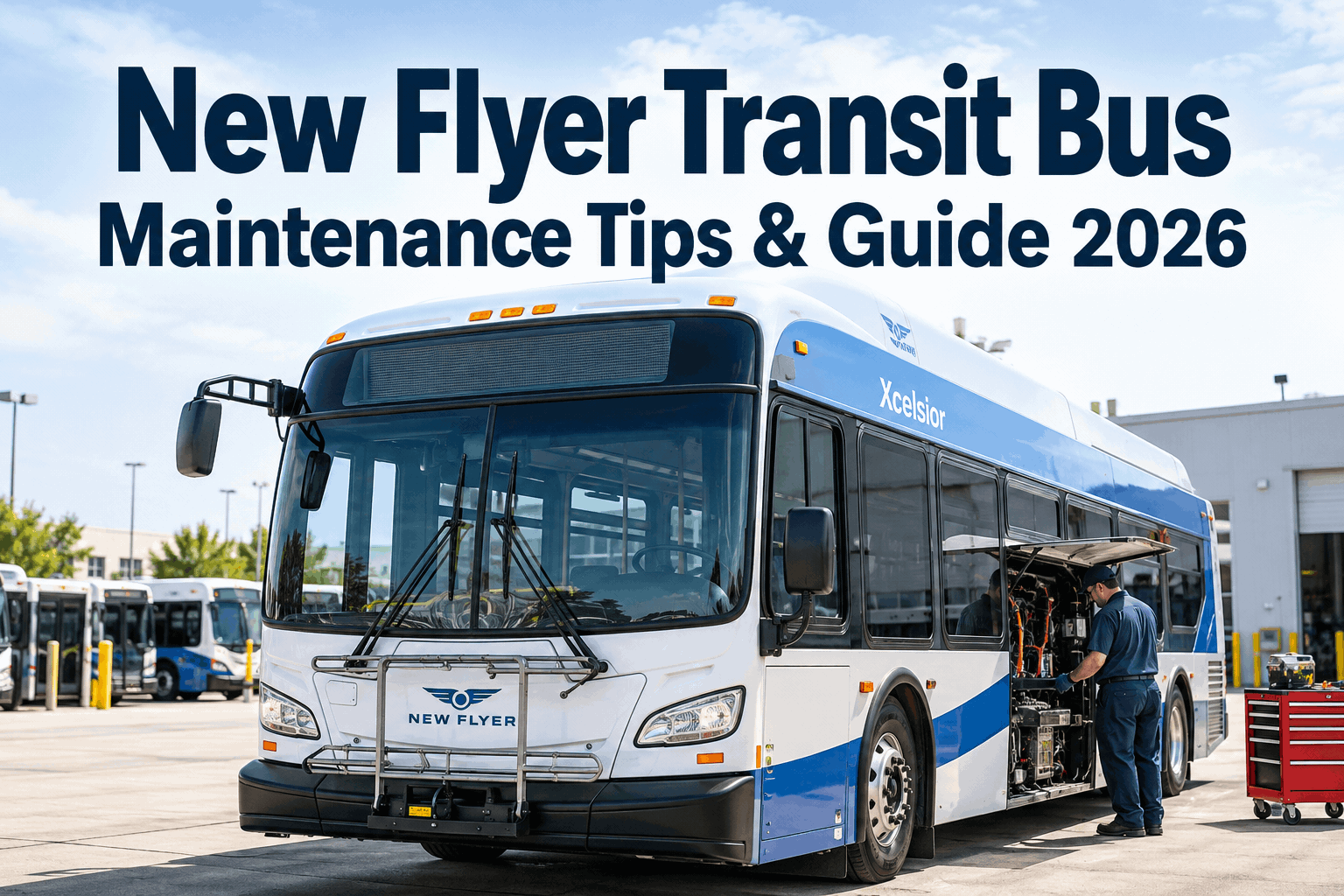
In one New Flyer yard you might park a 60-foot articulated diesel next to a CNG XN and a battery-electric Xcelsior CHARGE — same platform, three completely different maintenance jobs. New Flyer transit bus maintenance is really about one thing: keeping the widest powertrain range in transit all on schedule. You can book a demo to see every Xcelsior variant tracked on one dashboard and stop running them off one plan.
TRANSIT BUS MAINTENANCE · NEW FLYER XCELSIOR
New Flyer Transit Bus Maintenance Tips & Guide 2026
The New Flyer Xcelsior is North America's most common transit platform — one body, nearly every powertrain built. These are the tips that keep each variant reliable, from diesel to hydrogen, and how to track a mixed Xcelsior fleet without losing the plot.
35/40/60 ftXcelsior lengths, including the 60-ft articulated bus
6 powertrainsDiesel, hybrid, CNG, trolley, battery, hydrogen — each its own PM
2-4 wksTypical BusCMMS rollout — the whole mix on one dashboard
Why New Flyer Transit Bus Maintenance Spans So Many Variants
The Xcelsior is one monocoque body, but New Flyer builds it as diesel, hybrid, CNG, trolley, battery-electric, and hydrogen — a wider powertrain range than anything else in transit. Most agencies now run several of those at once, and that mix is what makes the maintenance hard.
The work shifts across the range
A diesel XD is mostly engine and aftertreatment work; a battery XE is mostly high-voltage, cooling, and charging. The same technician, the same shop, but a completely different checklist per bus.
Articulated buses add systems
The 60-foot artic brings its own driveline and the articulation joint and turntable — wear points a 40-foot rigid simply does not have, and ones that need their own inspection items.
Shared systems still fail
Every Xcelsior — diesel or electric, rigid or artic — has the same air brakes, low-floor ramp and kneeling, HVAC, doors, and multiplex electrical, and those shared systems cause most daily road calls.
The answer is one dashboard, the right PM profile per variant — each Xcelsior scheduled for its own powertrain, with the shared body systems tracked the same across the whole fleet.
One Platform, a Different Preventive Maintenance Mix per Variant
As you move across the Xcelsior range, the balance of work changes. Engine and aftertreatment service dominates the diesel and CNG end; high-voltage, battery, and charging work takes over at the electric and hydrogen end. Here is roughly how that mix shifts.
A system built for diesels alone cannot carry the electric end of your Xcelsior fleet, and a tool that only understands vehicles cannot tell an XD from an XE. You can create a free account and set the right PM profile for each variant.
New Flyer Maintenance Tips: What Stays the Same, What Changes
The simplest way to think about a mixed Xcelsior fleet is to separate the shared body systems, which you track the same on every bus, from the variant-specific drivetrain work, which changes with the powertrain.
Powertrain
Give each variant its own PM template — diesel by hours and miles, electric by charge cycles and high-voltage checks — never one blanket schedule.
Air brakes
Check the air system daily on every Xcelsior for leaks and build-up time; it is identical across variants and it is safety-critical.
Ramp & kneel
Cycle the low-floor ramp and kneeling daily — the most-used moving part on any transit bus and an ADA item riders depend on.
Artic joint
On 60-ft artics, inspect the articulation joint and turntable on their own interval — a wear point your 40-ft rigids do not have.
Electrical
Pull multiplex fault codes and log them against the bus; the Xcelsior electrical system flags trouble early if someone reads and records it.
Build these into the driver's digital DVIR so the safety-critical items cannot be skipped, and route anything that fails straight into a work order. Three are every-trip must-checks; two are logged by interval.
Air brakes and air build-upCheck for leaks, proper build-up time, and low-air warning. Identical on every Xcelsior and the single most safety-critical daily item.
EVERY TRIP
Low-floor ramp and kneelingDeploy the ramp and cycle the kneeling fully — the most-used moving part, and the ADA access a rider cannot board without.
EVERY TRIP
Doors, lights, mirrors, and warningsPassenger doors cycle clean, all lights work, mirrors set, and no dash warning lamp ignored — on artics, check the joint area too.
EVERY TRIP
Variant-specific powertrain PMDiesel oil/fuel/DPF, CNG fuel-system and leak checks, or electric high-voltage, cooling, and charging — each on its own interval.
BY INTERVAL
HVAC, electrical, and fault codesService HVAC on schedule and pull multiplex fault codes regularly — log every code against the bus so trends show before failures.
RECORD
When a failed check opens a work order automatically and a fault code lands in the queue the moment it appears, the daily checklist stops being paper and starts preventing road calls — start a free account and load the Xcelsior DVIR in minutes.
What Transit Fleet Maintenance Software Should Do for a New Flyer Fleet
A generic fleet tool treats every bus the same and leaves the transit-specific and powertrain-specific work to you. A bus-built CMMS ships knowing what a mixed Xcelsior fleet needs — you can book a demo to see it run on your own New Flyer mix. Four capabilities matter most.
A PM profile per variant
Diesel, hybrid, CNG, battery, and hydrogen Xcelsiors each on their own schedule, triggered by miles, hours, charge cycles, or date.
Transit DVIRs and work orders
Pre-loaded daily checks for air brakes, ramp, doors, HVAC, and the artic joint — a failed item auto-opens a work order before the bus rolls.
Fault codes to the queue
Telematics and multiplex faults on an Xcelsior turn into work orders, so an electrical or drivetrain code is a planned fix, not a road call.
Audit-ready transit records
Service history, PM compliance, and inspection logs ready for an FTA triennial review or NTD reporting, not scrambled together after.
95%+Fleet availability BusCMMS reports for fleets on scheduled PM
25-35%Maintenance cost reduction BusCMMS reports within 12 months
2-4 wksTypical BusCMMS rollout, not months of setup
Figures above are reported by BusCMMS from its own customer data, not independent third-party research.
A Transit Maintenance Manager's Take
Key Takeaways on New Flyer Transit Bus Maintenance
Keep a New Flyer fleet reliable and it comes down to four habits, all of which get easier when every Xcelsior is tracked as its own variant.
01
The variant decides the schedule
Diesel, CNG, hybrid, battery, and hydrogen Xcelsiors each need their own PM profile.
02
Shared systems cause road calls
Air brakes, ramp, HVAC, and electrical fail on every Xcelsior regardless of powertrain.
03
Artics add their own items
The 60-ft articulation joint and turntable get their own inspection interval.
04
Track it, do not remember it
Checks, codes, and history logged per bus is what keeps nothing from slipping.
Run every Xcelsior on the right profile and keep the shared systems in the daily check, and your availability number takes care of itself. For how it all fits together, our complete guide to what a bus CMMS does walks through the whole system.
FAQ
New Flyer Transit Bus Maintenance: Common Questions
What makes New Flyer Xcelsior maintenance different from other buses?+
The Xcelsior uses one monocoque body across its whole range, but New Flyer builds it with the widest set of powertrains in transit — diesel, diesel-electric hybrid, CNG, trolley, battery-electric (the Xcelsior CHARGE), and hydrogen fuel cell — and it comes as 35 and 40-foot rigid buses plus a 60-foot articulated. That means two Xcelsiors in the same yard can need completely different maintenance: a diesel XD is mostly engine and aftertreatment work, while a battery XE is mostly high-voltage, cooling, and charging. The body systems — air brakes, low-floor ramp, kneeling, HVAC, doors, multiplex electrical, and on the artic the articulation joint — are shared and get tracked the same. Good New Flyer maintenance means the right PM profile per variant plus consistent tracking of the shared systems that cause most road calls.
What are the most important New Flyer preventive maintenance items?+
Split them into daily driver checks and interval shop work. Every trip: the air-brake system (leaks, build-up time, low-air warning), the low-floor ramp and kneeling, and doors, lights, mirrors, and warning lamps — plus a look at the articulation area on a 60-foot artic. On an interval: the variant-specific powertrain PM for that bus — diesel oil, fuel filters, and DPF; CNG fuel-system and leak checks; or electric high-voltage, cooling, and charging service — along with HVAC service and regular review of multiplex fault codes. Transit duty is stop-and-go with heavy idle and constant door cycles, so many intervals come due on engine hours or calendar before mileage; service on whichever limit arrives first. Safety-critical systems like brakes and the ADA ramp get checked daily regardless.
How is maintaining an electric Xcelsior CHARGE different from a diesel?+
The body and the safety-critical systems are the same — air brakes, ramp, kneeling, HVAC, doors, and multiplex electrical all get the same daily checks whether the bus is a diesel XD or a battery XE. What changes is the drivetrain. A diesel runs engine PM: oil, fuel filters, DPF service, and the DEF system. A battery-electric Xcelsior CHARGE has no engine PM at all; instead it needs high-voltage system checks, battery and thermal-management service, and charging-equipment inspection, scheduled partly by charge cycles rather than just miles. Hydrogen XHE models add fuel-cell service on top of the high-voltage work. Because of that, you cannot run both ends of the fleet off one schedule, and the high-voltage work carries its own safety procedures. Assigning each bus its own PM profile is how agencies keep the electric and diesel sides both on track.
Can one system track a mixed diesel, CNG, and electric New Flyer fleet?+
Yes, and that is the main reason to use a bus-built CMMS rather than a spreadsheet or a generic fleet tool. The software assigns each Xcelsior its own PM template based on its variant, so the diesels run oil and DPF intervals, the CNG buses run fuel-system and leak checks, and the electrics run high-voltage and charging service — all on one dashboard, each triggered by miles, hours, charge cycles, or calendar. The shared systems — air brakes, ramp, kneeling, HVAC, electrical, and the artic joint on 60-foot buses — are tracked the same across every bus. It pulls odometer and hour readings from telematics so each bus's next-due date stays current, and keeps a full service history per bus for warranty, resale, and audit. For a fleet adding Xcelsior CHARGE electrics alongside existing diesel and CNG, that per-variant logic is the difference between planned service and missed work.
How does BusCMMS help manage a New Flyer transit fleet?+
BusCMMS is purpose-built for bus fleets, so New Flyer-relevant work ships ready rather than needing weeks of setup. It schedules preventive maintenance per bus by variant and fires on miles, hours, charge cycles, or calendar; it provides pre-loaded transit DVIRs for the daily air-brake, ramp, door, and HVAC checks, including the articulation-joint items on 60-foot artics; it auto-opens work orders from failed inspections and telematics or multiplex fault codes; and it keeps audit-ready service and PM-compliance records for FTA triennial reviews and NTD reporting. Parts like filters, DEF, and HVAC components are tracked with auto-reorder so they are on the shelf when a bus is due. Most agencies are live in two to four weeks. To see it mapped to your own Xcelsior fleet and variant mix, book a demo and bring your bus list.