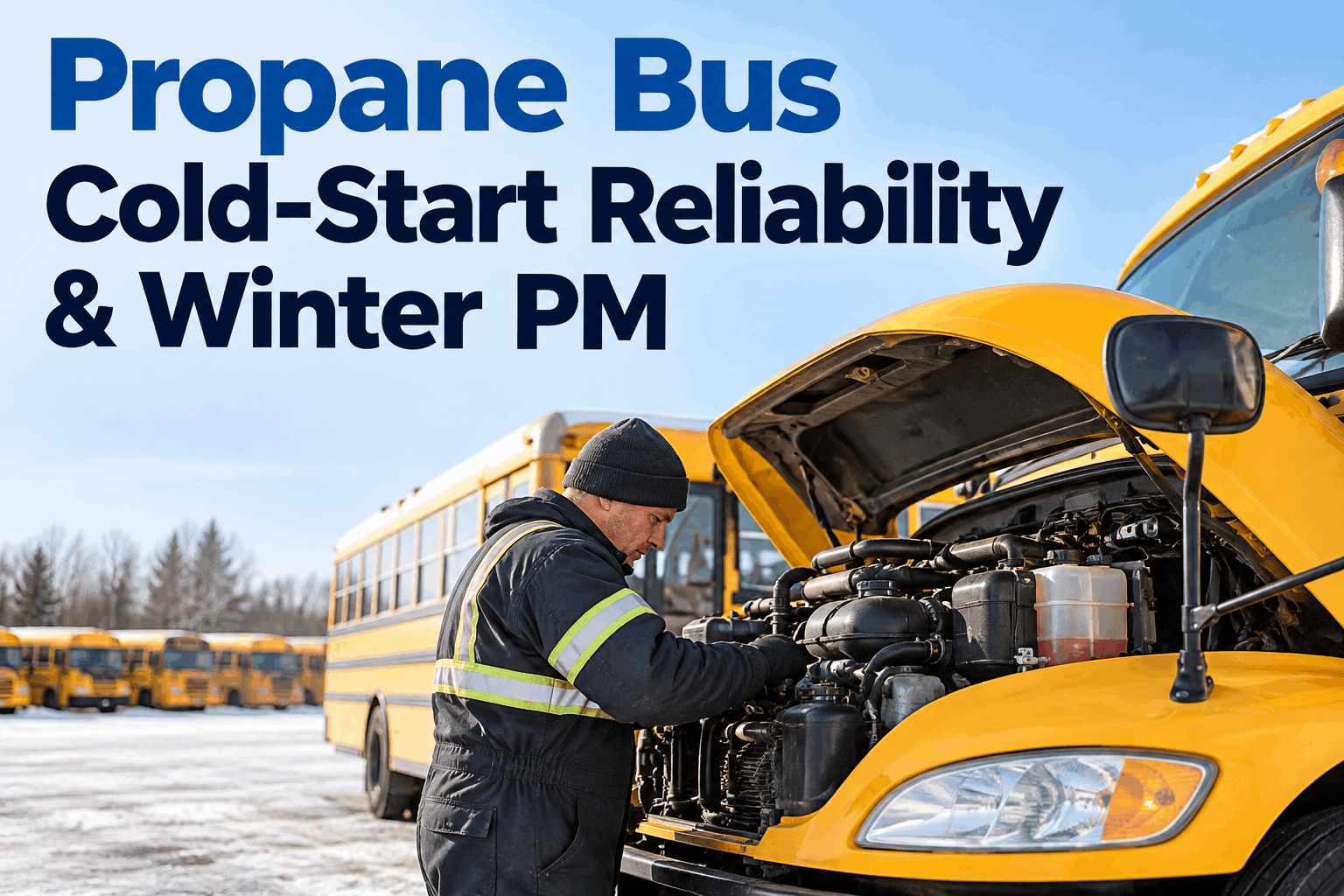
It is eight below, and every propane bus on your lot fires up in minutes while the diesels sit plugged in and grumbling. That is the propane cold-start advantage — until the one bus with a tired battery and neglected fuel lock won't crank, and a route waits. You can see how tracking cold-start issues keeps every propane bus starting.
Propane Bus Cold-Start Reliability: Protecting the Advantage With Winter PM
A well-kept propane autogas bus starts unaided in brutal cold — districts run them to 40 below without a block heater. But that cold-start reliability is earned through maintenance, not guaranteed by the fuel. Let a battery or fuel-system component slide, and the same bus no-starts long before the thermometer gets interesting.
Why Propane Buses Start in the Cold — and What Takes It Away
Propane autogas has a real cold-weather edge over diesel. It does not gel the way diesel does, the fuel system stays sealed and pressurized, and the engine fires and warms up in a few minutes instead of idling for twenty. That is why districts in Minnesota and Manitoba start propane buses unaided at 30 and 40 below without plugging anything in. But the fuel only hands you the potential — three things decide whether each bus actually delivers it.
Battery and charging health
Cold cuts battery output right when the engine needs the most cranking power. A battery that limps through fall will fail on the first hard freeze — the single most common cold no-start, propane or not.
Fuel system and regulator
The fuel lock, regulator, and lines have to deliver clean vapor on demand. A weak regulator or a contaminated filter that was fine in October becomes a hard-start in January, when vaporization is already working harder.
Ignition and engine basics
Spark plugs, coils, and sensors still have to be in spec. Cold is unforgiving of a marginal ignition component — what cranks over at 40 degrees may refuse at 40 below.
None of these are propane problems — they are maintenance problems that cold weather exposes. The buses that strand routes in January are almost always the ones carrying a known-but-unaddressed issue into winter. You can start free and track those issues before the first freeze.
The Propane Bus Winter Readiness Checklist
Cold-start reliability is not luck — it is a short list of things checked before the temperature drops. Run this on every propane bus in the fall, track what each one needs, and the quick-start mornings take care of themselves.
- Load-test every battery and clean the terminalsA battery good in fall can fail in deep cold — test, don't assume.CRITICAL
- Inspect the fuel lock, regulator, and filterService the propane fuel system per the OEM interval before winter load hits it.CRITICAL
- Check spark plugs, coils, and ignition componentsReplace anything marginal — cold does not tolerate a weak spark.KEY
- Verify the cabin and defrost heat outputA quick start means nothing if the windshield and riders stay cold.KEY
- Log every cold no-start and hard-start by busA bus that struggled once will struggle again — the trend tells you which one to pull.TRACK
Run on paper, this list gets rushed and the logging gets skipped. Run in BusCMMS, each item is a tracked task with a due date and a record — and that last line, logging the no-starts, is where the real winter savings hide. You can book a demo and see the winter checklist built in.
What Propane Buses Actually Do in Deep Cold
The cold-start reputation is not marketing — it holds up in the hardest winters in North America, as long as the buses are maintained. The numbers districts report are the bar your fleet should be hitting too.
Figures reported by school districts in Minnesota, Iowa, and Manitoba in Roush CleanTech cold-weather case studies, starting propane buses reliably at 30 to 40 below zero. The advantage is real — and it is only yours if every bus is maintained to earn it.
How Tracking Cold-Start Reliability Works in BusCMMS
A cold no-start logged on a sticky note disappears by spring. Tracked in one system, it becomes a pattern you can act on. Here is what that looks like for a propane fleet.
Log every cold-start issue by bus
Drivers and techs record a no-start or hard-start the moment it happens, tied to the bus and the temperature — so nothing gets forgotten between morning rush and spring.
See the repeat offenders
Trends show which buses struggle in the cold again and again — the ones carrying a battery, fuel, or ignition problem into winter — so you fix the cause, not the symptom.
Schedule fuel-type-specific PM
Propane buses get their own PM logic — fuel lock, regulator, filter intervals — alongside your diesel, CNG, and electric buses on one dashboard, so the winter work actually gets scheduled.
Protect fleet availability
Fewer cold no-starts means fewer routes scrambled on freezing mornings — the whole point of running propane in the first place, delivered consistently all winter.
That is the difference between hoping your propane buses start and knowing they will. It is also exactly what a bus-specific CMMS is built to do, and it is worth seeing on your own fleet in a short walkthrough of cold-start tracking.
We switched to propane partly for the cold starts, and the first winter proved it — except for two buses that kept no-starting. Turned out both had batteries we should have replaced in October. Once we started logging every cold crank and running a fall readiness check, the surprise no-starts stopped. The fuel was never the problem. We were.
Propane Bus Cold-Start Reliability: The Short Version
Propane's cold-start edge is real
A maintained propane bus starts unaided to 40 below and warms up in minutes — no block heater, no gelling.
But it is earned, not guaranteed
Battery health, the fuel system, and ignition decide whether each bus actually delivers that advantage.
A fall readiness check prevents most no-starts
Load-test batteries, service the fuel system and ignition, and verify heat before the first freeze.
Logging cold-starts is where the savings are
Tracked no-starts reveal the repeat-offender buses so you fix the cause before it strands a route.
Propane gives you a genuine winter advantage — but only the fleets that maintain for it get to keep it. Run the fall readiness check, track every cold no-start, and let the data point you at the one bus that needs attention before January does the pointing for you. That is how a propane fleet turns a fuel choice into reliable winter availability. You can start free and get your fleet winter-ready.
Propane Bus Cold-Start: Common Questions
Do propane buses start better than diesel in cold weather?
Generally, yes — when both are maintained. Propane autogas does not gel the way diesel fuel does in the cold, the fuel system stays sealed and pressurized, and propane buses warm up in a few minutes instead of the 20 to 30 a diesel needs. Districts in Minnesota and Manitoba report starting propane buses unaided at 30 to 40 degrees below zero without plugging into block heaters. The advantage is real, but it still depends on the battery, fuel system, and ignition being in good shape.
Why would a propane bus fail to start in the cold?
Almost always for the same reasons any vehicle no-starts in deep cold: a weak battery that cannot deliver cranking power when it is coldest, a neglected fuel-system component like the fuel lock, regulator, or filter, or a marginal ignition part that cold weather pushes over the edge. These are maintenance issues, not propane issues — cold weather simply exposes a problem the bus was already carrying. A fall readiness check catches most of them before the first hard freeze.
How cold can a propane bus start without a block heater?
Propane autogas buses are rated for unaided cold starts down to about 40 degrees below zero Fahrenheit, and districts in the coldest parts of the U.S. and Canada confirm they start reliably at those temperatures without block heaters or overnight plug-ins. That assumes the bus is maintained — a healthy battery, a serviced fuel system, and sound ignition. A neglected bus can lose that capability and struggle well before it ever gets that cold.
What winter maintenance do propane buses need?
The core winter readiness list is short: load-test every battery and clean the terminals, inspect and service the fuel lock, regulator, and filter per the OEM interval, check spark plugs, coils, and ignition components, verify cabin and defrost heat, and log every cold no-start or hard-start by bus. Running that check in the fall, before temperatures drop, prevents the large majority of cold-start problems. Tracking the results per bus is what turns a one-time checklist into year-over-year reliability.
How does BusCMMS help with propane bus winter reliability?
BusCMMS lets you build the winter readiness checklist as tracked tasks with due dates, schedule propane-specific preventive maintenance alongside your diesel, CNG, and electric buses on one dashboard, and log every cold no-start tied to the bus and temperature. The trend reporting then shows which buses repeatedly struggle, so you fix the underlying battery, fuel, or ignition problem before it strands a route. The result is the cold-weather availability propane promises, delivered consistently instead of hoped for.