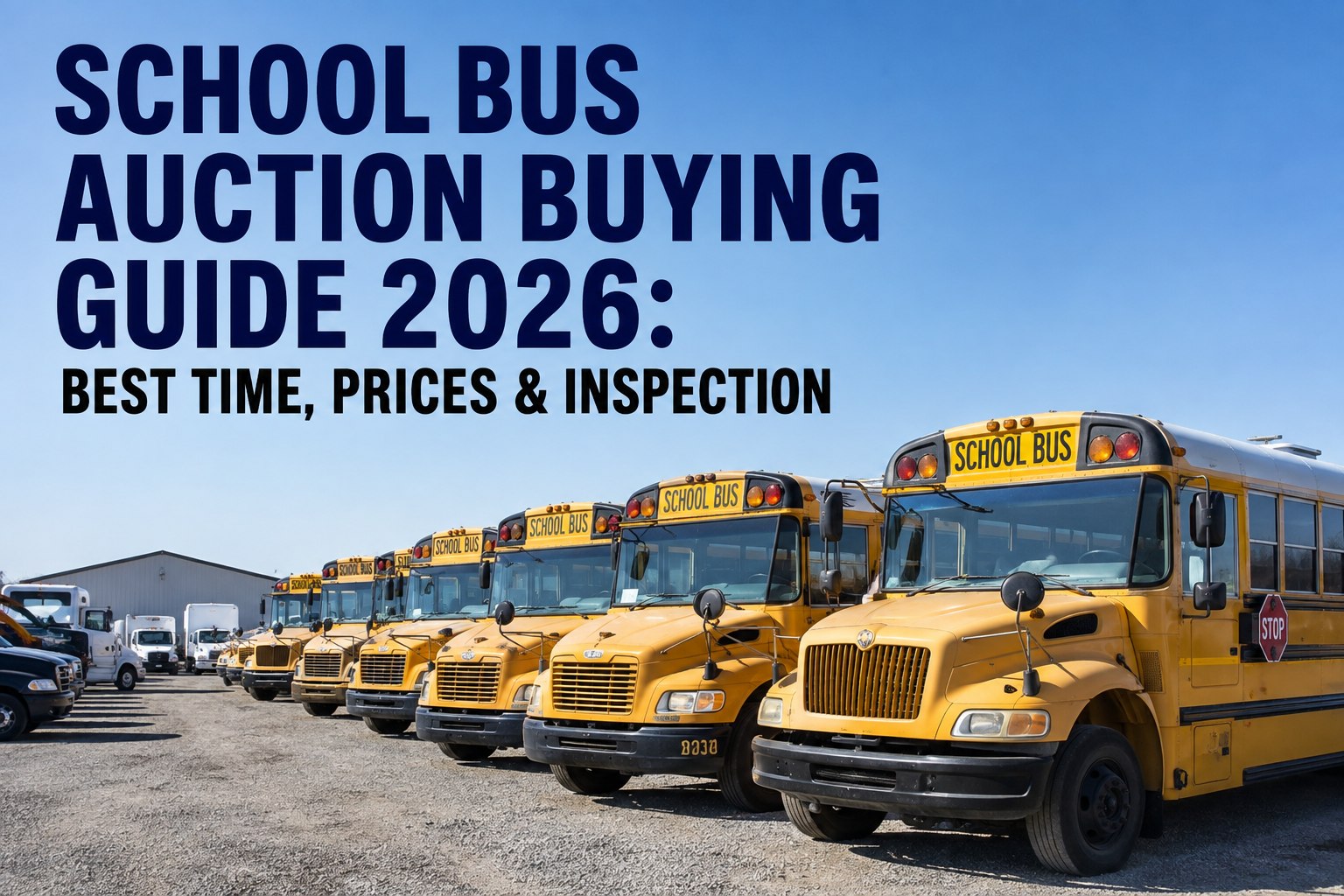
Government surplus auctions move roughly 40% of the used school bus market in the United States, with new listings coming online daily across GovDeals, Public Surplus, GSA Auctions, and Municibid. But the sticker price on the auction page is not what you actually pay. A $22,000 hammer bid on GovDeals lands at $31,950 by the time you factor in the 12.5% buyer's premium, credit-card surcharge, shipping, and the immediate repair work every auction bus needs. This is the 2026 buying guide -- the 4 platforms compared, real all-in cost math, the 11-point pre-bid inspection checklist, and the seasonality calendar every fleet buyer should know before submitting a bid. See BusCMMS log auction purchases with full acquisition cost per bus → book a 20-min demo.
School Bus Auction Buying Guide 2026
The 4 platforms compared, real all-in cost math, 11-point pre-bid inspection, and the seasonality calendar every fleet buyer needs before submitting a bid.
2026 Auction Prices by Bus Age
The real hammer-price ranges across GovDeals, Public Surplus, and dealer comparisons. Know the market before bidding.
Used school bus pricing at auction moves in three clear age bands. Anything under 7 years old sees the strongest competition and highest prices -- often close to what a dealer would quote once you add up all-in cost. The 7-to-10 year band is the sweet spot for fleet buyers -- most mechanical warranty is expired but the bus still has 5-8 years of productive service life. The 10-15 year band is the value play but comes with meaningfully higher repair budgets and shorter remaining service life.
Value play. Typical 200K-300K miles. Budget $8K-$18K in year-1 repairs. Best fit for parts trucks, short-route buses, or activity/spare buses.
7-10 years old. Most warranty expired but 5-8 years of productive service remain. Modern emissions, better safety features. Budget $3K-$8K year-1 repairs.
Under 7 years old. Most modern safety features, newest emissions. Highest bidding competition. Auction often equals dealer once you factor premium + shipping.
Bidding on a 2015 sweet-spot bus? Know the auction range, the regional adjustment, and the dealer alternative before submitting the max bid. See BusCMMS log purchase-price benchmarks per bus → book a demo.
The Real All-In Cost: Hammer Bid Is Not Your Actual Price
A $22,000 hammer bid lands at $31,950 on the road. Run the math before bidding, not after.
The most common mistake first-time auction buyers make is confusing the hammer price with the total cost. Buyer's premium, credit-card surcharge, shipping, and immediate post-purchase repairs add roughly 45% on average to the hammer price. Below is the actual math on a real-world 2015 Type C hammer at $22,000 on GovDeals -- what a fleet manager will actually cut checks for.
Hammer Price
Your winning bid on GovDeals+ Buyer's Premium (12.5%)
GovDeals non-negotiable, applied at checkout+ CC Surcharge (5% over $5K)
Avoid by paying ACH or wire+ Shipping / Drive-Away
Flatbed or drive-away, 500-1000 mile move+ Immediate Repairs (Year-0)
Tires, fluids, minor issues found post-saleREAL COST ON THE ROAD
45% above the hammer bidPay by ACH or wire to skip the credit card surcharge -- that alone saves $1,200 on a $22K hammer. And budget the immediate repairs BEFORE bidding, not after the bus arrives at your shop. See BusCMMS log acquisition cost + immediate repairs per bus → book a demo.
11-Point Pre-Bid Inspection Checklist
90 to 120 minutes on the auction lot before the bid closes. Bring a mechanic. Bring a flashlight. Bring a tape measure.
Auction inspection windows run 24-48 hours before close. The bus is sold as-is with no recourse. Once the hammer falls, whatever you missed on inspection is now your problem. The 11-point checklist below is the standard walkthrough a fleet mechanic runs before recommending a bid ceiling. Skip any single item and the odds of a costly surprise multiply.
- 01
Cold-Start & Engine Warm-Up
Have the engine started cold. Listen for knock, watch for excessive smoke color (black = fuel, blue = oil, white = coolant/timing). Let it come to operating temp. Watch dash for warning lights that clear vs stay lit.
- 02
Air Brake System Charging
Critical. Time from 85 to 100 PSI at governed idle. Anything over 40 seconds signals compressor or leaks. Cycle service brakes, check drop rate. Verify dryer purge audibly. Bendix systems especially.
- 03
Frame & Underbody Inspection
Under the bus with a flashlight. Rust on frame rails, crossmembers, spring hangers. Any rust hole bigger than a nickel is structural. Check body-to-frame mount condition. Fuel tank straps.
- 04
Tire Tread + DOT Date Code
4/32" minimum steer, 2/32" drive per FMCSA. Check DOT date code on sidewall (last 4 digits of DOT number = week/year of manufacture). Any tire over 6 years old needs replacement regardless of tread.
- 05
Transmission Engagement All Gears
Drive test if possible. Every gear engages cleanly with no slippage, harsh shifts, or delayed engagement. Allison 3000/4000 units: connect to Allison DOC if available to pull DTCs. TCM code review essential.
- 06
Fluid Conditions
Engine oil (color, level, texture). Coolant (color, cross-contamination check). ATF (bright red vs burnt brown). DEF (crystallization). Power steering fluid. Cross-contamination between systems = major internal damage flag.
- 07
Body Seams & Rust Damage
Walk the perimeter. Body-to-frame seam separation, rocker panel rust, rear wheel arch, floor pan corrosion. Interior floor lifts and buckles. Any structural rust is disqualifying.
- 08
Emergency Exits & Roof Hatches
Every emergency exit opens smoothly from inside. Roof hatches unlatch. Rear emergency door alarms function. Non-functioning exits = automatic DOT inspection fail once you register the bus.
- 09
Stop Arm, Crossing Gate, 8-Light System
All amber and red warning lights function. Stop arm extends and retracts. Crossing gate deploys. Missing or non-functional = costly regulatory retrofit before the bus can carry students.
- 10
Electrical & HVAC
All dash gauges accurate. Headlights high/low. Turn signals. HVAC blows hot and cold. Interior lights. Aged buses with electrical gremlins can eat $2K-$5K in diagnostic labor alone.
- 11
VIN Verification & Title Status
VIN plate present, unaltered, matches title. Verify title status through state DMV lookup if possible. Government surplus titles are typically clear but check for lien or salvage history flags. Get the seller's fleet number as a secondary reference.
Any single item failing this checklist should adjust your maximum bid downward by at least $2,000. Multiple failures should walk you away from the lot. Sign up free and log pre-bid inspection results per bus →
Best Time to Buy: The 2026 Seasonality Calendar
Auction pricing shifts predictably across the year. Buying in the wrong window costs 15-25% more.
School district surplus rhythms create predictable auction pricing waves. Districts retire and list buses at fiscal year-end and again after school-year startup panic subsides. The best deals of the year are in winter, when listing volume is thin but bidder attention is even thinner. The worst prices are late summer when everyone panics for school opening. Below is the 4-quadrant calendar every auction buyer should tape to the wall.
Fewer new listings, but far fewer competing bidders. Winter weather deters casual buyers. Prime window for value hunters willing to travel or ship. Set alerts and pounce.
End of school year district surplus dump. Highest inventory of the year -- best selection window. Prices at market baseline. Best window for fleet buyers needing specific configurations.
Post-fiscal year purge from districts on July-June fiscal calendars. Regular auction pace. Reasonable prices, decent selection. Fine for opportunistic buying.
Panic-buy season. Districts and charter operators rush to fill fleet gaps before Sept 1 route start. Highest prices of the year, worst selection, thinnest inspection windows. Avoid.
If a bus you need shows up in Aug-Sept, do not chase it. The same bus (or a similar one) will list 60-90 days later at $4K-$8K less with a lot less pressure on the bid.
Winter buying discipline saves 15-25% versus Aug-Sept panic bidding. That is real money spread across a fleet. See BusCMMS track auction seasonality vs your real acquisition cost → book a demo.
Where BusCMMS Fits Your Auction Buying Program
Six ways the auction bus goes from surprise budget item to trackable fleet asset from day zero.
Full Acquisition Cost Per Bus
Hammer + premium + surcharge + shipping + immediate repairs all logged per bus. No more surprises when the finance team asks what the bus really cost.
Pre-Bid Inspection Checklists
The 11-point checklist stored per bid candidate. Pass/fail per item. Photos attached. Decide bid ceiling from data, not gut feel.
Post-Purchase Repair Budget vs Actual
Estimated year-0 repairs at time of purchase compared to actual first-year spend. Learn which auction sellers are honest and which oversell.
VIN + Title + Auction Docs
VIN, title status, auction paperwork, seller info all attached to the bus record. Ready when DMV, state DOT, or the auditor asks.
Age, Mileage, CPM at Time of Buy
Baseline snapshot at acquisition. Track how the bus performs against that baseline over years. Data-driven case for or against buying more from that seller.
Auction Fleet vs Dealer Fleet TCO
Compare total cost of ownership between buses acquired at auction vs from dealers. Some fleets discover the 45% auction premium beats dealer markup, others do not.
First bus we bought at auction was a 2014 Type C for $18,500 hammer on GovDeals. I thought I got a great deal. By the time the premium, credit card surcharge, and shipping hit, it was $22,900 in my lot. Then the inspection found a slow-charging air brake compressor, two tires past their DOT date, a stop arm that only worked half the time, and a bad water pump. Six thousand dollars in the first three weeks. I ended up at just under $29,000 on a bus I thought I bought for $18,500. That was three years ago. Since then we run every auction candidate through the 11-point checklist BEFORE we bid, and every acquisition goes into BusCMMS with the full cost breakdown -- hammer, premium, shipping, immediate repairs, all in one number. We know exactly what each bus cost, exactly what its year-1 repair budget was vs actual, and the auction sellers we do NOT buy from anymore. Bought 14 more buses at auction since, average total cost 12% above hammer instead of 45%.
45% over hammer on the first bus. 12% over hammer on the next 14. Data changes the game. See how →
Frequently Asked Questions
When is the best time to buy a school bus at auction?
December through February consistently produces the best prices, running 10-20% below annual baseline. Listing volume is lower, but bidder competition is even lower -- winter weather deters casual buyers and fleet operators are typically not shopping during holidays. May through July is the peak listings window as school districts dump surplus at fiscal year end -- inventory is at its highest and prices sit near baseline, making it the best window if you need a specific configuration. September through November is a steady window with moderate volume and reasonable pricing. August through early September is the danger zone -- listing volume drops but bidder competition spikes as districts and charter operators panic-buy to fill fleet gaps before September route start. Prices in that window can run 15-25% above baseline. If a bus you need shows up in August or September, the smart move is to wait -- a similar bus almost always lists in the following 60-90 days at $4,000-$8,000 less with far less pressure on the bid.
What does a used school bus actually cost at auction in 2026?
Auction hammer prices break into three age bands. 2010-2015 buses (10-15 years old) run $16,000-$32,000 at auction versus $22,000-$45,000 at dealers -- the value play but budget $8,000-$18,000 in year-1 repairs. 2015-2018 buses (7-10 years old) run $32,000-$52,000 at auction versus $42,000-$68,000 at dealers -- the fleet-buyer sweet spot with modern emissions, decent safety features, and 5-8 years of productive service life remaining. 2018+ buses (under 7 years old) run $48,000-$68,000 at auction versus $60,000-$90,000 at dealers -- the highest bidder competition, and auction totals often equal dealer pricing after adding buyer's premium and shipping. Regional adjustments apply: Northeast runs 5-10% above baseline due to tight supply, California runs 20-25% above due to emissions requirements, Florida and Texas sit at baseline as the largest markets. Buying 5 or more buses at once often earns a 10-15% bulk discount from the seller.
What fees actually apply on top of the hammer price?
GovDeals adds a 12.5% buyer's premium (non-negotiable, applied at checkout) plus a 5% credit card surcharge on amounts over $5,000. So a $22,000 hammer bid paid by credit card lands at $25,988 before shipping and repairs. Paying by ACH or wire skips the credit card surcharge -- saving roughly $1,200 on that same $22,000 hammer. Public Surplus buyer's premium runs 0-10% depending on the seller, with a median around 7% -- some sellers absorb the premium entirely. GSA Auctions charges 0% buyer's premium but only accepts wire transfer, cashier's check, or money order -- no credit cards. GSA also assesses 20% liquidated damages for non-payment. Municibid runs 0% buyer's premium with payment terms set per seller. On top of premium and payment fees, factor shipping ($400-$3,500 depending on distance and drive-away vs flatbed) and immediate post-purchase repairs (typically $3,000-$8,000 on a running auction bus, more on older or higher-mileage units). All-in cost typically lands 35-50% above the hammer bid on a first purchase, tightening to 10-15% above hammer once a buyer is running consistent pre-bid inspections.
How do you inspect a school bus at auction before bidding?
Auction inspection windows run 24-48 hours before the bid closes and the bus is sold as-is with no warranty or return option. Bring a mechanic, a flashlight, and a tape measure -- expect the walk-through to take 90-120 minutes for a thorough job. The core 11-point checklist covers cold-start behavior and warm-up (watch for smoke color and warning lights), air brake system charging time from 85 to 100 PSI at governed idle (over 40 seconds signals compressor issues), frame and underbody rust condition (any rust hole bigger than a nickel is structural), tire tread depth and DOT date codes on sidewalls, transmission engagement in every gear including Allison DOC diagnostic scan if available, all fluid conditions with cross-contamination check, body seam and rocker panel rust, emergency exit and roof hatch operation, stop arm and crossing gate and 8-light warning system function, electrical and HVAC operation, and VIN plate verification against title status. Any single item failing should adjust the maximum bid downward by at least $2,000. Multiple failures should walk you away from the lot. Government surplus titles are typically clear but always verify state DMV status if possible before committing.
How does BusCMMS help manage school bus auction purchases?
BusCMMS logs full acquisition cost per bus -- hammer bid, buyer's premium, credit card surcharge, shipping, and immediate post-purchase repairs all rolled into one number attached to the bus record. Pre-bid inspection checklists based on the 11-point standard are stored per candidate with pass/fail per item and photos attached, so the bid ceiling comes from data instead of gut feel. Estimated year-0 repair budgets at time of purchase are compared automatically to actual first-year spend, which quickly reveals which auction sellers are honest and which oversell. VIN, title status, auction paperwork, and seller information all live on the bus record for DMV, state DOT, and auditor requests. Age, mileage, and cost-per-mile at time of buy establish the baseline the bus is measured against for the rest of its service life. And auction-acquired buses can be compared side-by-side with dealer-acquired buses on total cost of ownership -- some fleets discover the 45% auction premium beats dealer markup, others do not, and only the data tells you which. One 32-bus Midwest charter operator moving 8-12 auction buses annually reported average total cost dropped from 45% over hammer on their first purchase to 12% over hammer across the next 14 buses after moving pre-bid inspections and acquisition cost tracking into BusCMMS.