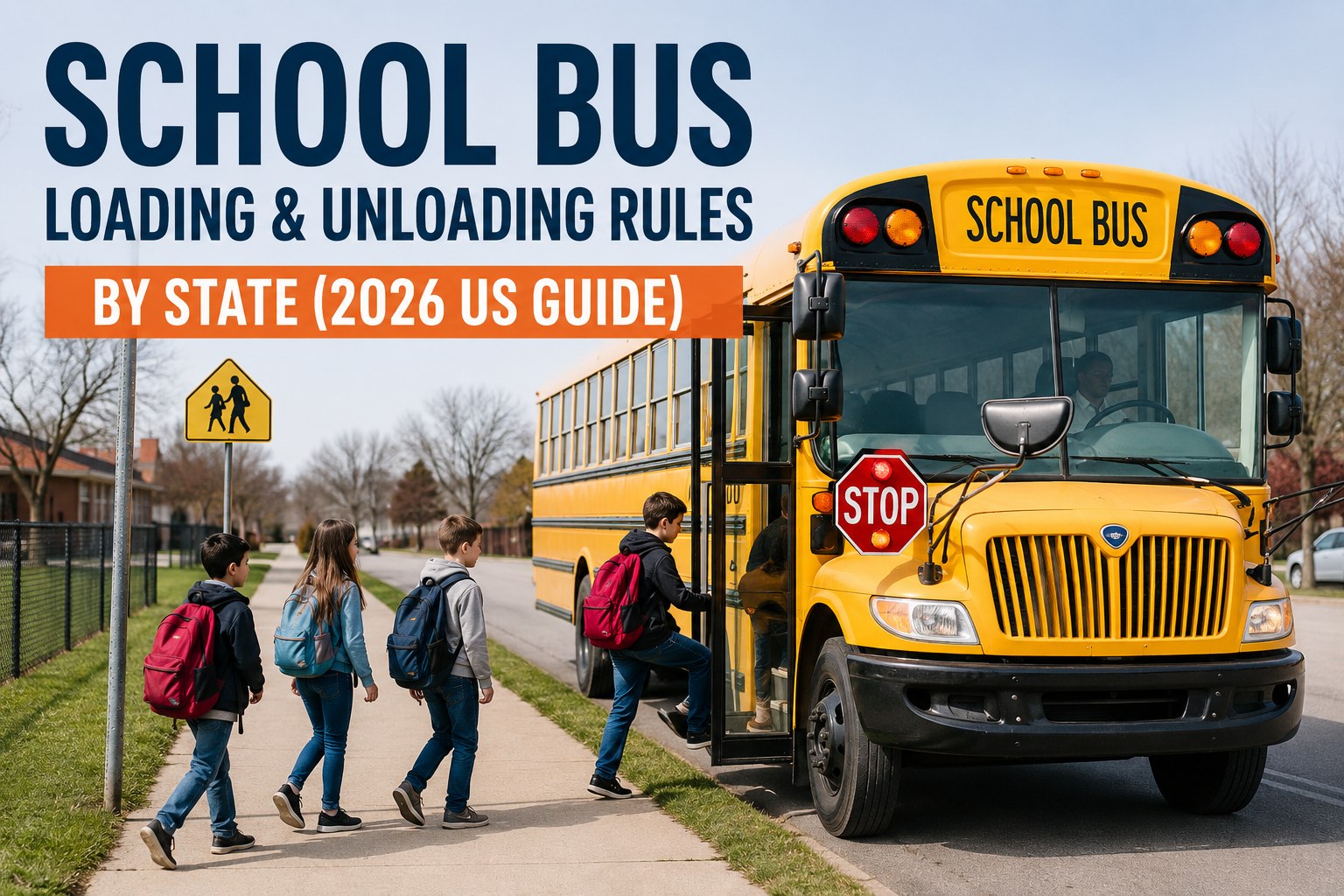
Every school day, drivers commit roughly 43.5 million illegal school bus passing violations across the U.S. -- and that number is up from 41.8 million the year before, per the National Association of State Directors of Pupil Transportation Services annual survey. The rules for when you must stop are universal in all 50 states. Where drivers get it wrong -- and where liability falls on the district if the bus procedure was not followed -- is the divided highway rules, the 10-foot danger zone, and the amber/red signal sequence that varies by state. This is the 2026 loading and unloading compliance reference: the universal 8-light signal system, the danger zone map, state-by-state fine tiers, divided highway exceptions, and the 10-step driver procedure every school bus fleet should audit against. See BusCMMS log driver loading procedure per route with DVIR audit trail → book a 20-min demo.
School Bus Loading & Unloading Rules by State
Universal 8-light signal system, danger zone map, state-by-state fine tiers, divided highway exceptions, and the 10-step loading procedure every school bus fleet audits against.
AMBER FLASHING
Bus is slowing to stop. Activated 200-300 ft before the stop. Traffic must prepare to stop. No stop arm yet.
RED FLASHING + STOP ARM
Bus is loading or unloading. All traffic in both directions must stop (unless divided-highway exception applies). Stay stopped until stop arm retracts.
ALL LIGHTS OFF
Stop arm retracted, red lights off, students clear of danger zone. Traffic may proceed with caution. Bus reenters road.
The 4 Universal Rules (All 50 States)
Where every state agrees. Everything below is the same everywhere. The state-specific rules layer on top.
Before the state-by-state variations, four rules apply everywhere in the country. Every school district and every school bus fleet must operate to these baselines. Failure to enforce any one of them exposes the district to civil liability the moment a student is injured -- regardless of the state.
Red Lights + Stop Arm = Full Stop
All traffic in both directions must stop when a school bus displays flashing red lights and has an extended stop arm. Passing is a violation in every state. No exception without the divided-highway rule (see Section 4).
Amber Lights = Prepare to Stop
Amber flashing lights signal the bus is slowing to stop. Traffic must prepare to stop. Activated 200-300 ft before the stop in most state driver manuals. Some states escalate the fine if traffic passes during amber phase.
10-Foot Danger Zone
The 10-foot area around every school bus is the danger zone. Students are most at risk of being hit here. Fatal-strike data is concentrated in this zone, especially front-of-bus and driver-side mirror blind spots.
Stop Only When Lights Retract
Traffic may not resume until the stop arm is fully retracted and red lights are off. Some states also require confirmation that students are clear of the roadway. In practice: wait for the bus to move before you move.
These 4 baselines are what every district's driver training program must document, and what every DVIR-linked pre-trip check must confirm operational before the bus leaves the yard. See BusCMMS pre-trip DVIRs confirm 8-light + stop arm function daily → book a demo.
The Danger Zone: Where Students Get Hit
10 feet in every direction. 4 blind spot zones. Every driver's death-avoidance map.
The National Highway Traffic Safety Administration reports the majority of school bus loading-and-unloading fatalities happen within 10 feet of the bus itself, not at the stop-arm violation point. The danger comes from the bus's own blind spots -- and from students who forget the "10 giant steps" rule they learned in kindergarten. Every driver-training program should overlay this diagram directly.
Highest fatality zone. Students crossing here disappear below the driver's line of sight.
Directly beneath the driver-side outside mirror. Students below the mirror line invisible from cab.
Boarding/exiting zone. Most controlled area but students may drop items and reach back.
Behind the bus. Fully blind from driver seat. Students crossing here are invisible.
10 Giant Steps
Students wait 10 ft back from curb until driver signals safe to approach.
Cross In Front
Always 10 ft in front of bus. Never behind. Front blind spot is deadly.
Eye Contact First
Make eye contact with driver before crossing. Wait for driver's signal.
Never Retrieve Items
Dropped item under or near bus? Tell the driver. Never bend down to grab it.
State Fine Tiers: Where Passing Costs Most
4 fine tiers across all 50 states. Camera enforcement now active in 30+ states.
State-by-state fine amounts for illegally passing a stopped school bus range from $100 in the lightest states to $1,500+ (with jail exposure) in the strictest. Missouri's SB 1421 takes effect August 28, 2026, adding 5 license points, $500-$1,000 first-offense fine, and a 90-day license suspension -- a major escalation. Below is the 4-tier map every driver-training program should reference for the states the district operates in.
30+ states now authorize stop-arm cameras. Georgia, Virginia, Maryland, North Carolina, Pennsylvania, Texas, and Florida are actively using them. Rebuttable presumption laws mean the ticket goes to the registered vehicle owner -- and it stands unless the owner proves someone else was driving.
Fine tiers are not the district's problem to enforce, but knowing which states the fleet operates in tells you which enforcement agencies to expect at driver depositions after an incident. See BusCMMS log incident reports with jurisdiction context → book a demo.
Divided Highway Rule: The Single Biggest State Exception
Where the "everyone stops" universal rule bends. Get this wrong and you either paralyze traffic or expose a student.
On a divided highway with a raised physical barrier or an unpaved median at least 5 feet wide, drivers moving in the opposite direction of the bus generally do not have to stop -- about 30 states allow this exception. But painted lines are NOT a barrier. And 2-way undivided roads always require both directions to stop. Below is the decision tree every district's driver training should teach.
Undivided 2-Lane Road
Both directions stop. No exceptions. This is the classic residential neighborhood scenario. Any student may cross to reach the bus.
Multi-Lane with Painted Median
Both directions stop. Painted lines are NOT a barrier under any state's law. Concrete divider or 5+ ft unpaved space is required for the exception.
Divided Highway, Raised Barrier
~30 states: opposite direction NOT required to stop but should slow down and watch for students. Same direction always stops. Confirm state rule.
Divided Highway, 5+ ft Unpaved
Florida and similar states: 5+ ft unpaved space qualifies as barrier. Opposite direction may proceed with caution. Painted lines never qualify.
Missouri districts may adopt a policy allowing school buses on divided 4+ lane highways to pull off the roadway and load/unload without extending the stop arm -- provided passengers do not cross traffic lanes and amber emergency flashers are used to signal drivers to proceed with caution. Most other states have similar pull-off provisions on divided highways where students board on the same side as the bus stop.
Getting the divided-highway rule wrong on the SOP either paralyzes traffic on 4-lane state routes or exposes a student on a painted-line median where drivers assumed they could keep moving. See BusCMMS load state-specific driver SOPs per route → book a demo.
The 10-Step Driver Loading Procedure
Universal sequence. Every district's SOP should read like this. Every driver's DVIR should confirm the equipment supports it.
- 01
Approach at Reduced Speed
Slow from posted speed 300-400 ft before stop. Scan mirrors for traffic behind. Assess road type (divided vs undivided).
- 02
Activate Amber Lights 200-300 ft Out
Critical timing. Amber flashing lights alert traffic that a stop is coming. Too late = following traffic cannot slow safely. Too early = drivers pass thinking the bus is not stopping soon.
- 03
Move to Right Lane if Multi-Lane
Signal early. On divided highways, position for pull-off if district policy allows loading without stop arm.
- 04
Stop 10+ ft from Waiting Students
The 10-ft rule works both ways -- students stay 10 ft back and driver stops 10 ft away. Never let students approach a moving bus.
- 05
Set Parking Brake + Neutral/Park
Bus must be stationary and secured before any loading begins. Transmission in neutral or park per district SOP.
- 06
Activate Red Lights + Extend Stop Arm
Red lights ON, stop arm extended, crossing gate deployed if equipped. Confirm all lights functioning before opening door.
- 07
Open Door + Signal Students
Only after red lights and stop arm are engaged. Give clear hand signal to boarding students. Make eye contact with each.
- 08
Count Students On/Off
Confirm all boarding/exiting students are safely on the bus or clear of the 10-ft zone. Look for dropped items.
- 09
Close Door, Retract Stop Arm, Deactivate Lights
Sequence matters. Door first (confirms students are seated), then stop arm retracts, then red lights off. Amber may re-flash briefly on some buses.
- 10
Signal + Reenter Traffic
Check mirrors, signal, wait for gap. In Missouri and similar 3-vehicle-rule states, wait for backed-up traffic to pass if 3+ vehicles are stopped behind (when safe to do so).
Every step above depends on a working 8-light system, functioning stop arm, and driver mirrors that pass daily DVIR. This is where compliance software meets safety. Sign up free and log daily 8-light + stop arm DVIRs per bus →
Where BusCMMS Fits Your Loading Compliance Program
Six ways the loading/unloading procedure becomes documented, defensible fleet compliance instead of a training memo nobody re-reads.
Daily DVIR With 8-Light Verification
Every pre-trip DVIR confirms amber + red flashers, stop arm extension, crossing gate deployment, and mirror function. Non-functional lights block bus from routes.
Driver Safety Checklists Per Route
The 10-step loading procedure formalized per route type -- residential, divided highway, school property. Drivers acknowledge digitally, dated and timestamped.
Stop-Arm + Crossing Gate PM
Auto-scheduled PM on stop arm mechanism, crossing gate deployment linkage, and 8-light bulb replacement. Failures caught before route, not during.
Incident + Passing Violation Log
Every observed passing violation logged with date, location, plate, direction. Documentation stands up in state DOT audits and civil actions.
Driver Certification + Training Records
CDL Class B + P + S endorsement expiration tracked per driver. Loading-procedure refresher training documented with completion dates.
State-Specific Compliance Templates
Templates for each state's stop-arm law, fine tier, camera enforcement status, and divided highway rules. District operating in multi-state region uses correct SOP per bus.
We had a passing incident in October where a driver ran the red lights while our bus was unloading a wheelchair student. Nobody was hurt, thank God. But when the state DOT came to review our driver-training records, our stop-arm PM history, and our DVIR trail for that specific bus that morning, we had 4 hours to produce it all. Before we moved to BusCMMS, that would have been the panic scramble of my career -- paper DVIRs in a filing cabinet, driver training records on my predecessor's laptop, PM history on 3 different spreadsheets. In BusCMMS, I pulled the DVIR from that morning (stop arm confirmed operational), the last stop-arm mechanism PM (23 days prior, clean), and the driver's loading procedure training records (all current, refresher completed August) in about 8 minutes. State DOT closed the review with no findings against us. That documentation IS the defense.
4 hours to produce driver training + PM history + DVIR. 8 minutes in BusCMMS. State DOT closed with no findings. See it →
Frequently Asked Questions
When do drivers have to stop for a school bus loading or unloading?
In all 50 states, drivers must stop when a school bus displays flashing red lights and an extended stop arm. Amber (yellow) flashing lights signal that the bus is about to stop -- traffic must prepare to stop but does not yet have to. Red flashing lights combined with the extended stop arm means the bus is loading or unloading students, and all traffic in both directions must stop until the stop arm retracts, red lights turn off, and students are clear of the roadway. The one universal exception is on divided highways with a raised physical barrier or an unpaved median at least 5 feet wide -- approximately 30 states allow drivers moving in the opposite direction to proceed with caution rather than stop. Painted lines never qualify as a barrier under any state's law. Passing a stopped school bus with red lights and stop arm extended is illegal in every U.S. state, with fines ranging from $100 in the lightest states to $1,500 or more (with jail exposure) in Washington and Massachusetts.
What is the school bus danger zone?
The danger zone is the 10-foot area extending in every direction around a school bus. The National Highway Traffic Safety Administration reports the majority of school bus loading and unloading fatalities happen within this zone -- not from stop-arm violations at distance. Four blind spot sub-zones exist within the danger zone: the front blind spot directly in front of the bus where students crossing disappear below the driver's line of sight (highest fatality zone), the rear blind spot behind the bus that is fully invisible from the driver's seat, the driver-side mirror blind spot directly beneath the outside mirror where students below the mirror line cannot be seen from the cab, and the passenger-side step zone where students are boarding or exiting. Universal student rules: wait 10 giant steps back from the curb until the driver signals, cross 10 feet in front of the bus (never behind), make eye contact with the driver before crossing, and never bend down to retrieve a dropped item near the bus -- tell the driver instead.
How much is the fine for passing a stopped school bus in 2026?
Fines fall into four tiers. Tier 1 ($100-$300) covers some Plains and Mountain states with lower base fines but still license points and mandatory court appearance. Tier 2 ($300-$600) covers most U.S. states including Ohio, Indiana, Kentucky, Tennessee, Alabama, and South Carolina, with points on license, mandatory court, and insurance premium increases. Tier 3 ($500-$1,500) covers California, Missouri (effective August 28, 2026 under SB 1421), New York, New Jersey, Maryland, Virginia, Pennsylvania, and North Carolina -- with stiff points, potential license suspension, and active camera enforcement. Missouri's SB 1421 specifically adds 5 license points and a 90-day license suspension on top of the $500-$1,000 first-offense fine. Tier 4 ($1,500+ with jail exposure) covers Washington and Massachusetts, with criminal charges automatic if any student is injured. On top of state fines, 30+ states now authorize stop-arm cameras -- with Georgia, Virginia, Maryland, North Carolina, Pennsylvania, Texas, and Florida actively using them. Rebuttable presumption laws mean the ticket goes to the registered vehicle owner and stands unless the owner proves someone else was driving.
What is the 10-step driver loading procedure?
The universal 10-step procedure runs: (1) Approach at reduced speed from 300-400 feet before the stop. (2) Activate amber lights 200-300 feet from the stop -- critical timing that alerts following traffic to prepare to stop. (3) Move to right lane if multi-lane. (4) Stop 10+ feet from waiting students so students never approach a moving bus. (5) Set parking brake and shift transmission to neutral or park. (6) Activate red lights, extend stop arm, and deploy crossing gate if equipped -- confirm all lights functioning before opening the door. (7) Open door and signal students with a clear hand signal, making eye contact with each. (8) Count students on or off and check for dropped items in the 10-foot danger zone. (9) Close door first (confirms students are seated), then retract stop arm, then deactivate red lights -- sequence matters. (10) Check mirrors, signal, and reenter traffic. In Missouri and similar 3-vehicle-rule states, wait for 3+ backed-up vehicles to pass before rejoining traffic when conditions are safe.
How does BusCMMS help school bus fleets stay compliant with loading and unloading rules?
BusCMMS runs daily pre-trip DVIRs that confirm amber flashers, red flashers, stop arm extension, crossing gate deployment (if equipped), and driver mirror function -- with any non-functional light or safety feature blocking the bus from leaving the yard until corrected. The 10-step loading procedure is formalized per route type (residential, divided highway, school property) with drivers acknowledging digitally with timestamps. Stop arm mechanisms, crossing gate linkages, and 8-light bulb replacements are scheduled on auto-triggered PM cycles so failures surface before the route, not during. Every observed passing violation is logged with date, location, plate, and direction -- documentation that stands up in state DOT audits and civil actions. Driver CDL Class B plus P (passenger) plus S (school bus) endorsement expirations are tracked per driver, and loading-procedure refresher training completion is documented per session. For districts operating in multi-state regions, state-specific compliance templates load the correct stop-arm law, fine tier, camera enforcement status, and divided highway rules per bus. One 118-bus Great Lakes K-12 transportation director reported closing a state DOT review with no findings after a passing incident during a wheelchair unload -- pulling the morning DVIR, last stop-arm PM record, and the driver's loading-procedure training records in about 8 minutes on BusCMMS instead of hours of scrambling through paper files.