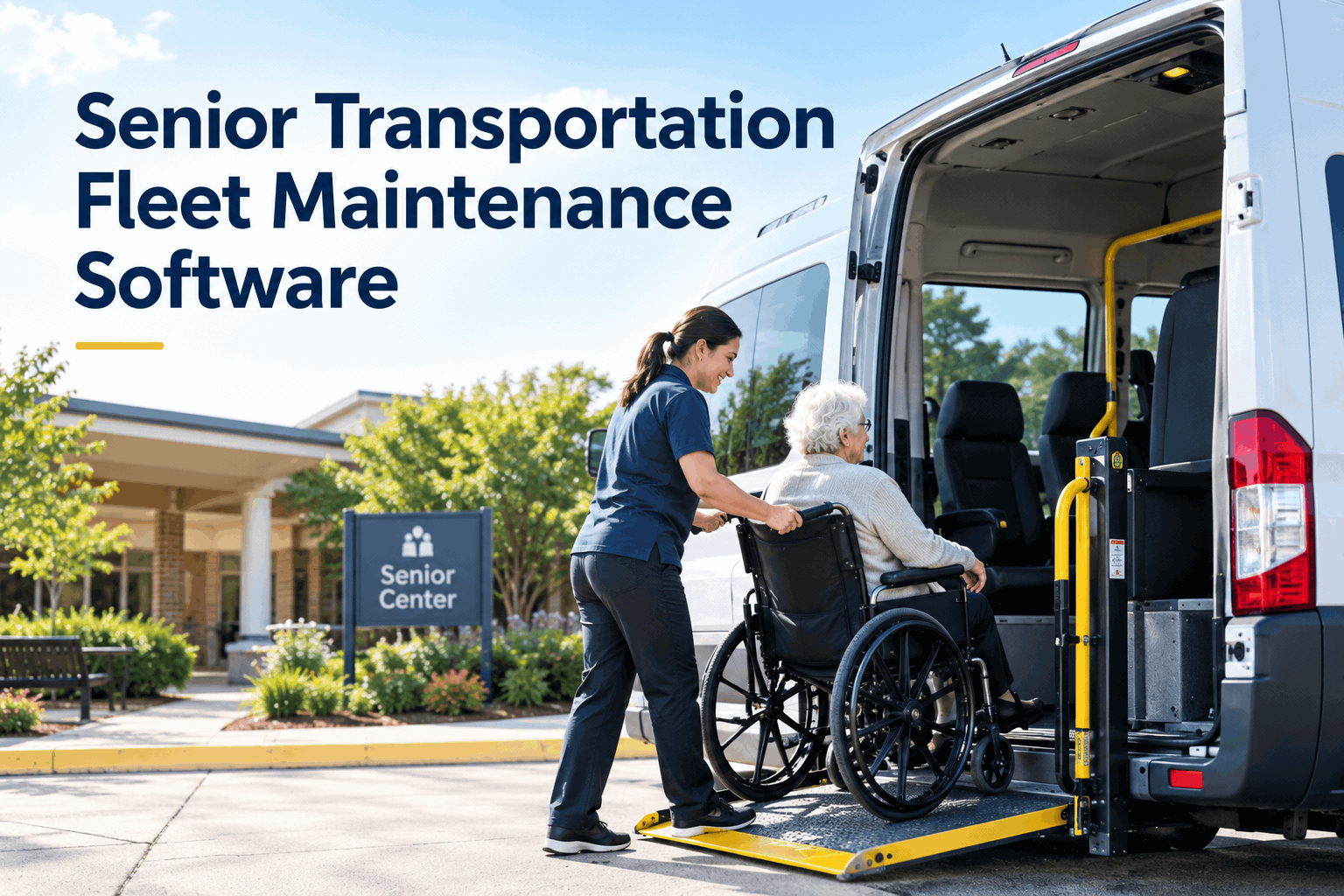
It is 8:10 on a Tuesday and the van on the dialysis route will not start — twelve riders waiting, no spare, no mechanic on staff. That scramble is what senior transportation fleet maintenance is really about: a small fleet carrying people who cannot just call another ride. The fix is not a bigger budget, it is a system that flags the failing van first. You can see a small senior-transport fleet kept road-ready in a demo.
Senior Transportation Fleet Maintenance Software That Fits a Small Fleet and a Tight Budget
Senior centers and nonprofit transport programs run small, aging, mixed van fleets with no spare and no shop. Here is how scheduled maintenance, inspections, and service records keep every van road-ready — without an enterprise price tag.
Why a Small Senior Transport Fleet Breaks Down at the Worst Moment
A big transit agency can pull a spare when a van goes down. A senior center usually cannot — you have six or eight vans, every one is committed to a route, and the riders on that route are headed to dialysis, a pharmacy, or a meal site, not somewhere they can skip. That is what makes senior center van maintenance a different problem than fleet upkeep anywhere else.
No spare to fall back on
One van down means a route is down. There is no reserve bus idling in a yard — the missed trip lands on a rider who was counting on it.
Aging, high-mileage vans
Grant-funded vans often run well past their useful life because capital replacement is slow. Old vehicles break more — and need the schedule most.
No mechanic on staff
Upkeep falls to a coordinator who also schedules rides and answers phones. Work farmed out to a local shop still needs tracking, or it slips.
On a small fleet, one unplanned breakdown is a bigger hit, not a smaller one — a missed route has no backup, and the rider has no second option.
One Fleet, Three Different Vans — Each Needs Its Own PM Logic
Here is the trap in senior transport van maintenance: the fleet looks uniform but is not. A gas minivan, a cutaway shuttle, and a wheelchair-accessible van wear differently and need different preventive maintenance. A single calendar for all of them either over-services the light vans or under-services the heavy ones.
Gas minivan
- Lighter duty, higher miles per day
- PM by mileage — oil, brakes, tires
- Simple, but easy to let slide
Cutaway shuttle
- Heavier chassis, more stop-start wear
- Shorter brake and tire intervals
- PM by mileage and engine hours
Wheelchair van
- Lift and securement add check layers
- Daily lift cycle on top of vehicle PM
- Defects pull it from accessible runs
The wheelchair van is the strictest case — its lift carries its own inspection cadence on top of the vehicle's PM, the kind of accessible-van upkeep covered in the paratransit fleet maintenance guide. Fuel-type-aware PM scheduling is exactly what a bus-built system handles, and you can walk through setting the right interval per van type in a demo or start free and map your fleet yourself.
What a Breakdown Really Costs a Senior Program — vs. a Planned Service
When you take a maintenance request to a nonprofit board, "we should do more preventive maintenance" does not move anyone. A side-by-side of what a roadside breakdown costs versus a planned service does. The road call is never just the tow.
Those are illustrative figures, but the shape holds everywhere: the planned service is the cheap one, and the breakdown bill hides most of its cost in missed trips and staff time. Book a demo and we will show the cost-per-van view your board will want.
Service Records That Hold Up for a Grant Audit or a Board Review
A lot of senior transport runs on grant money — FTA Section 5310 funds, local aging-services dollars, United Way. That money comes with a records expectation: show that the vehicles were maintained. A shoebox of receipts does not survive that review. A per-vehicle service record does.
When a funder or auditor asks for maintenance history on a specific van, that is a one-click export instead of a week of digging. See the per-vehicle service record and export in a demo.
The Small-Fleet Senior Transport Maintenance Checklist
You do not need an enterprise maintenance department — you need these pieces in place and tracked somewhere other than your memory. Run this against your program and mark each honestly. The gaps are what strands a van on a Tuesday.
- PM scheduled per van typeMileage or time intervals set for each vehicle, not one calendar for the whole fleet.FOUNDATION
- Daily pre-trip inspection by driverA quick walkaround catches the brake, tire, and lift issue before the first pickup.CRITICAL
- Defects become tracked work ordersA reported problem gets an owner and a status, not a sticky note that falls off the dash.CRITICAL
- Wheelchair lift on its own cadenceAccessible vans get a daily lift cycle plus periodic functional checks, tracked separately.CRITICAL
- Per-vehicle service history keptEvery service and repair logged against the van, exportable for a grant or board review.FOUNDATION
- A morning view of what is road-readyBefore routes roll, you can see which vans are ready, which are due, and which are down.FOUNDATION
If three or more of these live only in someone's head or a paper binder, that is the exposure — one sick day or one forgotten interval and a route goes dark. Start free and get every item on this list tracked in one place.
How BusCMMS Fits a Senior Transportation Program
BusCMMS is built for bus and van fleets, which means the van-specific inspection items, fuel-type PM logic, and service records are there on day one — not a generic fleet tool you spend weeks bending into shape. For a small team, that fast, affordable rollout is the whole point.
PM scheduled by van type
Gas minivan, cutaway, and wheelchair van each get the right interval by mileage or time, on one dashboard.
Inspections that create work orders
A driver's failed pre-trip item becomes a tracked work order automatically, so nothing gets lost between shifts.
Audit-ready service records
Per-vehicle history exports in a click for a grant funder, board, or state review — no shoebox of receipts.
It runs on the same dashboard whether you have four vans or forty, so a senior program gets the structure of a real maintenance system without the overhead of one. You can book a demo and bring your actual van list to see it mapped out.
A Senior Center Transportation Coordinator's Take
I run seven vans and I am also the dispatcher, the scheduler, and half the time the driver. Maintenance used to live on a whiteboard until someone erased it. Now every van has a schedule and a history, and I get a flag when a PM is coming due instead of finding out when it dies on a route. We went from three or four surprise breakdowns a quarter to maybe one. For a program our size, that is the difference between keeping every medical trip and apologizing to a family.
Key Takeaways on Senior Transportation Fleet Maintenance
Small fleets feel every breakdown harder
No spare van means one failure strands a whole route — and a rider with no other option.
Mixed vans need mixed PM logic
Gas minivan, cutaway, and wheelchair van each wear differently — one calendar fits none of them.
Records are grant money protection
Per-vehicle service history is what satisfies a 5310 audit or a board asking where the money went.
The tool has to fit the budget
A bus-built system priced for a nonprofit, live in weeks, beats an enterprise tool you cannot afford or staff.
Treat senior transportation fleet maintenance as a small, deliberate system — scheduled PM per van, driver inspections, tracked defects, and clean service records — and your vans are ready on the morning a rider needs them. The budget will never be big; the system is what makes a small one hold.