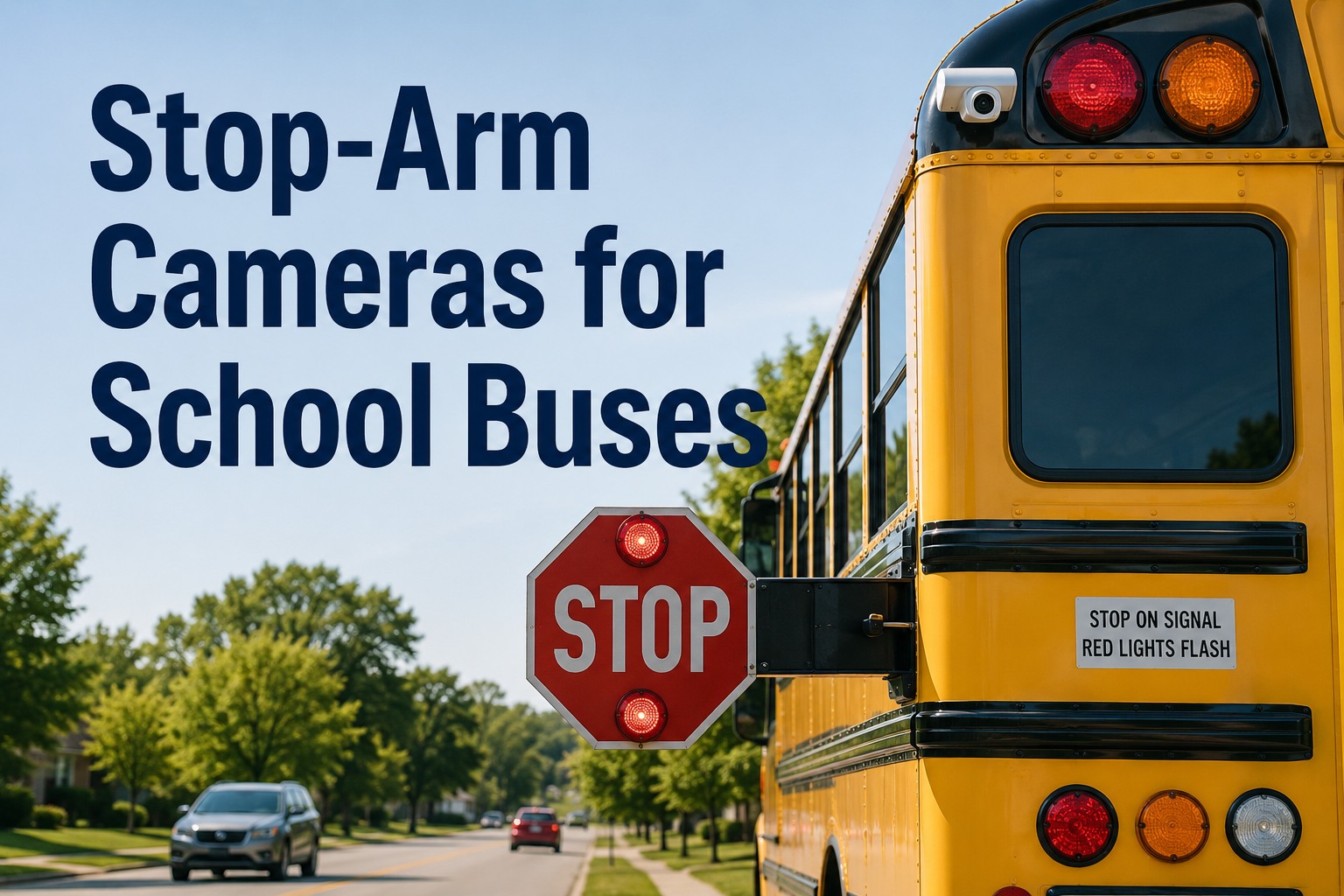
A BusPatrol pilot in Allentown, PA captured 205 stop-arm violations across just two buses in 47 school days — 2.18 per bus per day. That is the reality your fleet already lives in. This guide covers how stop-arm cameras actually work, 2026 state authorization, and where fleet operations software fits after the camera does its job. See BusCMMS turn stop-arm camera events into accountable fleet actions → book a 20-min demo.
The Stop-Arm Violation Lifecycle
Every stop-arm camera event flows through four stages. Understanding all four is what separates a fleet that installs cameras from a fleet that actually reduces violations and closes the operational loop.
DETECTION
AI cameras identify a vehicle entering the violation zone the instant the stop arm deploys and lights flash.
CAMERACAPTURE
High-def video from multiple angles plus dual license plate cameras (typically 5MP) record the full context.
CAMERAREVIEW
Safety professional validates the event, then law enforcement approves or rejects the citation package.
VENDOR + LEOACTION
Event logged to the bus asset history. Any camera fault or bus defect surfaced during review becomes a work order.
FLEET OPSHow Stop-Arm Cameras Actually Work
The tech has come a long way since analog side cameras. Understanding placement, coverage zones, and what each camera captures is step one for any evaluation.
A modern school bus stop-arm camera system is not one camera. It is a coordinated array of 4-6 exterior cameras plus interior cameras, all synchronized to trigger the instant the stop arm deploys and the 8-light warning system activates. Every camera has a specific job. The AI processor on board classifies vehicle motion in real time and packages evidence from multiple angles. The old assumption that a stop-arm camera only faces sideways -- catching the passing car on the left -- is completely outdated. Today's systems capture left-side and right-side passing, front-approach violations, and rear-departure violations, plus dedicated license plate cameras that read plates at highway speeds in low light.
Front-Left Approach
Wide-angle camera catches vehicles approaching from oncoming traffic that fail to stop as the bus deploys the stop arm.
Left-Side Passing
The classic violation zone. High-def video plus dedicated 5MP plate camera captures vehicles passing on the loading-door side.
Right-Side Passing
Often overlooked. Vehicles passing on the right side (curbside) between the bus and pedestrians -- highest injury risk zone.
Rear Departure
Rear-facing camera catches vehicles that were following the bus and continue past after the stop arm deploys.
License Plate Capture
Dedicated plate cameras (typically 5MP) read plates at highway speeds and in low-light conditions. Dual-plate systems catch front and rear tags.
Camera coverage determines whether a violation becomes a citation or a rejected review. See BusCMMS log per-camera health and coverage status per bus → book a demo.
The 8-Second Violation Timeline
From the moment the stop arm deploys to the moment the evidence package is sealed and uploaded, less than 8 seconds have passed. Here is exactly what happens.
The whole capture-and-package sequence is over before most drivers realize they even did something wrong. Understanding the millisecond-level workflow is how a transportation director explains to a school board why AI stop-arm cameras are meaningfully different from the analog systems installed a decade ago. The timeline below is what a modern AI-driven system executes for every stop-arm deployment -- whether the vehicle actually violates or not. If no vehicle enters the violation zone, the sequence terminates at T+3.4s. If a vehicle does enter the zone, the full evidence package is generated and sent to review.
- T+0.0s
Stop arm deploys
Driver activates the stop signal. 8-light warning system flashes. Camera array wakes to active detection mode. AI processor begins classifying every vehicle within 200 feet.
- T+2.1s
Vehicle approaches violation zone
Radar and vision sensors detect a vehicle continuing forward instead of stopping. Cameras begin recording pre-event buffer video.
- T+3.4s
AI classifies violation intent
Machine learning model determines with high confidence that vehicle motion equals violation-in-progress. Full multi-camera capture triggered.
- T+5.8s
License plate captured
Dedicated 5MP plate cameras lock the plate at multiple frames, front and rear. OCR extracts the plate string in real time for review.
- T+8.0s
Evidence package sealed
Timestamp, GPS coordinates, video from all zones, plate images, and metadata bundled into a cryptographically-signed package and uploaded to the review platform via cellular link.
Eight seconds from stop-arm deploy to sealed evidence package. That is the pace modern systems operate at. See BusCMMS log every camera event to bus asset history within seconds → book a demo.
The Evidence Package: What Reviewers Actually See
The reason modern camera systems succeed where older ones failed is not the video quality alone. It is the completeness and integrity of the evidence package sent to law enforcement.
A stop-arm camera does not issue a ticket. A safety professional reviews the event, packages it as evidence, and sends it to local law enforcement for approval. Law enforcement is the one that issues the citation. That is the human-in-the-loop model authorized by every state that permits automated stop-arm enforcement -- and it is the reason modern evidence packaging matters so much. A rejected package means no citation, no fine, and no behavior change. A complete evidence package is what triggers the ticket. Below is what a modern reviewer or law enforcement officer sees when they open a single event.
The completeness of this package is why modern systems get citations approved at rates old analog systems could not touch. Sign up free and see BusCMMS log every camera event to a bus asset timeline →
State Authorization Reality Check (2026)
All 50 states prohibit illegally passing a stopped school bus. Only about half authorize enforcement of that law via automated camera citation.
This is the single most misunderstood aspect of stop-arm camera programs. Every state makes the violation illegal. Not every state allows a school district or municipality to issue a citation based purely on camera evidence -- some still require a sworn officer to physically witness the violation in real time. Given that the U.S. has over 500,000 school buses covering millions of miles daily, that traditional model is functionally impossible to enforce at scale. As of July 2025, 26 states explicitly authorize automated stop-arm enforcement per NCSL data, with several vendor sources citing up to 30 as of 2026 after recent enabling legislation in Kentucky, Oregon, Massachusetts, and Nevada.
Authorized & Active
26+ states with enabling legislation permitting automated camera citations without an officer present. Examples: NY, PA, TX, GA, NC, MD, VA, WA, MN, CT, IL.
Recently Authorized
States that passed enabling legislation in the last 24 months. Oregon (2024), Nevada (July 2025 — 26th state), Kentucky HB 7 (April 2026), Massachusetts (2026).
Pending Legislation
States with active bills or ongoing legislative discussion. Advocacy organizations like NASDPTS publish current tracking. Contact your state DOT or state pupil transportation director for status.
Not Yet Authorized
States where camera evidence cannot substitute for an officer witnessing the violation. Cameras can still be installed for internal safety monitoring and driver deterrent value.
Fine structures also vary widely by state. New York issues $250 first-offense and up to $1,000 for three-in-three-years. Kentucky is $300 first-offense. Pennsylvania is $300 with $25 directed to a state school bus safety grant program under 75 Pa.C.S. §3345.1. Always cite your state statute directly rather than relying on vendor summaries. See BusCMMS log camera events regardless of enforcement authorization → book a demo.
District-Owned vs Vendor-Operated Programs
Two very different program models. Choose based on district capacity, capital budget, and how much of the workflow you want to run in-house.
The second major decision after "does my state authorize this" is what program model to run. District-owned programs mean the school district or transportation department purchases the cameras, owns the evidence, runs the review workflow (or contracts it out), and retains all citation revenue. Vendor-operated programs are turnkey -- the vendor installs cameras at no upfront cost, runs the entire review and citation workflow, and takes a percentage of collected revenue. Neither model is universally better. The right choice depends on your district size, capital budget, in-house safety review capacity, and comfort with the revenue-sharing arrangement.
DISTRICT-OWNED
VENDOR-OPERATED
Regardless of ownership model, the operational question stays the same: how does each camera event become an accountable action inside your fleet? See BusCMMS integrate with any camera vendor via event webhooks → book a demo.
Where BusCMMS Fits the Violation Workflow
The camera catches the event. BusCMMS manages what happens next. Six specific ways camera events flow into fleet operations.
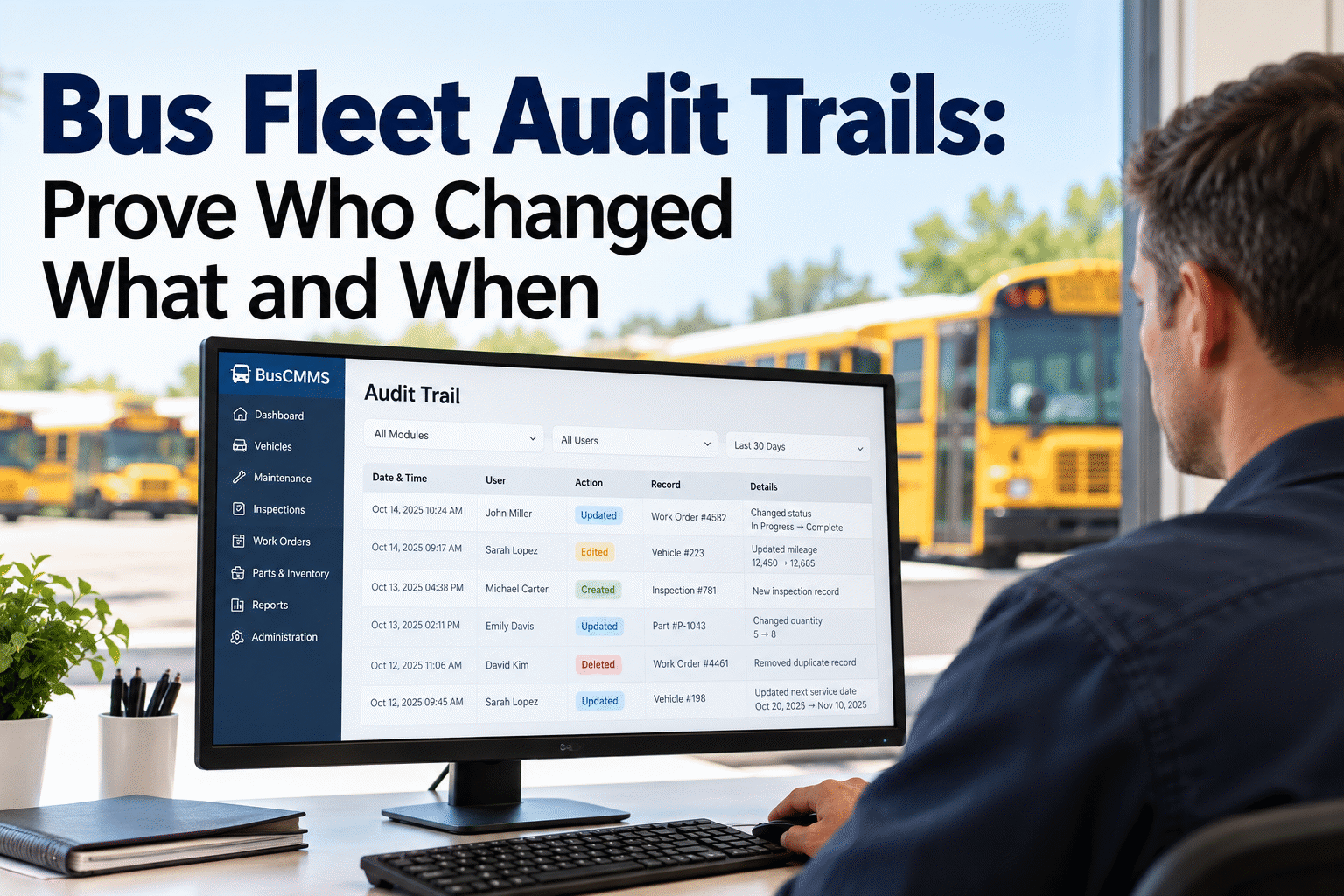
Every stop-arm camera vendor is excellent at stages 1-3 of the violation lifecycle: detection, capture, and review. What almost every camera vendor stops short of is stage 4 -- what happens inside the fleet as a result. BusCMMS is the fleet operations layer that closes the loop. Every camera event becomes a timestamped entry on that specific bus's asset timeline, alongside inspections, defects, work orders, PM history, and fuel. When a camera fault surfaces during review, it auto-generates a work order for the shop. When a bus's stop arm hardware fails intermittently, the pattern shows up in the maintenance history right next to the camera events. That is the wedge no camera-only platform provides.
Camera Events on Asset Timeline
Every stop-arm capture from any vendor auto-logs to the bus's chronological asset history alongside inspections, defects, and repairs.
Auto-Generated Work Orders
Camera hardware fault, stop-arm mechanism defect, or 8-light failure surfaced during review auto-creates a work order for the shop.
DVIR Linkage
Driver pre-trip inspection items for camera and stop-arm hardware tie back to event history — catching intermittent issues before they cause missed captures.
Any Camera Vendor via Webhooks
BusCMMS integrates with BusPatrol, Verra Mobility, AngelTrax, RedSpeed, Safety Vision, Seon, and Safe Fleet SAVES via event webhooks — no vendor lock-in.
Camera Health PM Cycles
Camera lens cleaning, DVR firmware updates, plate camera calibration all become scheduled PM tasks per bus with completion tracking.
Board-Ready Program Reports
Monthly violation counts per bus, per route, per driver plus camera uptime and evidence completeness. One-click export for superintendent briefings.
We installed stop-arm cameras on 38 buses in the fall of 2024. First month we captured 421 violations. Vendor did great work on detection and review. Where we struggled was inside our own operation. Camera hardware failures showed up in random emails to our director. Stop-arm mechanism defects that reviewers flagged never made it to a work order. We had no way to tell which bus was our worst offender for capture accuracy versus our worst offender for actual defect patterns. We put BusCMMS underneath the whole program six months in and every camera event now lands on the bus timeline. A camera fault becomes a work order. A stop-arm defect becomes a PM item. The board report writes itself. Zero events lost to email inbox chaos since.
Related reading: our full 2026 comparison of the 6 leading stop-arm camera platforms ranked head-to-head on AI detection, evidence quality, and citation workflow.
Frequently Asked Questions
How does a school bus stop-arm camera work?
A modern stop-arm camera system on a school bus is a coordinated array of 4-6 exterior cameras plus interior cameras, all synchronized to activate the instant the driver deploys the stop arm and the 8-light warning system flashes. Onboard AI processors continuously classify vehicle motion within roughly 200 feet of the bus. When a vehicle enters the violation zone -- passing on the left side, right side, or continuing through from front-approach or rear-departure -- the system triggers full multi-angle capture. Dedicated 5MP license plate cameras record both front and rear plates. Within about 8 seconds of the stop arm deploying, the complete evidence package (timestamp, GPS coordinates, video from every zone, plate images, AI confidence score, bus ID) is cryptographically sealed and uploaded to the review platform via cellular link. A safety professional then validates the event, and local law enforcement approves or rejects the citation package. The camera does not issue the ticket -- law enforcement does. This human-in-the-loop model is what every state authorizing automated stop-arm enforcement requires.
Which states allow automated stop-arm camera enforcement?
All 50 states prohibit illegally passing a stopped school bus. As of July 2025, according to National Conference of State Legislatures (NCSL) data, 26 states explicitly authorize school districts or local governments to use stop-arm cameras to issue citations without an officer physically witnessing the violation. Vendor sources cite up to 30 states as of 2026 following recent enabling legislation. Recent additions include Oregon (2024), Nevada (July 2025, becoming the 26th state), Kentucky HB 7 (April 2026), and Massachusetts (2026). Actively enforcing states include New York, Pennsylvania, Texas, Georgia, North Carolina, Maryland, Virginia, Washington, Minnesota, Connecticut, Illinois, and others. Fines vary by state: New York issues $250 for first offense and up to $1,000 for three violations in three years; Kentucky is $300 first offense; Pennsylvania is $300 with $25 directed to a state school bus safety grant program under statute 75 Pa.C.S. §3345.1. In states without authorization, cameras can still be installed for internal safety monitoring, driver deterrent effect, and incident documentation -- but citation issuance still requires an officer to physically witness the violation. Always cite your specific state statute rather than relying on vendor summaries, and contact your state DOT or state pupil transportation director for current status.
What is the difference between district-owned and vendor-operated stop-arm camera programs?
Two very different program models. District-owned programs mean the school district purchases and owns the cameras (typically $8,000-15,000 per bus in capital investment), pays ongoing SaaS and maintenance costs, runs the review workflow either in-house or via contracted third party, and retains 100% of citation revenue (minus any statutory state-level cuts). Evidence is fully owned by the district. This model fits mid-to-large districts with existing safety review capacity and available capital budget. Vendor-operated programs are turnkey: the vendor installs cameras at no upfront cost to the district, runs the entire detection, review, and citation workflow end-to-end, and takes a percentage of collected citation revenue (typically 30-70% depending on vendor and contract). Evidence is held by the vendor, with district access varying by contract. This model fits smaller districts without capital budget or in-house safety staff, or districts that want to launch quickly without operational build-out. Neither model is universally better. The right choice depends on district size, capital budget, existing safety review capacity, and comfort with the revenue-share arrangement. Regardless of model, the operational question stays constant: how does each camera event become an accountable action inside your fleet?
How many violations does a stop-arm camera typically capture?
Volumes are far higher than most transportation directors expect. A BusPatrol pilot in Allentown, Pennsylvania captured 205 violations across just two buses in 47 school days -- a rate of 2.18 violations per bus per day. By comparison, traditional law enforcement in all of Pennsylvania issued only 667 tickets over the course of a full year, across 30,000+ school buses. The NASDPTS annual illegal passing survey observed 1,003 stop-arm violations in a single day in Minnesota (2022 survey) across 4,359 participating school bus drivers, up from 583 violations observed in the 2018 survey. Minnesota law enforcement issued 4,652 stop-arm violation citations across the five-year period from 2017-2021, meaning even with cameras deployed, only a fraction of actual violations result in citations. Camera systems consistently reveal that the daily violation rate is orders of magnitude higher than traditional enforcement captures. Baltimore County, Maryland ranked second in a statewide survey on drivers ignoring stop arms in 2018 and partnered with AngelTrax on new camera systems in 2024 to combat the trend. Any district running the numbers for the first time is generally shocked at the volume their cameras capture in the first 30 days.
How does BusCMMS work with stop-arm camera systems?
BusCMMS is the fleet operations layer that sits underneath any stop-arm camera vendor and closes stage 4 of the violation lifecycle -- the accountable action inside the fleet. Every camera event from BusPatrol, Verra Mobility Stop Guard, AngelTrax IntelliGuard, RedSpeed CrossingShield, Safety Vision, Seon, or Safe Fleet SAVES auto-logs to the specific bus's chronological asset timeline via event webhooks -- no vendor lock-in. Camera hardware faults, stop-arm mechanism defects, or 8-light warning failures surfaced during vendor review automatically generate work orders for the shop instead of getting lost in a director's email inbox. Driver pre-trip DVIR items for camera and stop-arm hardware tie back to event history, catching intermittent issues before they cause missed captures. Camera lens cleaning, DVR firmware updates, and plate camera calibration all become scheduled PM tasks per bus with completion tracking. Board-ready program reporting exports monthly violation counts per bus, per route, per driver plus camera uptime percentage and evidence completeness rates. One 38-bus Mid-Atlantic district director reported that camera events, hardware faults, and stop-arm defect patterns all flow into a single chronological bus timeline after adopting BusCMMS six months into a stop-arm program -- zero events lost to email inbox chaos since. The camera vendor detects the event. BusCMMS manages what happens next.