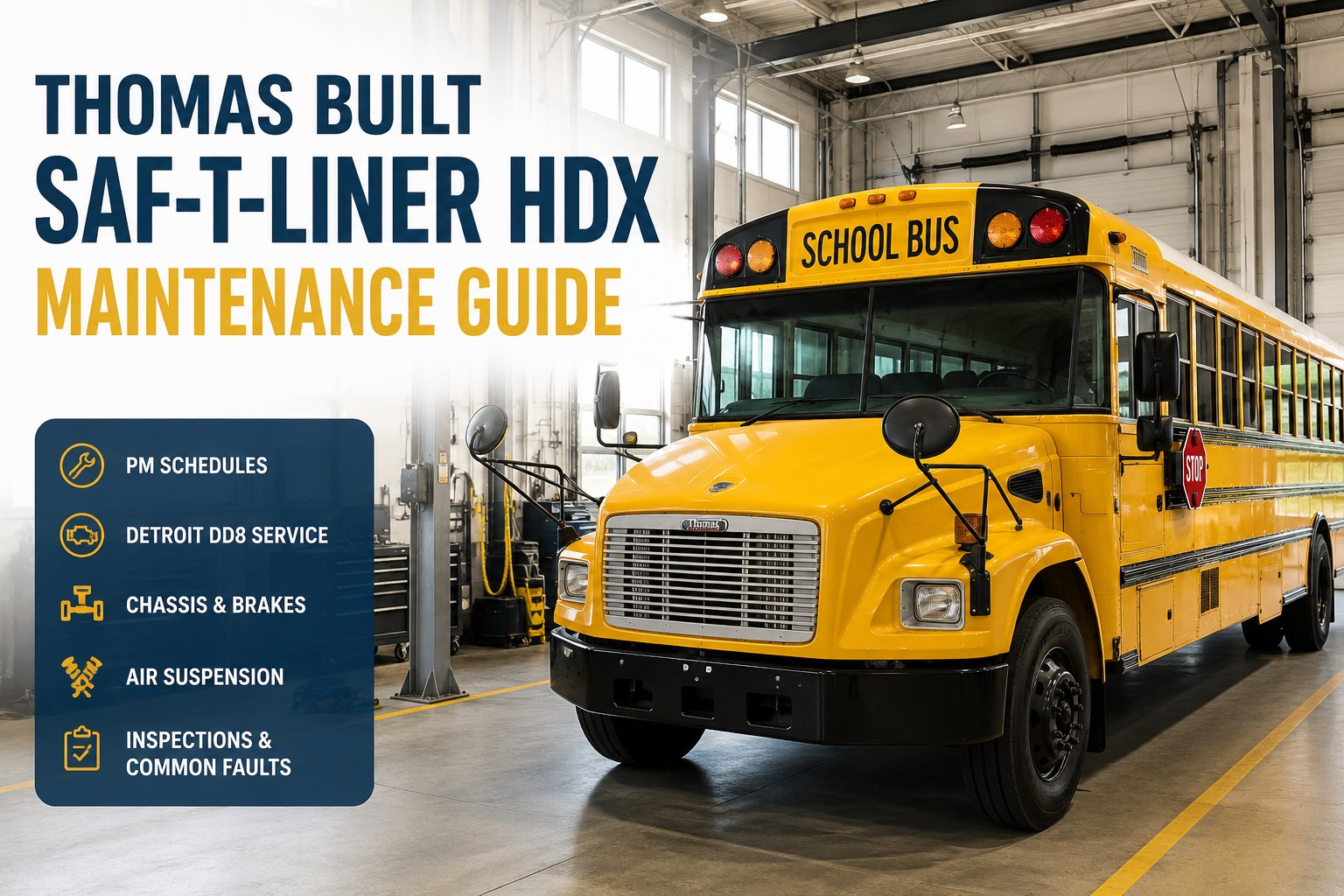
The Thomas Built Saf-T-Liner HDX is the heavy-duty Type D rear-engine platform Thomas has built since 1972 -- and July 2024 brought the biggest refresh in 20 years with the HDX2, taking design cues from the Saf-T-Liner C2 chassis and moving body production to Archdale, NC. Detroit DD8, Cummins B6.7, and Cummins L9 are the three current diesel engine options across the current build sheet, with the Detroit DD8 delivering 45,000-mile oil change intervals -- longest in class -- and the electric eHDX2 "Wattson" now available for grant-eligible districts. This is the 2026 maintenance guide -- engine lineup, 7-tier PM schedule ladder, fluid specifications, air brake and air suspension service intervals, and the 10 fault areas HDX fleet managers see most across a 200,000-300,000 mile service life. See BusCMMS run per-bus PM schedules on your Thomas HDX fleet → book a 20-min demo.
Thomas Built Saf-T-Liner HDX Maintenance Guide
Detroit DD8 / Cummins B6.7 / Cummins L9 engine lineup, 7-tier PM schedule ladder, fluid specs, and the 10 fault areas HDX fleet managers see most.
The 3-Engine Lineup: DD8 / B6.7 / L9
Every HDX in the fleet runs one of these three. Each has different PM intervals, fluid specs, and service tooling requirements.
Most district fleets running Thomas HDX have 2-3 engine platforms side by side across model years -- a Detroit DD8 that came in on a 2019 order, a Cummins B6.7 on the newer HDX2 buses, and a Cummins ISL9/L9 on the older heavy-duty routes. Each engine has its own oil change interval, its own filter part numbers, its own diagnostic tooling, and its own fault code library. Tracking PM at the fleet level without per-engine differentiation is where districts miss intervals and blow warranty claims.
DD8 delivers class-leading 45K-mile oil intervals and top-load filters above the frame rails for faster changes. Cummins B6.7 and L9 share diagnostic tooling but the L9's 8.9L displacement means significantly higher parts spend on major service. See BusCMMS track separate PM schedules per engine platform on the same fleet → book a demo.
The 7-Tier PM Schedule Ladder (A through G Service)
From daily DVIR to major overhaul checkpoints. Every service level defined, every interval targeted, every fluid + filter tracked.
A well-run Thomas HDX PM program breaks maintenance into 7 defined service tiers. Each tier has its own trigger (mileage, calendar, or condition), its own scope of work, and its own labor hours. Skip A-service DVIRs and you miss the small stuff that becomes big; skip F-service and the transmission failure at 120,000 miles that should have been avoided by fluid + filter at 100K is now a $12,000 tow-and-rebuild. The 7-tier ladder below is what leading district and transit fleets audit against.
Daily / Pre-Trip
DAILY · DRIVER- DVIR walk-around inspection
- All fluids visual check
- Tires + air pressure
- Air brake reservoirs drain
- 8-light system + stop arm test
- Wheelchair lift function (if equipped)
Weekly Inspection
WEEKLY · TECH- Full air tank purge
- Chassis lube point check
- Exterior wash + underbody rinse
- Battery terminal inspection
- Emergency exit function test
Monthly / 5,000 mi
5,000 MI · TECH- Air suspension bag + ride height check
- Air brake dryer purge test
- Hydraulic reservoir top-off (lift)
- Fuel filter primary drain
- Wheel lug torque check
- Detroit Connect diagnostic scan (if DD8)
15K-25K Mile
15K-25K MI · TECH- Full chassis grease per lube chart
- Wheel bearing pack inspection
- Transmission fluid level + condition
- Coolant sample for lab analysis
- Brake linings + drums inspection
30K-45K Mile Oil Change
30K-45K MI · SHOP- Engine oil + filter change (DD8: 45K)
- Fuel filter primary + secondary
- Air filter inspection / replace
- DEF quality test
- Detroit / Cummins diagnostic pull
- Aftertreatment regen cycle verify
100K Mile Major Service
100,000 MI · SHOP- Transmission fluid + filter (Allison TES 668)
- Differential fluid + drain
- Air dryer cartridge (Bendix 3-yr)
- Coolant flush + refill (OAT spec)
- Serpentine belt + tensioner
- Brake fluid full flush (hydraulic)
150K-200K Overhaul Checkpoint
150K-200K MI · SHOP- Injector service + spray test
- DPF cleaning / replacement
- Turbo inspection + wastegate
- Air suspension bag inspection (250K-400K life)
- Full engine health assessment
Fleets that discipline through F-service at 100K miles routinely see HDX buses hit 250,000-300,000 miles before major overhaul. Fleets that skip F-service face $12K-$18K transmission failures somewhere between 130K and 180K. See BusCMMS enforce A-through-G service intervals per HDX bus → book a demo.
Fluid Specifications: The 7-Fluid Reference
Wrong spec is warranty denial + accelerated wear. Every HDX shop should have this chart taped to the wall.
Cross-contamination of fluid specifications is one of the top warranty rejection reasons on both Detroit DD8 and Cummins engines. DD5 oil is not DD8 oil. TES 295 is technically backward-compatible with TES 668 but not the other way around. Coolant that meets ASTM D6210 in one bus may not meet Detroit 93K217 spec in another. Every bay technician needs a fluid chart specific to Thomas HDX -- like the 7-fluid reference below.
The Allison TES 668 spec matters most. TES 295 fluid still works but TES 668 has extended drain intervals and improved shear stability -- go 668-forward when refilling. Sign up free and log per-bus fluid specs and last-service dates →
The 10 Common HDX Fault Areas
Where Thomas HDX shops spend the most unscheduled labor. Anticipate these on every bus over 100,000 miles.
Every HDX platform accumulates fault patterns as it ages -- some engine-specific, some Type-D-chassis-specific, some duty-cycle-driven. Below is the 10-fault reference every shop supervisor should have memorized. Anticipating these on higher-mileage buses means catching the failure during a scheduled PM instead of a road call at 5:47 AM before the morning run.
- 01
DD8 Aftertreatment / DPF Regen Faults
DIAGNOSTICShort-route buses fail to reach regen temperature. Symptom: warning light + reduced power. Fix: forced regen via Detroit Connect, review duty cycle.
- 02
Air Suspension Bag Cracks & Leaks
HIGH-MILEAGERear air bag life 250K-400K mi. Look for hissing at rest, low ride height on one corner, bus dropping overnight. Check monthly.
- 03
DEF Crystallization / Cross-Contamination
CHEMISTRYDEF stored past 2-year shelf life. Petroleum cross-contamination. Symptom: DEF quality fault, SCR efficiency drop. $2,500-$5,000 SCR damage.
- 04
Wheelchair Lift Hydraulic Leaks
ADA COMPLIANCESlow lift, pressure loss, cylinder seal leaks. ADA 90-day certification at risk. Monthly hydraulic top-off + annual full inspection.
- 05
Air Brake Charging Time Drift
SAFETY-CRITICALBendix AD-9 or AD-IS dryer cartridge aging. Should charge 85 to 100 PSI in under 40 sec at governed idle. Replace every 3 years.
- 06
Radiator + CAC Debris (Rear Engine)
REAR-ENGINE SPECIFICUnderbelly + rear placement collects road grit, leaves, plastic bags. Symptom: cooling stress, elevated intake temp. Blow out every C-service.
- 07
Rear Differential Wear
HEAVY DUTY CYCLE36,200 lb GVWR + 80+ passenger loading punishes rear axle. Fluid change per F-service. Listen for whine, watch for magnetic drain-plug debris.
- 08
Body Seam + Rocker Panel Rust
CLIMATE-DRIVENNorthern climate salt exposure. Body-to-frame mount seams, rear wheel arches, floor pans. Annual undercarriage rinse + inspection prevents structural loss.
- 09
ISL-G CNG Turbo Failure (Older HDX)
LEGACY ENGINEDiscontinued 2022. Turbo failures common around 100K on older CNG builds. Diagnostic: boost pressure drop, exhaust smoke. Rebuild or replace.
- 10
Coolant Extender Miss on OAT Spec
WARRANTY-CRITICAL600K-mile OAT coolant life only holds without extender addition. Adding wrong SCA type invalidates spec. Send samples to lab annually.
Faults 2, 4, and 5 all surface during proper C-service monthly inspection. Fleets skipping C-service catch these as road calls instead. See BusCMMS flag HDX common faults from PM inspection templates → book a demo.
Where BusCMMS Fits Your HDX Fleet
Six ways the Thomas HDX PM program becomes disciplined, per-engine, and fully documented instead of the shared spreadsheet everyone forgets to update.
Per-Engine PM Schedules
Separate schedules for Detroit DD8 (45K oil), Cummins B6.7, Cummins L9 on the same fleet. No manual tracking of which bus is on which engine platform.
7-Tier Service Templates
A through G service templates pre-built to Thomas HDX spec. Techs check off items on mobile. Nothing missed, nothing skipped.
Per-Bus Fluid Log
Every oil change, transmission service, coolant sample logged per bus with spec, quantity, tech name, and date. Warranty claims documented.
Detroit Connect Integration Ready
Fault codes and Virtual Technician alerts route to the bus record, triggering work orders automatically before the road call.
Common Fault Watch Lists
The 10 HDX faults from Section 4 loaded as inspection sub-items on C-service and F-service templates. Anticipatory, not reactive.
Warranty + Repair History
Full service history per bus exports as a warranty package. When the DD8 goes down at 240K miles, the extended-warranty claim goes in with clean records.
We run 34 Thomas HDX buses on a 22-bus average annual mileage of 24,000. Half are 2019-2020 DD8s and half are 2022-2024 Cummins B6.7s. Before BusCMMS the shop was running everything on a spreadsheet with the same oil interval across all buses -- 30,000 miles. Which meant we were changing DD8 oil 15,000 miles early on every service, wasting $180 in oil and filters per interval on 17 buses, 3 times a year. Do the math: about $9,200 a year in oil we didn't need to change. Once BusCMMS was live with per-engine PM schedules, DD8s went to their 45K interval, B6.7s stayed on their 30K interval, and the shop reclaimed those 51 unnecessary service intervals a year. Paid for the platform in oil savings alone in the first 12 months.
$9,200 a year in unnecessary DD8 oil changes eliminated. Platform paid for itself in year one on oil alone. See how →
Frequently Asked Questions
What engines does the Thomas Built Saf-T-Liner HDX use?
The current 2026 Thomas Built Saf-T-Liner HDX and its 2024 refresh HDX2 offer three primary diesel engines. The Detroit DD8 is a 7.7L in-line six-cylinder producing 260-350 horsepower and 660-860 lb-ft of torque with class-leading up-to-45,000-mile oil change intervals and top-load oil and fuel filters positioned above the frame rails. The Cummins B6.7 is a 6.7L I6 turbo producing 240-300 horsepower and 520-660 lb-ft, primary on newer HDX2 builds. The Cummins L9 is a heavier-duty 8.9L I6 turbo producing 260-300 horsepower and 720-900 lb-ft for full-size Type D duty cycles. Historical HDX engines still in fleet service include the Cummins ISL9 diesel, ISB6.7 diesel, and the ISL-G CNG (discontinued in 2022). The all-electric eHDX2 "Wattson" is now available for grant-eligible districts through the EPA Clean School Bus Program. Detroit engines use Detroit Connect Virtual Technician remote diagnostics; Cummins engines use Cummins INSITE.
What is the recommended PM schedule for a Thomas HDX?
Leading Thomas HDX fleets run a 7-tier PM schedule ladder. A-Service is daily and driver-owned: DVIR walk-around, fluids visual check, tires, air brake reservoir drain, 8-light system test, wheelchair lift function. B-Service is weekly and tech-owned: full air tank purge, chassis lube point check, exterior wash and underbody rinse, battery terminal inspection, emergency exit test. C-Service runs monthly or every 5,000 miles: air suspension bag and ride height check, air brake dryer purge test, hydraulic reservoir top-off for wheelchair lift, fuel filter primary drain, wheel lug torque, Detroit Connect diagnostic scan on DD8-equipped buses. D-Service runs every 15,000-25,000 miles for full chassis grease, wheel bearing inspection, transmission fluid check, coolant sample, and brake inspection. E-Service is the 30,000-45,000 mile oil change interval (Detroit DD8 hits the top end at 45K; Cummins B6.7 and L9 sit at 25K-35K for standard duty, up to 50K severe duty). F-Service at 100,000 miles covers transmission fluid and filter (Allison TES 668), differential fluid, Bendix air dryer cartridge, coolant flush, serpentine belt, and brake fluid flush. G-Service at 150,000-200,000 miles is the major overhaul checkpoint: injector service, DPF cleaning or replacement, turbo inspection, air suspension bag inspection, full engine health assessment.
What fluid specifications does the HDX require?
Seven core fluids need per-bus specification tracking. Detroit DD8 engine oil requires Detroit specification 93K222 or 93K224 in 15W-40 or 10W-30 CK-4 grade with up-to-45,000 mile change intervals. Cummins B6.7 and L9 engine oil requires Cummins CES 20081 in 15W-40 CK-4 with 25,000-35,000 mile standard intervals (up to 50,000 severe). Allison 3000 transmission fluid requires Allison TES 668 (TES 295 is backward-compatible but TES 668 delivers extended drain intervals and improved shear stability -- go 668 forward when refilling) with 75,000-150,000 mile change intervals. Coolant is OAT-only, meeting ASTM D6210, Detroit 93K217, and Cummins 14603 specifications with a minimum 600,000-mile service life guarantee without extender addition. DEF (Diesel Exhaust Fluid) is ISO 22241 32.5% urea, stored separately from petroleum products with a 2-year shelf life. Rear differential takes SAE 80W-90 GL-5 (75W-90 synthetic optional depending on axle manufacturer) at 100,000-mile intervals. Chassis grease is NLGI 2 EP at all chassis and suspension lube points on 15,000-25,000 mile intervals. Cross-contamination of any of these fluids is one of the top warranty rejection reasons on both Detroit and Cummins engine platforms.
What are the most common HDX fault areas?
Ten fault areas surface repeatedly on Thomas HDX buses over 100,000 miles. Detroit DD8 aftertreatment and DPF regeneration faults happen on short-route buses that never reach regen temperature -- symptom is warning light plus reduced power, fix is forced regen via Detroit Connect. Air suspension bag cracks and leaks are high-mileage failures with typical bag life of 250,000-400,000 miles; watch for hissing at rest, low ride height on one corner, or the bus dropping overnight. DEF crystallization from expired fluid or petroleum cross-contamination causes SCR efficiency drops with $2,500-$5,000 SCR damage. Wheelchair lift hydraulic leaks compromise ADA 90-day certification. Air brake charging time drift on aging Bendix AD-9 or AD-IS dryer cartridges pushes 85-to-100-PSI build time past 40 seconds. Radiator and CAC debris accumulation is a rear-engine-specific issue on HDX. Rear differential wear from 36,200-lb GVWR and 80+ passenger loading. Body seam and rocker panel rust in northern climates from road salt. ISL-G CNG turbo failures around 100,000 miles on older discontinued-2022 CNG builds. Coolant extender misapplication that invalidates OAT specification and voids the 600,000-mile service life guarantee. Faults 2, 4, and 5 all surface during proper monthly C-service inspection -- fleets skipping C-service catch these as road calls at 5:47 AM instead.
How does BusCMMS help manage Thomas HDX fleet maintenance?
BusCMMS runs separate PM schedules per engine platform on the same fleet -- so Detroit DD8 buses hit their 45,000-mile oil interval, Cummins B6.7 buses stay on 30,000, and Cummins L9 heavy-duty buses run their own schedule -- eliminating the manual tracking that leads to premature oil changes or missed intervals. The 7-tier A-through-G service templates are pre-built to Thomas HDX specification with mobile checklists techs work through in the bay, so nothing is missed and nothing is skipped. Every oil change, transmission service, and coolant sample is logged per bus with specification, quantity, technician, and date -- clean warranty documentation ready for the extended-warranty claim on the DD8 that goes down at 240,000 miles. Detroit Connect Virtual Technician fault codes and Cummins INSITE alerts route to the bus record with automatic work order triggers, catching issues before they become road calls. The 10 common HDX fault areas load as inspection sub-items on C-service and F-service templates -- anticipatory instead of reactive. Full service history per bus exports as a warranty package with two clicks. One 34-bus Great Plains school district maintenance supervisor reported paying for the entire BusCMMS platform in year one on oil savings alone -- eliminating $9,200 in premature DD8 oil changes annually by moving from a single fleet-wide oil interval to per-engine PM scheduling.