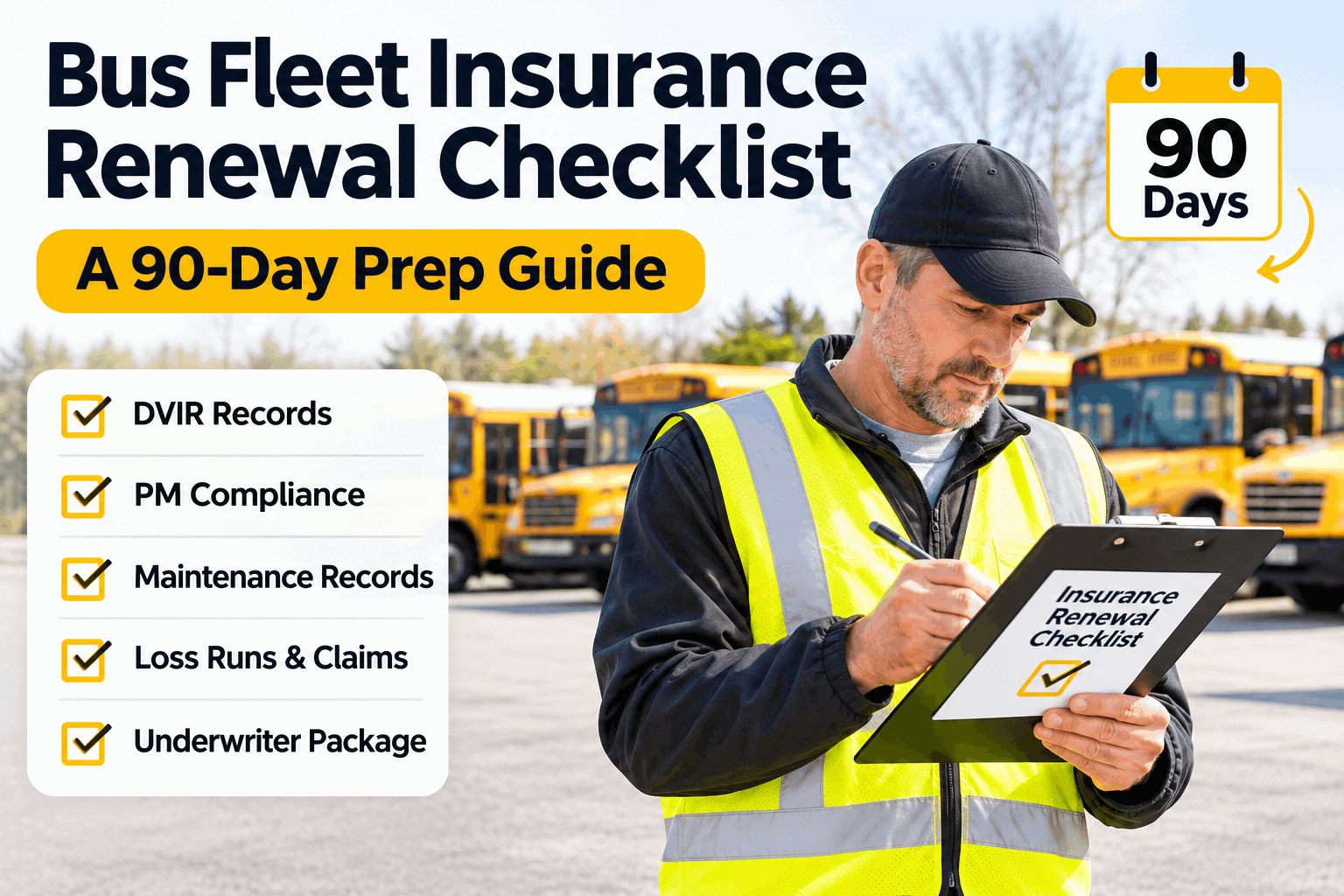
The renewal quote that stings usually isn't a surprise — it's the result of walking in with nothing to show. Your broker asks for your loss runs and safety records three weeks out, you scramble through binders and spreadsheets, and the underwriter prices your fleet on assumption because you couldn't prove otherwise in time. A bus fleet insurance renewal is won or lost in the ninety days before it, not in the meeting. Start early, assemble the right evidence, and you turn a rate you're handed into one you can argue with documentation in a short demo.
Bus Fleet Insurance Renewal Checklist: A 90-Day Prep Guide
Underwriters reward fleets that show their work. Here's the ninety-day timeline, the evidence package, and the records that move your rate — built for school, transit, and charter operators.
Why Renewal Prep Is the One Lever You Control
Most of what drives your premium — litigation trends, repair inflation, the broader market — is outside your hands, and we cover that in depth in our guide to why bus fleet insurance costs keep rising. Preparation is the part you own. Insurance consistently ranks among the largest operating costs for bus operators — frequently cited in the range of 10 to 15 percent of total fleet spend — so a renewal that lands a few points better isn't a rounding error; it's real money a transportation director can take back to the board.
Here's the shift that matters: underwriters increasingly price on what a fleet can evidence, not on the story it tells. Two agencies with identical bus counts get different quotes because one can hand over complete DVIR history, a PM compliance rate, and a falling road-call trend, and the other can't. A strong bus fleet insurance renewal starts with accepting that the documentation is the negotiation. You can see what that evidence file looks like on a live fleet before you build your own.
The 90-Day Bus Fleet Insurance Renewal Workflow
Work it backward from your renewal date in three phases. Each has a job, and skipping the first one is why most fleets end up scrambling in the last.
Audit your records
Pull your loss runs and read them before the underwriter does. Confirm your DVIR history is complete with no gaps, check that PM is actually logged against schedule, and find the holes now — a missing month of inspections is fixable at ninety days, not at ten.
Build the underwriter package
Assemble the evidence into one clean file: PM compliance rate, defect-to-repair times, driver certification roster, and your road-call trend. Hand it to your broker early so the carrier has time to validate the risk and price the improvement in — not rush it.
Present and negotiate
Walk your broker through the trend, not just the snapshot: fewer road calls, rising PM compliance, defects closed fast. A fleet that's visibly improving gives the underwriter a reason to move. Then bind, and start the next renewal file the day this one closes.
The fleets that get the best outcomes aren't the ones with perfect loss histories — they're the ones whose records are ready to pull on day ninety. You can sign up free and start building that record from your next inspection.
Your Renewal Evidence Checklist
This is the package. Ninety days out, every item below should be a clean export you can email your broker in minutes — not a weekend of digging. The first three make or break the submission; the rest sharpen your case.
- 12 months of complete digital DVIRsEvery bus, every service day — no gap a carrier can question.MUST HAVE
- PM compliance rate, exportableOne number showing how much scheduled maintenance you actually hit.MUST HAVE
- Defect-to-repair turnaround logProof failed inspection items got fixed fast, not parked.MUST HAVE
- Driver CDL & certification rosterCurrent, with expiry dates — nobody driving on a lapsed credential.STRONG PLUS
- Road-call & loss trendA downward line tells your loss-ratio story better than any pitch.STRONG PLUS
- One broker-ready package, not ten foldersEverything above in a single file your agent can forward.STRONG PLUS
An unchecked item is a preparation task, never a reason to backdate or fabricate a record — underwriters catch that, and it costs you trust you can't buy back. You can book a demo and see every checklist item generated automatically from the work your shop already does.
What Goes in the Underwriter Package — and What It Proves
Every document in your file answers a specific question the carrier is asking about your risk. Here's the translation.
| What you submit | The risk question it answers |
|---|---|
| Complete digital DVIR history | Is there a real, followed inspection program on every bus? |
| PM compliance rate & overdue list | Is preventive maintenance actually done on time, fleet-wide? |
| Work-order & defect-closure log | When something fails, does it get fixed — and how fast? |
| CDL & certification roster | Is every bus leaving the yard with a qualified driver? |
| Road-call & loss trend report | Is this fleet's risk getting better or worse over time? |
Notice the pattern: every answer already exists in your daily operations. The job of renewal prep isn't to create new data — it's to be able to pull what you already generate, clean and on demand.
How BusCMMS Assembles the Package for You
The reason most fleets scramble is that the evidence lives in five places — paper DVIRs, a PM spreadsheet, a work-order whiteboard, a driver binder. A purpose-built bus CMMS captures all of it as a by-product of running the operation, so the renewal file is a report you pull, not a project you build.
Bus-specific digital DVIRs
Pre-loaded forms for stop arms, crossing gates, wheelchair lifts, and student mirrors — time-stamped and complete, the exact inspection record a carrier wants.
PM compliance you can export
Fuel-type-aware schedules for diesel, CNG, and electric buses, with a compliance rate you pull in one click for the submission.
Work orders that close the loop
Failed inspection items auto-generate work orders, so every defect links to its repair with a timestamp — the follow-through underwriters reward.
Driver certification tracking
CDL and certification status with expiry alerts, so you can prove every route ran with a qualified driver — no lapses, no exposure.
Audit-ready reporting
The same FMCSA and state DOT reports that pass an audit double as your insurance evidence — one source of truth for compliance and renewal.
Loss-history trends over time
Dashboards showing road calls falling and PM compliance climbing give your broker the improving-risk story that moves a rate.
New to the category and want the full picture first? Start with our complete guide to what a bus CMMS does, or if you run a transit agency, see how BusCMMS supports passenger transit fleet operations. When you're ready, you can book a demo tailored to your bus count and renewal date.
The Numbers Worth Taking to the Board
A few figures that make the case that renewal prep pays for itself.
Lower operating costs and a cleaner, documented loss history pull in the same direction — a better bus fleet insurance renewal and a budget line your board can defend.
A Transportation Director's Take
Key Takeaways for Your Next Renewal
You can't control the market, but you decide how your fleet reads to an underwriter. Four things to remember.
Start at day ninety
The renewal is won in the three months before the meeting, not in it.
Documentation is the negotiation
Carriers price on what you can prove — records, not reputation.
Submit the trend, not a snapshot
An improving loss history gives the underwriter a reason to move.
Make the file automatic
A bus-built CMMS captures the evidence so renewal is an export, not a scramble.
Treat your bus fleet insurance renewal as a ninety-day project with a hard deadline, and you stop being priced for the worst case — and start getting credit for the clean, documented operation you actually run. That part is still in your hands.