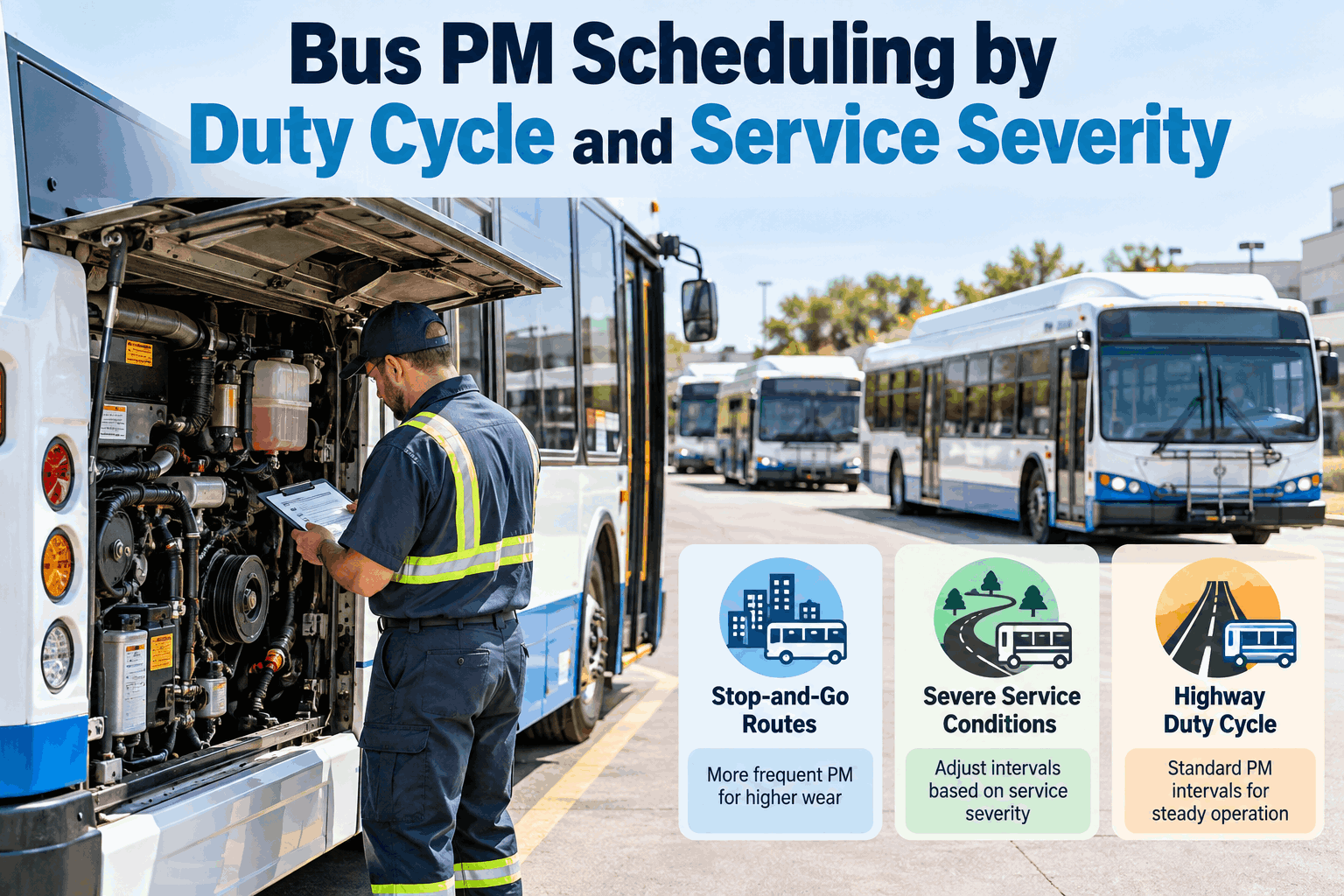
Two buses hit 6,000 miles the same week and both come in for the same A-service. One ran a downtown route — 800 stops a day, constant idling, brakes worked to death. The other ran a highway express and barely touched its brakes. Servicing them identically means you're over-maintaining one and under-maintaining the other. Bus PM scheduling by duty cycle fixes that: the interval flexes to how the bus is actually used, not a fleet-wide average that fits neither route.
Bus PM Scheduling by Duty Cycle and Service Severity
A flat mileage interval over-services the easy routes and under-services the hard ones. Match the interval to the duty cycle and every bus gets serviced at the right time — not the average time.
Why One Flat PM Interval Fits No One
Most fleets run a single PM interval — every bus gets its A-service at the same mileage, full stop. It's simple, and it's wrong for a fleet that runs mixed routes. Mileage counts distance, but wear comes from how that distance is driven. A mile of downtown stop-and-go is nothing like a mile of highway cruise, so an interval built on distance alone lands in the wrong place for most of your buses.
The easy-route buses come in on the same schedule as the hard ones, so you're changing fluids and parts that still had life left. That's wasted labor, wasted parts, and shop time those buses didn't need — money spent servicing wear that hasn't happened yet.
The severe-route buses hit real wear well before the flat interval catches them — brakes, oil, and filters degrade faster than the schedule assumes. That's where the road calls come from: the bus failed between services because the service came too late for how it was worked.
The flat interval is a compromise that satisfies neither end. Set it tight enough to protect the severe routes and you're burning money over-servicing the easy ones; set it loose enough to be efficient on the easy routes and you're under-protecting the severe ones and eating road calls. The only real fix is to stop treating every bus the same and let the interval move with the duty cycle. This is a different question than whether to trigger on miles or calendar — our mileage vs time-based PM scheduling guide covers that trigger choice; duty cycle is about how far apart those triggers should sit. Book a demo to see severity-adjusted intervals on a mixed-route fleet.
What Makes a Duty Cycle "Severe"
Engine and component manufacturers have long recognized severe-service duty cycles that call for shortened maintenance intervals. For buses, a handful of factors push a route into severe territory — and most urban transit and a lot of school routes check more than one box.
Frequent Stops
Stop-and-go routes hammer brakes and drivetrains. A downtown or dense school route with hundreds of stops a day wears components far faster than steady running.
Extended Idling
Long idle time at stops and layovers ages oil and stresses the engine without adding miles — so a mileage-only interval misses the wear entirely.
Hilly Terrain
Grades load the engine, transmission, and brakes hard. A hilly route asks far more of the drivetrain per mile than flat ground does.
Heavy Loads
A consistently full bus works everything harder than a lightly loaded one. Sustained high passenger loads shorten the life of brakes, tires, and suspension.
Climate Extremes
Extreme heat, cold, and dust push fluids and filters harder. A hot-climate or dusty-region route ages consumables faster than a temperate one.
Short Trips
Lots of short runs never let the engine reach full operating temperature, which accelerates oil contamination — a classic severe-service condition.
The reason this matters for buses specifically is that the fleet often splits cleanly by route type. Your urban transit or dense school routes are usually severe on several factors at once — frequent stops, heavy idling, full loads — while your express or rural runs are much lighter. That split is exactly what a duty-cycle-aware PM schedule is built to handle: tighter intervals for the severe group, standard for the rest, instead of one number pretending the whole fleet works the same. Sign up free and flag which of your routes run severe duty.
Severity Tiers: Adjusting the Interval to the Duty
Once you group routes by severity, the interval adjustment follows. Start from your manufacturer's standard interval as the baseline, then tighten it for severe duty and, where justified, relax it for genuinely light duty. The tiers below show the shape of it — use your OEM's severe-service guidance for the exact numbers.
Severe Duty
Tighten intervalUrban transit, dense school routes, hilly or hot-climate runs. Multiple severe factors stacked. Shorten the PM interval below standard — often meaningfully — to catch the faster wear before it becomes a road call. Follow OEM severe-service intervals.
Normal Duty
Standard intervalMixed suburban routes, moderate stops and loads, temperate climate. This is what the standard interval was designed for — keep the baseline OEM schedule and let it do its job.
Light Duty
Relax with cautionHighway express, low-stop rural, light loads, mild climate. You may be able to extend intervals modestly — but never past OEM maximums or safety and compliance minimums, and never on safety-critical items just to save a service.
Two guardrails keep this honest. First, the baseline is always the manufacturer's schedule — you tighten from it freely, but you relax from it only within OEM limits and never below a safety or compliance floor. A wheelchair-lift inspection or a brake check has a minimum cadence that duty cycle doesn't get to override. Second, not every item scales the same way: brakes and oil respond strongly to duty cycle, while some calendar-based items (like certain fluid changes) barely move. For the standard baseline intervals you're adjusting from, our bus maintenance schedule by mileage guide lays them out. Book a walkthrough to see severity tiers configured per route class.
How to Classify a Route's Duty Cycle
You don't need a lab study to classify duty cycle — you need to look at how each route actually runs and sort it. Here's the practical path from a fleet-wide flat interval to duty-cycle-aware scheduling.
Profile each route
Look at stops per mile, idle time, terrain, typical load, and climate for each route or route type. Most fleets already know which routes are brutal and which are easy — this just makes it explicit.
Group into severity tiers
Sort routes into severe, normal, and light based on how many factors they hit. Assign each bus the tier of the route it primarily runs.
Set the interval per tier
Start from the OEM standard interval, tighten it for the severe tier per severe-service guidance, and hold or cautiously relax it for the others — within safety and compliance floors.
Validate against failures
Watch where road calls and early wear actually happen. If a "normal" route keeps failing early, it's really severe — move it up a tier. Let real data refine the classification over time.
Step four is what makes this a living system instead of a one-time guess. Your first classification is an educated starting point; the failure data tells you where you got it wrong. A route you tagged normal that keeps throwing early brake wear is telling you it belongs in the severe tier. And where telematics is connected, a lot of the profiling in step one comes straight from the data — idle time, stop frequency, and mileage flow in automatically rather than being estimated by hand. That's how duty-cycle scheduling gets sharper every quarter instead of drifting stale. Sign up free and classify your routes into severity tiers this week.
How BusCMMS Runs Duty-Cycle PM Scheduling
A flat interval is easy for any system to run; duty-cycle scheduling needs a PM engine that can hold different intervals for different buses and trigger each correctly. BusCMMS is built for exactly that — and where telematics is connected, it can pull the real usage data that tells you which tier a route belongs in. The features below make it work.
-
Severity-Adjusted Intervals
Configure different PM intervals per bus or route class — severe, normal, light — instead of one flat rule forced across the whole fleet.
-
Mileage & Calendar Triggers
Each tier fires on whichever comes first — miles or days — so a heavy-idle bus that racks up hours without miles still gets caught on time.
-
Telematics Usage Data
Pre-built connectors (Samsara, Geotab) feed idle time, stop frequency, and odometer readings — the real signals that classify a route's severity.
-
Failure-Data Validation
Correlate road calls and early wear against route class, so a mis-tiered route reveals itself and the interval can be corrected from evidence.
-
Safety & Compliance Floors
Hold minimum cadences on safety-critical and compliance items, so relaxing a light-duty interval never drops a brake or lift check below its floor.
-
Fuel-Type-Aware Logic
Duty-cycle adjustments layer on top of separate diesel, CNG, and electric PM schedules, so severity and powertrain are both handled correctly.
The payoff shows up on both sides of the ledger. Tightening intervals on the severe routes cuts the road calls that came from under-servicing hard-worked buses; holding or relaxing intervals on the light routes stops the waste of servicing wear that hadn't happened yet. Same total maintenance effort, aimed where it actually protects the fleet. That precision — the right service at the right time for each bus — is the whole point of duty-cycle scheduling, and it only works when the PM engine can tell the buses apart. Book a demo to see duty-cycle intervals driven by real telematics data.
The Maintenance Manager's View
That's the shift in one voice: the same interval hiding two completely different buses, and the fix being to stop pretending every mile wears the same. Split by duty cycle, tighten where it's hard, hold where it's easy — and the road calls and the waste both drop. Sign up free and set your first duty-cycle-adjusted intervals.
The Bottom Line on Bus PM Scheduling by Duty Cycle
Bus PM scheduling by duty cycle fixes the flaw in a flat interval: mileage measures distance, but wear comes from how that distance is driven. A stop-and-go urban route, heavy idling, hills, full loads, and climate extremes all push a bus into severe service that a fleet-wide interval under-protects — while it over-services the easy highway runs. Profile each route, sort it into severe, normal, or light, adjust the interval from the OEM baseline per tier — tighter for severe, standard or cautiously relaxed for the rest, never below a safety or compliance floor — and validate against where failures actually happen. Do that, and every bus gets serviced at the right time for how it's worked, not the average time. The road calls from under-servicing and the waste from over-servicing both fall, because the schedule finally matches reality. Book a walkthrough to see duty-cycle PM scheduling on a fleet like yours.