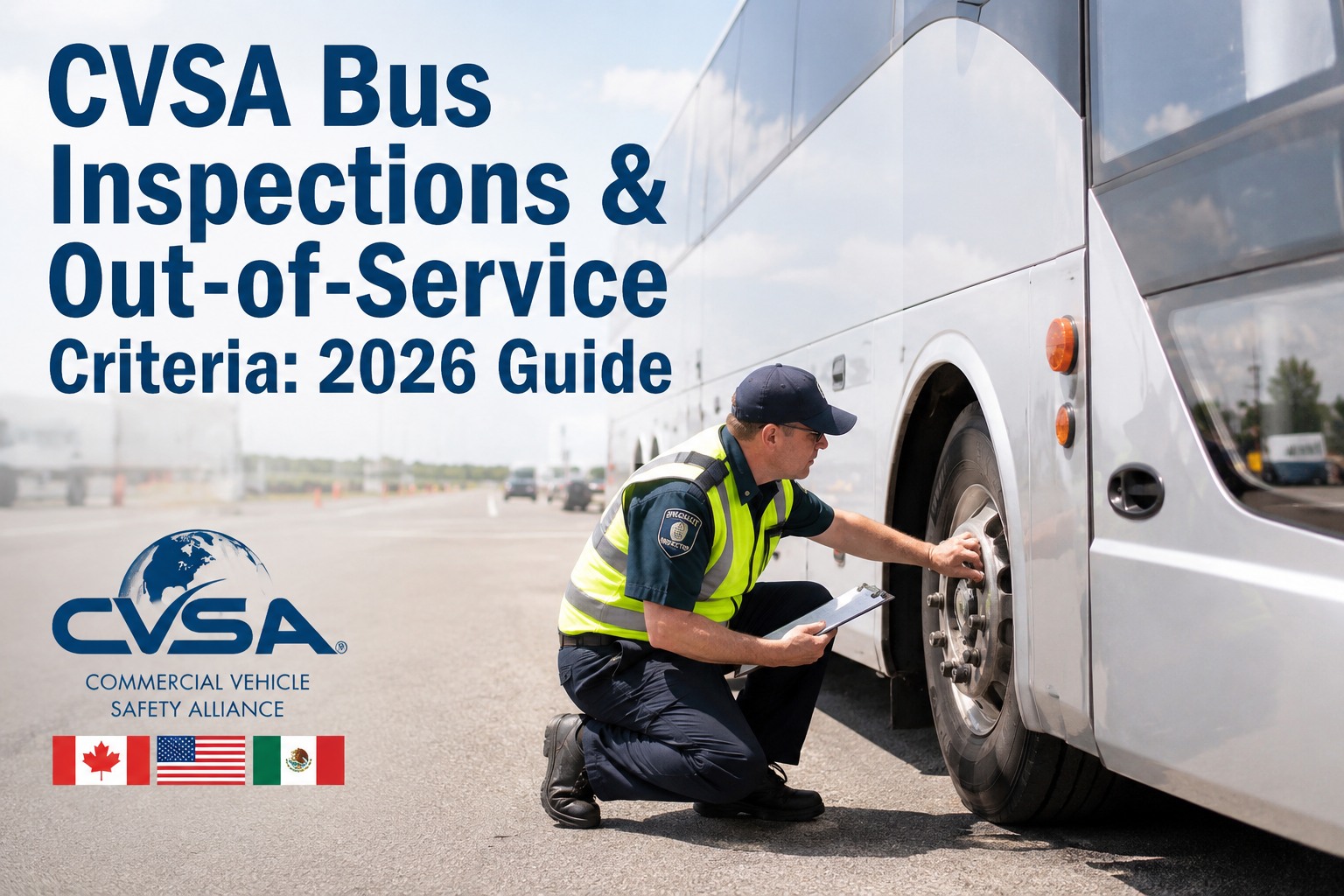
18.1% of vehicles and 5.9% of drivers inspected during the 2025 CVSA International Roadcheck were placed out of service — and brake violations alone accounted for 41.1% of vehicle OOS findings. When a CVSA inspector stops your bus at a roadside checkpoint, the 37-step Level I inspection determines whether your bus rolls or sits until repairs are verified. This 2026 guide covers the 6 CVSA inspection levels, bus-specific out-of-service categories, the defect-to-return-to-service workflow, and where fleet operations software fits after an OOS decision. See BusCMMS turn CVSA defects into work orders with return-to-service evidence → book a 20-min demo.
The 2025 CVSA Roadcheck Reality & 2026 Focus
DOT inspections happen every day. International Roadcheck simply increases volume and visibility for 72 hours. The safest bus fleets don't prepare for Roadcheck — they operate Roadcheck-ready all year.
The 6 CVSA Inspection Levels Bus Fleets Face
Not every roadside inspection is the same. Which level you're facing determines how much is examined, how long the stop takes, and what defects can put your bus out of service.
CVSA-certified inspectors work from a defined menu of 6 inspection levels, each with a specific scope and typical duration. Most roadside stops become Level I inspections — the comprehensive 37-step North American Standard covering both driver credentials and vehicle mechanical fitness. Buses face additional inspection items beyond standard commercial vehicles: emergency exits, seating condition, and electrical cables and systems in the engine and battery compartments. Understanding which level you're likely facing helps drivers know what to expect and helps compliance officers preview the failure surface.
North American Standard Inspection
Walk-Around Driver + Vehicle Inspection
Driver Credential Inspection
Special One-Item Inspection
Vehicle-Only Inspection
Enhanced Radioactive Shipment Inspection
Most bus fleets face Levels I, II, III, and V in routine operation. The CVSA decal from a passing Level I or V is valid for up to 3 months and generally exempts the vehicle from reinspection during that window. See BusCMMS track CVSA decals per bus with expiration alerts → book a demo.
The 6 Bus-Specific Out-of-Service Categories
The CVSA North American Standard Out-of-Service Criteria defines exactly what triggers an OOS decision. For buses, these 6 categories account for the overwhelming majority of vehicle OOS findings.
An out-of-service condition is not the same as an inspection finding. Inspectors document many minor defects that get noted but don't stop the vehicle. An OOS condition is a specific defect defined in the CVSA North American Standard Out-of-Service Criteria that requires the vehicle be restricted from operation until the defect is corrected. The 6 categories below are where bus fleets get placed OOS, ranked by 2025 Roadcheck violation frequency. Brake defects alone accounted for 41.1% of vehicle OOS findings across all commercial vehicles — and buses are no exception.
BRAKE SYSTEMS
2025 data: 3,304 brake system OOS violations during Roadcheck; another 2,257 for 20% defective brakes (when at least 1/5 of the bus's brakes have OOS conditions).
Common bus failures: Air pressure leaks, worn brake linings past OOS thresholds, broken slack adjusters, damaged air lines, defective air compressor.
TIRES
2025 data: Second most common vehicle OOS category. Bus tires face heavy passenger loads and frequent stop-and-go duty cycle.
Common bus failures: Tread below OOS depth threshold, sidewall damage, exposed belt material, air loss below minimum inflation, mismatched tire types on same axle.
LIGHTING & ELECTRICAL
Bus-specific inspection: CVSA inspectors examine electrical cables and systems within the engine and battery compartments — unique to passenger-carrying vehicles.
Common bus failures: Non-functional stop lamps, turn signals, marker lights, exposed wiring in battery compartment, missing insulation on engine electrical.
STEERING & SUSPENSION
OOS trigger: Steering system deficiencies affecting driver control. Suspension component failures affecting vehicle stability under passenger load.
Common bus failures: Excessive steering wheel lash, worn kingpins beyond OOS threshold, broken suspension components, damaged air bags or springs.
WHEELS, RIMS & HUBS
OOS trigger: Cracked rims, loose wheels, missing lug nuts, hub oil leaks affecting bearing lubrication.
Common bus failures: Missing or damaged lug nuts (any missing = OOS), cracked wheels, hub oil below inspection glass, damaged rim flanges.
EMERGENCY EXITS & SEATING
Bus-only inspection: Unique to passenger-carrying vehicles — CVSA inspectors examine emergency exits and seating condition on every bus Level I.
Common bus failures: Emergency exit blocked or non-functional, broken seat frames, damaged seat belts, missing exit signage, non-working exit lighting.
Every OOS category traces back to a preventable defect that a properly-run pre-trip inspection or 90-day emergency exit check should have caught. Digital DVIRs with defect-to-work-order chains are how the 81.6% pass rate happens. See BusCMMS surface OOS-risk defects on pre-trip inspections → book a demo.
The Defect → Repair → Return-to-Service Workflow
An OOS decision starts a workflow, not a crisis. The 5 stages below are what happens between "you're placed out of service" and "the bus is authorized to operate again."
A bus placed out of service cannot be operated until the cited violation is corrected. What matters operationally is how quickly the fleet moves from OOS notice to verified repair and return-to-service documentation. Fleets running paper-based repair workflows often take days — parking the bus, losing route coverage, scrambling for a substitute vehicle. Fleets running digital defect-to-work-order chains typically move from OOS to return-to-service in hours, with complete evidence documentation preserved for any follow-up FMCSA review or insurance inquiry. The 5-stage workflow below is what disciplined bus fleets run.
OOS Decision & Documentation
Inspector issues out-of-service notice citing specific defect and CVSA OOS criteria reference. Notice logged into fleet system with bus ID, driver, location, defect category, and CVSA criteria reference.
Work Order Auto-Generated
OOS defect converts to priority work order assigned to shop foreman. Route replacement or substitute vehicle dispatched. Bus flagged non-operational in dispatch system so no accidental re-dispatch occurs.
Technician Repair & Evidence Capture
Technician performs repair. Photos of before/during/after captured. Parts used logged. Labor hours recorded. Technician certification verified where required. All evidence attached to work order and bus asset timeline.
Verification Inspection
Shop foreman or certified inspector verifies repair. Test-drive if applicable. CVSA OOS criteria reference re-checked to confirm defect is corrected to acceptable standard. Verification signed and timestamped.
Return-to-Service Record
Bus authorized to return to service. Return-to-service record generated with full evidence chain: original OOS notice, work order, technician photos, parts used, verification signature, timestamp. Ready for any FMCSA follow-up or insurance inquiry.
Districts that produce complete return-to-service evidence packages routinely close OOS incidents without further FMCSA follow-up. Districts that can't produce evidence face repeat inspections and CSA score damage. Sign up free and build defect-to-return-to-service chains per bus →
The International Roadcheck 4-Week Preparation Playbook
Roadcheck lasts 72 hours in May, but the CSA score damage lasts 12 months. The 4-week countdown below is how disciplined bus fleets land in the 81.6% who pass clean.
The safest bus fleets don't prepare for Roadcheck — they operate Roadcheck-ready all year. But even for well-run fleets, the 4-week window before the May International Roadcheck event is worth using intentionally. Focused pre-Roadcheck preparation typically catches marginal-condition items (brake lining approaching but not yet at OOS threshold, tire tread near limits, lighting bulbs at end of expected life) before an inspector does. Under the 2026 CSA scoring changes, OOS violations carry a severity weight of 2 compared to 1 for non-OOS violations — making OOS prevention twice as valuable to your CSA score.
Fleet-wide brake inspection sweep
Brakes are 41.1% of vehicle OOS findings. Pull every bus for a comprehensive brake inspection: linings, air pressure, slack adjusters, air lines, compressor performance. Log every defect. Convert every defect to a scheduled work order.
Tire + lighting + electrical review
Second and third most common OOS categories. Check tread depth on every position, sidewall condition, inflation. Test every lamp, marker, and signal. Inspect engine and battery compartment electrical (bus-specific inspection item).
Emergency exits + seating + bus-specific items
Every emergency exit tested for function. Seat frames inspected. Seat belts checked. Exit signage and lighting verified. This is where routine bus operations often miss items that CVSA inspectors specifically check.
Driver documentation + ELD verification
2026 driver focus is ELD tampering. Verify every driver's ELD data is clean, HOS records current, medical certificate valid, endorsements current, Clearinghouse status confirmed. Verify no drivers are using a delisted ELD (PSS ELD, Black Bear ELD, or RT ELD Plus — all delisted Feb 7 2026).
Operate Roadcheck-ready
Enhanced pre-trip inspections every day of the 72-hour event. Drivers carry complete credential packages. Fleet dispatcher tracks any bus that receives inspection. Post-inspection documentation captured immediately — clean-pass or any findings.
Every clean CVSA inspection actively improves your CSA scores under the 2026 methodology. The 4-week prep window turns Roadcheck from a compliance threat into a scoring opportunity. See BusCMMS run the 4-week Roadcheck prep playbook per bus → book a demo.
Where BusCMMS Fits CVSA Inspection Response
Six specific capabilities that connect roadside inspections, technician findings, corrective work, and return-to-service evidence into one bus asset timeline.
Live CVSA Decal Registry
Every CVSA decal issued to your fleet tracked per bus with issuance date, expiration (up to 3 months), and reminder alerts. No expired decals surprising drivers at the next inspection.
Defect-to-Work-Order Chain
Every DVIR defect and every CVSA-cited OOS defect auto-converts to work order tied to the correct bus. Complete chain from driver observation or inspector citation through completed repair.
Return-to-Service Evidence Package
Photos, parts logs, labor hours, technician certification, verification signature bundled per repair. Ready for FMCSA follow-up, insurance inquiry, or state review within minutes.
OOS-Risk Flagging on Pre-Trip
Digital DVIRs flag defects approaching OOS criteria thresholds before drivers hit the road. Brake linings at 30%, tire tread near minimum, lighting bulbs at end of life — all surfaced pre-departure.
Roadcheck Preparation Workflow
4-week countdown playbook (brake sweep, tires/lighting, emergency exits/seating, driver documentation) auto-scheduled fleet-wide starting mid-April every year.
CSA Score Impact Tracking
Every inspection outcome (clean or OOS) logged to bus and driver records. 2026 CSA severity weights (2 for OOS, 1 for non-OOS) tracked. 12-month violation window monitored per bus.
We operate a 63-bus school and charter fleet crossing state lines regularly for extracurricular trips. Every year we picked up 3-5 OOS citations during International Roadcheck. Brake issues, lighting, emergency exits — the same categories that show up in the CVSA annual data. Each OOS meant a bus parked roadside, substitute vehicle scrambled, angry parents when the field trip got delayed. And each violation stayed on our CSA record hurting our scores. In February 2024 we deployed BusCMMS with the OOS-risk flagging on pre-trip DVIRs. Every defect approaching OOS criteria surfaces before dispatch. Our shop closes those defects on the calendar we choose, not on the timeline an inspector forces. May 2025 Roadcheck: 12 buses inspected across three states, zero OOS findings, all three eligible buses received CVSA decals. May 2026 Roadcheck: 15 buses inspected, still zero OOS findings, and our CSA Vehicle Maintenance BASIC score improved 18 percentile points over 24 months. Same buses, same routes, same drivers. Different operational model.
Related compliance pillars: DOT audit preparation, driver qualification files, and the full compliance hub.
Frequently Asked Questions
What is a CVSA bus inspection?
A CVSA bus inspection is a roadside commercial vehicle inspection conducted by a CVSA-certified inspector following the Commercial Vehicle Safety Alliance North American Standard Inspection Procedures and the North American Standard Out-of-Service Criteria. Six defined inspection levels exist. Most bus fleets face Level I (37-step North American Standard covering both driver credentials and vehicle mechanical fitness, 45-60 minutes), Level II (walk-around driver + vehicle inspection without under-vehicle exam, 25-35 minutes), Level III (driver credential inspection only including HOS, medical certificate, endorsements, and Clearinghouse status, 15-20 minutes), and Level V (vehicle-only inspection without driver portion, 30-45 minutes). Bus-specific inspection items unique to passenger-carrying vehicles include emergency exits, seating condition, and electrical cables and systems in the engine and battery compartments. A bus that passes a Level I or V inspection without critical out-of-service violations may receive a CVSA decal valid for up to 3 months, which generally exempts the vehicle from reinspection during that window. During the 2025 CVSA International Roadcheck, inspectors conducted 56,178 vehicle inspections with 18.1% of vehicles and 5.9% of drivers placed out of service.
What is CVSA out-of-service criteria?
The CVSA North American Standard Out-of-Service Criteria is a defined set of specific defects that, when identified during a roadside inspection, require the vehicle be restricted from operation until the defect is corrected. The criteria is updated annually each April 1 — the current 2026 version took effect April 1, 2026. An out-of-service condition is different from an inspection finding: inspectors document many minor defects that get noted but don't stop the vehicle. An OOS condition specifically triggers vehicle restriction. For buses, the top OOS categories are (1) brake systems — accounting for 41.1% of vehicle OOS violations during 2025 Roadcheck with air pressure leaks, worn linings, broken slack adjusters, and defective air compressors being common failures; (2) tires — 21.4% of OOS with tread depth, sidewall damage, and inflation failures leading; (3) lighting and electrical including bus-specific engine and battery compartment inspection; (4) steering and suspension; (5) wheels, rims, and hubs including missing lug nuts; and (6) bus-only inspection items covering emergency exits and seating condition. Under 2026 CSA scoring methodology, OOS violations carry a severity weight of 2 versus 1 for non-OOS violations — making OOS prevention twice as valuable to your CSA Vehicle Maintenance BASIC score.
When is the 2026 International Roadcheck and what are the focus areas?
The 2026 CVSA International Roadcheck took place May 12-14, 2026 — a 72-hour commercial vehicle enforcement blitz conducted across the United States, Canada, and Mexico. The 2026 focus areas were electronic logging device (ELD) tampering, falsification, or manipulation for the driver portion, and cargo securement for the vehicle portion (bus applications include wheelchair securement and luggage compartment requirements). Inspectors at weigh stations, fixed inspection sites, and pop-up checkpoints primarily conduct North American Standard Level I Inspections during Roadcheck — the same 37-step procedure used year-round. What changes during Roadcheck is inspection volume and enforcement visibility, not the standards. Vehicles passing Level I or V without critical OOS violations may receive a CVSA decal valid up to 3 months. The 2025 Roadcheck resulted in 56,178 vehicle inspections with 81.6% of vehicles and 94.1% of drivers passing without any OOS violations — proving that consistent pre-trip preparation and defect management works. Roadcheck aggregate data is typically published later in the year the event occurred. The safest bus fleets don't prepare for Roadcheck — they operate Roadcheck-ready all year through digital DVIRs, defect-to-work-order chains, and OOS-risk flagging on pre-trip inspections.
What happens after a bus is placed out of service?
A bus placed out of service cannot be operated until the cited violation is corrected. The 5-stage workflow disciplined bus fleets run: Stage 1 — OOS decision and documentation: inspector issues out-of-service notice citing specific defect and CVSA OOS criteria reference; notice logged with bus ID, driver, location, defect category. Stage 2 — work order auto-generated: OOS defect converts to priority work order assigned to shop foreman; route replacement dispatched; bus flagged non-operational in dispatch system to prevent accidental re-dispatch. Stage 3 — technician repair and evidence capture: technician performs repair; photos of before/during/after captured; parts used logged; labor hours recorded; technician certification verified; all evidence attached to work order and bus asset timeline. Stage 4 — verification inspection: shop foreman or certified inspector verifies repair; test-drive if applicable; CVSA OOS criteria reference re-checked to confirm defect corrected to acceptable standard; verification signed and timestamped. Stage 5 — return-to-service record: bus authorized to return to service; return-to-service record generated with full evidence chain (original OOS notice, work order, technician photos, parts used, verification signature, timestamp) ready for any FMCSA follow-up or insurance inquiry. Districts producing complete return-to-service evidence routinely close OOS incidents without further FMCSA follow-up. Districts that cannot produce evidence face repeat inspections and CSA score damage.
How can BusCMMS help bus fleets prepare for CVSA inspections?
BusCMMS connects mobile inspections, technician findings, defect records, corrective work, and return-to-service evidence into one operational workflow per bus. Six specific capabilities support CVSA inspection readiness: (1) live CVSA decal registry tracking every decal issued to your fleet per bus with issuance date, expiration up to 3 months, and reminder alerts so no expired decals surprise drivers at the next inspection; (2) defect-to-work-order chain where every DVIR defect and every CVSA-cited OOS defect auto-converts to a work order tied to the correct bus with complete chain from observation through completed repair; (3) return-to-service evidence bundling with photos, parts logs, labor hours, technician certification, and verification signature bundled per repair — ready for FMCSA follow-up or insurance inquiry within minutes; (4) OOS-risk flagging on pre-trip DVIRs where digital inspections surface defects approaching OOS criteria thresholds before drivers hit the road (brake linings at 30%, tire tread near minimum, lighting bulbs at end of life); (5) Roadcheck preparation workflow with the 4-week countdown playbook auto-scheduled fleet-wide starting mid-April every year; and (6) CSA score impact tracking with every inspection outcome (clean or OOS) logged, 2026 severity weights tracked (2 for OOS versus 1 for non-OOS), and 12-month violation window monitored per bus. One 63-bus school and charter fleet reported zero OOS findings across 12 buses inspected during 2025 Roadcheck and 15 buses inspected during 2026 Roadcheck — and an 18-percentile-point improvement in their CSA Vehicle Maintenance BASIC score over 24 months.