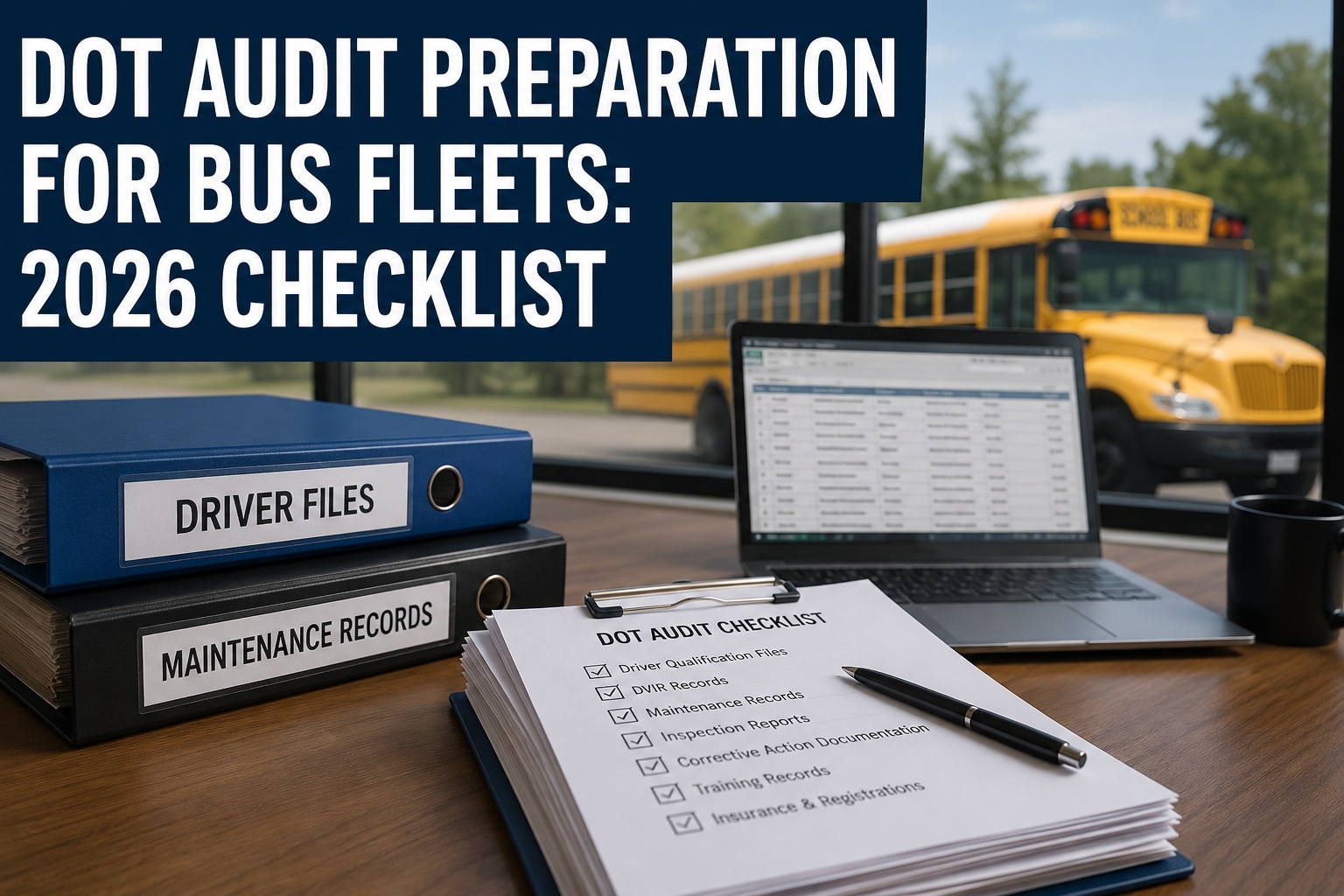
Only 7% of motor carriers pass a DOT compliance review without a single violation — the other 93% walk away with at least one citation, and out-of-service violations can reach $23,048 per instance in 2026. When an FMCSA auditor asks for a driver's DVIR from 8 months ago, you have 48 hours to produce it. This 2026 guide covers the 4 audit types, the 6 document categories auditors check first, the recent 2026 regulatory shifts, and where fleet operations software fits when the audit letter arrives. See BusCMMS produce audit-ready records in under 5 minutes → book a 20-min demo.
The 7% vs 93% Reality of DOT Bus Fleet Audits
The gap between the 7% who pass clean and the 93% who don't is not luck. It's documentation, systems, and preparation. Everything below is what the 7% do differently — and what 2026 penalty amounts look like for the fleets who don't.
- Digital DVIRs closed within 24 hours
- DQ files complete across all 10 documents
- Records producible in under 5 minutes
- 2026 CSA + ADA + ELD changes tracked
- Up to $23,048 per out-of-service violation
- $1,584/day for missing records
- CSA score damage for 24 months
- Rating downgrade Satisfactory → Conditional
The 4 Types of DOT Audits Bus Fleets Face
Not every audit is the same. Which type you face determines what auditors examine, how long the review takes, and what preparation matters most. Identify your risk profile below.
A DOT audit is a category, not a single event. FMCSA runs four distinct types of reviews, each triggered by different factors and scoped differently. Understanding which type you're most likely to face — based on your operation type, CSA scores, crash history, and new-entrant status — determines where preparation effort matters most. In 2026 FMCSA is using more focused audits than ever, arriving already knowing where your weak spots are based on data. That shift makes preparation more targeted, not less important.
COMPLIANCE REVIEW
FOCUSED AUDIT
NEW ENTRANT SAFETY AUDIT
SECURITY AUDIT
Most school districts and passenger carriers face Types 01, 02, or 03. Charter and motorcoach fleets crossing state lines see all four in normal operation. Prepare for the type your data profile makes most likely. See BusCMMS pre-configure audit-response packets per audit type → book a demo.
The 6 Document Categories Auditors Check First
Every DOT audit examines these six categories in roughly this order. Where the audit finds its first serious gap is where the deeper investigation begins. Prepare all six equally.
FMCSA auditors follow a predictable examination pattern. They start with the categories most likely to reveal systemic issues, and any gap in a single area can trigger deeper investigation across your entire operation. The 6 categories below appear on every compliance review and every focused audit — and the specific bus-fleet nuances (DVIRs under 49 CFR 396.11, 90-day emergency exit inspections, ADA wheelchair lift documentation) determine what a passenger-carrier audit looks like versus a general freight audit.
DRIVER QUALIFICATION FILES
DVIR & INSPECTION RECORDS
DRUG & ALCOHOL TESTING
HOS / ELD RECORDS
ACCIDENT REGISTER
FINANCIAL RESPONSIBILITY
Auditors will find the weakest link first. Prepare all 6 categories to the same standard — the 3-year-old accident register matters as much as the current DVIR. See BusCMMS produce audit-ready exports across all 6 categories → book a demo.
The 2026 Regulatory Timeline
Four recent regulatory shifts every bus fleet needs to have documented before the next audit. Missing any of these is an easy citation for an auditor arriving with 2026 knowledge.
Auditors arrive knowing what changed in the past 18 months and specifically probe for compliance with recent updates. The four milestones below are the ones most likely to surface in a 2026 audit — and the fleets that address each proactively land in the 7% who pass clean rather than the 93% who don't. If your compliance documentation was last updated before October 2025, work through this timeline before your next audit letter arrives.
MC Numbers Eliminated
USDOT numbers became the sole federal identifier as of October 1, 2025. Fleets must update all vehicles, insurance filings, and documentation to reference USDOT only. Old MC numbers appearing on vehicle side panels or paperwork are an easy audit finding.
ELD Delistings
FMCSA removed PSS ELD, Black Bear ELD, and RT ELD Plus from the registered list effective February 7, 2026. Carriers using any delisted ELD must replace immediately — continued use is an HOS non-compliance finding.
CSA Scoring Overhaul
The 2026 CSA Safety Measurement System overhaul launched February 2026 with a new "Driver Observed" category creating a separate compliance score for defects found during driver pre-trip inspections. Fleets using digital DVIRs with GPS-stamping and photo documentation now have a direct scoring advantage.
ADA Wheelchair Lift Documentation
Timestamped daily inspection records and preventive maintenance logs with specific measurements are now required for all wheelchair lift operations. Paper checklists without timestamps and measurements are no longer sufficient for ADA compliance verification during audits.
Every one of these changes is where an auditor's first "let me see your..." question will land in 2026. Update your documentation to reflect all four before the letter arrives. Sign up free and log 2026 regulatory milestone compliance per bus →
The 48-Hour Audit Response Workflow
The audit notice arrives at 10:00 AM Monday. The auditor expects records by 10:00 AM Wednesday. Here's what disciplined bus fleets do in those 48 hours — and where the 93% fall behind.
FMCSA remote audits typically give carriers 48 hours to produce requested records. On-site compliance reviews expect records within the audit window itself — often the same day. The fleets that survive both timelines have pre-built response workflows and pre-organized digital record archives; the fleets that don't spend those 48 hours in filing cabinets discovering they never had the record in the first place. Below is the hour-by-hour response the 7% actually run.
Audit notice received
Compliance officer logs the notice, identifies the audit type (Compliance Review, Focused, New Entrant, or Security), and captures the specific records requested and response deadline.
Response team assembled
Named leads assigned per document category: DQ files to HR, DVIRs to shop foreman, drug/alcohol to safety director, HOS/ELD to dispatch supervisor, accident register + insurance to compliance officer.
Records pulled & gaps identified
Each category lead exports the requested records for the specified drivers, buses, and date range. Missing documents or expired credentials flagged internally before auditor sees them. Corrective action initiated for any gap.
Packet assembled & internally reviewed
All records compiled into one audit-response packet. Compliance officer conducts internal review of packet completeness. Any gap either resolved, or the corrective-action-in-progress documented and included.
Legal / counsel review
District counsel or general counsel reviews packet for privacy considerations (student data redaction, controlled disclosure of camera footage) before delivery to auditor. Chain of custody documented.
Packet delivered to auditor
Complete, defensible response delivered within FMCSA-stated window. Delivery timestamped. Full audit trail preserved for the district's own records and any future follow-up inquiries.
Districts running this workflow rarely see rating downgrades. Districts scrambling through filing cabinets discover their gaps during the audit itself. See BusCMMS execute the 48-hour audit response workflow with role-based access → book a demo.
The Audit-Ready Bus Fleet Packet
Pre-organize these 8 document sets so the 48-hour response workflow starts from a running start rather than an empty folder. This is what should live in your audit-ready archive at all times.
The single practice that separates the 7% from the 93% is maintaining a pre-organized audit-ready packet at all times — not building one after the notice arrives. The 8 document sets below should be current, digital, and producible on demand. Bus-fleet-specific items (90-day emergency exit records, ADA wheelchair lift measurements, annual bus inspection reports) sit alongside the universal FMCSA categories. When the audit notice lands, the packet is 80% assembled before hour 0 begins.
Driver Qualification Files
All 10 documents per driver from §391.51; current annual MVR review; medical certificates verified against National Registry.
Daily DVIR Records
12 months minimum of driver vehicle inspection reports; defects tied to corrective work orders; driver signatures verified.
90-Day Emergency Exit Records
Bus-specific: 4 quarterly emergency exit inspection reports per bus per year; results, signatures, and any repair documentation.
Annual Inspection Reports
Complete annual bus inspections with inspector qualifications on file; all defects tied to closed work orders.
Drug & Alcohol Testing Records
Pre-employment queries, random test schedules, post-accident documentation, Clearinghouse queries (hire + annual).
HOS & ELD Records
6 months of ELD data per driver; supporting docs (fuel receipts, dispatch records); ELD verified as currently registered with FMCSA.
Accident Register + Reports
3 years of FMCSA-reportable accidents; police reports; witness statements; insurance claim numbers linked.
ADA Wheelchair Lift Documentation
Bus-specific: timestamped daily lift inspections; PM logs with specific measurements; corrective work orders for any lift defects.
Every item above should be exportable as a PDF packet in under 5 minutes on demand. That is the operational bar the 7% clear routinely. See BusCMMS maintain a live audit-ready packet across all 8 document sets → book a demo.
Where BusCMMS Fits DOT Audit Readiness
Six specific capabilities that turn fleet inspection and maintenance records into role-based evidence views ready for any DOT audit type.
Always-Current Audit Packet
All 8 audit-ready document sets maintained live per bus, per driver. Notice arrives — the packet is already 80% assembled. No filing cabinet scramble.
Role-Based Evidence Access
Transportation leadership sees full compliance dashboard. Shop foreman sees DVIRs + work orders. HR sees DQ files. Board sees monthly compliance summary. One system, four views.
2026 Regulatory Compliance Tracking
USDOT-only vehicle documentation, ELD registration verification, CSA "Driver Observed" digital DVIR alignment, and ADA wheelchair lift documentation all tracked.
Defect-to-Work-Order Chain
Every DVIR defect auto-converts to work order tied to the bus. Complete chain of custody preserved from driver observation through repair completion.
Privacy & Controlled Disclosure
Student data and camera footage handled with role-based access, redaction workflows, and audit trail. Producing only records authorized by the specific request.
One-Click Audit Export
Complete audit response packet exported as organized PDF bundle with cover sheet, category tabs, and chain of custody documentation. Ready for FMCSA compliance officer within minutes.
We are a 47-bus charter and school extracurricular operation running interstate routes across three states. Received a focused audit notice from FMCSA in October 2024 targeting our HOS BASIC score after two roadside inspection violations. Previous DOT reviews had left us in Satisfactory but never zero-violation. This one, we treated differently. Put BusCMMS underneath the whole compliance program 6 months earlier and had our full 48-hour response workflow pre-configured. When the audit letter landed on Tuesday, we had the packet compiled and legally reviewed by Wednesday evening — 30 hours ahead of the deadline. The auditor's final finding: zero violations across the focused review scope. Our first clean audit in 12 years of operation. Not because we changed our drivers or our routes. Because we had every record producible on demand instead of buried in file cabinets and old spreadsheets.
Related compliance pillars: driver qualification files, CDL P & S endorsements, and the full compliance hub.
Frequently Asked Questions
What is a DOT audit and what triggers one for a bus fleet?
A DOT audit is a formal review conducted by the Federal Motor Carrier Safety Administration (FMCSA) to verify compliance with federal safety regulations under 49 CFR. Four distinct audit types exist: (1) Compliance Review — the most comprehensive, typically 2-5 days on-site examining all 6 document categories and resulting in a safety rating of Satisfactory, Conditional, or Unsatisfactory; (2) Focused Audit — targeted 1-2 day review of 1-2 specific compliance areas identified by data; (3) New Entrant Safety Audit — automatic within 18 months of USDOT number issuance, examining safety management systems; (4) Security Audit — specialized review for hazmat carriers or security-sensitive operations. Audits are triggered by poor CSA Safety Measurement System scores, high crash rates, high-profile accidents, citizen complaints, random selection, or automatic new-entrant status. In 2026 FMCSA is using more focused audits than ever, arriving already knowing where fleet weak spots are based on CSA data. Only 7% of motor carriers pass DOT compliance reviews without a single violation — the other 93% walk away with at least one citation, and out-of-service violations can reach $23,048 per instance under 2026 penalty schedules.
What documents do FMCSA auditors check first?
Auditors examine six document categories in roughly this priority order: (1) Driver Qualification Files under 49 CFR Part 391 — 10 required documents per driver including current annual MVR review and valid medical examiner's certificate, with bus-specific verification of P and S CDL endorsements and state school bus certification; (2) DVIR and Inspection Records under 49 CFR 396.11 and 396.13 — daily driver vehicle inspection reports with defects tied to corrective work orders, plus bus-specific 90-day emergency exit inspections and annual comprehensive reviews; (3) Drug and Alcohol Testing under 49 CFR Part 382 including Clearinghouse queries at hire and annually; (4) Hours of Service and ELD records under 49 CFR Part 395 — important 2026 alert: FMCSA delisted PSS ELD, Black Bear ELD, and RT ELD Plus effective February 7, 2026, requiring immediate replacement; (5) Accident Register under 49 CFR 390.15 covering FMCSA-reportable crashes (tow-away, injury, or fatality regardless of fault) with 3-year retention; and (6) Financial Responsibility under 49 CFR Part 387 with passenger-carrier insurance scaled by seating capacity. Any gap in a single category can trigger deeper investigation across the entire operation, so all six require equal preparation.
How long do bus fleets have to produce records during a DOT audit?
FMCSA remote audits typically give carriers 48 hours to produce requested records. On-site compliance reviews expect records within the audit window itself — often the same day. Roadside inspections require the driver to produce records in under 2 minutes. Retention windows vary by document type: ELD records 6 months; DVIRs minimum 3 months but 12+ months recommended since CSA scoring uses a 24-month violation window; DQ files employment period plus 3 years from termination; accident register 3 years from date of accident; drug and alcohol testing records vary by record type under §382.401; annual bus inspection reports 14 months; current insurance coverage documentation ongoing. Digital storage is strongly recommended because paper records almost never survive the 48-hour turnaround demand from remote audits or the sub-2-minute demand at roadside. Districts running paper files, shared spreadsheets, and disconnected HR databases universally struggle to meet the response window — the 7% who pass clean have universally digitized their compliance records.
What 2026 regulatory changes affect DOT audit preparation for bus fleets?
Four regulatory shifts are most likely to surface in 2026 audits. First, MC Numbers were eliminated as of October 1, 2025 — USDOT numbers are now the sole federal identifier and any vehicle side panels, insurance filings, or documentation still referencing MC numbers is an easy audit finding. Second, ELD delistings effective February 7, 2026 removed PSS ELD, Black Bear ELD, and RT ELD Plus from the FMCSA registered list — carriers still using any delisted ELD are in HOS non-compliance. Third, the CSA Safety Measurement System overhaul launched February 2026 introduced a new "Driver Observed" category creating a separate compliance score for defects found during driver pre-trip inspections, giving fleets using digital DVIRs with GPS-stamping and photo documentation a direct scoring advantage. Fourth, ADA wheelchair lift documentation now requires timestamped daily inspection records and preventive maintenance logs with specific measurements — paper checklists without timestamps and measurements are no longer sufficient for ADA compliance verification. Every audit conducted in 2026 will probe compliance with these four changes, so fleets should verify their documentation reflects each before the next audit notice arrives.
How can BusCMMS help bus fleets prepare for a DOT audit?
BusCMMS is the fleet operations layer that maintains an always-current audit-ready packet across all 8 document sets so when the notice arrives, the packet is already 80% assembled instead of being built from filing cabinets under 48-hour pressure. Six specific capabilities support DOT audit readiness: (1) live audit packet with DQ files, DVIRs, 90-day emergency exit records, annual inspections, drug/alcohol records, HOS/ELD data, accident register, and ADA wheelchair lift documentation all current per bus and per driver; (2) role-based evidence access so transportation leadership sees full compliance dashboard while shop foreman sees DVIRs + work orders and HR sees DQ files — one system, four purpose-built views; (3) 2026 regulatory compliance tracking for USDOT-only vehicle documentation, ELD registration verification, CSA "Driver Observed" digital DVIR alignment, and ADA wheelchair lift measurements; (4) defect-to-work-order chain with every DVIR defect auto-converting to work order tied to the correct bus with complete chain of custody; (5) privacy and controlled disclosure workflows handling student data and camera footage with role-based access, redaction, and audit trail for producing only records authorized by the specific request; and (6) one-click audit export producing complete organized PDF bundle with cover sheet, category tabs, and chain of custody documentation ready for FMCSA compliance officer within minutes. One 47-bus charter operation reported their first clean audit in 12 years after implementing this system — audit packet compiled and legally reviewed 30 hours ahead of the 48-hour deadline.