Onboard bus cameras have evolved through three generations of video retrieval — from USB stick pulls that took an hour per bus, to Wi-Fi yard upload, to 4G cellular streaming that delivers clips in minutes. This 2026 guide covers what onboard camera systems actually do, DVR configuration by bus type, video retrieval workflows, and where fleet operations software fits when a parent calls at 4 PM asking for yesterday's footage. See BusCMMS track DVR health and video retrieval per bus → book a 20-min demo.
The 3 Generations of DVR Video Retrieval
Every school bus onboard camera program lives on one of these three generations. The generation you are on determines whether pulling video takes 5 minutes or 90 minutes per bus — and whether that clip actually gets to the parent, the principal, or the insurance adjuster on time.
USB Manual Pull
Wi-Fi Yard Upload
4G / 5G Cellular Streaming
What Onboard Camera Systems Actually Do
A mobile DVR at the center. Multiple cameras feeding it. Solid-state storage. A defined retrieval path. That is the entire architecture — and understanding it is step one for any evaluation.
A school bus onboard camera system is architecturally simple but operationally consequential. The heart of every system is a mobile digital video recorder (MDVR) — a ruggedized, solid-state DVR unit typically mounted under a seat or in an equipment closet on the bus. The DVR takes video feeds from 4 to 16 cameras positioned around the interior and exterior, records continuously to solid-state storage, and delivers that footage to whichever retrieval path the district has invested in. The 1080P AHD (analog high-definition) standard dominates 2026 onboard camera hardware because it delivers HD image quality without the bandwidth overhead of IP cameras — making it well-suited to onboard use where every wire matters.
MOBILE DVR (MDVR)
Solid-state ruggedized recorder. 4-16 camera channels. G-sensor for event triggers. GPS integrated. The heart of the whole system.
CAMERA ARRAY
Interior wide-angle cameras (2.5mm lens covers seat rows), driver-facing camera, forward road camera, plus optional side and rear exterior cameras.
STORAGE MEDIUM
Solid-state SD card or SSD onboard the DVR. Continuous recording rolls over the oldest footage as newer footage is captured. Event clips saved separately.
RETRIEVAL PATH
USB (Gen 1), Wi-Fi yard upload (Gen 2), or 4G/5G cellular (Gen 3). Determines how quickly video gets from bus to reviewer.
The MDVR is the single most important hardware decision in the whole program. Everything else works around it. See BusCMMS log DVR health per bus → book a demo.
Camera Configuration by Bus Type
How many cameras go on a bus depends heavily on bus size, seat count, and what problems the program is solving. Here is what 2026 fleets typically deploy per bus type.
The question "how many cameras do I need per bus" has no single answer — it depends on bus size, passenger count, route type, and program objectives. A small Type A bus running suburban routes may need only 3 cameras. A large 84-passenger Type D transit bus running dense urban routes with active parent-inquiry volume may run the full 8-camera configuration. The matrix below shows what 2026 fleets typically specify per bus type, alongside the DVR channel count needed to support each configuration.
TYPE A
Up to 30 passengersTYPE C / D
54-83 passengersTRANSIT / COACH
40+ ft coaches, articulated transitConfiguration decisions made at RFP time constrain your program for the whole hardware lifecycle. Spec generously. Sign up free and log camera configuration + DVR spec per bus →
The Video Retrieval Reality Check
Every operational pain point in an onboard camera program traces back to how fast video can be pulled from the bus. Here is what 2026 workflows actually look like in minutes.
A parent calls at 4 PM about an incident on their child's route this morning. How long does it take you to have that footage in front of your safety director? That is the question that separates onboard camera programs that work from ones that struggle. The workflow you have chosen — USB manual, Wi-Fi yard upload, or 4G cellular — determines whether your answer is 5 minutes, 30 minutes, or half a business day. The comparison below shows what each generation actually takes in real fleet operations.
USB MANUAL PULL
- Locate bus in yard
- Access DVR housing (often under seat)
- Pull USB drive or SD card
- Walk to review station
- Copy files to computer
- Scrub timeline to find event
- Export clip
WI-FI YARD UPLOAD
- Bus returns to yard end of day
- DVR auto-detects Wi-Fi coverage
- Event clips upload automatically
- Non-event footage requested via portal
- Review from web dashboard
- Export ready-to-share clip
4G / 5G CELLULAR
- Log into cloud portal
- Select bus + date/time range
- Cellular link delivers clip on demand
- Review live or download
- Export with metadata attached
The retrieval workflow is the single largest determinant of program operational success. Everything else is subordinate to it. See BusCMMS log every retrieval per bus with time-stamped audit → book a demo.
The Parent Inquiry Response Workflow
The single most common onboard camera use case. A parent calls. Something happened on the bus. You have 24-48 hours to respond credibly. Here is the 5-step workflow every district should run.
Every school district transportation director knows the call: it is 4 PM Wednesday, the parent is on the line, their child says something happened on the ride home Tuesday afternoon, and they want to see the footage. How your district handles the next 48 hours determines whether the parent walks away satisfied or escalates to the superintendent's office. The 5-step response workflow below is what disciplined onboard camera programs run every time an inquiry comes in — and where BusCMMS ties every step to an accountable action instead of letting requests fall into supervisor inboxes.
- 01 TARGET: WITHIN 2 HOURS
Log the inquiry
Capture parent contact info, student name, bus number, route, date, approximate time, and specific incident described. Assign case ID. Communicate expected response timeline to parent.
- 02 TARGET: WITHIN 4 HOURS
Pull footage from DVR
Retrieve video for the specified bus, date, and time window. Retrieval time depends on generation: 45-90 min (USB), 15-30 min (Wi-Fi), 2-5 min (4G cellular). Preserve original file for chain of custody.
- 03 TARGET: WITHIN 24 HOURS
Review and validate
Safety director or designated reviewer watches footage. Corroborates or contradicts the parent's description. Documents findings. Flags any driver coaching or disciplinary action needed for follow-up.
- 04 TARGET: WITHIN 48 HOURS
Parent response with findings
Contact parent with documented findings. If viewing is appropriate under district policy and student privacy protections, arrange controlled viewing session. Never share video files directly.
- 05 TARGET: WITHIN 72 HOURS
Close the loop · document actions
Log outcome to the bus asset timeline. Any driver coaching, DVIR item, or hardware issue surfaced becomes a work order. Full audit trail preserved for potential future inquiries or legal action.
Every parent inquiry that follows this workflow closes cleanly. Every inquiry that skips a step turns into an escalation risk. See BusCMMS run the 5-step parent inquiry workflow with accountability tracking → book a demo.
Where BusCMMS Fits Onboard Camera Operations
The DVR captures the video. BusCMMS turns every DVR event and camera-health signal into an accountable action per bus. Six specific capabilities for onboard camera programs.
MDVR Health Monitoring
Every DVR reports recording status, channel health, GPS lock, and storage utilization per bus. Offline DVRs auto-flag as high-priority work orders.
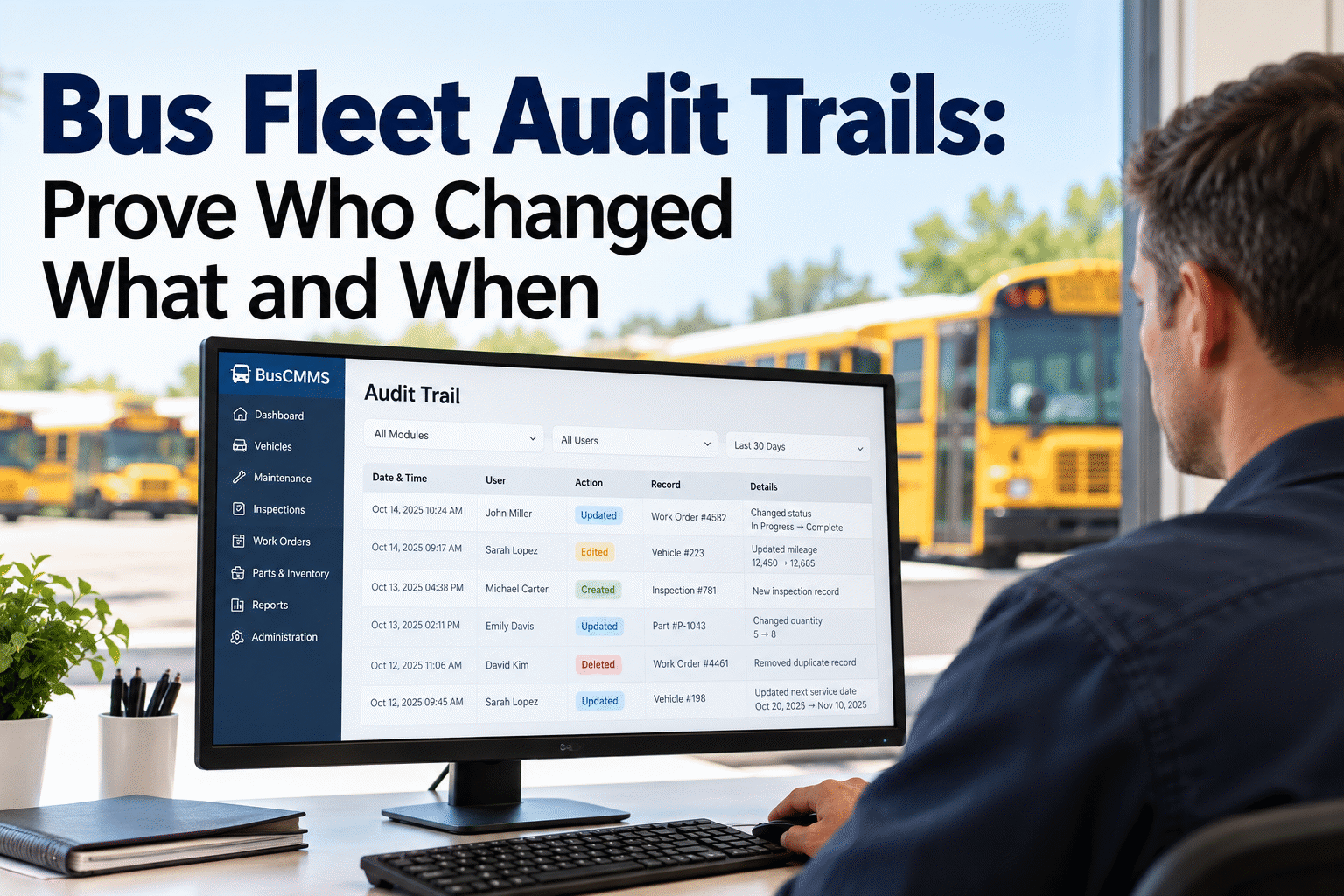
Video Retrieval Audit Trail
Every video pull logged: who requested, when, which bus, which date range, purpose. Chain-of-custody preserved for legal and insurance evidence.
Parent Inquiry Response Tracking
5-step workflow (log → pull → review → respond → close) tracked per case with time-target alerts and escalation triggers.
Camera Array on Driver DVIR
Interior, driver-facing, forward, side, and rear cameras each become named DVIR inspection items. Driver flags create instant defect work orders.
DVR Events to Bus Timeline
G-sensor triggers (hard braking, impact), overspeed events, and manual event marks route to the correct bus asset timeline alongside inspections and maintenance.
Any DVR Vendor via Webhooks
Works with Safe Fleet, Safety Vision, Pro-Vision, American Bus Video, AngelTrax, Seon, and most major mobile DVR platforms via event webhooks.
We are a 96-bus urban school district running Safety Vision mobile DVRs on every bus. 4 interior cameras plus driver-facing plus forward and rear on the standard Type C configuration. Before BusCMMS: parent inquiries were living in email chains, DVR health was checked manually about once a week, and video pulls were tracked in a shared spreadsheet nobody trusted. In September 2024 we started getting escalated parent complaints because response times were slipping past 72 hours. Investigation revealed the pattern — DVRs going offline for weeks without anyone noticing, video retrieval getting delayed because nobody logged the request, review findings never getting documented. We put BusCMMS underneath the whole onboard camera program 6 months later. DVR health monitoring now surfaces any offline recorder within 24 hours as a work order. Every parent inquiry gets logged as a case with the 5-step workflow attached. Video retrieval audit trail preserves chain of custody automatically. 12 months in: zero parent complaints escalated to superintendent level, average inquiry response down from 68 hours to 22 hours, and 100% DVR uptime tracking. Same DVRs. Different operational model.
Related pillars in the camera cluster: school bus camera systems master guide, stop-arm cameras, rear cameras, and forward dash cams.
Frequently Asked Questions
What is an onboard camera system on a school bus?
A school bus onboard camera system is a coordinated array of 4-16 cameras connected to a mobile digital video recorder (MDVR) installed on the bus, with a defined path for retrieving video from the recorder. The MDVR is a ruggedized, solid-state DVR unit typically mounted under a seat or in an equipment closet on the bus. It records continuously from all connected cameras to solid-state storage (SD card or SSD), with configurable retention windows typically ranging from 30 to 120 days for continuous footage. Event-triggered clips (from a built-in 3-axis accelerometer detecting hard braking, impact, or overspeed, or from manual event marks) are typically preserved separately and can be saved indefinitely. Camera positions on a modern 2026 configuration include interior wide-angle cameras covering seat rows, driver-facing camera, forward road camera, and optional rear and side blind-spot cameras. The 1080P AHD standard dominates 2026 onboard hardware because it delivers HD image quality without the bandwidth overhead of IP cameras, making it well-suited to bus environments where every wire matters and physical robustness is critical.
How many cameras should a school bus have?
Camera count depends on bus size, passenger capacity, route type, and program objectives. Small Type A school buses (up to 30 passengers) typically deploy 3-4 cameras: one interior wide-angle covering all seat rows, one driver-facing, one forward-road, and optionally one rear. Standard Type C or Type D school buses (54-83 passengers) typically run 5-6 cameras: two interior (front and rear seat coverage), driver-facing, forward-road, rear/backup, and optionally one side blind-spot. Large transit buses, coaches, or articulated units (40+ feet) run 7-9 cameras including 3-4 interior positions (front, mid, rear, stairwell), driver-facing, forward-road, rear/backup, and 1-2 side blind-spot cameras. DVR channel count should always be specified with 2 extra channels beyond the current camera count so the program can expand in year 2 without a hardware swap. A 4-channel DVR for a 4-camera install locks the fleet into replacing the DVR when a rear camera gets added later. Small fleets typically buy 4-channel DVRs, standard Type C/D deployments buy 8-channel DVRs, and large transit fleets buy 16-channel DVRs.
How does video get pulled from an onboard camera system?
Three generations of video retrieval exist in 2026 fleets. Generation 1 (USB manual pull, 2000-2015 era, still common in smaller fleets): a technician walks to the bus, accesses the DVR housing under a seat, pulls a USB drive or SD card, walks to a review computer, copies files, scrubs the timeline to find the event, and exports the clip — typically 45-90 minutes per pull, with risks including corrupt drives and misidentified buses. Generation 2 (Wi-Fi yard upload, 2015-2022 era, most common in 2026 deployments): the DVR auto-detects Wi-Fi coverage when the bus returns to the yard at end of day, event clips upload automatically, and non-event footage is requested through a web portal — typically 15-30 minutes per pull, with next-day turnaround. Generation 3 (4G/5G cellular streaming, 2022-present, current standard for new deployments): the transportation director logs into a cloud portal, selects the bus and date/time range, and the cellular link delivers the clip on demand — typically 2-5 minutes per pull with same-hour response capability. The generation your program is on determines whether parent inquiries close in hours or half a business day.
How should a district respond to a parent inquiry about bus camera footage?
Through a defined 5-step workflow with time targets at each step. Step 1 within 2 hours: log the inquiry — capture parent contact information, student name, bus number, route, date, approximate time, and specific incident described. Assign a case ID. Communicate expected response timeline to the parent. Step 2 within 4 hours: pull footage from the DVR for the specified bus, date, and time window. Retrieval time varies by generation: 45-90 minutes for USB manual, 15-30 minutes for Wi-Fi yard upload, 2-5 minutes for 4G cellular. Preserve original file for chain of custody. Step 3 within 24 hours: safety director or designated reviewer watches the footage, corroborates or contradicts the parent's description, documents findings, and flags any driver coaching or disciplinary action needed. Step 4 within 48 hours: contact parent with documented findings. If viewing is appropriate under district policy and student privacy protections, arrange a controlled viewing session — never share video files directly with parents. Step 5 within 72 hours: log the outcome to the bus asset timeline, generate any resulting work orders or DVIR items, and preserve the full audit trail for potential future inquiries. Districts that follow this workflow close inquiries cleanly; districts that skip steps escalate to the superintendent's office.
How does BusCMMS work with school bus onboard camera systems?
BusCMMS is the fleet operations layer that sits underneath any onboard camera DVR vendor and turns every DVR event, camera health signal, and video retrieval into an accountable action on the correct bus record. It works with Safe Fleet, Safety Vision, Pro-Vision, American Bus Video, AngelTrax, Seon, and most major mobile DVR platforms via event webhooks — no vendor lock-in. Every MDVR reports recording status, channel health, GPS lock, and storage utilization per bus, with offline DVRs auto-flagged as high-priority work orders instead of getting lost in an unchecked vendor portal. Every video pull is logged with who requested it, when, which bus, which date range, and purpose — preserving chain-of-custody for legal and insurance evidence. The 5-step parent inquiry response workflow (log, pull, review, respond, close) is tracked per case with time-target alerts and escalation triggers. Camera array positions (interior, driver-facing, forward, side, rear) each become named DVIR inspection items where driver flags create instant defect work orders. G-sensor triggers, overspeed events, and manual event marks route to the correct bus asset timeline alongside inspections, PM history, and maintenance actions. One 96-bus Southwest urban district director reported cutting average parent inquiry response time from 68 hours to 22 hours, achieving 100% DVR uptime tracking, and eliminating superintendent-level escalations — using the same Safety Vision hardware after adopting BusCMMS underneath the program.