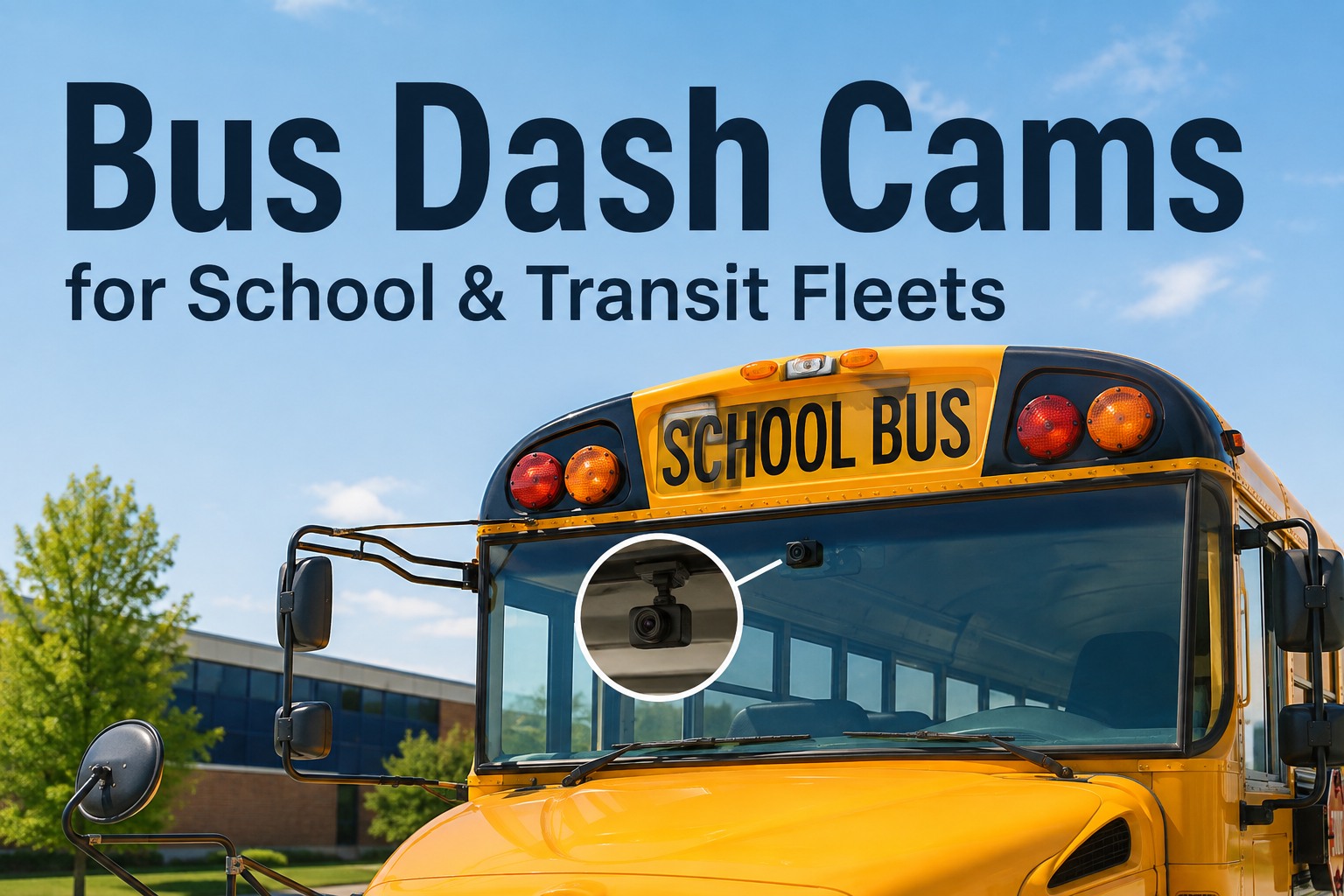
91% of fleet managers have used dash cam footage to exonerate a driver. A single exonerated not-at-fault claim saves $5,000 to $25,000 — often more than a full year of dash cam subscription. This 2026 buyer's guide covers the 4 camera positions, AI vs passive recording, deployment path, and where fleet operations software fits after the camera catches the event. See BusCMMS turn dash cam events into work orders and closed claims → book a 20-min demo.
The Bus Dash Cam ROI Math
A dash cam is not a safety expense — it is a claims-defense asset that pays for itself on a single exonerated event. The 2026 numbers are strong enough to build a board proposal on.
The 4 Dash Cam Positions
Forward, driver-facing, side, and rear. Each position catches different events and defends against different claims. Most 2026 bus fleets run at least the first two.
Every dash cam evaluation starts with a positioning decision: which cameras go where. The minimum viable configuration for modern bus safety is a dual-facing setup — forward-facing plus driver-facing — because those two positions catch roughly 80% of the events that matter for claims defense and driver coaching. Fleets running twilight routes, dense-traffic urban routes, or those with a heavy student behavior component typically add side and rear cameras for full coverage. Here is what each position does and when it earns its place on the bus.
FORWARD-FACING
DRIVER-FACING
SIDE-FACING
REAR-FACING
A dual-facing setup (forward + driver) is the 2026 baseline. Side and rear are added based on route type, insurance requirements, and known incident history. See BusCMMS log all 4 position feeds per bus in one asset record → book a demo.
AI-Enabled vs Passive Recording: The Single Biggest Buyer Decision
Both types of dash cam record continuous video. The difference is what happens after the recording. That difference is measured in hours of safety-review time per week.
Passive dash cams (traditional DVR-style systems) record continuous video to a local hard drive. When an incident happens, a supervisor pulls the footage, scrubs through hours of clip to find the relevant event, and exports it for review. AI-enabled dash cams (Samsara, Lytx DriveCam, Motive, Netradyne, SmartWitness, and similar 2026-generation systems) run continuous edge-AI classification on the video stream and only surface events that match configured risk patterns: harsh braking, tailgating, distracted driving, unsafe following distance, rolling stops, seatbelt non-compliance. The safety team reviews 5-15 flagged events per week instead of 500 hours of raw footage. That is the entire buyer-side argument for AI.
Records everything. Reviews nothing until asked.
- Recording: Continuous 24/7 to local DVR
- Event detection: None — supervisor scrubs manually
- Weekly review time: 8-15 hours per fleet supervisor
- Incident response: Reactive — only after complaint or crash
- Coaching support: Limited — hard to find teaching moments
- Insurance benefit: Some — provides post-crash footage
Records everything. Flags what matters. Coaches in real time.
- Recording: Continuous plus event-triggered clips
- Event detection: Edge-AI classifies risk patterns live
- Weekly review time: 30-60 minutes on flagged events
- Incident response: Proactive — in-cab alerts + coaching queue
- Coaching support: Structured — scored, prioritized, teachable
- Insurance benefit: Substantial — 15-45% premium reduction typical
The 2026 baseline for a bus fleet dash cam program is AI-enabled. Passive DVR is a claims-defense floor, not a safety-improvement lever. Sign up free and route AI-detected events to per-bus records →
The 10-Bus Pilot to Fleet-Wide Deployment Path
Five phases from pilot selection to full-fleet rollout. Each phase unlocks the next only if its KPIs land. This is how disciplined districts avoid the cost of a fleet-wide misdeployment.
Committing to a 60-bus dash cam program without a pilot is how districts end up with the wrong vendor, the wrong camera positions, or the wrong workflow — and no way to back out cleanly at contract renewal 24 months later. The phased deployment path below starts with a 10-bus pilot on high-risk routes, gates each phase against measurable outcomes, and only rolls fleet-wide after the operational workflow proves itself. The whole path typically takes 6-9 months and generates the internal data needed for the board approval that unlocks the full rollout budget.
- PHASE 01
Pilot Selection (weeks 1-2)
Pick 10 buses on your highest-incident routes. Mix veteran and newer drivers. Include at least one bus with a recent claim history so the pilot has a natural claims-defense test case.
KPI: Pilot fleet locked, baseline claims count documented - PHASE 02
Installation + Configuration (weeks 3-4)
Cameras installed. AI detection thresholds set. In-cab alerts tuned for your route type. Driver training delivered. Portal access granted to fleet supervisor, safety director, and shop foreman.
KPI: All 10 buses reporting; zero installation issues - PHASE 03
Event Review Ownership (weeks 5-8)
Assign named event reviewer. Establish weekly coaching cadence. Define escalation path for high-severity events. Set up integration with fleet operations software so events land on bus records.
KPI: 100% flagged events reviewed within 48 hours - PHASE 04
Coaching + Behavior Change (weeks 9-16)
Weekly driver coaching sessions using flagged event footage. Measure event volume per driver over time. Adjust AI thresholds as false-positive patterns emerge. Track camera health via DVIR items.
KPI: 30%+ reduction in flagged events per driver by week 12 - PHASE 05
Fleet-Wide Rollout (months 6-9)
Board approval package prepared using pilot KPI data. Rollout schedule set. Vendor pricing renegotiated with fleet-wide volume. Same operational workflow scaled from 10 buses to full fleet.
KPI: Full fleet deployed; workflow scaled; board sign-off
A disciplined phased rollout generates the internal proof points that turn a "camera project" into a documented safety program. See BusCMMS support the 10-bus pilot to fleet-wide path → book a demo.
The 2026 Bus Dash Cam Buyer's Checklist
Six spec groups every dash cam evaluation should score vendors on. Skip a group and vendor responses become impossible to compare apples-to-apples.
Bus dash cam vendor pitches focus on whatever spec makes their system look best. Samsara emphasizes AI accuracy. Lytx emphasizes professional reviewer coaching. Motive emphasizes bundled telematics. Seon and Safety Vision emphasize school bus specialization. To compare vendors on merit rather than marketing, score them against these six spec groups. The realistic 2026 price band for a mature AI-enabled bus dash cam is $30-$45 per vehicle per month for the software subscription, plus $500-$2,000 per bus in installed hardware for the camera array.
VIDEO & IMAGE QUALITY
AI & DETECTION
STORAGE & CONNECTIVITY
EVIDENCE & PRIVACY
INTEGRATION
SUPPORT & WARRANTY
Score every vendor across all 6 groups. Vendors that decline to answer any group are self-selecting out of your shortlist. See BusCMMS integrate with Samsara, Lytx, SmartDrive, Motive, Seon, and Safety Vision via webhooks → book a demo.
Where BusCMMS Fits Dash Cam Operations
The camera captures the event. BusCMMS turns it into a documented fleet action. Six specific capabilities purpose-built for dash cam programs.
Every 2026 bus dash cam vendor is excellent at stages 1-2 of the event lifecycle: capture and detection. What almost every vendor stops short of is stage 3: what happens inside the fleet as a result. A high-severity event flagged by the vendor portal is only valuable if it becomes an assigned action — driver coaching session scheduled, work order created for the camera itself if hardware faulted, video linked to the correct bus asset for incident investigation, and full documentation trail preserved for insurance defense 18 months later. That is the operational layer BusCMMS provides on top of any dash cam vendor.
Video Event to Bus Asset
Every AI-flagged event from Samsara, Lytx, SmartDrive, Motive, Netradyne, Seon, or Safety Vision auto-lands on the correct bus asset timeline via event webhooks.
Camera Fault to Work Order
Camera hardware faults, lens fogging, DVR errors, and connectivity dropouts auto-generate work orders for the shop instead of getting lost in the vendor portal.
Dash Cam as DVIR Item
Forward, driver-facing, side, and rear cameras each become named inspection items on the electronic DVIR. Driver flags create instant defect records.
Coaching Session Documentation
Weekly coaching sessions tied to specific flagged events. Driver acknowledgment logged. Coaching history per driver preserved for HR and safety records.
Insurance-Ready Evidence Package
Video, GPS, event metadata, and driver record bundled per incident for insurance and legal submission. Chain of custody preserved end-to-end.
Board + Insurance Program Reports
Monthly report of flagged events per bus, per driver, per route. Coaching completion rates. Camera uptime. One-click export for board and insurer reviews.
Our 84-bus urban transit district deployed Samsara AI dash cams in fall 2024. First 6 months were a mixed bag. The cameras worked beautifully. The events were flagged accurately. What we could not do was turn a flagged event into an accountable coaching session or a fixed camera hardware issue — those lived in two different systems: the Samsara portal and my shop foreman's email. In April 2025 we put BusCMMS underneath the whole program. Every Samsara event now creates the correct action on the correct bus: coaching queue entry for the driver, work order for the shop if the camera itself faulted, video link on the bus asset timeline for incident review. 12 months in: 47% reduction in flagged distracted-driving events per driver, 3 not-at-fault crash defenses using dash cam evidence saving us an estimated $65,000 in insurance settlements, and zero cameras offline for more than 48 hours. Same Samsara hardware. Different operational model.
Cluster hub & sibling pillars: school bus camera systems master guide, stop-arm cameras, rear and backup cameras.
Frequently Asked Questions
What is a bus dash cam?
A bus dash cam is a fleet-grade video camera installed on a school bus, transit bus, or motorcoach to record continuous video plus AI-detected safety events for use in claims defense, driver coaching, and incident investigation. Modern 2026-generation bus dash cams come in dual-facing or multi-camera configurations. The minimum viable setup is dual-facing — forward-facing (140-170 degree road view) plus driver-facing (100-120 degree cabin view with infrared for low light). Larger deployments add side-facing cameras (blind-spot coverage for lane-change events) and rear-facing cameras (backing events and rear-collision context). The most important 2026 differentiator is AI capability: passive dash cams record continuous video that must be manually reviewed after an incident, while AI-enabled dash cams from Samsara, Lytx DriveCam, Motive, Netradyne, SmartWitness, and similar vendors run edge-AI classification live and only surface events that match configured risk patterns (harsh braking, tailgating, distracted driving, phone use, seatbelt off, rolling stops, unsafe following distance). Adoption has jumped from 15% of bus fleets in 2019 to 68% in 2025, driven by insurance premium reductions of 15-45% on AI-enabled fleets and single-event claims defense that can save $5,000-$25,000 per exonerated not-at-fault crash.
What cameras should a bus fleet have?
The 2026 baseline recommendation for most bus fleets is a dual-facing dash cam setup: forward-facing plus driver-facing. These two positions catch roughly 80% of events that matter for claims defense and driver coaching. Forward-facing catches collision context, harsh braking, following distance events, road conditions, and other-driver behavior for the not-at-fault claims defense that produces the biggest single-event ROI. Driver-facing catches driver attention, phone distraction, seatbelt use, and drowsiness signs for the structured coaching program that produces sustained behavior change. From that baseline, fleets add side cameras for transit and urban routes with frequent lane changes and heavy pedestrian activity, rear cameras for backing-heavy operations (covered in depth on the bus rear camera pillar), and stop-arm cameras where state law authorizes automated enforcement (covered on the stop-arm camera pillar). School buses typically also add interior passenger cameras for behavior documentation. Full stack of 4-8 cameras is common in large urban districts. Configuration should be driven by fleet-specific factors: route type, known incident history, insurance requirements, and student population density.
Are dash cameras required on school buses?
No federal standard universally requires dash cameras on school buses. FMVSS No. 111 Rear Visibility (49 CFR 571.111) requires rear visibility systems on vehicles under 10,000 lb GVWR, which typically means rear or backup cameras on Type A school buses, but no federal mandate specifically requires forward-facing, driver-facing, or side-facing dash cameras. A growing number of states have adopted enabling legislation authorizing automated stop-arm camera enforcement (26 states as of July 2025 per NCSL). School district policies and insurance carrier requirements sometimes set additional camera requirements beyond state law. What matters more than any federal mandate is the operational and financial reality: 91% of fleet managers have used dash cam footage for driver exoneration, insurance premiums on AI-enabled fleets typically drop 15-45%, and single not-at-fault claims defense can save $5,000-$25,000 per event — often covering months of subscription cost in one incident. Always verify current federal, state, and district requirements against primary regulatory sources rather than vendor summaries. The lack of a federal mandate does not mean dash cameras are optional from an insurance or liability standpoint.
What should a fleet look for in a bus dash camera system?
Score every vendor across six spec groups. Video and image quality: 1080p minimum with 2K road-facing preferred, IR + low-light sensor for night performance, forward 140-170 degree and driver 100-120 degree fields of view, IP67 minimum weather rating for exterior cameras. AI and detection: 10+ configurable event types, real-time in-cab audio and visual alerts to the driver, auto-prioritization by severity, documented false-positive rate per event type. Storage and connectivity: cloud plus local edge SSD storage, 30-120 day retention for continuous with event clips indefinite, 4G cellular data minimum (5G preferred), native GPS integration. Evidence and privacy: MP4 export with chain-of-custody metadata, role-based access permissions with audit trail, TLS 1.3+ encryption in transit and at rest, configurable audio recording per state law. Integration: event webhooks plus REST API for CMMS integration, native or partnered telematics/ELD, camera-health as DVIR inspection item, open API with documented endpoints. Support and warranty: 3-year hardware warranty minimum with 10-year achievable, turnkey or district-installed options, over-the-air firmware update capability, dedicated customer success manager for fleets over 25 vehicles. Realistic 2026 price band is $30-$45 per vehicle per month for the software subscription plus $500-$2,000 per bus in installed hardware. Vendors that decline to answer any of the six groups are self-selecting out of your shortlist.
How can dash camera events connect to fleet maintenance?
Through a fleet operations layer that sits underneath any dash cam vendor and turns every event into an accountable action on the correct bus record. Camera vendors excel at capture and detection but stop short of the operational workflow: what happens to the flagged event, who reviews it, when it gets converted to a coaching session, and what happens when the camera hardware itself faults. BusCMMS integrates with Samsara, Lytx DriveCam, SmartDrive, Motive, Netradyne, Seon, Safety Vision, and most major dash cam platforms via event webhooks. Every AI-flagged event auto-lands on the correct bus asset timeline. Camera hardware faults, lens fogging, DVR errors, and connectivity dropouts auto-generate work orders for the shop instead of getting buried in the vendor portal. Forward, driver-facing, side, and rear cameras each become named inspection items on the electronic DVIR under applicable 49 CFR 396.11 and 396.13 workflows — driver flags create instant defect records. Weekly coaching sessions tie to specific flagged events with driver acknowledgment logged. Insurance-ready evidence packages bundle video, GPS, event metadata, and driver record per incident with chain of custody preserved end-to-end. Monthly board and insurance reports export in one click. One 84-bus Mid-Atlantic transit safety director reported 47% reduction in flagged distracted-driving events per driver, 3 not-at-fault crash defenses saving an estimated $65,000 in insurance settlements, and zero cameras offline for more than 48 hours — using the same Samsara hardware after adopting BusCMMS underneath the program.