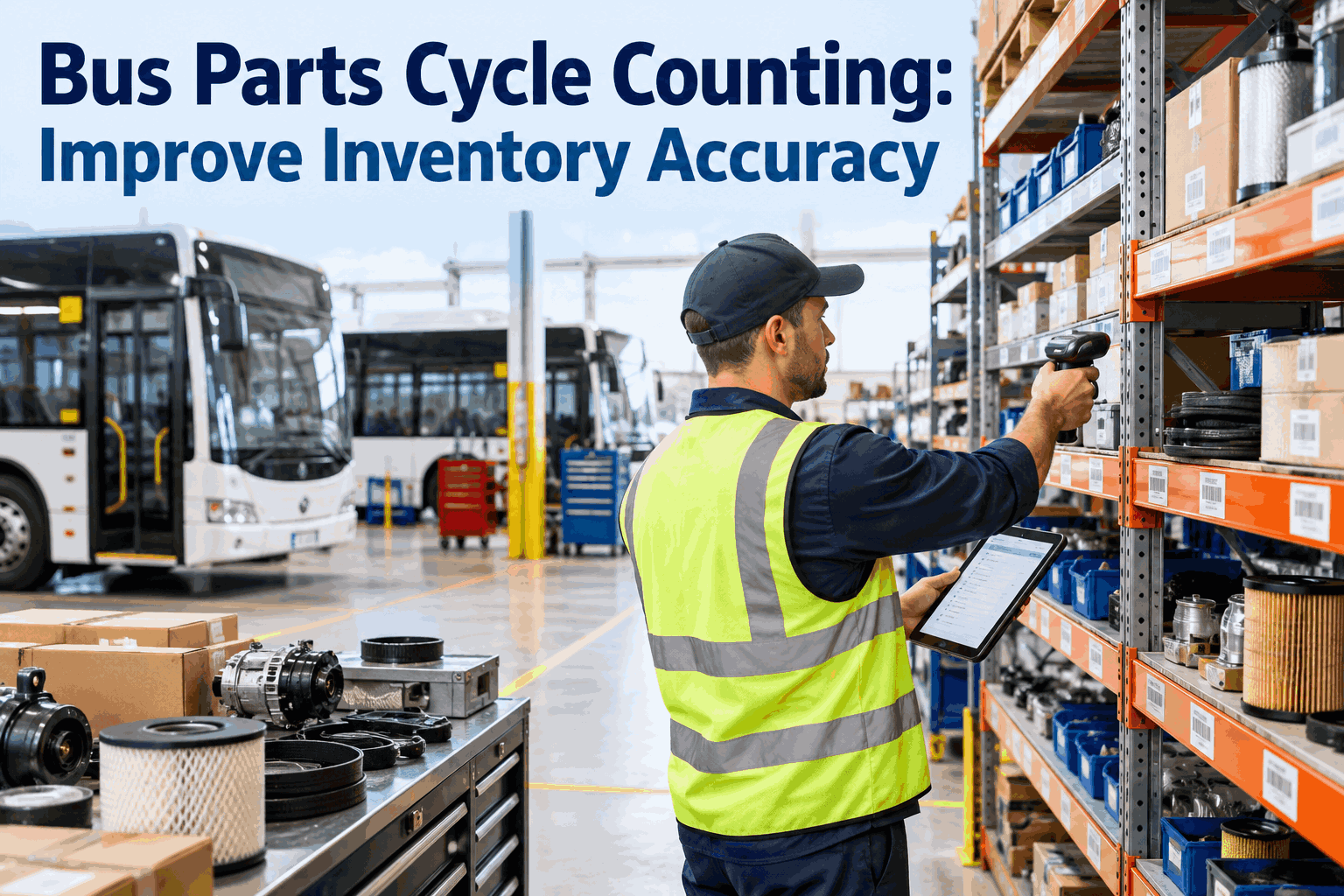
Every February you shut the parts room, hand out clipboards, and lose three days finding out how wrong last year's count was. Bus parts cycle counting ends that ritual — instead of one giant annual stocktake, you count a small slice of the storeroom every week, catch the discrepancies while they're still small, and never close the shop to do it.
Bus Parts Cycle Counting: Accuracy Without the Annual Shutdown
Count a little every week instead of everything once a year. Catch discrepancies early, keep the shop open, and trust the number on the screen.
Why the Annual Stocktake Fails a Bus Parts Room
The once-a-year physical count feels responsible — everyone counting, the books reconciled, a clean number to hand the board. But for a working bus parts room it fails in a specific way: it tells you how wrong you were, eleven months too late to do anything about it. A brake chamber that went missing in April doesn't surface until the February count, and by then you can't reconstruct where it went, whether it was a theft, a miscount, or an un-logged issue.
Eleven Months of Blind Drift
Between counts, the number on the screen slowly stops matching the shelf. You make reorder and budget calls all year on data you can't trust.
The Shop Grinds to a Halt
A full count means the whole team on clipboards for days — work orders stack up, buses wait, and overtime piles on to catch back up.
You Can't Find the Cause
A big year-end variance is a mystery by the time you see it. No trail, no timeframe, no way to tell theft from a data-entry slip.
There's also the accuracy ceiling. Professional parts operations aim for 95-99% inventory accuracy on high-value A-items and 85-95% on B-items — and you simply cannot hold those numbers with a single annual count, because the drift window between checks is far too long. The fix isn't counting harder once a year. It's counting a little, all the time. If your storeroom itself needs structure first, our guide to setting up a CMMS storeroom covers the ABC and layout groundwork. Book a demo to see rolling count accuracy on a real parts room.
What Bus Parts Cycle Counting Actually Is
Cycle counting replaces the one-time annual stocktake with a rolling process: you count a small subset of the storeroom on a regular schedule, so that over a set period every part gets counted — the high-value stuff several times, the low-value stuff at least once. The trick is that not everything gets counted at the same frequency. You count what matters most, most often. That's ABC-based count frequency, and it's the heart of the method.
A-Items · High Value / Critical
Count monthlyEngines, transmissions, brake assemblies, expensive electronics — the roughly 20% of parts that hold ~80% of your inventory dollars. Target 95-99% accuracy. Count these most often because an error here is an expensive error.
B-Items · Moderate Value
Count quarterlyBelts, batteries, mid-range sensors, common wear components. Meaningful dollars but not the top tier. Target 85-95% accuracy. A quarterly rhythm keeps them honest without over-counting.
C-Items · Low Value / High Volume
Count 1-2x per yearFasteners, fittings, bulbs, clamps — cheap, plentiful, low-stakes. A light touch once or twice a year is plenty. Spending equal effort here is where fleets waste their counting hours.
Match count frequency to part value and the whole thing becomes sustainable — you're never overwhelmed, because on any given week you're only counting a manageable slice. And because A-items cycle through monthly, a discrepancy on an expensive part surfaces within weeks, not next February. This is also where reorder accuracy comes from: a trustworthy count is what makes your min-max levels fire correctly, which our min-max stock level framework builds on. Sign up free and set ABC count frequencies on your own parts list.
A Week in a Rolling Count Schedule
The reason cycle counting doesn't feel like a burden is that any single count is small. Here's what a typical week looks like when the system tells one person what to count each day — twenty minutes here, a shelf there, never a shutdown.
System assigns the count
The CMMS surfaces this week's due sections based on ABC frequency — today, the A-item brake shelf. No spreadsheet of count dates to manage.
Count the slice
One person scans or counts the assigned shelf in about twenty minutes. Physical count entered against the recorded count — done before the first work order of the day.
Variances flag automatically
The system compares physical to recorded and flags any gap on the spot. A clean shelf closes itself; a mismatch opens an investigation.
Investigate while it's fresh
Because the count is recent, the trail is warm — you can check the last few work orders, receipts, and issues for that part and usually find the cause the same week.
Correct and move on
Adjust the record, note the cause, and the next section is queued for Monday. The storeroom stayed open all week and got more accurate, not less.
Multiply that light weekly rhythm across a year and every part gets counted on its proper schedule — A-items a dozen times, C-items once or twice — without ever closing the shop or pulling the whole team off buses. The annual shutdown becomes unnecessary because the storeroom is never more than a few weeks from its last check on anything that matters.
The Discrepancy Loop: Where Cycle Counting Earns Its Keep
Catching a variance is only half the value — the other half is learning from it. A good cycle count process runs every discrepancy through the same short loop, and over time that loop makes the whole storeroom tighter.
Count
Physical count of the assigned section entered against the recorded number.
Flag
Any gap between physical and recorded surfaces immediately — sized and dated.
Investigate
Check recent transactions on that part. Large gaps point to theft, damage, or a miscount — worth chasing down.
Correct & Learn
Adjust the record, log the cause, and if a pattern shows up, fix the process behind it — not just the number.
The professional guidance here is worth stating plainly: large or repeated discrepancies aren't just numbers to true up — they're signals. A part that keeps coming up short may be walking out the door; a part that's always over may have a receiving-entry problem. Cycle counting turns those signals into something you can act on while the trail is fresh, instead of a single unexplained year-end write-off. Book a walkthrough to see the discrepancy-flag-and-investigate flow in BusCMMS.
Cycle Counting vs Annual Stocktake, Head to Head
Laid side by side, the two approaches aren't close. One keeps the shop open and the number honest; the other closes the shop to discover how dishonest the number became.
- FrequencyOnce a year
- Drift windowUp to 11 months
- Shop impactDays of shutdown
- LaborWhole team, all at once
- Root causeCold trail, unknowable
- A-item accuracyHard to hold
- FrequencyA slice every week
- Drift windowDays to weeks
- Shop impactNever closes
- LaborOne person, one section
- Root causeWarm trail, findable
- A-item accuracy95-99% sustainable
Many fleets keep a lighter annual reconciliation as a final year-end verification even after switching — but it becomes a quick formality instead of a three-day fire drill, because the storeroom was already accurate going in. That's the real shift: the count stops being an event you dread and becomes a background rhythm you barely notice. Sign up free and replace your next annual shutdown with a rolling schedule.
How BusCMMS Runs Cycle Counting
Because BusCMMS already holds every part, work order, and transaction, cycle counting isn't a separate chore bolted on — it's the system telling you what's due, checking your count against its own records, and keeping the trail you need to explain any gap. The features below are what make a rolling count sustainable.
-
ABC Count Scheduling
Set count frequency by part tier — A monthly, B quarterly, C once or twice a year — and the system surfaces what's due each week automatically.
-
Scan-to-Count
Count a section by scanning on iOS or Android. The physical count checks against the recorded number in real time — no manual reconciliation.
-
Automatic Variance Flags
Any gap between physical and recorded surfaces instantly — sized, dated, and queued for investigation before it compounds.
-
Warm Transaction Trail
Every receipt and issue is logged, so a fresh variance can be traced to recent work orders while the cause is still findable.
-
Variance Trend Reporting
See which parts drift repeatedly — the pattern that points to shrinkage, a receiving error, or a bin mix-up you can fix at the source.
-
No-Shutdown Accuracy
Hold 95-99% on A-items with a rolling schedule that never closes the shop or pulls the team off buses for a full count.
The connection is the point. A standalone count sheet tells you a number is wrong; BusCMMS tells you which part, by how much, when it last moved, and on which work order — so the count becomes the start of a fix instead of the end of a mystery. Accuracy stops being an annual event and becomes a property of the system. Book a demo to see the count-to-cause connection in action.
The Parts Manager's View
That's the whole case from someone who lived both sides of it. The count got more accurate, the shop stayed open, and the year-end mystery disappeared — because the storeroom is never more than a few weeks from its last honest check. Sign up free and start your first rolling count this week.
The Bottom Line on Bus Parts Cycle Counting
Bus parts cycle counting beats the annual stocktake because it counts a little all the time instead of everything once a year — so discrepancies surface in days while the trail is warm, the shop never closes, and high-value A-items hold the 95-99% accuracy a working parts room actually needs. Set your count frequency by ABC tier, let the system assign each week's slice, run every variance through the flag-investigate-correct loop, and the once-a-year shutdown simply becomes unnecessary. The number on the screen finally matches the shelf, all year long — and the reorders, budgets, and board reports built on it become trustworthy too. Book a walkthrough to see cycle counting on a fleet like yours.