Six years into running twelve battery-electric school buses, Route 14 returns with 11% charge instead of 32%, yet the dash still reads 94% health. When you file an OEM warranty claim, the manufacturer demands 24 months of cell-voltage deltas and thermal coolant logs scattered across portals. Structured electric bus battery health tracking unifies these records per VIN—see how BusCMMS automates SOH and warranty logs in a live demo.
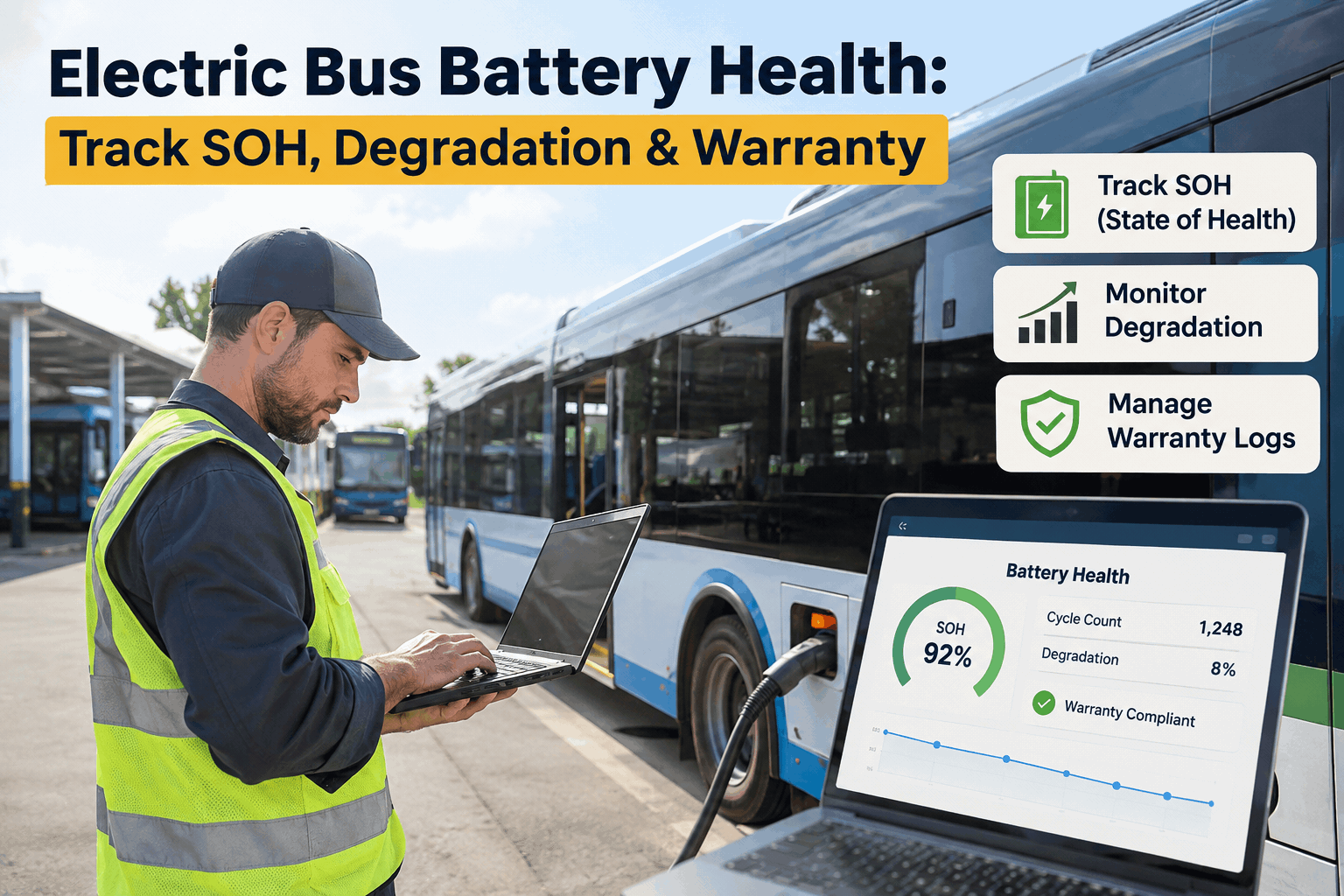
Electric Bus Battery Health: Track SOH, Degradation & Warranty
An out-of-warranty bus battery pack costs $55,000 to $110,000. Protect your fleet by tracking true State of Health (SOH), cycle counts, thermal stress, and OEM inspection proof in one place.
Why Dashboard SOH Alone Fails Electric Bus Battery Health Tracking
On-board Battery Management Systems (BMS) often buffer early capacity fade, keeping dash displays near 98% while usable kilowatt-hours quietly shrink. True electric bus battery health tracking pairs telematics SOH with real route energy throughput.
What the Driver Sees
- Smoothed SOH percentage masked by top-end capacity buffers
- Single fleet-wide alert light only after a critical fault triggers
- No historical trend line connecting winter heater draw to range loss
What Your Shop Tracks
- Actual kWh/mile energy throughput cross-referenced per VIN
- Automated alerts when annual fade exceeds 2%–3% or cell deltas spike
- Timestamped PM, coolant, and charging logs ready for OEM audit
Standard coverage runs 8 yrs / 100k mi, extending to 10–12 yrs / 150k mi in states like California.
Most OEM warranties guarantee 70% SOH standard (80% on select extended plans) before replacement triggers.
Replacing a full electric school or transit bus battery pack without valid warranty proof hits capital budgets hard.
Well-managed packs retain 80%+ capacity past year 12, unless heat or heavy DC fast charging accelerates wear.
Battery Degradation & Warranty Timeline Across the Bus Lifecycle
Battery fade accelerates once a pack hits its thermal or cycle knee point. Matching shop PMs to each lifecycle stage prevents surprise route failures—set up automated SOH threshold alerts in BusCMMS in minutes.
Per-VIN Baselines & Charging Discipline
Log delivery-day SOH, pack serials, and firmware versions. Track AC vs. DC fast-charge ratios and verify chiller coolant at every 10,000-mile PM.
Cell Imbalance & kWh/Mile Drift
Monitor full-charge cell-voltage spread and winter vs. summer energy draw. Auto-generate diagnostic work orders whenever SOH drops 3%+ year-over-year.
Warranty Claims & Route Reassignment
Run a capacity audit 12 months before warranty expiry. Export SOH trends and PM proof for no-cost OEM replacement, or move 78% SOH units to shorter routes.
What Accelerates EV Bus Battery Degradation—and What Your Shop Should Log
Research cited by WRI India shows high operating temperatures can cut LFP cycle life in half—from 4,000 cycles at 25°C down to 2,000 at 45°C. Logging these drivers in your passenger transit and school bus CMMS lets you fix charging habits early.
| Degradation Driver | Impact | Telemetry / Shop Signal | Threshold & CMMS Action |
|---|---|---|---|
| Excessive DC Fast Charging | HIGH | High-kW sessions >50% of total throughput | Log AC vs. DC kWh split; flag routes forcing midday fast charges |
| Thermal System Neglect | HIGH | Elevated pack temps, chiller faults, low coolant | Schedule 6-month chiller, fan, and dielectric coolant PMs |
| Deep Discharge Cycling | MODERATE | Buses returning below 15%–20% State of Charge | Trigger route-length review when end-of-day SOC drops below 20% |
| Cell-Voltage Imbalance | HIGH | Module delta >30–50 mV at rest | Auto-create high-voltage balancing or module inspection work order |
| 100% Hot-Soak Parking | MODERATE | Packs sitting at 100% SOC in summer yards | Cap overnight charge target at 80%–90% on short-route buses |
For mixed diesel, propane, and electric fleets, keeping battery PMs beside brake and DVIR workflows prevents missed checks—schedule a 20-minute walkthrough to see EV and diesel PMs side by side.
OEM Warranty Compliance Checklist: 6 Records Every Fleet Needs
Manufacturers deny capacity claims when fleets cannot prove thermal systems were serviced on time. Verify your shop captures these six records for every electric bus VIN:
Timestamped SOH & Cycle Logs
Store monthly SOH percentages, kWh throughput, and charge cycles per pack serial to prove when degradation crossed the warranty floor.
Thermal & Coolant Service History
Attach completed work orders for chiller inspections, radiator cleaning, and coolant flushes—the first records OEM engineers audit.
Cell-Level Voltage & Temp Deltas
Log min/max cell voltages and module temps during PMs to isolate a weak module before it drags down the entire pack.
DC Fast-Charge & SOC Profiles
Document charger session logs showing adherence to OEM fast-charging limits and overnight balancing routines.
HV Isolation & DVIR Sign-Offs
Pair daily driver DVIRs (dash lights, charge-port latch) with shop high-voltage insulation checks on one tamper-evident timeline.
Pre-Expiration Claim Triggers
Set reminders 12 months before warranty end dates so borderline packs at 72%–76% SOH are capacity-tested before coverage lapses.
Fleets using BusCMMS report saving ~$2,800 per bus annually at 95%+ availability, and catching one warrantable pack early saves $55,000+ in capital spend—create a free BusCMMS account to start logging EV battery records.
A Transit Maintenance Director's Perspective
Key Takeaways for Electric Bus Battery Health Tracking
Keeping electric school and transit buses reliable over a 12-year service life comes down to four shop habits:
Verify SOH with real kWh/mile
Pair BMS readouts with actual route energy consumption instead of relying on smoothed dash percentages.
Automate degradation alerts
Flag any unit dropping faster than 2%–3% SOH per year or showing module voltage spread before a route fails.
Document thermal & charging PMs
Attach chiller service, coolant flushes, and DCFC ratios to each VIN so OEM warranties stay enforceable.
Audit 12 months before expiry
Run capacity checks ahead of the 8-year or 12-year warranty cutoff to capture covered replacements.
Consistent electric bus battery health tracking turns battery longevity into a predictable maintenance workflow—book a live BusCMMS demo with our fleet team to see SOH alerts and warranty logs on your routes.