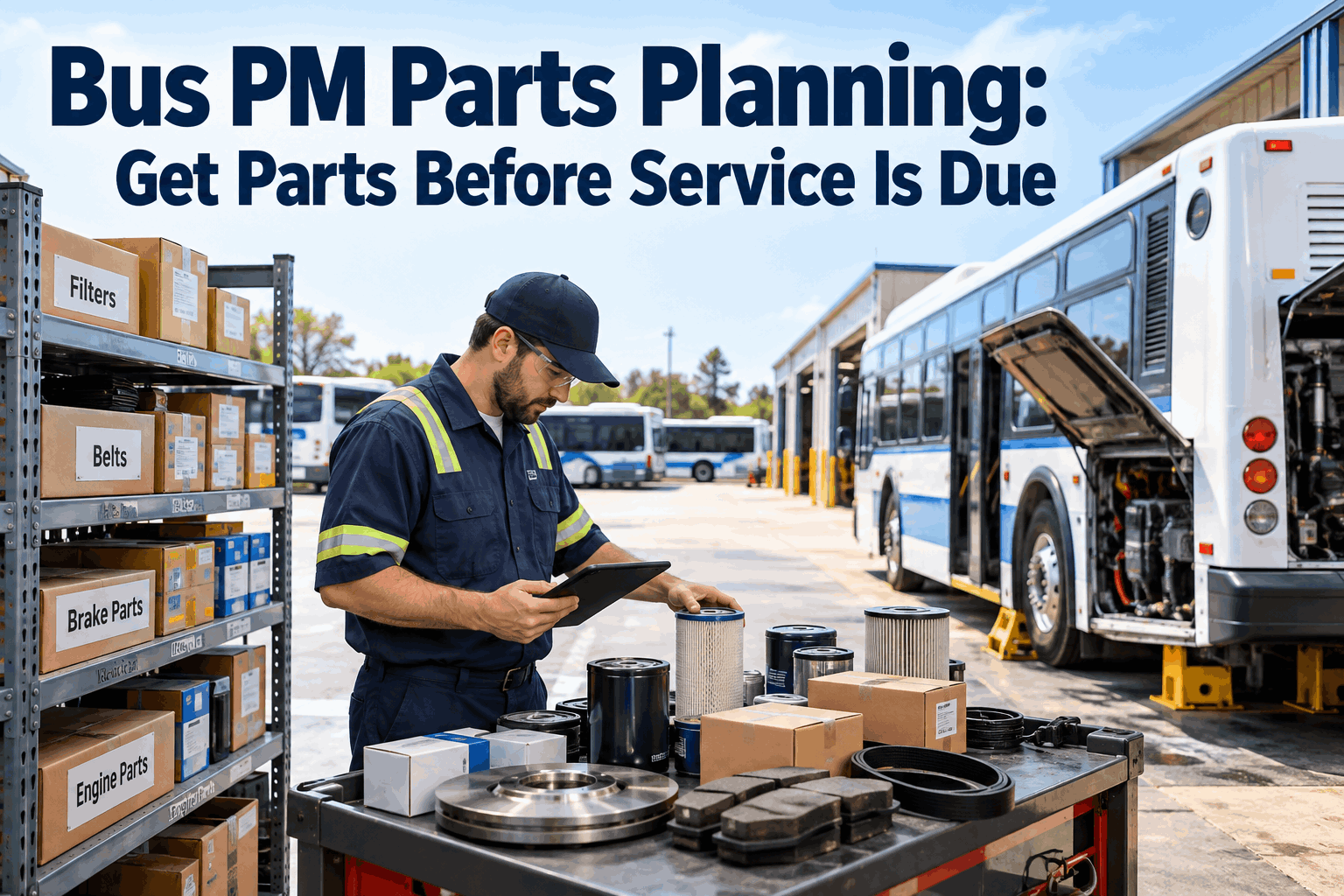
The PM is on the board for Tuesday. The bus rolls in, the tech opens the work order — and the air dryer cartridge is on backorder with a two-week lead time. Now the bus either sits or goes back out with the PM deferred. That's the problem bus PM parts planning solves: the service date was never a surprise, so the part shouldn't be either. Order backward from the PM date and the part beats the bus to the shop.
Bus PM Parts Planning: Get the Part Before Service Is Due
Your PM dates are known weeks out. Work backward from each one by the part's lead time, and the kit is staged before the bus ever pulls into the bay.
Why the Part Isn't There When the PM Is Due
A deferred PM almost never happens because the schedule failed — the calendar did its job and flagged the service. It happens because the parts side never got the memo. The PM date and the parts order live in two different worlds: one in the maintenance scheduler, one in the parts room, and nothing connects them. So the part gets ordered the day the bus shows up, not the two weeks before it needed to.
Ordered Too Late
The part gets ordered when the work order opens — the same morning the bus arrives. A lead time longer than a day means the PM is already behind.
No Line of Sight
Nobody sees which PMs are coming and what they'll consume. The parts lead is reacting to today's bay, not planning for next month's schedule.
Deferred or Rushed
Without the part, the PM slips — or you pay rush freight and premium pricing to overnight it. Either way, the timing gap costs you money or uptime.
The cost shows up in two places. First, deferred PMs push your compliance and effectiveness the wrong way — a service that slips two weeks is two weeks of extra wear on a component you meant to protect. Second, the rush-order habit quietly inflates parts spend; overnighting a part you could have ordered ground two weeks earlier is pure avoidable cost. Both disappear when the PM schedule and the parts order finally talk to each other. If you're still building the PM side, our guide to building a bus fleet PM program lays the groundwork. Book a demo to see upcoming PMs and their parts on one screen.
The Backward-Planning Math
Bus PM parts planning is really just one piece of arithmetic done in the right direction. Instead of ordering when the bus arrives, you start from the known PM date and subtract backward. The formula is simple, and once it runs automatically, the part is always early.
The safety buffer is the part fleets skip and regret. A supplier who quotes a ten-day lead time will occasionally take fourteen, so building in a couple of days of cushion is what keeps the occasional slow shipment from turning into a deferred PM. The other half of the equation is knowing the PM date far enough ahead — which is exactly what a mileage-and-calendar PM schedule gives you, because it can project when a bus will hit its next service based on how it's actually accumulating miles. That projection is what makes the whole backward calculation possible. Sign up free and set lead times against your own PM schedule.
The PM Parts Kit: Every Service Has a Known Bill of Materials
The backward math only works if you know what the PM will consume, not just when. That's the PM parts kit — the bill of materials attached to each service type. Once every PM type has its kit defined, the system knows the parts an upcoming service needs the moment it's scheduled.
A-Service Kit
light, frequentOil and filters, lube, common wear checks. High-volume consumables you keep in steady stock — short lead, high turnover. The kit tells the system to keep these topped up against PM frequency.
B-Service Kit
deeper, scheduledBelts, air dryer cartridges, fuel filters, brake components. Mid-lead parts worth staging ahead per bus — this is where backward planning earns its keep most often.
Major Service Kit
heavy, plannedLarger components, fuel-type-specific items, sometimes long-lead or special-order parts. These need the longest planning horizon — order weeks ahead of the scheduled service.
Bus fleets have an advantage here that many industries don't: PM services are highly repeatable, so the kits are stable and knowable. An A-service on a diesel bus consumes nearly the same parts every time. Define the kit once and every future instance of that PM inherits it — and because BusCMMS runs fuel-type-aware PM logic, a diesel B-service kit and an electric bus's service kit are tracked separately, each with its own parts and lead times. That per-fuel accuracy is what keeps the planning honest across a mixed fleet. Book a walkthrough to see PM parts kits defined per service type.
Lead Time Reality: Not Every Part Plans the Same
The planning horizon isn't one number — it depends on the part. Group your PM parts by lead time and each group gets a different ordering rhythm. Getting this grouping right is what keeps you from over-stocking the fast stuff and getting caught short on the slow stuff.
Short Lead
Common consumables — oil, standard filters, bulbs, fittings. Managed by min-max reorder points, always in stock. No per-PM planning needed; they're just there.
Medium Lead
Belts, air dryer cartridges, sensors, brake parts. The sweet spot for backward planning — stage them per upcoming PM using the order-by date, not steady stock.
Long Lead / Special Order
Major components, fuel-type-specific and OEM-only parts. Plan against the projected PM date weeks out, and confirm supplier lead time before you commit the service date.
The two ends of this spectrum are handled differently on purpose. Short-lead consumables don't need PM-by-PM planning at all — steady min-max reorder points keep them on the shelf, which our min-max stock level framework covers in depth. The medium and long-lead parts are where backward planning from the PM date does the real work, because those are the parts that actually cause deferred services when they're ordered reactively. And for aggregate demand across the whole fleet, parts demand forecasting looks further out still. Sign up free and group your PM parts by lead time this week.
How BusCMMS Connects the PM Schedule to the Parts Room
The whole problem is that the PM schedule and the parts order usually live in separate systems. BusCMMS holds both — the projected PM dates and the parts kits — so it can do the backward math automatically and flag the order-by date before anyone has to remember. The features below are what make parts beat the bus.
-
PM Schedule Projection
Mileage and calendar triggers project when each bus hits its next PM — giving you the future service dates the whole plan works backward from.
-
PM Parts Kits (BOM)
Attach a bill of materials to each PM type, so the system knows exactly what parts an upcoming service will consume the moment it's scheduled.
-
Lead-Time Backward Planning
Store a lead time per part and the system computes the order-by date from the PM date automatically — no manual countdown, no missed windows.
-
Order-By Alerts
Get flagged when it's time to order for an upcoming PM — before the window closes, so ground freight replaces rush freight.
-
Parts-Staged Confirmation
See at a glance whether an upcoming PM's parts are on the shelf, so you never schedule a bus into a bay for a service you can't complete.
-
Fuel-Type-Aware Kits
Diesel, CNG, and electric buses carry their own PM kits and lead times, so planning stays accurate across a mixed fleet, not averaged into guesswork.
The connection is the entire value. A standalone scheduler tells you a PM is due; a standalone parts system tells you what's in stock. Only when they're one system can the software look at a PM projected for three weeks out, check its kit, subtract the lead time, and tell you to order today. That's the difference between a parts room that reacts to the bay and one that's already staged for next month's schedule. Book a demo to see order-by alerts driven by the PM schedule.
The Maintenance Manager's View
That's the shift in one voice: from ordering reactively the morning of the service to seeing next month's PM board with every bus's parts already accounted for. The PM date was always known — connecting the parts to it just made the part known too. Sign up free and stage your first month of PM parts ahead of the schedule.
The Bottom Line on Bus PM Parts Planning
Bus PM parts planning comes down to reversing the order of operations: instead of ordering the part when the bus arrives, you start from the known PM date, subtract the lead time and a safety buffer, and order by that date — so the part is staged before the service is due. It works because PM services are repeatable enough to define a parts kit per service type, and because a mileage-and-calendar PM schedule projects the service dates far enough ahead to plan against. Group your parts by lead time, let the system compute the order-by date from each projected PM, and the deferred-PM-for-a-missing-part problem simply stops happening — along with the rush-freight bill that came with it. The part beats the bus, every time. Book a walkthrough to see PM parts planning on a fleet like yours.