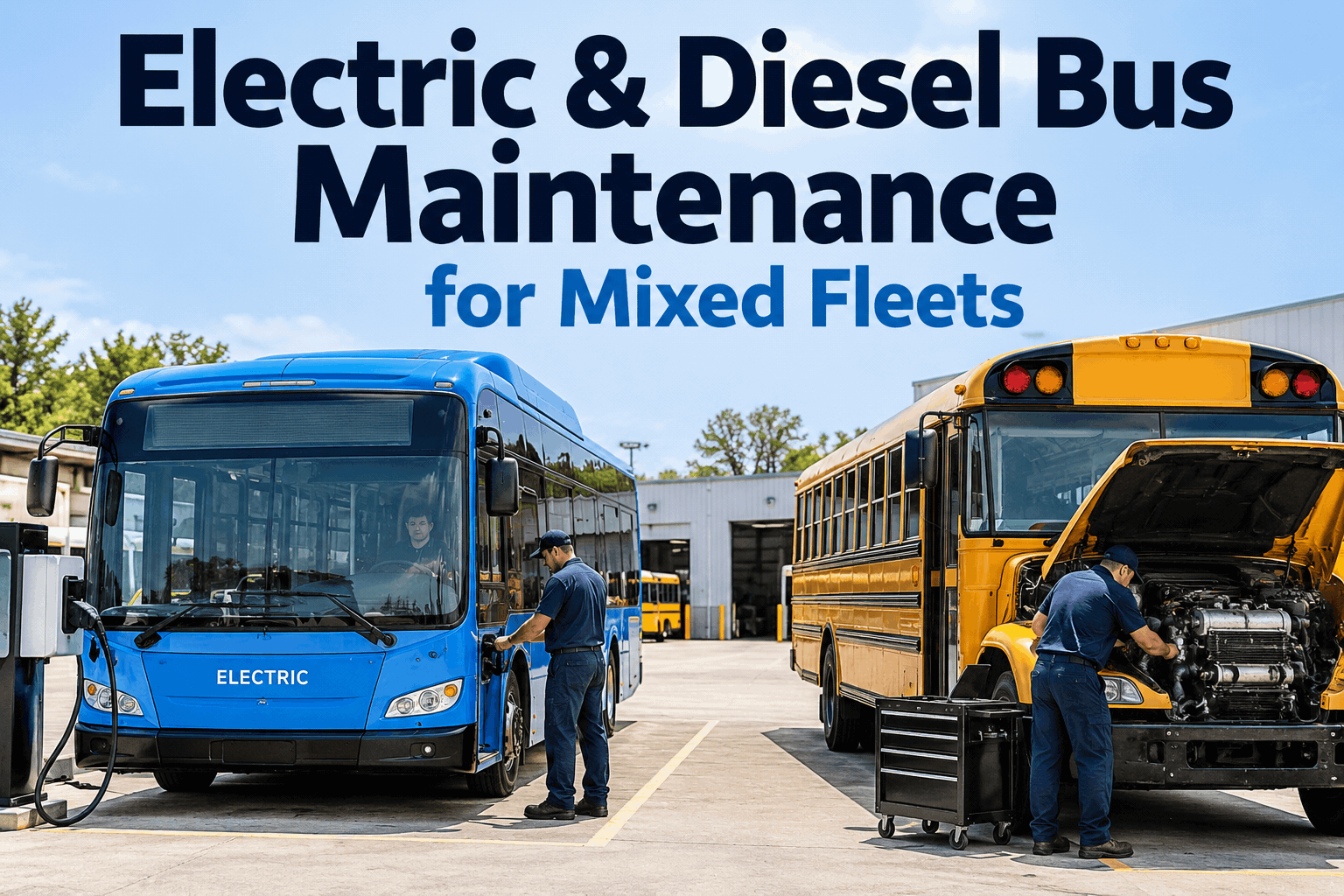
Electric & Diesel Bus Maintenance for Mixed Fleets
Electric vs diesel bus maintenance isn't a harder job or an easier one — it's a different one, and the trouble starts when you run both on the same lot. Some service disappears, some stays identical, and some is brand new. You can see both fuel types scheduled on one dashboard in a demo, but first, here's exactly what changes.
COMPARISON · MIXED-FLEET MAINTENANCE
Electric vs Diesel Bus Maintenance: What Actually Changes
Move from diesel to electric and the work splits three ways: tasks that go away, tasks that stay exactly the same, and tasks that are entirely new. Knowing which is which is the whole job.
WHAT CHANGES WHEN A BUS GOES ELECTRIC
What Goes Away on an Electric Bus
An electric drivetrain has a fraction of the moving parts of a diesel — roughly twenty in the motor versus a couple thousand in a diesel engine. A whole category of routine diesel maintenance simply disappears.
No oil, fuel, or filter service
No engine oil changes, no fuel filters, no fuel system to maintain. The recurring fluid-and-filter work that fills a diesel PM schedule is gone.
No DPF, DEF, or regens
No diesel particulate filter, no diesel exhaust fluid, no forced regens to chase. The entire aftertreatment system and its headaches come off the list.
Less brake wear
Regenerative braking does much of the slowing, so friction brakes wear far slower. You still inspect them — you just replace pads and shoes much less often.
The flip side is a set of tasks a diesel shop has never done — built around a high-voltage system that is genuinely dangerous if handled wrong. This is where electric bus maintenance gets specialized.
High-voltage battery health
State of charge and state of health per pack, cell balance, and capacity over time — the battery is the most expensive component on the bus, so monitoring it is the new core task.
Thermal and charging systems
Battery packs run their own coolant loop that needs service, and the charger and charging connectors become maintenance items in their own right.
HV cabling and qualified techs
High-voltage cables, inverters, and converters to inspect — and every one of these jobs must go to a technician trained and qualified to de-energize and work on high voltage.
The clearest way to see the difference is to line up the two preventive-maintenance schedules. Some rows match exactly, some are diesel-only, and some are electric-only — which is precisely why one generic schedule can't cover both.
Maintenance areaDiesel busElectric bus
Engine / drivetrainOil, filters, fuel system on intervalMotor & reducer check — minimal
EmissionsDPF, DEF, regen monitoringNone
Energy storageN/AHV battery health, thermal, charging
BrakesInspect & replace on wearInspect — wear far slower (regen)
An electric bus has fewer routine PM touchpoints over a year — no oil, no filters, no aftertreatment, slower brake wear. But the items it does have are specialized and safety-critical, so the work shifts from frequent-and-simple to less-frequent-but-expert.
ROUTINE PM TOUCHPOINTS PER YEAR — RELATIVE
So "less maintenance" is true on volume, but it hides a catch: the electric work that remains can only go to a qualified tech — which changes how you assign jobs. You can start a free account and route HV work by qualification.
The One Rule You Can't Bend: Qualified Techs Only
Diesel work can go to any qualified diesel tech. High-voltage work can't. An electric bus carries lethal voltage, and manufacturers tie warranty to approved technicians — so every HV job has to route to a trained, in-date tech, every time.
EVERY HIGH-VOLTAGE JOB IS GATED
On a mixed fleet this is the hard part to manage by memory — which is why the routing gets built into the work-order system, not left to who's standing nearest the bus.
How BusCMMS Runs Electric and Diesel Buses Together
The reason a mixed fleet is hard isn't the electric buses or the diesels — it's running two maintenance realities on one lot without two systems. BusCMMS handles both fuel types on one dashboard, each with its own schedule and rules.
Fuel-type-aware PM
Diesel, electric, and CNG each follow their own preventive-maintenance schedule — the right tasks on the right intervals for each — on one dashboard.
Qualified-tech routing
High-voltage work orders are assignable only to in-date qualified techs, so an EV job never lands on an untrained bench by accident.
Cost per mile by fuel type
Maintenance and energy cost tracked per bus and per fuel, so you can finally see what each half of the fleet actually costs to run.
BusCMMS reports bus fleets running at 95%+ availability once every bus — diesel and electric — is on one system — a company-reported figure from its own customer base, not independently audited, but a fair picture of what one dashboard is worth. For the bigger picture, see the complete guide to what a bus CMMS does.
A Fleet Maintenance Manager's Take
Key Takeaways: Electric vs Diesel Bus Maintenance
Going electric doesn't mean less work so much as different work — and running both at once means managing two realities on one lot. Four things to carry into it.
01
The work splits three ways
Tasks that go away, tasks that stay the same, and tasks that are new.
02
Fewer routine items, less wear
No oil, no aftertreatment, slower brakes — electric usually costs less per mile.
03
The new work is HV-only
Battery, charging, and cabling jobs must go to qualified technicians.
04
A mixed fleet needs two schedules
One generic PM plan can't cover both — manage them on one dashboard.
So electric vs diesel bus maintenance comes down to this: electric trades a long list of routine, fluid-and-filter work for a short list of specialized, high-voltage work. Keep the schedules separate, send the HV jobs to the right hands, and run the whole mixed fleet on one dashboard — and both halves stay on the road.
FAQ
Electric vs Diesel Bus Maintenance: Common Questions
Is electric bus maintenance really less than diesel?+
On routine volume, yes. An electric drivetrain has far fewer moving parts than a diesel — roughly twenty in the motor versus a couple thousand in a diesel engine — and a whole category of recurring work disappears: no oil changes, no fuel filters, no DPF or DEF aftertreatment, and no forced regens. Regenerative braking also means friction brakes wear much more slowly. That's why electric buses tend to cost less to maintain per mile. The catch is that the work which remains is specialized: high-voltage battery, thermal, and charging systems that must be serviced by a qualified technician. So it's fewer routine touchpoints, but a more expert core — and that only pays off once your shop is set up to do the electric work safely in-house rather than paying out to a dealer.
What maintenance does an electric bus need that a diesel doesn't?+
The new work centers on the high-voltage system. That means monitoring the traction battery's state of charge and state of health per pack, servicing the battery's thermal-management coolant loop, and maintaining the charging system and its connectors. There are also high-voltage cables, inverters, and converters to inspect. Every one of these jobs requires a technician trained and qualified to de-energize and work on high voltage safely — it is not work a general diesel tech should do untrained. None of this exists on a diesel bus, which instead has the engine, fuel, and emissions systems an electric bus doesn't. The shared items — tires, suspension, steering, body, wipers, HVAC, the 12-volt auxiliary battery, and all the bus safety equipment like stop arms and lifts — are maintained the same way on both.
Do electric and diesel buses need separate maintenance schedules?+
Yes. A single generic preventive-maintenance schedule can't correctly cover both, because the service profiles genuinely differ. A diesel schedule is built around oil, filters, fuel, and aftertreatment on mileage or calendar intervals; an electric schedule is built around battery health, thermal and charging systems, with no oil or emissions service at all. Running electric buses on a diesel schedule produces nonsense work orders — flagging oil changes a battery-electric bus will never need — and, worse, can miss the HV-specific checks that do matter. The practical answer is fuel-type-aware preventive maintenance: each bus follows the schedule for its own fuel type, while shared items like tires and brakes stay on a common interval. A bus CMMS that supports this lets you run diesel and electric on one dashboard without forcing a compromise schedule on either.
Can my existing diesel technicians work on electric buses?+
For the shared systems — tires, brakes, suspension, body, and the bus safety equipment — yes, a diesel tech works on an electric bus the same way. But high-voltage work is different: it requires specific training and qualification to de-energize and safely service the battery and HV components, because the system carries lethal voltage and unqualified work can also void the manufacturer's warranty. So the realistic path is to get at least some of your techs HV-qualified, and then make sure high-voltage jobs route only to those qualified, in-date technicians. The non-HV work can still go to anyone on the bench. Tracking who is qualified and keeping their certifications current becomes a real part of managing a mixed fleet — and it's one of the first things to set up before the electric buses arrive.
How do I manage maintenance for a mixed electric and diesel bus fleet?+
The goal is one system that understands both fuel types rather than two separate tools or a spreadsheet workaround. In practice that means fuel-type-aware preventive maintenance, so each bus gets the right schedule automatically; work-order routing that sends high-voltage jobs only to qualified technicians; certification tracking so you always know who's cleared to work an electric bus; and cost-per-mile tracking by fuel type so you can compare the two halves of your fleet on real numbers. That's exactly what BusCMMS is built to do — run diesel, electric, and CNG buses on one dashboard, each with its own maintenance reality, so a mixed fleet is one coordinated operation instead of two that fight each other. Most fleets are up and running on it in two to four weeks.