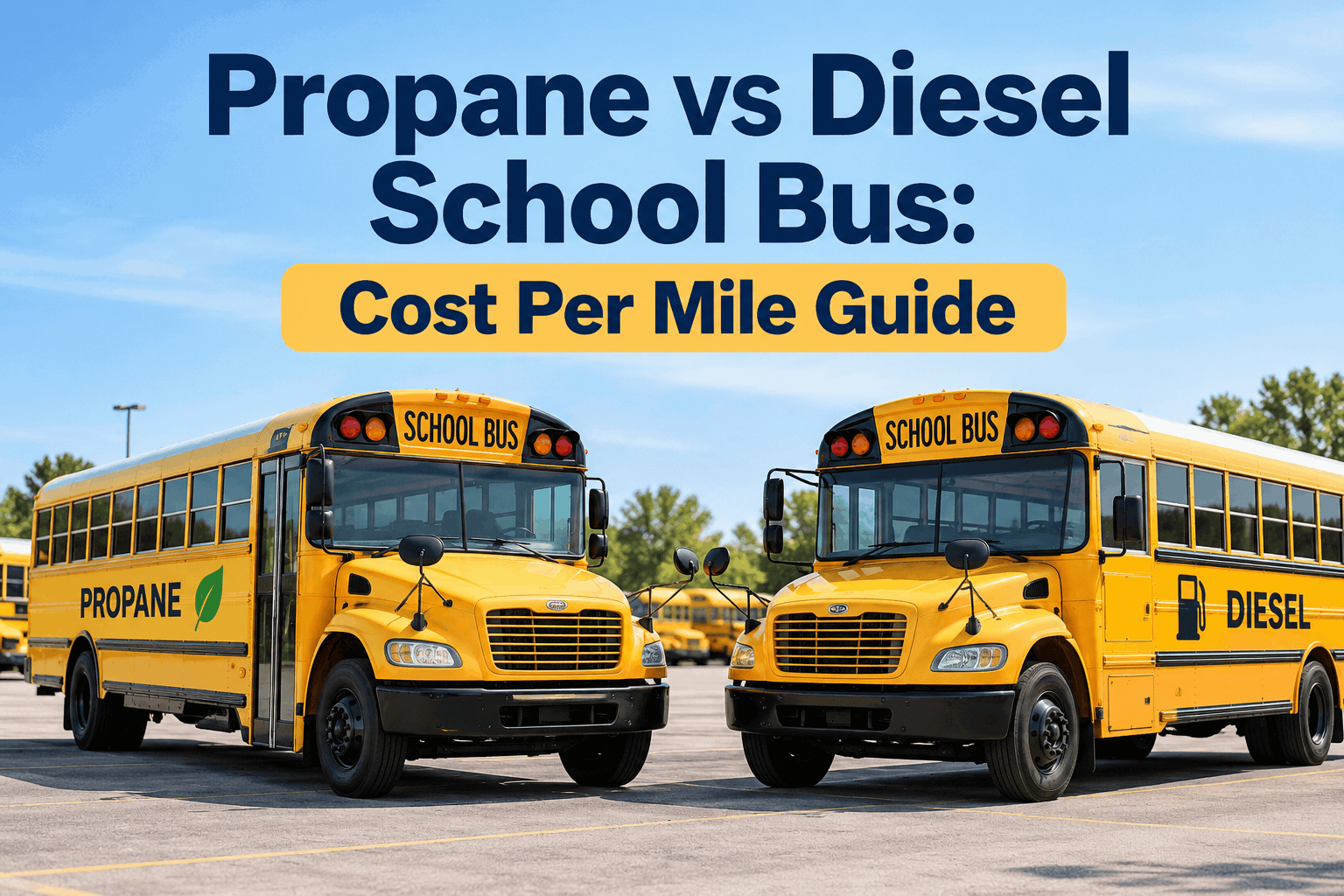
The propane vs diesel school bus question almost never has a clean answer, because the honest one is "it depends on your routes." Propane wins on maintenance and total cost; diesel wins on range and fuel economy. You can see your real cost per mile by fuel type in a demo — but first, here's where each one actually comes out ahead.
FUEL COMPARISON · COST PER MILE
Propane vs Diesel School Bus: Which Really Costs Less?
Propane's edge isn't cheaper fuel — it's lower maintenance. Diesel burns fewer gallons but costs more to service. The total depends on how the two slices stack up for your fleet.
COST PER MILE: FUEL vs MAINTENANCE, STACKED
Where Each Fuel Actually Wins
This isn't a contest with one winner. Propane and diesel each have real, concrete advantages, and which ones matter more comes down to the specifics of your fleet — how long your routes run, how cold your winters get, what your shop is set up to service, and whether you have room for new fueling. Here's the honest split, with no thumb on the scale for either side.
Propane wins on…
Maintenance cost. A simpler spark-ignition engine with no DPF or DEF aftertreatment to service — the biggest driver of its lower total.
Cold-morning starts. No fuel gelling and no forced DPF regens to chase through the winter.
Lower emissions. Far less NOx than diesel, which matters for districts under air-quality pressure.
Quieter, cleaner cabins. Less noise and no diesel smell for the students.
Diesel wins on…
Fuel economy. More energy per gallon, so it burns fewer gallons for the same miles.
Range per tank. Fewer fill-ups — a real advantage on long rural routes.
Fueling infrastructure. Diesel is everywhere; propane needs an on-site tank and dispenser.
Resale and parts. A deeper used market and parts network after years of dominance.
Cost per mile is the day-to-day number, but the purchase decision is usually made on lifetime total cost of ownership — the sticker price, every gallon of fuel, and every hour of maintenance across a bus's full eight-to-fifteen-year service life. A fuel that costs a little more per gallon but far less to service can still win that longer race, which is exactly what the numbers tend to show. Here's how the two compare in a widely cited federal cost model, and why the gap lands where it does.
ESTIMATED LIFETIME COST OF OWNERSHIP PER BUS
Lifetime figures are from Argonne National Laboratory's AFLEET model as compiled in a 2025 propane school bus report (medium-duty vehicle basis); treat them as directional rather than exact for your fleet. The gap is driven mostly by lower maintenance, which the same report puts near $0.21 per mile for propane versus $0.31 for diesel. You can start a free account and build this comparison from your own costs.
The Fuel-Cost Myth: Propane Isn't Always Cheaper to Fuel
Here's the part propane brochures tend to skip. Propane has less energy per gallon than diesel — so a propane bus burns noticeably more gallons to cover the same route. Even at a lower price per gallon, your fuel spend can land higher, not lower.
Run your own situation against these factors. If most of your answers point one way, that's usually your fuel — but a mixed fleet, matching each bus to its routes, is often the smartest answer of all.
Your situationLeans propaneLeans diesel
Route lengthShort, in-town, stop-and-goLong rural runs, high daily miles
ClimateCold winters (no gelling, no regens)Mild, or long highway warm-ups
FuelingCan install an on-site autogas tankNo space or budget for new fueling
PriorityLower maintenance and emissionsMaximum range and fuel economy
Shop capacityWant less aftertreatment workTechs deep on diesel already
How BusCMMS Handles a Mixed Propane and Diesel Fleet
Whichever way you go — or if you run both — the one thing that settles the propane vs diesel argument for your fleet is your own cost-per-mile data. BusCMMS is built to track it by fuel type on one dashboard.
Cost per mile by fuel type
Fuel and maintenance cost tracked per bus and rolled up by fuel, so you compare propane and diesel on your own routes, not a brochure.
Fuel-type-aware PM
Diesel and propane each follow their own maintenance schedule — DPF and DEF service for one, ignition and fuel-system checks for the other — on one system.
Fuel and MPG tracking
Gallons, MPG, and fuel spend by bus, driver, and route — so the gallons-burned reality shows up in the numbers, not just the pitch.
BusCMMS reports bus fleets cutting maintenance costs by 25–35% within a year once every bus runs on one system — a company-reported figure from its own customer base, not independently audited, but a fair picture of what measuring the real numbers is worth. For the bigger picture, see the complete guide to what a bus CMMS does.
A Transportation Director's Take
Key Takeaways: Propane vs Diesel School Bus Cost
There's no universal winner — just the right fit for your routes, climate, and budget. Four things to carry into the decision.
01
Propane wins on maintenance
Simpler engine, no DPF or DEF — the real driver of its lower total cost.
02
Diesel wins on range and fuel
More energy per gallon means fewer fill-ups — better for long rural routes.
03
Propane fuel can cost more
Lower energy density means more gallons burned — the savings are in the shop.
04
Your data makes the call
Cost per mile by fuel type on your routes beats any vendor calculator.
So the propane vs diesel school bus answer is honest and unglamorous: propane for lower maintenance and emissions on short, cold routes, diesel for range and economy on long ones, and often both in one fleet. Track your real cost per mile by fuel type, and the choice stops being a guess.
FAQ
Propane vs Diesel School Bus: Common Questions
Is a propane school bus really cheaper than a diesel one?+
Usually on total cost, but not for the reason most people assume. In a widely cited 2025 analysis built on Argonne National Laboratory's AFLEET model, propane came out roughly $43,500 lower in lifetime cost of ownership than diesel — but that gap is driven mainly by maintenance, estimated near $0.21 per mile for propane versus $0.31 for diesel, not by cheaper fuel. Propane's simpler spark-ignition engine has no diesel particulate filter or DEF aftertreatment to service, which is where the savings pile up. Fuel is a different story: because propane has less energy per gallon, a propane bus burns more gallons, and its lifetime fuel bill can actually run higher than diesel's. So "cheaper" is true overall for many fleets, but it's a maintenance win, not a fuel win — and it depends heavily on your routes. Treat the published figures as directional and confirm against your own cost per mile.
Why does a propane bus burn more fuel than a diesel bus?+
Because propane (autogas) carries less energy per gallon than diesel. Diesel is one of the most energy-dense common fuels, so a diesel engine extracts more miles from each gallon. A propane bus covering the same route therefore burns noticeably more gallons and needs more frequent fill-ups, and it gets less range out of a same-size tank. A lower price per gallon for propane offsets some of that, and historically autogas pricing has been more stable than diesel, but the extra gallons mean a propane fleet's fuel spend doesn't automatically come out lower — and on long, high-mileage routes, diesel's fuel economy advantage is most pronounced. This is exactly why tracking gallons burned and MPG per bus matters more than any per-gallon price comparison.
Which is better for cold-weather school bus routes?+
Propane has a clear cold-weather edge on starting and maintenance. It doesn't gel the way untreated diesel does in freezing temperatures, and because propane buses have no diesel particulate filter, there are no forced DPF regens to chase through the winter — two of the biggest cold-morning headaches on a diesel fleet. Propane buses also tend to start more easily in the cold. The trade-off is efficiency: propane fuel economy can drop meaningfully in extreme cold, so you'll burn even more gallons on the coldest days. For a northern district running short, stop-and-go routes where diesels never get hot enough to self-clean their filters, propane often makes a lot of sense. For long highway routes where a diesel stays warm and gets good economy, the cold-weather advantage matters less.
What are the downsides of switching a school bus fleet to propane?+
A few real ones. First, fueling infrastructure: propane needs an on-site autogas tank and dispenser, which is an upfront cost and takes space, whereas diesel is available everywhere. Second, range and fuel economy: the lower energy density means more gallons and more frequent fueling, which can complicate long rural routes. Third, your shop and parts: technicians experienced with diesel need some retraining, and the used-bus and parts markets for propane are smaller than diesel's deep, established network. None of these are dealbreakers — many districts run propane successfully — but they're the factors that can tip the math back toward diesel for a given fleet, especially one with long routes or no room for new fueling. The way to know is to model it against your own routes and costs rather than a generic calculator.
How do I compare propane and diesel costs for my own fleet?+
Track cost per mile by fuel type on your actual routes. The published comparisons are a useful starting point, but your fuel prices, route lengths, climate, and shop labor are what decide the answer for you. At a minimum, capture fuel cost and gallons per bus, maintenance cost per bus, and the miles each bus runs, then roll those up separately for your propane and diesel buses. That gives you a true cost per mile for each fuel on your routes — including the gallons-burned reality that vendor calculators tend to gloss over. A bus CMMS like BusCMMS does this automatically, tracking fuel and maintenance cost per mile by fuel type and running diesel and propane buses on one dashboard, so when the next purchase decision comes up you're deciding on your own numbers instead of a sales projection.