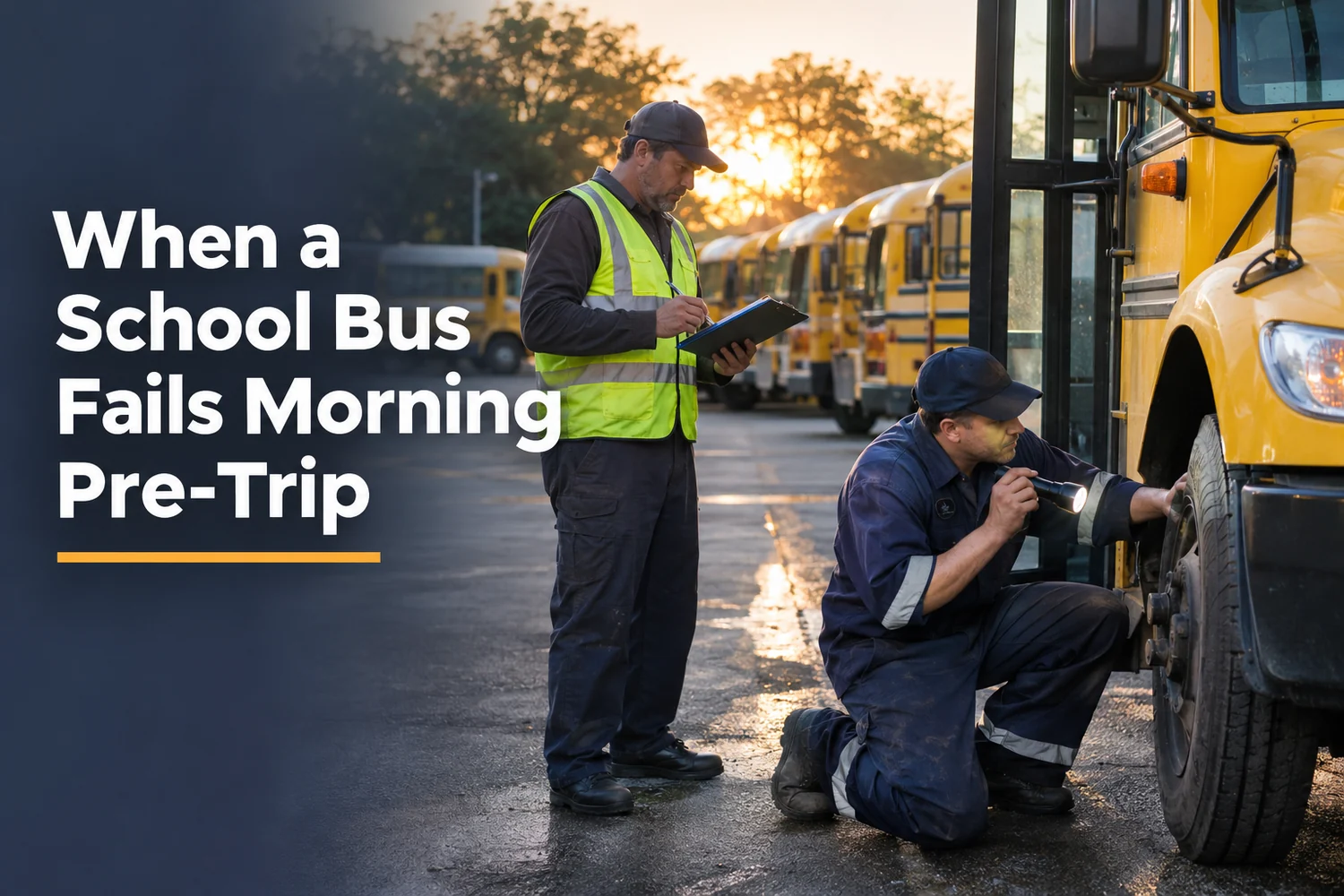
The driver on the first wave taps Fail on a cracked warning light, and a school bus failed inspection is now sitting in the yard with its route due to pull out. What happens in the next few minutes decides whether students wait at the stop, whether the school hears about it from a parent first, and whether the defect is still open tomorrow. When a school bus fails morning pre-trip, the job is a short, owned decision window: hold the bus, pick repair, spare or delay, tell the school, and close the record the same day. Book a demo to walk that window with your own checklist.
SCHOOL BUS OPERATIONS | MORNING PRE-TRIP
When a School Bus Fails Morning Pre-Trip: Next Steps
A failed pre-trip is a decision with a clock on it. This page is about the minutes before the route leaves: who decides, which bus covers, who gets told, and how the day ends with a closed record.
- FindThe Fail is logged
- DecideRepair, spare or delay
- TellSchool and families
- CloseSame-day record
Who Owns Each Call in the Window
Most morning fails go wrong at a handoff, not at the defect. Name the owner of each call before the next fail, so nobody is deciding by committee at the yard gate. Titles differ by district; the roles below are the usual split.
| Role | Decides | Records |
|---|---|---|
| Driver | Marks the item Fail and does not take the bus out | Photo, note and on-screen signature on the pre-trip |
| Shop lead or mechanic | Whether the defect can be fixed in the yard before departure | The work order, the repair and the sign-off |
| Dispatcher | Which spare and driver cover the route, or whether it runs late | The swap: route, spare bus and driver |
| Transportation supervisor | A delay, and who calls the school | The notice sent and the time it went out |
| Office or routing staff | Which families and schools get the message | The contact list used for that route |
General information, not legal advice. Whether a defect keeps a bus off the road is set by your state rules and district policy, not by this page.
One Morning, Minute by Minute
An illustrative morning, not a customer account. Your times will differ; the order is what matters.
-
5:30
The pre-trip finds the fail
The driver scans the QR code on the bus, works the checklist and marks the cracked rear light Fail with a photo and a note. Signed and submitted, the report lands in the inspection records and the failed item opens a maintenance work order. The shop sees the same defect the driver saw.
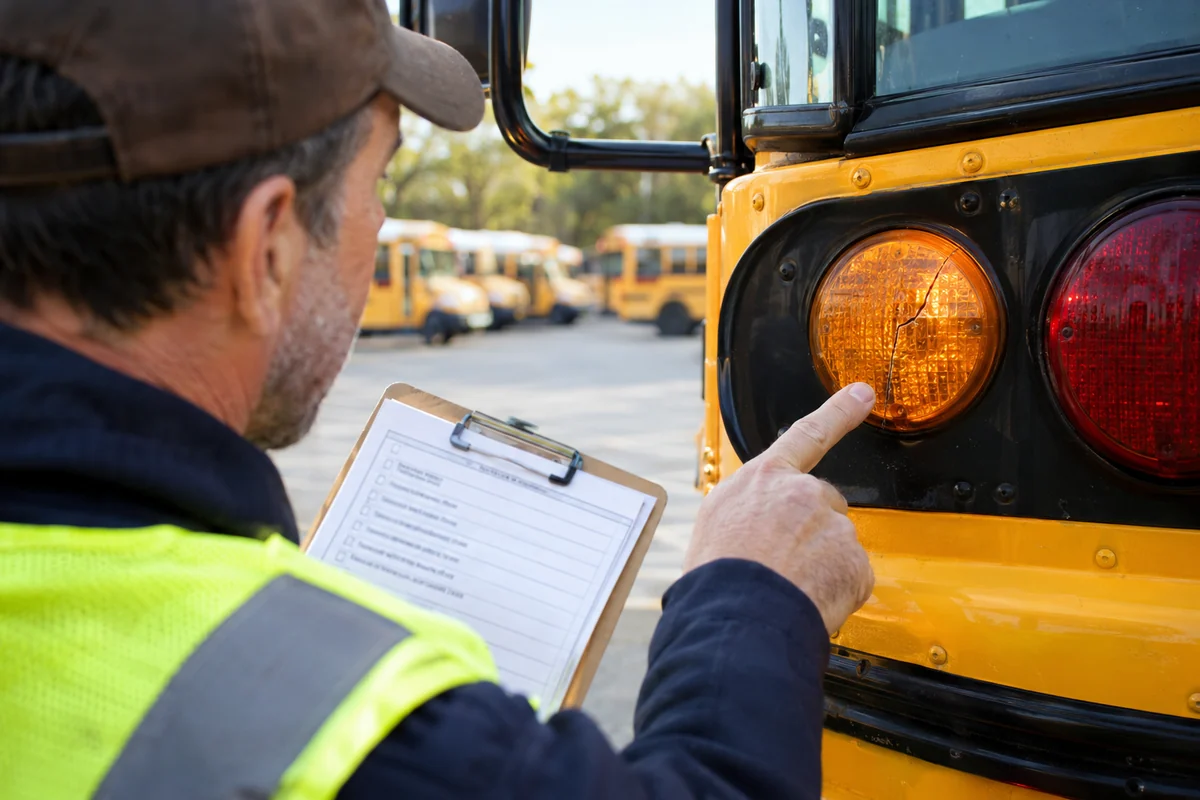
5:30 | FINDA cracked lens found at the yard. The Fail goes in while the driver is still at the bus. -
5:40
Hold the bus and make one call
The bus stays in the yard. The shop lead looks at the defect and gives dispatch one answer: fixable before pull-out, or not. If the answer takes longer than the window allows, treat it as not. A bus does not leave on a maybe.
-
5:50
Cover the route with a ready spare
Dispatch moves the driver to a spare that has its own passed pre-trip, fuel and the right equipment for the route, such as a lift for riders who need one. A spare that has not been inspected this morning is a second problem, not a fix. The driver runs a pre-trip on the spare before it moves.
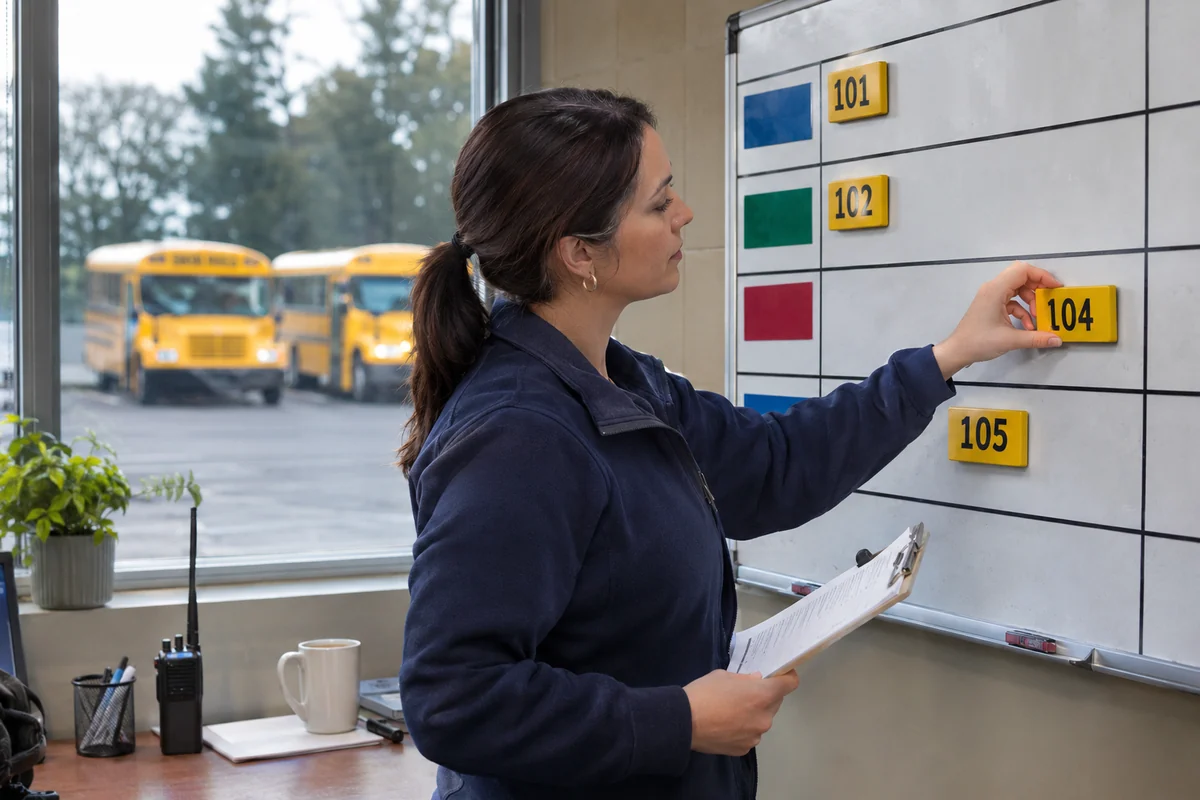
5:50 | SWAPThe swap goes on the board: route, spare and driver, so nobody guesses later. -
6:00
Tell the school before families ask
If the spare will be late, or the bus number on the route changes, the supervisor or office sends the notice your district uses for route changes. Keep it short: route, new bus number, expected delay.
-
6:15
The route leaves; the defect does not disappear
Once students are moving, the morning feels done. It is not: the held bus still has an open work order, and the spare is out of the pool until it returns.
-
Same day
Close the loop before the afternoon run
The shop works the order, records the repair and the sign-off, and the bus gets a fresh inspection before it goes back on the board. Dispatch knows by the afternoon wave whether it has its bus back or keeps the spare on the route.
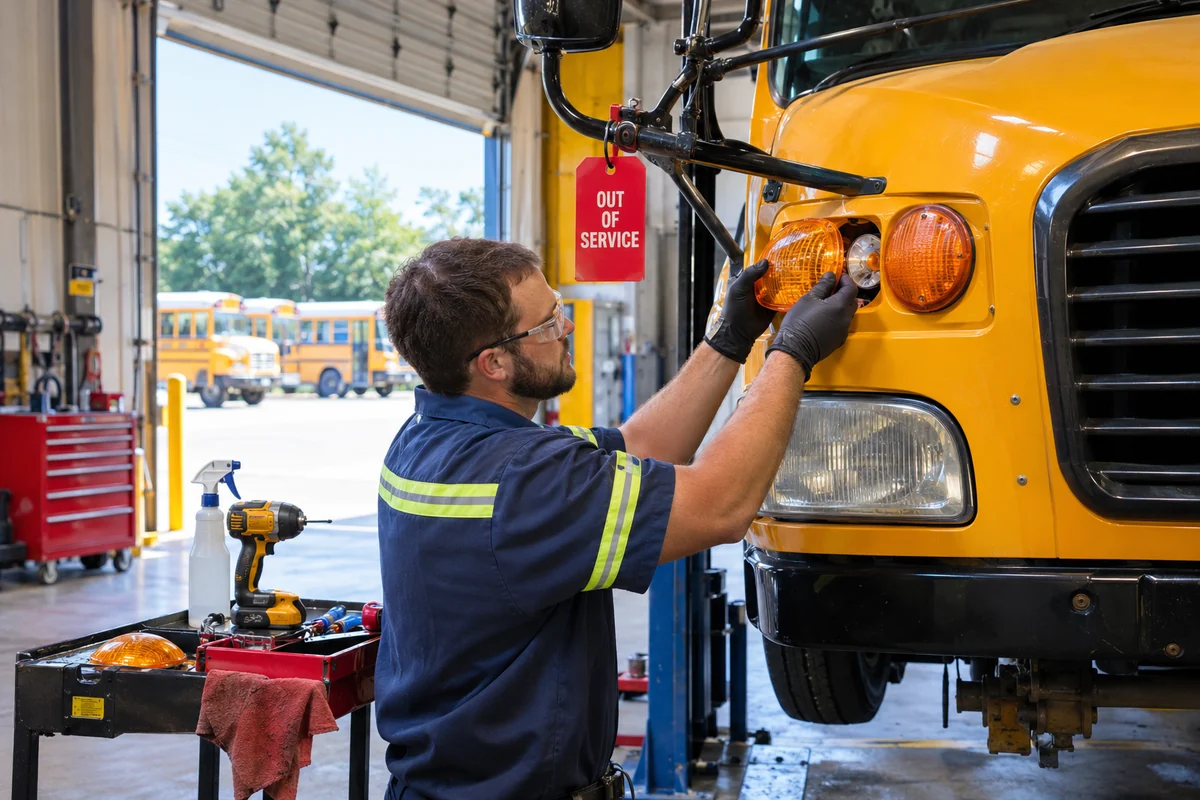
SAME DAY | CLOSERepair, sign-off and a new inspection on record: then the bus returns.
Repair, Swap or Delay: Pick One Fast
There are only three honest answers in the window. Each card shows when it fits, who signs it off and what goes on the record.
ARepair in place
- Fits when
- The shop lead can fix and re-check it in the yard before pull-out, and a qualified person signs it off.
- Signs off
- Shop lead or mechanic; the driver re-inspects the item.
- Records
- The work order with the repair, and a new passed pre-trip.
BSwap to a spare
- Fits when
- The repair needs the bay, parts or more time than the window gives, and a ready spare is in the yard.
- Signs off
- Dispatcher, once the spare has its own passed pre-trip.
- Records
- The swap, the spare's pre-trip and the open work order on the held bus.
CDelay the route
- Fits when
- No ready spare exists, or the right equipment is not available, and the route waits for a bus from another run.
- Signs off
- Transportation supervisor, who also owns the school notice.
- Records
- The delay, the notice and the bus that finally covered the route.
Running the failed bus is not on the list. If delays keep happening because the spare pool is thin, that is a planning problem: see the spare bus planning guide.
A Transportation Supervisor's Take
I used to think the hard part of a failed morning pre-trip was the repair. It almost never was. The hard part was the people who each assumed somebody else had called it: the driver waiting for the shop, the shop waiting for dispatch, and the school learning from a parent that the bus was late. What fixed it for us was naming one owner for each call and writing it down where everyone could see it. The driver logs the Fail, the shop gives one answer, dispatch picks the bus, and the office sends the notice. Then nobody goes home until the work order is closed or the spare is booked for tomorrow.
Transportation SupervisorSchool district pupil transportation
Before the First Bus Leaves: Window Checklist
Hold this against the last morning a bus failed in your yard. Each row closes a gap that turns one defect into a missed route.
- One owner per call Driver, shop lead, dispatcher and supervisor each know which decision is theirs.KEY
- The Fail is on the record Photo and note on the failed item; admins can require both before submit.KEY
- A spare is truly ready Passed pre-trip this morning, fuelled, and fitted for the route's riders.VERIFY
- The swap is written down Route, spare bus and driver, not just said over the radio.VERIFY
- The school hears first A standing message for route changes, and a named person who sends it.VERIFY
- Same-day closeout Repair, sign-off and a new inspection before the bus returns to the board.KEY
For a daily form to start from, use the daily school bus pre-trip checklist.
What the Record Should Show by End of Day
The defect
The signed pre-trip with the failed item, photo and note, searchable by bus or date in the inspection records.
The repair
The work order opened from the failed item, with the work done and who signed it off.
The return
A new inspection on the repaired bus, so it goes back on the board on a record, not on a verbal all-clear.
The route swap and the school notice live wherever your district keeps them; the point is that they exist. For the full hold-and-release gate, read the out-of-service and return-to-service guide. For the step-by-step response to a failed inspection, the deeper read is what to do when a bus fails inspection before route service.
Failed Morning Pre-Trip: Common Questions
Who should decide whether a failed bus can be fixed before the route?
A shop lead or mechanic, not the driver or dispatcher. Dispatch needs one answer quickly: fixable in the yard before pull-out, or not. The morning shop triage rules help set that call in advance.
Does Bus CMMS pick the spare bus for us?
No. Choosing the spare and driver is a dispatch call. Bus CMMS records the failed pre-trip and the work order so dispatch and the shop see the same defect. For keeping spares ready, see the morning dispatch readiness guide.
How does the failed item reach the shop?
The driver marks the item Fail, adds a photo and note, signs and submits. The failed item auto-creates a maintenance work order. See the inspection software page and the defect-to-work-order guide.
When should we tell the school or families?
As soon as the route will run late or on a different bus number, and before the usual pick-up time. Use your district's standing message for route changes. The school bus fleet page shows how inspections and repairs sit together.
How is this page different from the failed-inspection guide?
That guide covers the full response to a failed inspection. This page covers the morning window: who owns each call, spare readiness, the school notice and same-day closeout. Read both, starting with what to do before route service.